You’ll find storm chasers rely on Doppler radar networks that detect frequency shifts in microwave energy, GNSS systems tracking water vapor through satellite signal delays with 30-60 minute updates, and radiosondes measuring atmospheric profiles via weather balloons. These technologies identify mesocyclones, rotating updrafts, and instabilities before visible storm formation begins. Dual-polarization radar distinguishes precipitation types while ground-based sensors initialize numerical models. The integration of mobile Doppler units, ASOS stations, and real-time data transmission creates thorough situational awareness that extends severe weather warnings from 15 minutes to one hour—transforming prediction capabilities through multi-sensor fusion.
Key Takeaways
- Dual-polarization Doppler radar identifies mesocyclones and hook echoes through velocity measurements, tracking storm rotation and predicting tornado formation.
- Weather balloons provide vertical atmospheric profiles for hodograph analysis, extending severe weather warnings from 15 minutes to one hour.
- GNSS networks track water vapor through satellite signal delays, forecasting storm initiation 30-60 minutes before cloud formation begins.
- AutoNowcaster combines radar, satellite, and ground sensor data to generate probabilistic forecasts for storm development and supercell evolution.
- Mobile Doppler units deliver real-time velocity measurements of rotating updrafts, providing situational awareness for intercept decisions and storm positioning.
Doppler and Dual-Polarization Radar Technology for Storm Detection
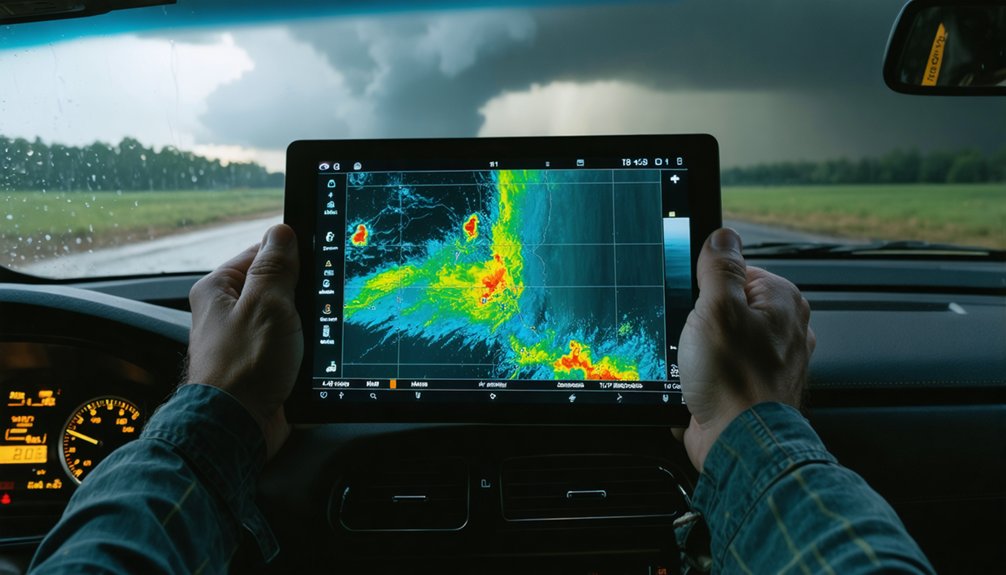
Since the late 1980s, Doppler radar has transformed storm detection by measuring not just where precipitation exists, but how it moves. You’ll track storms through pulse-Doppler technology that detects frequency shifts in returned microwave energy, revealing wind velocities up to 70 m/s with remarkable 0.1 ppm precision.
Pulse-Doppler technology revolutionized meteorology by detecting frequency shifts in microwave energy, measuring storm velocities with 0.1 ppm precision since the 1980s.
Modern dual-polarization systems enhance your capabilities by transmitting both horizontal and vertical waves, enabling you to distinguish rain from hail, ice pellets, or tornado debris through particle shape analysis.
The NEXRAD WSR-88D network processes this data through storm tracking algorithms that identify mesocyclones, hook echoes, and velocity couplets—critical tornado precursors. You’ll leverage radar based precipitation analysis to differentiate precipitation types and monitor rotating updrafts spanning 2-6 miles.
Mobile Doppler units positioned near storms provide real-time velocity measurements for unprecedented situational awareness.
Ground-Based Atmospheric Monitoring and Sensor Arrays
While Doppler radar excels at detecting precipitation and wind patterns aloft, you’ll need complementary ground-based sensors to capture the atmospheric conditions that fuel storm development before clouds even form. These integrated atmospheric profiling systems deliver the data autonomy you require for independent storm prediction.
Critical ground-based monitoring capabilities:
- GNSS Networks – Track water vapor through satellite signal delays, enabling multi scale water vapor tomography with 30-60 minute updates for storm anticipation
- ASOS Stations – Provide real-time temperature, humidity, and wind measurements that initialize numerical weather models
- Supplemental Radar Arrays – Fill low-level coverage gaps with high-resolution tropospheric data
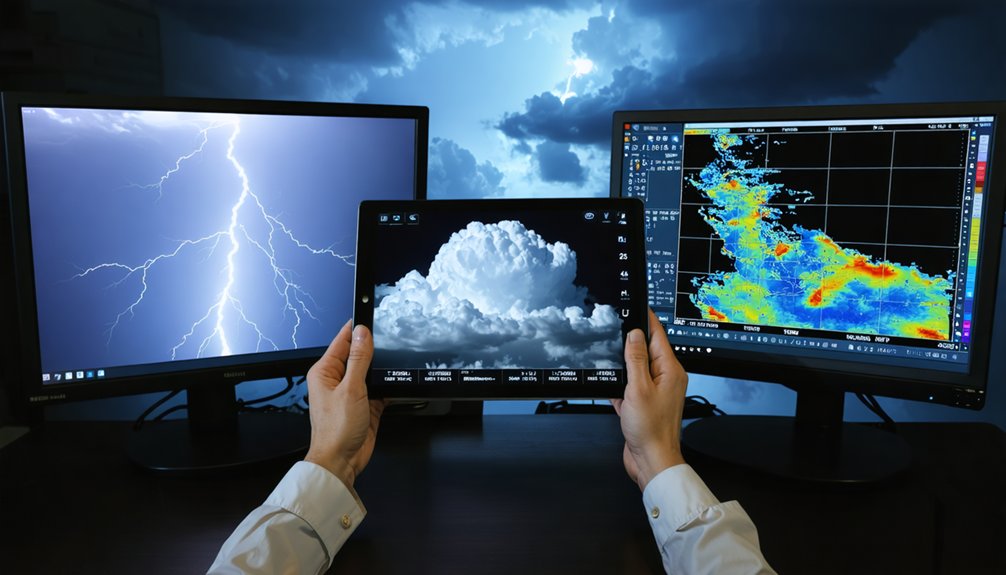
- AutoNowcaster Integration – Combines multiple sensor inputs for probabilistic storm initiation forecasts you can refine manually
Weather Balloon Systems for Multi-Layer Data Collection
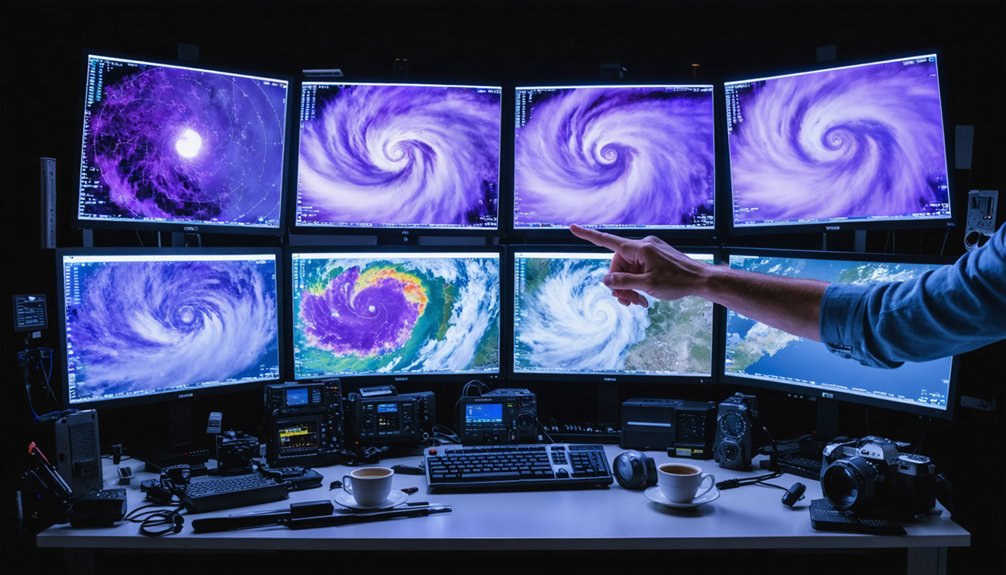
How do you capture the complete atmospheric column when surface sensors and radar can’t reveal the pivotal vertical structure driving storm development? Weather balloon systems deliver direct stratospheric sampling through high altitude ballooning missions reaching 100,000 feet. Radiosondes measure temperature, humidity, and pressure while GPS modules track drift patterns—revealing wind profiles essential for hodograph analysis and tornado potential assessment.
Advanced self-flying balloons multiply data collection efficiency thirtyfold, covering oceanic regions traditional methods can’t reach. Flight control software adjusts altitude via gas venting, gathering atmospheric profiles throughout the stratosphere. These vertical measurements extend severe weather warnings from 15 minutes to one hour, transforming supercell and squall line predictions. You’re accessing the complete atmospheric column—the foundation for understanding storm modes before they materialize.
Mobile Storm Chasing Vehicles and Deployment Platforms
When conventional chase vehicles can’t withstand 200-mph projectiles or maintain stability in tornadic wind fields, purpose-built armored platforms bridge the gap between observation and direct intercept missions. You’ll find TIV and Dominator series vehicles engineered with 1/4-inch steel plating, bullet-resistant polycarbonate windows up to 1.63 inches thick, and hydraulic deployment mechanisms including ground-anchoring spikes that penetrate pavement.
Armored tornado intercept vehicles deploy hydraulic spikes and steel plating to withstand 200-mph projectiles where conventional chase platforms fail.
These platforms carry mobile instrumentation packages—weather stations, 360° IMAX turrets, vertical windspeed radar—while maintaining operational independence through 60-gallon fuel systems and 8kW generators.
Critical deployment capabilities:
- Hydraulic skirts and lowering systems exclude wind from chassis underside
- 625-horsepower turbodiesel engines achieve 100-mph intercept speeds
- 14,000-15,000 pound mass resists debris impact and vehicle uplift
- Redundant air systems support off-road maneuverability during rapid repositioning
Real-Time Communication Networks and Data Transmission Systems
Modern storm interception operations demand transmission bandwidths exceeding 25 Mbps to relay high-definition video feeds, real-time radar composites, and telemetry data from mobile platforms operating in environments where traditional cellular infrastructure fails or becomes oversaturated. You’ll achieve uninterrupted connectivity through systems like the EnGo 265, which maintains internet access inside 160-170 mph wedge tornadoes via GateWay Mode.
Cellular network reliability deteriorates during severe weather events, necessitating satellite data redundancy through DataStorm systems for emergency communications when ground-based networks collapse. The Spotter Network integrates position tracking across RadarScope and mobile applications, enabling coordinated deployments without manual refresh protocols.
SRT, WebRTC, and RTMP protocols transmit vehicle-mounted and drone camera feeds simultaneously, while Baron’s Mobile Threat Net delivers radar updates every five minutes for autonomous navigation decisions.
Frequently Asked Questions
How Accurate Are Tornado Predictions Made Using Current Storm Chasing Technology?
You’ll find tornado predictions achieve 70-90% accuracy using advanced radar systems and storm observation techniques. AccuWeather provides 16-minute average warnings—double the National Weather Service’s 8 minutes—giving you critical time to act independently and protect yourself.
What Is the Typical Cost of Equipping a Professional Storm Chasing Vehicle?
While initial costs seem steep, you’ll need $50,000-$100,000 for professional equipment, including radar systems, cameras, and communications gear. However, ongoing vehicle maintenance costs and fuel efficiency requirements add $2,000-$5,000 per chase season.
How Far in Advance Can Storm Chasers Predict Tornado Formation Locations?
You’ll get approximately 15 minutes of lead time analysis using current technology, though storm trajectory modeling with phased array radar and machine learning can extend your prediction window. Mobile Doppler systems provide real-time data for autonomous chase decisions.
What Percentage of Storms Chased Actually Produce Measurable Tornado Activity?
You’ll see tornadoes on 25% of your chase attempts based on storm prediction accuracy. This one-in-four success rate reflects data collection methods tracking tornado-specific outings, giving you realistic expectations when pursuing your independent storm-chasing objectives.
How Do Storm Chasers Decide Which Storms to Pursue During Outbreaks?
You’ll prioritize storms showing rotation on radar and strong environmental parameters. Your chasing strategies adapt through real-time storm monitoring techniques, balancing surface observations with model data. You’re targeting the most violent-looking cells while maintaining escape routes and positioning freedom.