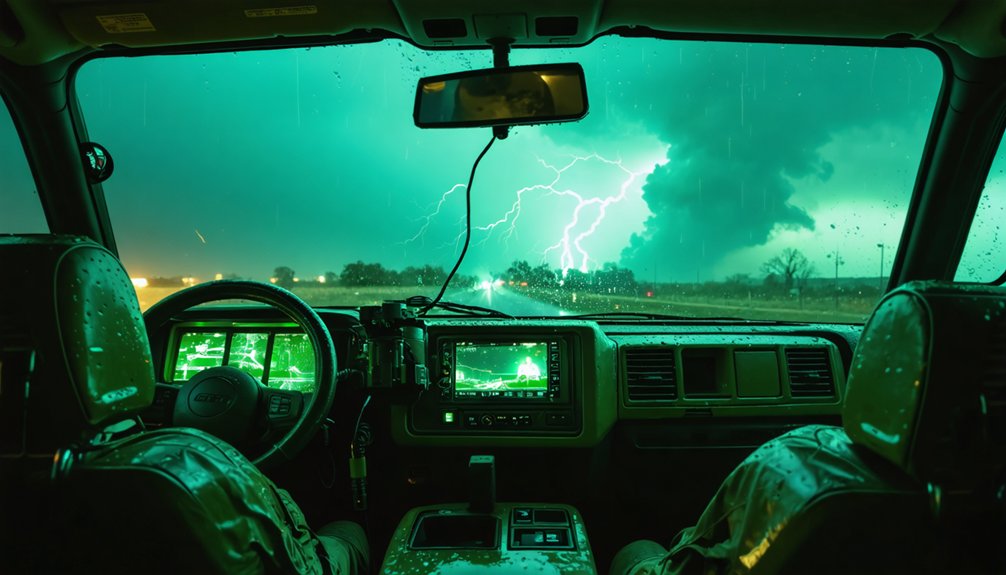
Advanced storm prediction tools are vital because they extend your warning time from minutes to hours while reducing alert zones by 70%, enabling targeted responses that protect lives and assets. You’ll gain access to probabilistic forecasts with 5-minute resolution that predict tornado, hail, and flash flood threats up to 6 hours ahead, addressing the $2 trillion in global weather-related losses recorded between 2014-2023. These systems transform reactive emergency response into proactive defense, with AI-powered platforms processing atmospheric data 40,000 times faster than conventional models to close critical protection gaps.
Key Takeaways
- Advanced systems predict severe weather 6 hours ahead with storm-scale details, enabling earlier warnings for tornadoes, hail, and floods.
- AI-powered platforms forecast lightning strikes 15-60 minutes before occurrence, preventing injuries compared to traditional post-strike detection systems.
- Extreme weather caused $2 trillion in global losses from 2014-2023, with precision forecasting helping close the 62% protection gap.
- Storm-based warnings reduce alert zones by 70%, improving community response and protecting vulnerable populations lacking warning access.
- Real-time data integration enables emergency agencies to pinpoint high-risk zones and coordinate resource deployment before crisis escalation.
Pinpointing Storms With Unprecedented Precision
How do forecasters predict the exact location and timing of severe thunderstorms hours before they develop? WoFS delivers probabilistic predictions six hours ahead by assimilating radar and satellite data every five to 15 minutes, then updating forecasts every half hour. This system displays conditions at five-minute resolution, enabling you to see storm-scale details as they evolve.
The platform’s documented success includes extended lead times for tornadoes, hail, winds, and flash floods. By optimizing model resolution for localized impacts, WoFS provides actionable intelligence rather than regional generalizations. You’re not dependent on outdated forecasting methods anymore.
Tools like AutoNowcaster integrate radar, satellite, numerical weather prediction, soundings, and surface observations, tailoring storm insights to industries requiring precision timing and spatial accuracy for critical operations.
Delivering Forecasts at Lightning Speed
While traditional lightning detection systems notify you only after strikes occur, next-generation AI-powered platforms now predict lightning threats 15 to 60 minutes before the first flash. NASA’s SPoRT Lightning-AI delivers 15-minute forecasts, while NOAA’s LightningCast extends warnings to one hour by analyzing GOES-R satellite imagery. Atmo AI processes atmospheric data 40,000 times faster than conventional models, maximizing response time for critical decisions.
Thor Guard systems monitor electrostatic fields 170,000 times per second, detecting pre-strike conditions 8-20 minutes ahead. Vaisala’s network captures 2 billion lightning events annually with 99.99% uptime, optimizing data workflows through real-time processing. This speed advantage transforms your operational flexibility—you’ll evacuate personnel, secure assets, and implement safety protocols before danger materializes, not after. Machine-learning algorithms trained on historical patterns guarantee you’re never caught unprepared.
Reducing Financial Losses From Severe Weather
Speed matters little if economic devastation still occurs—advanced storm prediction tools directly reduce the $2 trillion global economy hemorrhaged from extreme weather events between 2014-2023. You’re facing a 19% surge in damages over recent years, with insured losses hitting $145 billion in 2025.
By leveraging big data analytics, you’ll close the 62% protection gap where only $111 billion of 2021’s $270 billion losses were insured. These tools enable you to make autonomous decisions about optimizing infrastructure resilience before hurricanes generate $36 billion in damages like Ida did.
When you’re confronting 5-7% annual growth in catastrophic losses, precision forecasting isn’t optional—it’s your primary defense against billion-dollar disasters that’ve cost America $2.915 trillion since 1980.
Protecting Communities Through Timely Warnings
When tornado warnings narrow to 50% of county size, protective action rates increase measurably—you’re witnessing storm-based warning systems that’ve reduced warned areas by 70% while delivering the specificity that drives shelter-seeking behavior. Geographic precision correlates directly with response: Elmira’s 2012 Wireless Emergency Alert enabled basement sheltering before touchdown, minimizing injuries across 2000 damaged buildings.
Storm-based warnings cut alert zones by 70%—precision that transforms vague county-wide alarms into pinpointed calls to action that save lives.
You’ll find enhancing public trust in alerts requires consequence-based messaging and selective siren activation targeting storm paths rather than blanket coverage.
Improving community disaster resilience demands addressing coverage gaps—30% of global populations lack warning access despite 500 annual weather-related deaths and $15 billion U.S. damages. Vulnerable groups face compounding barriers: mobile home residents show lower shelter efficacy; low-income minorities report reduced NWS trust and warning comprehension.
Community-based systems integrating hazard mapping, vulnerability assessments, and trained disaster councils close these critical gaps.
Strengthening Emergency Response Capabilities
Emergency response effectiveness hinges on millisecond-precision situational awareness—you’re leveraging meteorological analytics that pinpoint high-risk zones before storms, floods, or wildfires escalate beyond containment thresholds.
Coordinating emergency agencies becomes seamless when platforms integrate radar, satellite, IoT sensors, and GIS data into unified command structures. Federal entities like DoD and Homeland Security access granular five-minute resolution graphics, while local governments prioritize hard-hit zones through high-definition visualizations.
Centralizing damage assessments via AI-driven models guarantees resource deployment aligns with actual impact severity rather than preliminary estimates. Real-time data assimilation every five to fifteen minutes enables dispatch teams, recovery units, and forensic analysts to operate from identical information streams.
MRMS blends multiple radars and lightning networks, delivering tornado diagnostics and hail signatures that eliminate jurisdictional blind spots during crisis escalation.
Bridging the Weather Prediction Gap in Developing Nations
While high-income nations deploy millisecond-precision forecasting infrastructure, nearly 100 countries operate without early warning systems—a disparity that costs lives when cyclones, floods, and droughts strike populations lacking preparation time. You’ll find low-income nations spend 15-20 times less per capita on meteorological infrastructure, creating data voids that compromise global forecast accuracy.
Decentralizing data access through proven models demonstrates measurable impact:
- RIMES expanded Bangladesh’s observational stations from 10 to 32, contributing 500 stations across member nations
- India’s AgriMet transfers satellite technology to eight developing countries, delivering zero-cost weather advisories that increase farmer incomes
- European snow depth data from six countries improved northern hemisphere temperature forecasts
Bolstering regional cooperation fills critical tropical data gaps—enhancing both local resilience and mid-latitude prediction skill where most forecasting centers operate.
Harnessing AI to Complement Traditional Meteorology
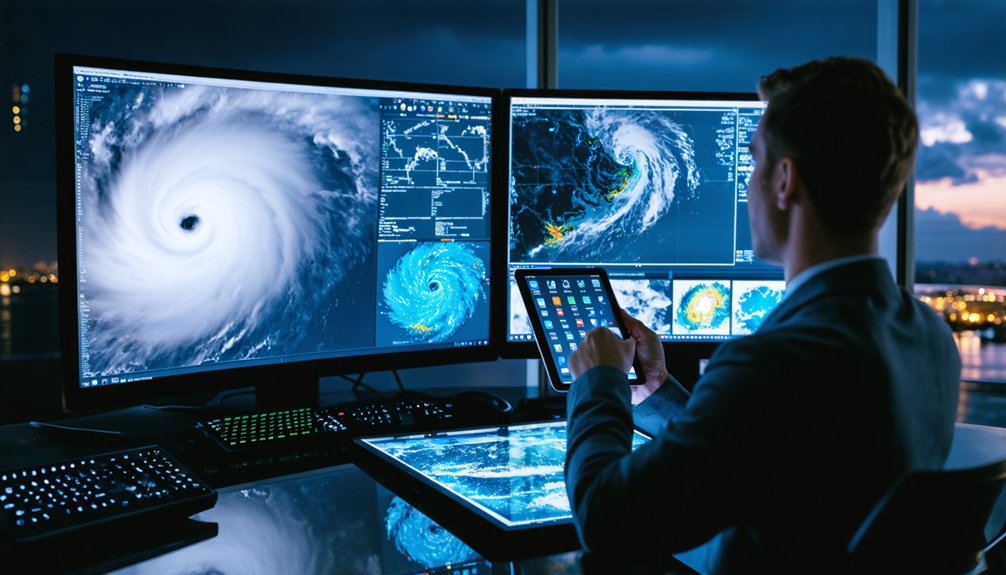
Neural networks now process atmospheric datasets at speeds traditional physics-based models can’t match—ECMWF’s AIFS outperforms conventional systems by up to 20% for tropical cyclone tracks while consuming 1/1000th the computing power. You’ll gain 18-24 hours better lead time at medium range, with WeatherNext 2 generating hundreds of scenarios in under one minute on a single TPU versus hours on supercomputers.
Machine learning uncovers non-linear patterns in ocean heat, humidity, and wind that traditional models miss during rapid intensification events. Integration proceeds operationally: ECMWF deployed AIFS alongside physics-based systems in February, improving probabilistic modeling through ensemble predictions at 30 km resolution.
Deep learning merges radar, satellite, and observational data, enabling finer grained nowcasting for precipitation, hail, wind gusts, and lightning—liberating forecasters from computational constraints while maintaining forecast sovereignty.
Enabling Proactive Decision-Making With Probabilistic Data
Raw computational power means little without actionable insights tailored to stakeholder thresholds. Probabilistic forecasts deliver enhanced situational awareness by quantifying uncertainty ranges rather than single-outcome predictions. You’ll access data driven decision frameworks that weigh protective action costs against scenario likelihoods, enabling autonomous choices without bureaucratic constraints.
Quantifying uncertainty ranges transforms raw forecasts into autonomous decision frameworks that bypass traditional bureaucratic constraints while delivering stakeholder-specific actionable insights.
Implementation advantages include:
- 12-24 hour advance alerts balancing forecast skill with preparation requirements
- Ensemble distributions revealing extreme event probabilities deterministic models miss
- Context-adapted thresholds supporting non-expert users like event organizers
Economic benefits exceed traditional deterministic approaches, particularly for weather-sensitive operations. You’re not dependent on expert interpretation—validated tools provide goal-post scenarios with explicit confidence levels. Retrospective testing confirms effectiveness, while expanded operational deployment demonstrates measurable value in risk-based processes where predictability limitations previously constrained proactive planning.
Democratizing Access to Life-Saving Weather Intelligence

Advanced forecasting capabilities now reach organizations operating on laptop-grade hardware rather than remaining exclusive to government supercomputing centers. AI models require 1/1000th the computing power of traditional systems while delivering up to 20% accuracy gains. NOAA generates 10-day forecasts in under 60 seconds versus three hours traditionally.
You’ll find open-source platforms like FourCastNetv2 enable university labs, regional utilities, and startups to deploy specialized predictions for agriculture and emergency response. This technological shift directly addresses forecasting disparities correlated with national wealth, bringing advanced capabilities to vulnerable populations previously lacking supercomputer-dependent systems.
Frequently Asked Questions
How Do Advanced Storm Prediction Tools Handle Rapidly Changing Weather Conditions?
You’ll leverage real time monitoring systems processing data at millisecond intervals, while predictive algorithms analyze multi-source feeds instantaneously. This enables you to track storm evolution dynamically, receiving automated updates that deliver precision nowcasts during rapidly intensifying convective events.
What Training Do Emergency Responders Need to Use Ai-Powered Forecasting Systems?
You’ll need storm response training covering AI platform operation, advanced weather analysis interpretation, and real-time data processing. Master machine learning outputs, geospatial risk mapping, and impact-based warning systems to execute rapid, autonomous decisions during critical weather events.
Can Storm Prediction AI Models Account for Climate Change Impacts?
Current AI storm models struggle to account for climate change influences because they’re trained on historical data lacking unprecedented extremes. You’ll need hybrid systems combining environmental factors analysis with physics-based synthetic scenarios to forecast novel warming-driven patterns accurately.
How Accurate Are AI Forecasts Compared to Experienced Meteorologists’ Intuition?
You’ll find AI models leave human intuition in the dust, achieving 99.8% accuracy versus meteorologists’ data interpretation challenges. However, experienced forecasters excel at forecast uncertainty quantification and contextualizing anomalous patterns AI systems can’t independently assess.
What Happens When AI Predictions Conflict With Traditional Weather Models?
You’ll receive uncertainty flags highlighting divergent insights between AI and traditional models. The system quantifies data discrepancies, assigns confidence scores based on historical accuracy, and delivers actionable recommendations—empowering you to make informed decisions despite conflicting predictions.