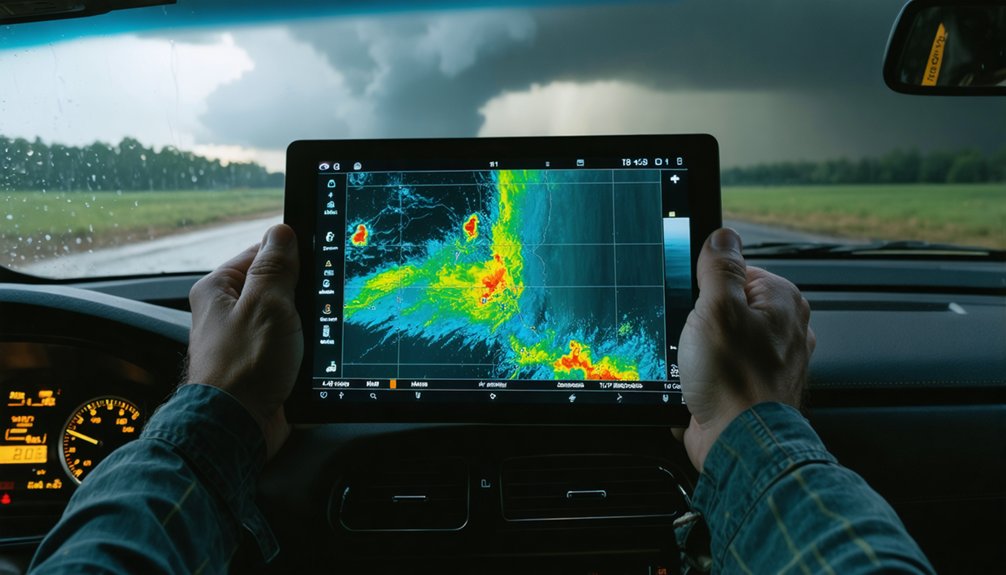
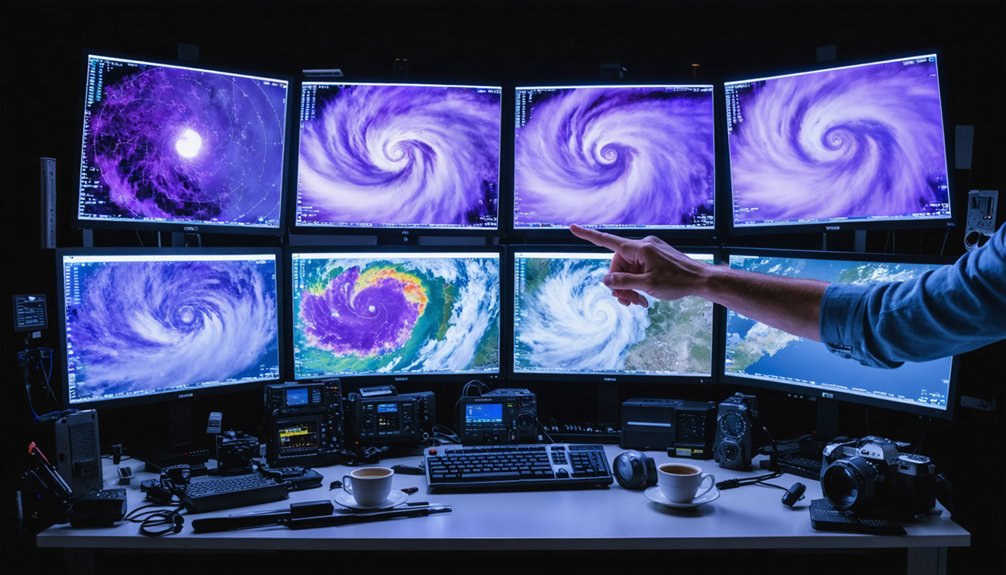
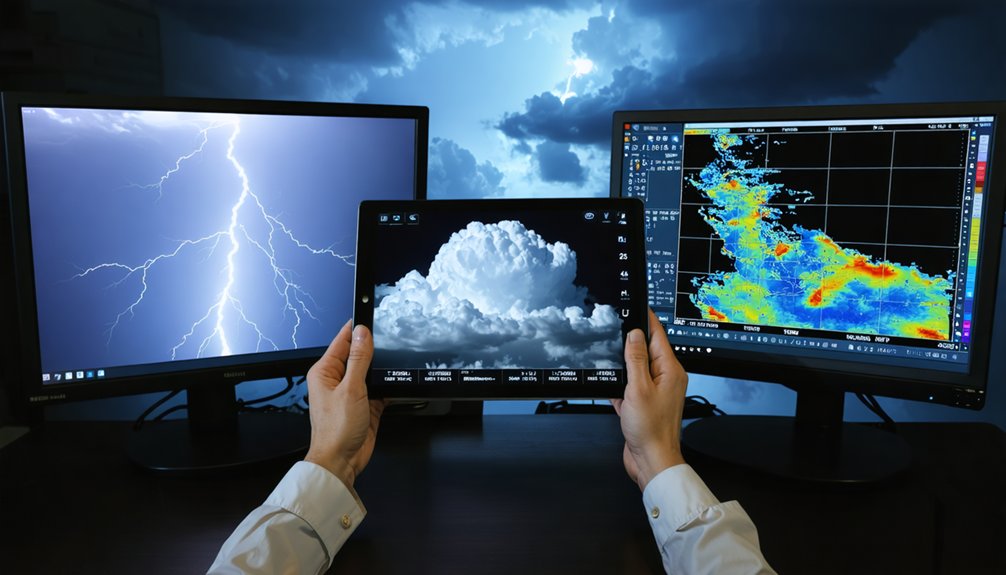
Storm chasers succeed because they collect real-time atmospheric data that satellites can’t capture alone. Aircraft like the P3 and Gulfstream IV deploy up to 40 dropsondes per mission, measuring temperature, pressure, humidity, and wind speed across multiple atmospheric layers. These missions improve track forecasts by up to 24% and boost accuracy by 10-15%. Infrasound tools even detect tornadoes 60 minutes before formation. The specialized tools and techniques behind these results go much deeper.
Key Takeaways
- Hurricane hunter aircraft deploy up to 40 dropsondes per mission, measuring temperature, pressure, humidity, and wind speed for real-time data assimilation.
- Gulfstream IV missions improve hurricane track forecasts by up to 24% compared to relying solely on satellite data.
- P3 aircraft penetrating storms directly boost forecast accuracy by 10-15%, especially during early missions on weaker storms.
- Infrasound equipment detects low-frequency storm emissions over 100 miles away, enabling tornado warnings up to one hour before formation.
- Mesocyclone Detection Algorithms and NTDA machine learning analyze radar rotation patterns, reducing false alarms and improving storm identification accuracy.
How Storm Chasers Collect Real-Time Weather Data
When hurricane hunters deploy aircraft like the Gulfstream IV or P3 into active storms, they’re gathering critical atmospheric data that ground-based systems simply can’t replicate.
Each mission releases up to 40 dropsondes, measuring temperature, pressure, humidity, and wind speed as they descend through the storm. This raw storm data feeds directly into numerical models, tightening forecast accuracy considerably.
You’d notice the difference immediately in model performance. G-IV missions improve track forecasts by up to 24%, while P3 penetrations boost accuracy by 10-15%.
Forecasters identify shifting weather patterns faster because dropsondes transmit real-time atmospheric profiles straight into model systems. Missions targeting weaker storms produce the largest error reductions, giving forecasters a precise advantage when uncertainty is highest and decisive action matters most.
The Tools Storm Chasers Use to Track Dangerous Weather
Storm chasers rely on an arsenal of specialized tools that extend their observational reach far beyond what traditional weather stations can offer. Each instrument directly sharpens data accuracy and strengthens storm tracking capabilities:
- Dropsondes release atmospheric profiles measuring temperature, pressure, humidity, and wind, feeding data directly into numerical models.
- Infrasound equipment detects low-frequency emissions over 100 miles away, providing tornado warnings up to one hour before formation.
- Mesocyclone Detection Algorithms analyze radar rotation patterns by size, strength, depth, and duration, identifying mesocyclones 2-6 miles in diameter.
You’re looking at a system where every tool fills a critical gap.
In storm chasing, redundancy isn’t inefficiency—it’s survival. Every instrument exists because nothing else can replace it.
When these technologies operate together, model consensus tightens considerably, and forecast errors drop measurably—giving you actionable intelligence before dangerous weather strikes.
Why Storm Chasers Fly Directly Into Hurricanes to Improve Forecasts
Flying directly into a hurricane isn’t reckless—it’s one of the most data-dense operations in modern meteorology. When you deploy P3 aircraft through a storm’s core, you’re boosting forecast accuracy by 10–15%.
Gulfstream IV missions targeting environmental steering winds improve track forecasts by up to 24% over satellite data alone.
Each flight releases roughly 40 dropsondes, measuring temperature, pressure, humidity, and wind at multiple atmospheric layers. That data feeds directly into numerical models, tightening forecast consensus within 1–2 days.
Understanding hurricane impacts depends on precise initial storm positioning—something satellites simply can’t provide alone.
Weaker storms yield the largest error reductions, making early-mission flights particularly critical.
Post-data assimilation, model spread collapses dramatically, giving you actionable, high-confidence forecasts when they matter most.
How Infrasound and Radar Algorithms Detect Storms Before They Strike
Before a tornado touches down, infrasound detection betrays its presence up to an hour in advance—detectable from over 100 miles away. Acoustic instruments, originally adapted from nuclear test monitoring, capture low-frequency oscillations that radar alone can’t identify.
Simultaneously, radar algorithms like the Mesocyclone Detection Algorithm and NTDA analyze rotation patterns using machine learning and dual-polarization statistics, calculating real-time tornado probability.
These technologies give you actionable intelligence before destruction arrives:
- Infrasound detects pre-tornado signatures 60+ minutes early
- Mesocyclone algorithms identify rotational structures 2-6 miles in diameter
- NTDA machine learning integrates storm criteria for precise probability assessment
Combined, these systems reduce false alarms, minimize dangerous proximity chasing, and deliver verified threat data directly into your decision-making window.
How Real-Time Storm Data Sharpens Track and Intensity Forecasts
When Hurricane Hunter aircraft penetrate a storm, they don’t just observe—they directly recalibrate the numerical models driving your forecast. Each dropsonde releases atmospheric profiles measuring temperature, pressure, humidity, and wind vectors, feeding raw data into data assimilation systems that correct model errors in real time.
The results are measurable. G-IV missions improve track forecasts by up to 24%, while P3 penetrations boost forecast accuracy by 10-15%.
Before missions launch, model spreads remain wide and unreliable. After 1-2 days of data collection, model consensus converges tightly around the storm’s actual trajectory.
Case studies of Hurricanes Marco and Zeta confirm rapid forecast improvements immediately following data assimilation.
You’re not relying on guesswork—you’re relying on recalibrated science that gives you actionable, life-saving intelligence.
Frequently Asked Questions
How Do Storm Chasers Stay Safe While Pursuing Dangerous Weather Systems?
You stay safe by following strict safety protocols and risk management strategies. You’re using real-time data, maintaining escape routes, and leveraging infrasound technology detecting tornadoes up to one hour early, reducing dangerous close-proximity chasing considerably.
What Qualifications or Training Do Professional Storm Chasers Typically Need?
You’ll trade classroom calm for storm chaos, but meteorological education grounds your storm prediction skills. You need a degree, field training, and data analysis expertise to professionally chase and interpret dangerous weather systems accurately.
How Do African Meteorologists Access Storm Data Without Advanced Radar Systems?
You access storm data through African SWIFT’s remote sensing satellites, which process information every 15 minutes. Data collaboration uploads findings to Chilbolton Observatory’s website, letting you track storm paths and severity hourly without relying on advanced radar systems.
Can Infrasound Technology Eventually Replace Traditional Storm Chasing Methods Entirely?
Infrasound applications won’t fully replace traditional storm chasing, but they’ll greatly enhance storm prediction. You can detect tornadoes up to an hour early, over 100 miles away, reducing dangerous close-proximity chasing while complementing existing observational methods.
How Accurate Are Tornado Probability Watches Derived From Statistical Storm Assessments?
You’re staring down a 90% probability wall of destruction! Tornado prediction models, fueled by statistical analysis, deliver watch probabilities like 90% for 2+ tornadoes, derived from thorough dual-polarization radar data and machine learning-driven storm criteria assessments.
References
- https://www.preventionweb.net/news/new-study-shows-hurricane-hunter-flights-significantly-increase-forecast-accuracy
- https://www.clickorlando.com/weather/hurricane/2025/05/27/heres-how-the-hurricane-hunters-play-critical-role-in-advancing-forecast-accuracy-research/
- https://www.youtube.com/watch?v=3AqKJWk-Sso
- https://environment.leeds.ac.uk/icas-research-impact/doc/storm-chasers-making-life-saving-forecasts
- https://www.nssl.noaa.gov/education/svrwx101/tornadoes/detection/
- https://www.discovery.com/science/tornado-science–predicting-the-whirlwind-
- https://stormtrack.org/threads/accuracy-of-watch-probabilities.19956/