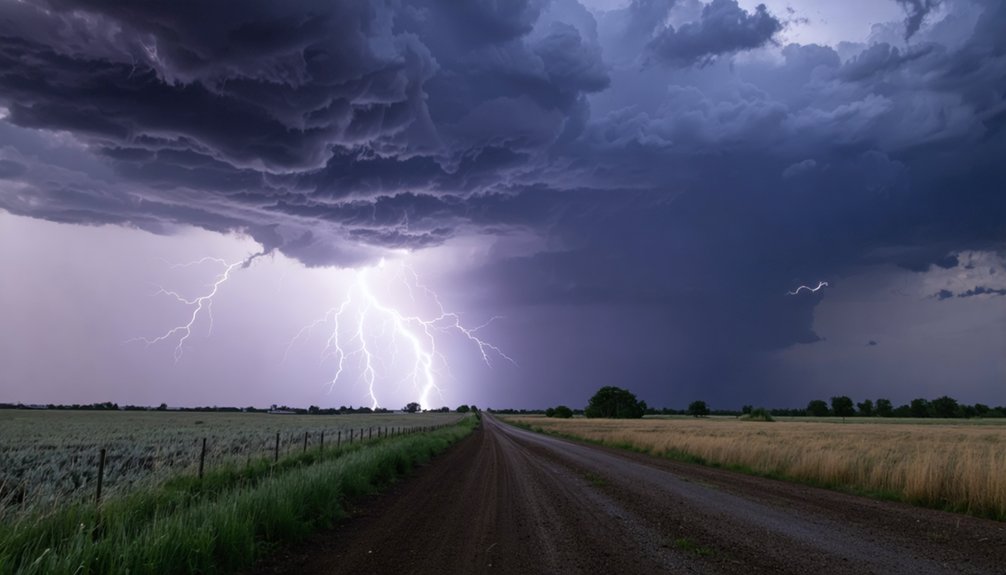
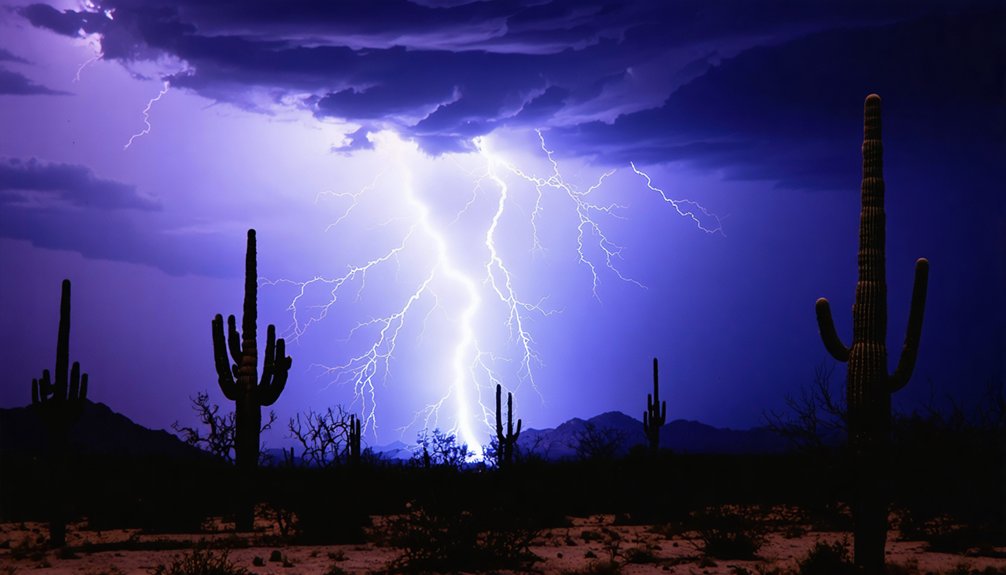
Lightning photography essentials compensate for 300-million-volt discharges traveling at 270,000 mph. You’ll need manual exposure control to balance ISO, aperture, and shutter speed during rapidly changing storm conditions. Wide-angle lenses let you maintain safe 6-10 mile distances while capturing complete meteorological events. Tripods prevent vibration blur during 5-30 second exposures, while remote triggers eliminate camera shake. Lightning detection systems achieve 95% accuracy for strikes within frame, dramatically increasing your success rate compared to manual timing. Mastering these tools transforms unpredictable electrical phenomena into consistently captured images.
Key Takeaways
- Manual exposure control enables precise adjustment of aperture, ISO, and shutter speed for capturing lightning in varying conditions while minimizing noise.
- Wide-angle lenses maximize capture probability by framing expansive storm scenes from safe distances of 6-10 miles away from strikes.
- Tripod stability prevents blur during long exposures by withstanding wind gusts and eliminating vibrations with non-conductive, sturdy construction.
- Remote shutter releases eliminate camera shake from physical contact, ensuring sharp images during extended exposures critical for lightning photography.
- Lightning trigger systems detect infrared bursts before visible strikes, achieving 95% detection accuracy and significantly increasing successful captures.
Manual Exposure Control Enables Precise Storm Photography Adjustments
When lightning illuminates the sky in unpredictable bursts, automatic camera modes can’t keep pace with the split-second exposure demands of storm photography. You’ll need manual mode on your DSLR or mirrorless camera to independently control aperture, ISO, and shutter speed. This gives you the freedom for real time exposure adjustments as conditions shift between ambient darkness and brilliant lightning flashes.
Set your aperture between f/8–f/16 for daytime storms, narrowing to f/13 for intense, nearby bolts. At night, open to f/5.6–f/8 to capture ambient light. Keep ISO low—100 to 400—minimizing noise during long exposures. Your shutter speed becomes critical for dynamic lightning capture: 5–30 seconds for multiple bolts at night, or trigger-assisted bursts under 1/60 second for single strikes. Underexpose by 1–2 stops to prevent blown highlights.
Wide-Angle Lenses Capture Expansive Lightning Storm Scenes
Wide-angle lenses from 14-24mm let you frame entire storm systems while maintaining safe distances from lightning activity. You’ll capture dramatic shelf clouds, multiple lightning branches, and foreground landscapes in a single composition that conveys the storm’s true scale.
This broader field of view keeps you positioned safely away from strike zones while still recording the full atmospheric structure from base to anvil.
Dramatic Storm Structure Framing
As storm systems develop across the horizon, your choice of wide-angle lenses fundamentally transforms both capture probability and compositional impact. Focal lengths between 14mm and 35mm deliver thorough storm composition enhancement, revealing cloud formations, lightning patterns, and atmospheric conditions within single exposures.
You’ll capture the relationship between approaching cells and landscape elements, creating visual storytelling enhancement that documents complete meteorological events rather than isolated strikes. Wide-angle perspectives preserve storm scale while accommodating multiple lightning phenomena simultaneously—cloud-to-ground bolts alongside intercloud discharges.
This expanded field of view eliminates reactive framing during active strike periods, allowing you to establish stable compositions before electrical activity intensifies. The broader coverage reduces missed opportunities and maintains flexibility when storms shift direction unexpectedly, giving you control over unpredictable atmospheric dynamics.
Safe Distance Coverage Advantage
Beyond compositional benefits, your wide-angle lens selection directly influences operational safety during electrical storms. Distance mitigation becomes achievable when you’re shooting with 14-24mm focal lengths—you’ll capture detailed storm structures from safe vantage points rather than approaching hazardous strike zones. This minimal risk exposure strategy lets you maintain 6-10 miles from active cells while still framing complete atmospheric phenomena.
Your 70-200mm alternative forces closer proximity for equivalent coverage, escalating danger unnecessarily. Wide-angle coverage compensates for remote positioning without sacrificing frame content. You’ll document expansive cloud-to-ground networks from your vehicle or sheltered locations, preserving both photographic opportunity and personal security. The field of view advantage means you won’t chase strikes into exposed terrain—freedom comes from capturing nature’s violence without subjecting yourself to it.
Tripod Stability Prevents Blur During Extended Exposures
Lightning photography demands absolute camera stability during exposures that can last several seconds or longer. You’ll need a tripod that handles your complete payload—camera body, lens, batteries, and accessories combined. Wind gusts during thunderstorms will topple inadequate setups, destroying your gear and ruining shots.
Carbon fiber construction delivers superior sturdiness without excess weight, while aluminum provides cost-effective steadiness. Either material offers non-conductive properties that reduce electrical risk during storms. Your tripod height adjustment capabilities enable ideal composition angles, while leg spread flexibility creates a wider stance against wind forces.
Heavy-duty construction prevents vibration-induced blur during extended exposures. You’ll maintain tack-sharp focus across multiple frames when using an intervalometer. Position your camera at the precise angle needed, then trigger exposures remotely to avoid contact-induced shake.
Remote Shutter Release Eliminates Camera Shake
When you’re capturing lightning strikes with long exposures, even the slightest pressure on your camera’s shutter button introduces vibrations that compromise image sharpness. A remote shutter release eliminates this physical contact entirely, allowing you to trigger exposures from a safe distance without touching the camera body.
This hands-free operation is critical when using telephoto lenses or shooting in bulb mode, where magnified shake and extended exposure times would otherwise blur the precise detail of lightning bolts against the dark sky.
Minimizes Physical Contact Vibration
Even the slightest pressure on your camera’s shutter button introduces micro-vibrations that compromise image sharpness, particularly during the long exposures required for lightning photography. Remote shutter releases provide critical vibration isolation between you and your gear, ensuring minimized hand movement during capture.
When you’re shooting in bulb mode for unpredictable strikes, physical contact creates wavering that’s magnified through your lens—especially with telephoto setups that amplify every tremor like unsteady binoculars. Specialized triggers like MIOPS eliminate this issue entirely, detecting lightning automatically without requiring your touch.
You’ll maintain rock-steady detail throughout ultra-long exposures that exceed your camera’s standard limits, capturing fleeting moments with precision while your hands remain completely free from the equipment.
Enables Hands-Free Operation
Remote shutter releases transform your lightning photography setup into a completely hands-off system, eliminating every tremor that physical contact introduces during those critical capture moments. You’ll capture millisecond-precise lightning strikes without touching your camera, maintaining absolute stability throughout extended shooting sessions.
Silent shutter activation guarantees zero vibration transfer while you wait for nature’s perfect moment, unlike fumbling with buttons during storm sequences. Self timer override gives you immediate control—no 2-3 second delays causing missed opportunities when lightning illuminates the sky.
Position yourself safely away from exposed tripod locations while maintaining complete firing authority. This hands-free operation proves essential for telephoto compositions where magnification amplifies any movement, delivering tack-sharp results that match your sensor’s full resolution capabilities during those spectacular electrical displays.
Lightning Trigger Systems Increase Strike Capture Success
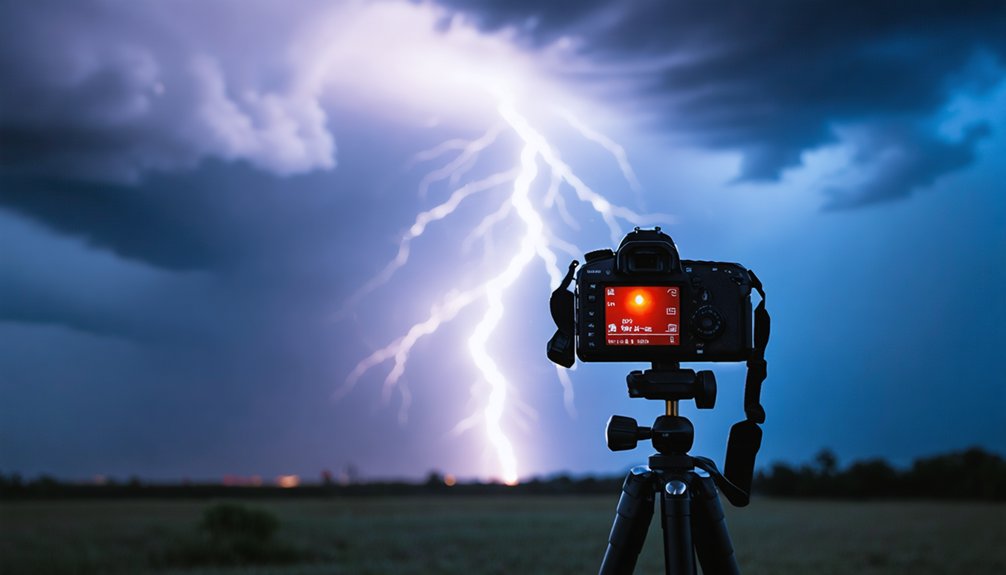
Lightning trigger systems transform the odds of capturing electrical storms by detecting infrared bursts that precede visible bolts, activating your camera’s shutter before the strike completes. You’ll achieve 95 percent detection accuracy when lightning fires within your frame, with actual capture rates reaching two-thirds of detected strikes using standard DSLRs—significantly higher with mirrorless cameras. Ground strikes show 70 percent success rates when you’ve established a reliable hardware configuration.
Your trigger’s customizable sensor sensitivity creates a trade-off: higher settings reduce missed strikes but increase false positives from distant lightning. Mirrorless systems like Sony’s a7RIII deliver 0.020-second shutter lag, critical when bolts complete within milliseconds. Set shutter speeds between 1/4 and 1/20 second to capture multiple strokes without overexposing your image.
Violent storms with extended bolt duration dramatically improve your success rates.
Optimal Camera Settings Balance Light and Image Quality
Your trigger system fires reliably, but incorrect camera settings will produce overexposed bolts or murky backgrounds that waste the capture. Manual mode grants complete control over your exposure triangle—no automatic interference when conditions shift rapidly.
Configure these core parameters:
- Aperture f/8-f/11 balances sharpness with lightning intensity; widen to f/5.6 for distant strikes, narrow to f/16 for close bolts
- ISO 100-200 minimizes noise during long exposures while preventing blown highlights
- Shutter 5-15 seconds captures multiple branches without overloading your card
- Manual focus at infinity using Live View zoom on distant lights—autofocus fails in darkness
- Exposure compensation enhancement recovers ambient detail in post; focus bracketing techniques aren’t practical during storms
Disable image stabilization on your tripod and lock these settings for consistent results across sequences.
Sensor Size and Type Impact Low-Light Performance
Three sensor formats dominate storm photography, each trading light-gathering capability for portability and cost. Full-frame sensors like the Canon EOS R6 Mark II deliver superior low light image quality, producing usable shots at ISO 1600-3200 with minimal noise when capturing distant lightning. You’ll achieve better cropping flexibility through higher resolution in dim conditions.
APS-C sensors gather 2.4 times less light but remain effective with optimized lenses—Fuji models compete well at ISO 3200. Micro Four Thirds handles ultra-low light adequately; the Panasonic LUMIX GH5s uses pixel density optimization through lower resolution and dual-native ISO for efficiency.
Modern backside-illuminated sensors outperform older designs regardless of megapixel count, debunking myths that lower resolution always wins in darkness. Choose based on your mobility needs versus light-gathering demands.
Proper Equipment Integration Maximizes Lightning Photography Results
Successful lightning photography demands four core equipment components working in unison: a camera body with manual controls, a lens matched to your composition goals, a tripod that resists wind vibration, and a remote shutter release. This integrated approach guarantees lightning portrait clarity while maintaining low light noise management during extended exposures.
Your essential gear synergy includes:
- Weather-sealed bodies like Pentax K-70 withstand storm conditions safely
- Wide-angle zooms (16-35mm) capture expansive lightning landscapes efficiently
- Heavy-duty tripods eliminate shake during 10-30 second exposures
- Intervalometers automate sequences without touching the camera
- Prime lenses (35mm f/1.4) deliver superior sharpness for detailed bolt capture
Entry-level APS-C cameras paired with quality wide-angle glass produce professional results. You’ll avoid expensive upgrades while maintaining flexibility to adapt focal lengths and exposure settings as storms develop.
Frequently Asked Questions
What Safety Precautions Should Photographers Take When Shooting Lightning Storms?
You’ll need proper grounding techniques and lightning detection devices to stay safe. Monitor proximity using flash-to-thunder counts, shoot from enclosed vehicles or buildings, avoid open areas, and maintain six miles minimum distance from storm cores.
How Do Weather Conditions Affect Lightning Photography Equipment Performance?
Weather throws curveballs at your gear constantly. Rain damages cameras and lenses, wind destabilizes tripods requiring adjustments to camera settings, and atmospheric conditions like dust scratch optics while temperature extremes cause condensation or overheating, compromising your equipment’s performance and reliability.
What Post-Processing Techniques Enhance Lightning Strike Photograph Quality?
You’ll maximize lightning detail through RAW file editing—adjusting white balance, recovering highlights, and boosting texture. Master exposure blending by stacking multiple strikes using Lighten mode, then refine with gradient filters and masks for dramatic, natural-looking results.
Can Smartphone Cameras Capture Quality Lightning Photos With Proper Accessories?
Yes, you’ll capture stunning lightning shots when you pair your smartphone’s sensor resolution with tripod stabilization and lightning detection apps. Manual controls, low ISO settings, and remote triggers eliminate blur while you safely document nature’s electrical fury.
What Time of Year Provides Optimal Conditions for Lightning Photography?
Summer months provide the ideal storm season for lightning photography. You’ll find perfect atmospheric conditions with maximum instability, intense heat-driven convection, and frequent cumulonimbus development producing abundant lightning strikes perfect for capturing dramatic electrical displays safely.