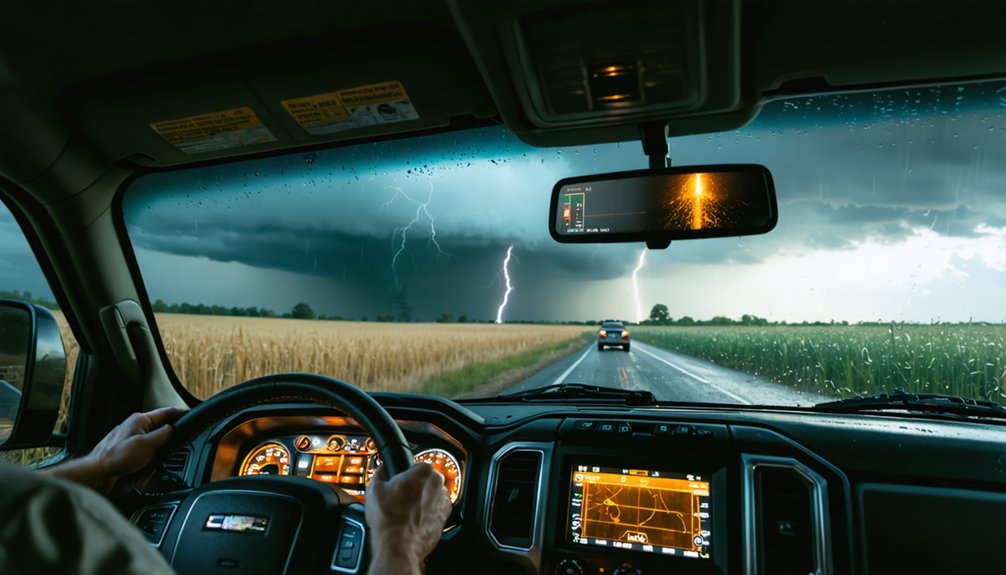
You’ll intercept mountainous thunderstorms because terrain-forced convection creates phenomena unattainable on flat ground—orographic lifting doubles CAPE values, generates anomalous helicity through topographic vorticity, and concentrates moisture flux between ridgelines to intensify mesocyclones. Mountains accelerate development cycles (200 feet/second updrafts) while creating critical forecasting gaps, as models at 10-25 km resolution can’t resolve the lifting mechanisms that initiate convection. Lightning strikes peak at 3486.4±614.3 m elevations, making exposure your primary hazard. The operational frameworks below address these measurement and prediction challenges.
Key Takeaways
- Mountains amplify storm severity by doubling CAPE values and generating vorticity that intensifies mesocyclones beyond flat-terrain capabilities.
- Orographic lifting forces rapid storm development at 200 feet per second, enabling documentation of extreme convective phenomena.
- Terrain convergence zones between hills concentrate moisture flux and atmospheric instability, producing strategically positioned severe weather.
- Weather prediction models lack resolution for mountain processes, creating critical forecast gaps that field observations must address.
- Climate change increases mountain thunderstorm frequency, requiring improved observation networks and operational warning systems for public safety.
Understanding Mountain-Induced Storm Formation Mechanisms
When air masses encounter mountainous terrain, they undergo forced vertical displacement that fundamentally alters their thermodynamic properties and initiates convective processes. You’ll observe orographic lifting when winds perpendicular to ridges force moist air upward to saturation levels, generating cumulus clouds that evolve into thunderstorms given sufficient instability.
Storm initiation timing accelerates when solar heating combines with upslope flow convergence—mountain slopes warm adjacent air, creating winds that converge at peaks with rising thermals from adjacent faces. The impact of terrain channeled winds becomes critical as they transport detached thermals downwind, positioning convection beyond ridgelines rather than directly overhead.
Wind shear introduces vertical pressure gradients that inhibit cumulus deepening, while cross-barrier flow determines whether stable air achieves necessary lift for sustained convective development.
The Amplification Effect: How Terrain Enhances Storm Severity
As thunderstorms interact with mountainous terrain, they undergo systematic intensification through three primary physical mechanisms: enhanced convective available potential energy (CAPE), modified wind shear profiles, and concentrated convergence patterns.
You’ll observe CAPE variance across slopes reaching double baseline values during peak seasons, driven by terrain moisture channeling from Gulf and Atlantic sources. This amplification persists independently of wind shear conditions, establishing persistent severe weather corridors.
Mountain-induced vorticity generation creates backing surface winds through valley configurations, substantially increasing storm-relative helicity. You’ll find moisture flux convergence maximizes between adjacent hills, where upslope flows concentrate atmospheric instability. These combined mechanisms produce mesocyclone intensification unavailable on flat terrain, with transient subvortices developing greater intensity.
Understanding these amplification processes enables strategic positioning for documenting severe convective phenomena.
Rapid Development Cycles in Complex Topography
The terrain amplification mechanisms that intensify storm structure also compress development timescales, creating forecast challenges absent in plains environments.
You’ll observe cumulonimbus clouds towering at 200 feet per second when orographic lifting combines with solar heating on summer afternoons. These rapid development cycles demand adaptive interception strategies since storms form quickly and produce flash floods within minutes.
High-resolution numerical simulations and weather balloon observations now rank meteorological condition importance, though improved mesoscale cloud-triggering representation remains critical for accurate forecasts. Your success depends on local microclimate assessment—analyzing wind convergence patterns through valleys, moisture availability from oceanic sources, and vertical wind shear effects.
Strong flow convergence supports narrow updrafts that transform into deep thunderstorms before conventional warning systems can alert populations downstream.
Lightning Hazards Intensified by Elevation
Lightning strikes escalate to critical concern at elevations above 3000 m, where mountaineers encounter mean strike altitudes of 3486.4 ± 614.3 m across exposed summits. You’ll face heightened risk on iconic peaks like Matterhorn’s Hörnligrat and Eiger’s Mittellegigrat, where strike distribution patterns concentrate along exposed ridges.
The data reveals 15 documented cases from 4687 mountain emergencies, representing 0.32% incidence among high-altitude recreationists. Impact severity analysis demonstrates surprisingly low lethality—zero fatalities recorded despite mean NACA scores of 3.1 ± 2.5. Your elevation advantage becomes liability as you become the tallest object in lightning’s targeting mechanism.
While hiking incidents occur at lower mean altitudes of 1883.8 ± 425.7 m, mountaineering exposure multiplies strike probability. You’re assuming calculated risk pursuing vertical terrain during electrical activity.
Critical Knowledge Gaps in Mountain Weather Prediction
Current numerical weather prediction models at 10-25 km resolution can’t resolve orographic lifting that drives convective initiation over complex terrain, with coarse grid spacing underestimating peak elevations and creating systematic errors in windward precipitation forecasts. You’ll encounter critical data gaps when high-quality initial conditions prove unavailable—GDAS FNL forcing produces rainfall estimates of 20-25 mm compared to observed 52.8 mm, while ECMWF IFS datasets align peak timing within 30 minutes (1240-1310 UTC).
Real-time validation requires dense observation networks with lidar and radar coverage, yet most mountain regions lack the finite-site measurements necessary for probabilistic forecast verification at ridgeline (3300m) and mid-elevation (2700m) reference points.
Orography in Prediction Models
Although global circulation models have revolutionized weather forecasting, their spatial resolution remains inadequate for mountainous terrain, with grid cells averaging 100 km that fundamentally can’t capture the fine-scale orographic processes driving severe convection. You’ll need terrain following coordinates to simulate airflow over complex landscapes, but standard 10-25 km resolution models still fail to resolve critical mesoscale effects.
Orographic precipitation parameterization remains challenging—mountain waves propagate hundreds of kilometers, while localized lifting and precipitation gradients escape detection. Even high-resolution models require sub-5 km grids for accuracy. Two-dimensional representations predict average precipitation reasonably well when including elevation statistics, yet struggle with wind-precipitation relationships.
The climatology of small-scale mountain precipitation patterns remains poorly constrained, limiting your ability to anticipate where severe thunderstorms will intensify. Operational models only recently achieved sufficient resolution for meaningful orographic simulation.
Real-Time Data Deficiencies
Despite advances in satellite technology and numerical modeling, critical observational gaps severely undermine your ability to predict severe thunderstorms in mountainous regions. Sparse weather station networks fail to capture localized microclimatic variations essential for convective initiation forecasting.
You’ll find approximately 21.9% of precipitation forecasts miss observed amounts entirely, with grid spacing too coarse to resolve terrain elevation accurately. Remote sensor proliferation hasn’t solved fundamental resolution problems—operational models systematically underestimate topographic effects on storm development.
Without real-time monitoring in high-altitude zones, you’re forecasting blind. Improving model resolution remains constrained by inadequate ground-truth data for validation. Small magnitude errors in snow level and precipitation intensity compound exponentially, producing unreliable predictions precisely when storm chasers need accuracy most for route planning and safety assessments.
Current Limitations of Forecasting Models and Technologies
Standard numerical weather prediction models struggle to capture the intricate atmospheric processes that govern severe thunderstorms in mountainous terrain. Model resolution limitations prevent you from accurately simulating valley flows and orographic lifting at standard 3 km grids—you’ll need convection-permitting 1 km resolution or finer to resolve critical terrain-induced mechanisms.
Data assimilation challenges compound these issues: GDAS FNL forcing produces rainfall totals shifted 25-30 km from observed locations, while ECMWF datasets better capture localized events. You’re constrained by sparse boundary layer observations in complex topography and inadequate radar coverage due to beam blocking.
Convective parameterization schemes prematurely remove atmospheric instability, delaying storm development. Double-moment microphysics and sophisticated boundary layer physics remain computationally expensive for operational continental-scale forecasting, limiting your prediction capabilities.
Advancing Real-Time Monitoring Systems for Alpine Environments

Real-time monitoring systems have evolved to address the specific challenges of detecting severe thunderstorms in alpine environments through integrated sensor networks and advanced data fusion architectures. USPLN’s dense sensor network delivers exact strike locations with near real-time data delivery, addressing regional blind spots in mountainous terrain where satellite coverage falters.
You’ll access validated lightning data through platforms like LightningMaps.org while harnessing crowdsourced data from global meteorological sources. NOAA GOES and EUMETSAT Meteosat provide HD satellite imagery, while Zoom Earth integrates radar, rain maps, and wind forecasts for all-encompassing storm tracking.
Automated alert systems like Max Alert Live and StormGeo deliver color-coded proximity warnings with adjustable thresholds. WMO’s Severe Weather Information Centre and NWS regional offices provide CAP warnings sorted by severity, enabling you to monitor threats independently without relying on centralized emergency services.
Operational Challenges in Severe Weather Warning Systems
While advanced monitoring systems provide critical infrastructure for storm detection, operational implementation faces persistent challenges that compromise warning effectiveness in mountainous environments.
You’ll encounter significant precipitation measurement challenges stemming from data scarcity in remote areas, particularly across the Global South’s mountain ranges. Mountainous terrain dynamics create extreme spatial variability—forecasting models using different forcing data sources show rainfall predictions shifted 25-30 km from actual locations with intensity differences of 20-25 mm.
You’re working with civil engineering infrastructure designed on merely 50-70 years of historical data, inadequate for capturing current precipitation extremes. Complex topography generates rapid discharge rises and unpredictable social-ecological responses.
Without standardized proxy data and subnational-level disaggregation, you can’t develop the exhaustive threat assessments necessary for protecting vulnerable mountain communities from flash floods.
Field Research Priorities for Improving Safety Protocols

Although mountain terrain greatly influences thunderstorm development through localized temperature gradients and wind convergence patterns, field research methodologies haven’t systematically addressed the safety protocols necessary for in-situ observation campaigns. You’ll need interdisciplinary collaboration between meteorologists, emergency responders, and terrain specialists to establish robust operational frameworks.
High-resolution numerical simulations require validation through direct measurement of near-cloud wind shear and humidity conditions, yet complex orography creates heterogeneous environments that exponentially increase observer risk. Effective risk communication strategies must integrate real-time CAPE measurements with terrain-specific escape route mapping.
Your research priorities should emphasize developing convection-permitting observation networks that balance scientific data requirements against personnel safety constraints. Climate change projections indicating increased severe thunderstorm frequency in mountainous regions demand immediate protocol standardization across international research teams.
Frequently Asked Questions
What Equipment Do Storm Chasers Need for Mountainous Terrain Interception?
You’ll need durable all-terrain vehicles with high ground clearance, specialized radar systems like RadarScope Pro for real-time storm tracking, GPS units for remote navigation, portable weather stations, communication boosters, and professional cameras to document severe weather phenomena effectively.
How Do Rescue Operations Locate Stranded Hikers During Active Mountain Thunderstorms?
You’ll find rescue teams use weather monitoring equipment like altimeters and barometers to track stranded hikers’ positions, while helicopters and radio systems enable emergency evacuation procedures. Aircraft coordinate multi-group searches, transporting injured subjects cross-country to awaiting ambulances efficiently.
Which Mountain Ranges Globally Experience the Most Severe Thunderstorm Activity?
You’ll find fierce frequencies favor Mitumba Mountains (205 strikes/km²), Lake Maracaibo’s Andes (233 strikes/km²), and Himalayan foothills. Monsoonal weather patterns and elevation-induced convection create ideal conditions where warm, moisture-laden air collides with cooler mountain barriers, triggering intense electrical activity.
What Insurance Considerations Exist for Research Teams Intercepting Mountain Storms?
You’ll need specialized coverage addressing operational risks like vehicle damage, equipment loss, and liability exposure. Guarantee policy limits adequately cover high-value meteorological instruments, personnel injuries, and third-party damages during mountainous terrain operations where evacuation’s limited.
How Do Communication Systems Function During Storms in Remote Alpine Areas?
Globalstar transceivers achieved 100% transmission success in open-sky conditions. You’ll need satellite systems for signal reliability since VHF radios fail in mountainous terrain. Power backup systems using mobile generators safeguard you maintain connectivity when storms compromise infrastructure.