When you’re chasing storms, interpreting meteorological data isn’t optional — it’s what keeps you alive. Real-time Doppler radar feeds show you exactly where atmospheric energy is shifting, so you can reposition before conditions turn lethal. Atmospheric pressure readings and wind shear measurements guide every decision you make in the field. Without accurate data interpretation, you’re risking false alerts, misread rotation signatures, and dangerous positioning errors. Keep going to uncover exactly how the pros do it.
Key Takeaways
- Accurate data interpretation ensures storm chasers position themselves safely while collecting critical measurements during dangerous weather events.
- Real-time Doppler radar and atmospheric readings guide positioning decisions, directly influencing both operational safety and data quality.
- Recognizing visual cues like wall clouds and rear-flank downdrafts helps chasers identify tornado formation before dangerous touchdowns occur.
- Ground-level observations enable faster public warnings, bypassing radar confirmation delays and potentially saving lives during severe storms.
- Misreading storm data risks false alerts, misdirected emergency responders, eroded public trust, and compromised storm chaser safety.
How Meteorological Data Keeps Storm Chasers Alive
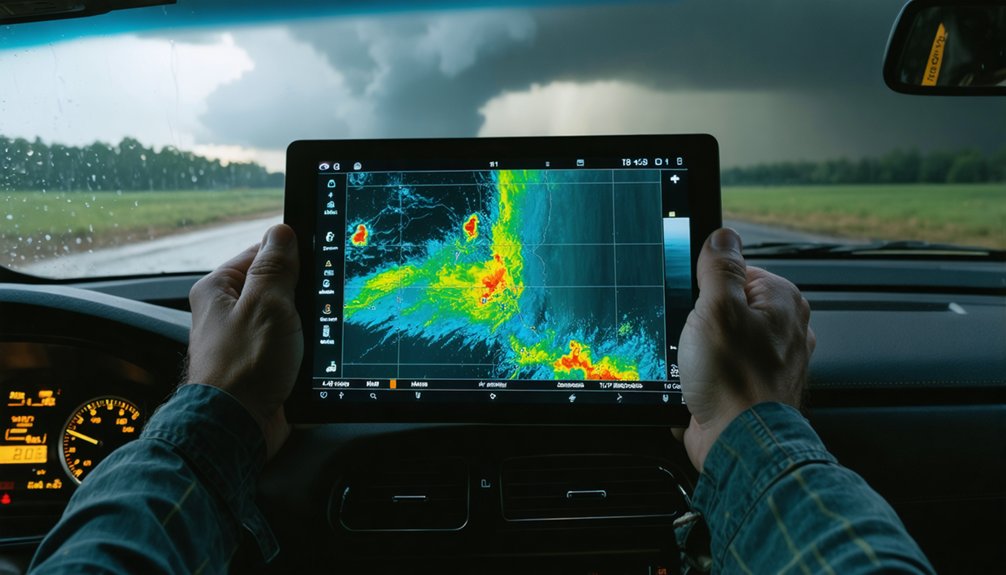
When you’re positioned within striking distance of a tornado, meteorological data isn’t a convenience—it’s your primary survival mechanism. Real-time Doppler radar feeds, atmospheric pressure readings, and wind shear measurements dictate your positioning decisions with split-second precision.
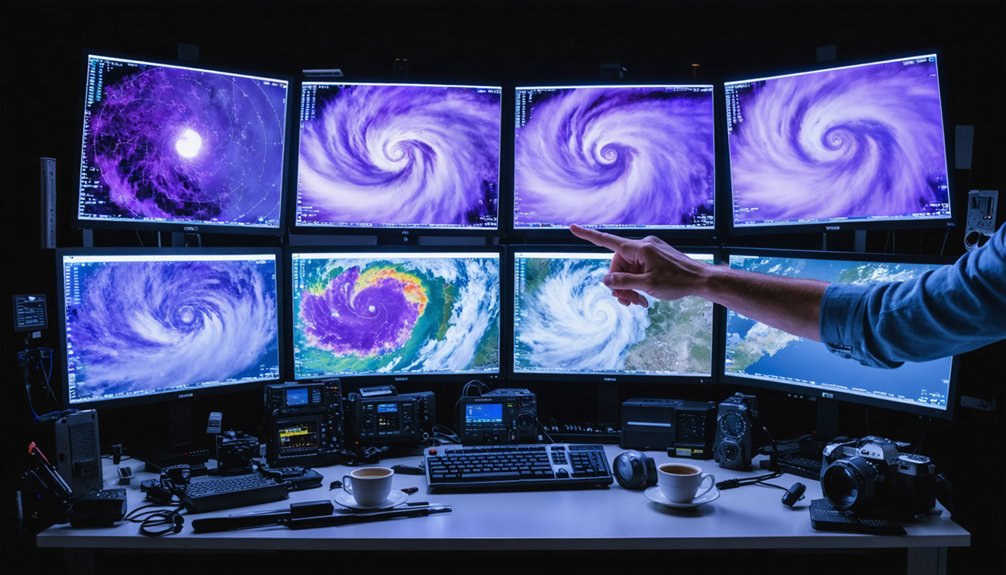
Data accuracy determines whether you’re collecting critical storm measurements or directly in a dangerous debris field. You’re cross-referencing mobile radar outputs, weather balloon telemetry, and satellite imagery simultaneously, identifying storm rotation vectors before visual confirmation becomes possible.
In storm chasing, your data feed is the difference between scientific precision and a debris field.
Your safety measures aren’t instinct-based—they’re data-driven protocols built from decades of field research. Pressure drops, hook echo formations, and velocity azimuth display signatures tell you exactly when retreat becomes mandatory.
Understanding these variables doesn’t just enhance your scientific contribution; it’s what keeps you operational for the next deployment.
What Data Tools Do Storm Chasers Actually Use?
From the moment you deploy into the field, your toolkit determines the quality and safety of your operation.
You’re relying on mobile Doppler radar mounted on trucks to capture high-resolution storm data from multiple angles simultaneously. Weather balloons measure temperature, humidity, and atmospheric pressure both outside and inside active storm systems.
Your data collection arsenal also includes in situ precipitation stations equipped with disdrometers, measuring raindrop sizes and precipitation patterns directly within severe thunderstorms.
Drone technology now supplements balloon-based measurements for targeted atmospheric sampling.
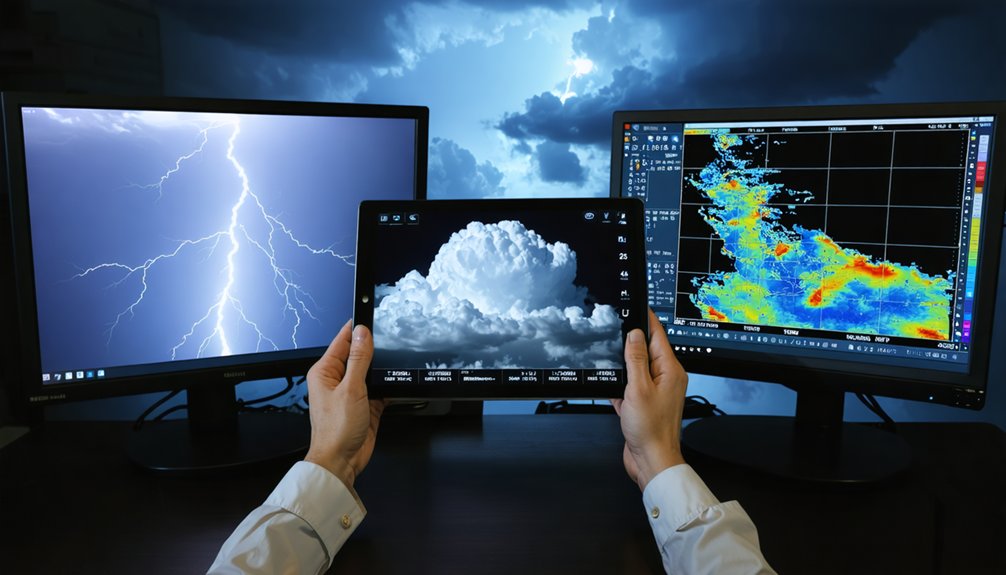
Your analysis techniques combine networked radars, cameras, and instrumented vehicles, constructing extensive three-dimensional storm pictures in real time.
This multi-instrument approach reveals wind speed, relative humidity, and pressure variations across different storm angles, giving you actionable intelligence before conditions turn lethal.
What Visual Signals Tell Storm Chasers a Tornado Is Coming?
Beyond radar returns and instrument readings, your eyes remain a critical sensor system in the field. Recognizing visual cues tied to tornado formation can mean the difference between timely warnings and preventable fatalities.
Your eyes are instruments too — and in the field, they can be the difference between a warning issued and a life lost.
Watch for these specific storm structure indicators:
- Wall cloud formation: A persistent, rotating lowering beneath the rain-free cloud base signals strong updraft activity.
- Inflow bands: Low-lying clouds streaming toward the storm base indicate intense surface convergence.
- Rear-flank downdraft clear slot: A wrapping clear area around the wall cloud precedes many tornado touchdowns.
- Condensation funnel: Visible rotation extending earthward confirms active tornado development.
These atmospheric phenomena can deceive untrained observers. Scud clouds, gustnadoes, and land spouts mimic tornado structure without producing equivalent threats.
Your ability to distinguish genuine precursors from look-alikes directly sharpens warning accuracy.
How Storm Chasers Get Warning Data to the Public Faster Than Radar
Radar scans update every 4–6 minutes, but your ground-level report reaches emergency managers in seconds. That gap saves lives.
When you spot rotation, a wall cloud, or a developing funnel, you transmit observations directly to National Weather Service offices through real-time communication networks, bypassing the radar’s scan cycle entirely.
Your field report triggers immediate public safety alerts—warnings issued before radar confirms the threat. The 1973 Union City tornado recorded zero fatalities precisely because ground observers delivered actionable intelligence ahead of radar verification.
You’re operating as a human sensor node. Paired with mobile Doppler units and networked instrumented vehicles, your position-stamped observations give forecasters multi-angle data, enabling them to push warnings to at-risk populations faster than any single remote-sensing system can independently achieve.
What Happens When Storm Chasers Misread the Data?
When you misread storm data, the consequences cascade through the entire warning system. Data misinterpretation consequences range from unnecessary evacuations that erode public trust to catastrophic missed warnings that cost lives.
Storm prediction challenges intensify when you confuse a wall cloud with a rain-wrapped tornado, triggering false alerts that desensitize communities to future warnings.
Misidentifying rotation signatures on mobile Doppler radar can send emergency responders toward the wrong coordinates, leaving vulnerable populations unprotected.
You’ll compromise the entire observational network when inaccurate field reports contradict radar interpretation, creating conflicting data streams that paralyze emergency management decisions.
Every misread pressure gradient, humidity spike, or wind shear measurement introduces compounding errors into forecast models, directly undermining the rapid-warning advantage that storm chasers provide over standard radar confirmation timelines.
Frequently Asked Questions
How Does Storm Chasing Data Improve Forecasting Accuracy for Future Severe Weather Events?
When you collect field observations, you’re driving data integration that validates tornado formation theories. Analyzing storm patterns across years of chasing refines forecast models, sharpening warning accuracy and giving communities critical extra minutes before severe weather strikes.
What Economic Sectors Benefit Most From Storm Chaser Meteorological Observations?
When the chips are down, you’ll find storm chaser data shields construction, transport, aviation, agricultural planning, insurance assessments, disaster preparedness, and urban development sectors—delivering precise meteorological intelligence that slashes economic losses and empowers your operational decision-making.
How Do Developing Nations Use Storm Chasing Data Without Radar Infrastructure?
You’ll leverage satellite-based nowcasting and community collaboration to fill radar gaps. Through data sharing, you receive 15-minute satellite cycles, ground observations, and training programs that build local forecasting expertise, protecting vulnerable populations from severe weather threats.
What Scientific Theories Have Storm Chasers Helped Validate Through Field Research?
Like detectives cracking a case, you’ve helped validate Doppler radar technology through field studies. Your observational techniques and storm dynamics data validation confirmed tornado formation theories, giving science the freedom to build accurate, life-saving forecasting systems independently.
How Does Drone Technology Enhance Traditional Storm Chasing Data Collection Methods?
Drone capabilities let you target specific storm regions, collecting atmospheric measurements that supplement weather balloon data. You’ll achieve superior data integration by combining drone readings with ground instrumentation, capturing precise wind, humidity, and pressure variations from previously inaccessible locations.
References
- https://www.accuweather.com/en/weather-news/the-importance-of-professional-storm-chasing/420198
- https://www.preventionweb.net/news/what-do-storm-chasers-really-do-two-tornado-scientists-take-us-inside-chase-and-tools-studying
- https://www.leeds.ac.uk/news-environment/news/article/4594/the-storm-chasers-making-life-saving-forecasts
- https://phys.org/news/2020-05-storm-chasers-life-saving.html
- https://www.weather.gov/oun/stormspotting
- https://www.youtube.com/watch?v=Bdsi3rQay3g