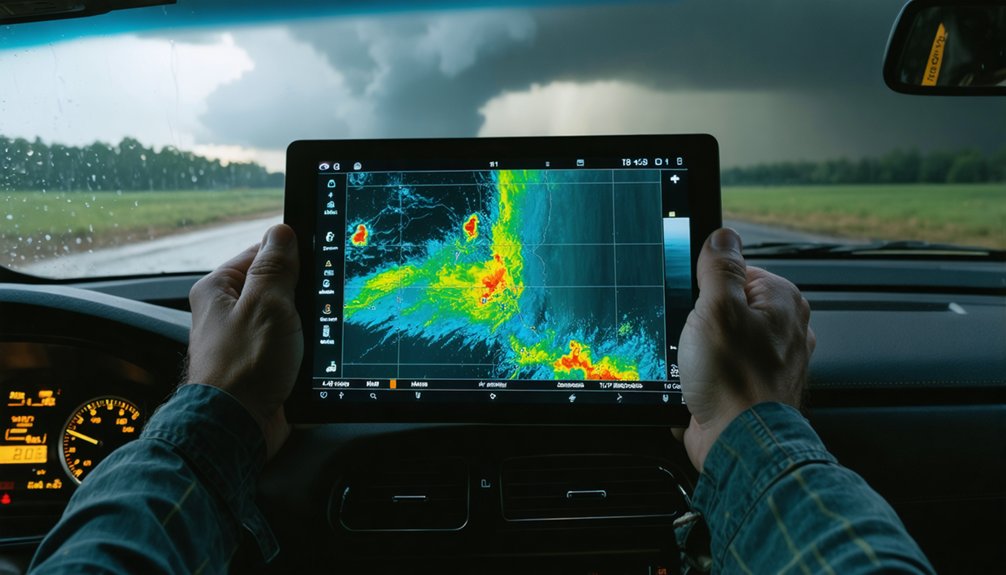
Predictive analytics is essential because it transforms your meteorological observations into accurate forecasts by processing massive atmospheric datasets through machine learning algorithms that achieve 90% accuracy—delivering 10-20% improvements over traditional methods. You’ll gain access to systems that detect severe weather patterns 6-14 hours earlier, capture 96% of rare extreme events conventional forecasting misses, and complete 72-hour flood simulations in just 4 seconds. These capabilities enable you to protect communities, optimize operations, and reduce weather-related disruptions through intelligence that extends beyond basic pattern recognition.
Key Takeaways
- Machine learning achieves 90% forecast accuracy with 10-20% improvement over traditional methods while reducing prediction errors by 30%.
- Advanced systems detect severe weather patterns 6-14 hours earlier, capturing 96% of rare extreme events conventional forecasting misses.
- AI-powered disaster forecasting provides 12-18 hour advance warnings, completing 72-hour flood simulations in just 4 seconds.
- Integration of satellite and ground-based data delivers 3.5km resolution forecasts, processing 10 times more data than traditional approaches.
- Weather intelligence enables 5-10% revenue increases across commercial sectors through optimized supply chain planning and risk management.
Transforming Weather Forecast Accuracy Through Advanced Analytics
Advanced analytics has fundamentally restructured meteorological forecasting, pushing accuracy levels that seemed unattainable just decades ago. You’re witnessing 90% forecast accuracy through machine learning systems that process thousands of variables simultaneously—achieving 10-20% improvement over traditional methods while reducing errors by 30%.
Fine tuning model hyperparameters and improving feature engineering enables AI systems to deliver 3.5km resolution with real-time updates, handling 10 times more data than conventional approaches.
Seven-day forecasts now reach 80% accuracy, while five-day predictions hit 90%. You’ll find 48-hour forecast errors have plummeted from 200-400 nautical miles in the 1970s to just 50 nautical miles today.
These systems cut time-to-insight by 80%, processing ensemble methods like WxMix that combine AI precision with expert validation, liberating you from outdated forecasting constraints.
Integrating Diverse Data Sources for Comprehensive Climate Insights
You’ll achieve thorough climate insights by merging satellite observations with ground-based measurements through systematic data assimilation processes.
Real-time integration protocols like CMAP and GPCP combine geostationary satellite imagery at 250 km resolution with NMHS station networks, producing unified precipitation datasets that capture both spatial coverage and point-specific accuracy.
Your NWP models synchronize these heterogeneous inputs with first-guess atmospheric fields, generating time-correlated meteorological estimates that extend beyond sparse observation networks into continuous gridded forecasts.
Satellite and Ground Integration
When you bring together satellite observations and ground-based measurements, you’re combining two fundamentally different data collection approaches that offset each other’s limitations. Data fusion techniques enable unprecedented analytical capabilities by merging satellite’s global coverage with ground sensors’ localized precision.
Ground sensor calibration becomes your reference standard for validating atmospheric models and reducing measurement variances across distributed networks.
This integration delivers measurable advantages:
- Validation accuracy: Ground measurements verify satellite parameters like humidity, temperature, and atmospheric composition with quantifiable precision
- Gap elimination: Ground networks capture data under cloud cover and in areas satellites can’t effectively monitor
- Error reduction: Cross-verification between sources identifies and corrects measurement inconsistencies
- Resolution enhancement: Ground data compensates for satellite pixel-level limitations in urban-scale applications
You’ll achieve all-encompassing environmental monitoring without sacrificing either global scope or local detail.
Real-Time Multi-Source Assimilation
Modern meteorological systems process approximately 20 million data points daily by synthesizing observations from satellites, radar networks, ground instruments, aircraft, ships, and buoys into unified atmospheric analyses. You’ll find this integration operates through 6-hour cycles for global models and 1-hour cycles for regional systems, applying 4D-Var and hybrid ensemble-deterministic methods to merge 90% satellite-derived measurements with surface observations.
Model sensitivity analysis reveals how each data stream influences forecast accuracy, enabling you to refine initial conditions and minimize error propagation. Observational network optimization secures strategic placement of sensors where uncertainty reduction is greatest. Advanced operators like ray-tracing techniques convert raw GPS refraction angles directly into usable parameters, while ensemble data assimilation generates flow-dependent background errors that respond dynamically to atmospheric conditions.
Delivering Timely Alerts for Extreme Weather Events
Early threat detection systems leverage machine learning algorithms to identify severe weather patterns 6 to 14 hours before traditional models, enabling you to activate emergency protocols when they matter most.
Real-time alert APIs process atmospheric data streams and deliver instant notifications when conditions meet predefined risk thresholds, reducing response latency from hours to minutes.
You’ll capture 96% of rare extreme events that conventional forecasting misses, translating directly to measurable reductions in property damage and operational disruptions.
Detecting Threats Early
As extreme weather events intensify in frequency and severity, advanced monitoring systems have transformed our capacity to detect meteorological threats before they materialize into disasters.
Early warning systems deploy wide-range sensors and detectors that analyze real-time data streams, replacing outdated end-of-day communication protocols. These technological advances enable community engagement through improved lead times—Nepal’s flood risk detectors now provide eight hours’ advance notice, empowering residents to make autonomous decisions about resource management and evacuation.
Multi-hazard monitoring capabilities identify concurrent threats:
- Real-time data transmission enables continuous observational analysis
- Advanced sensor networks detect multiple simultaneous hazards
- Statistical modeling processes historical trends for accurate forecasting
- AI-enhanced systems predict not just weather conditions but their practical impacts
This detection infrastructure forms one of four critical elements in effective early warning systems, directly influencing your ability to protect lives and property.
Reducing Disaster Impact
When extreme weather threatens populated regions, the window between accurate prediction and effective response determines survival outcomes. You’ll gain critical hours through machine learning algorithms that process meteorological datasets 1,000% faster than traditional methods, enabling resource optimization strategies before hazards strike.
Your emergency teams can position personnel and supplies at predicted landfall zones rather than scrambling reactively. Bayesian frameworks integrate vulnerability assessments with real-time satellite data, distinguishing hazard intensity levels across geographical areas. This infrastructure resilience planning reduces casualties by empowering populations to evacuate efficiently.
You’ll minimize property damage through strategic deployment of protective resources to flood-prone regions identified by computational models. Social sensors combined with meteorological data enhance warning system effectiveness, transforming raw predictions into actionable intelligence that protects lives and assets.
Protecting Communities Through Natural Disaster Forecasting
Natural disaster forecasting has evolved into a critical defense mechanism that saves lives and reduces economic losses across vulnerable communities. You’ll find AI-powered systems now detect disaster outcomes 12 to 18 hours earlier than conventional methods, giving you unprecedented time for community resilience planning and emergency management coordination.
Modern forecasting empowers you through:
- Rapid flood predictions completing 72-hour simulations in 4 seconds, enabling immediate evacuation decisions
- Real-time monitoring of fire ignition, spread patterns, and landslide activity across global regions
- Agricultural protection through early flood alerts that prompt timely harvesting actions
- Risk management intelligence providing policymakers with predicted loss estimates for proactive mitigation
GPM satellite data delivers near-global coverage with observations 80% less than 3 hours apart, ensuring you’re never caught unprepared when nature strikes.
Empowering Industry-Specific Decision Making

Beyond protecting communities from natural disasters, predictive meteorological analytics now drives strategic advantages across commercial sectors where weather directly impacts bottom-line performance. You’ll achieve 5-10% revenue increases through weather intelligence that anticipates disruptions weeks ahead, enabling optimized supply chain planning that adjusts routes and inventory before storms strike.
In agriculture, you’re guided through planting and harvesting decisions with tailored storm and drought alerts that align irrigation with real-time conditions. Energy sectors leverage forecasted temperature bands to adjust procurement and generation, while utilities establish predictive maintenance schedules based on historical flooding and wind patterns.
Your IoT-monitored infrastructure deploys cooling measures during heatwaves and activates drainage systems before heavy precipitation. Custom risk indices stratify portfolio exposure across thousands of locations, protecting assets through hail detection and extreme weather simulations.
Leveraging Machine Learning and Artificial Intelligence Innovations
How substantially can machine learning compress computational demands while maintaining forecast precision? You’ll find FourCastNet generates week-long forecasts at 25km resolution in under 2 seconds—orders of magnitude faster than traditional models. This transformation enables adaptive climate modeling through deep neural networks that maintain stability across multiyear simulations while reproducing mean climate and variability patterns.
FourCastNet compresses week-long forecasts into 2 seconds while preserving accuracy—revolutionizing climate modeling through neural networks that maintain multiyear stability.
Core ML capabilities reshaping automated weather monitoring:
- Accuracy benchmarks: Support vector machines achieve 92.5% precision on multi-year datasets
- Parametrization emulation: Neural networks replicate microphysical processes without computational slowdown
- Downscaling operations: Models bridge coarse-to-fine resolution mapping globally except polar regions
- Ensemble generation: Rapid large-ensemble forecasts augment traditional NWP predictions
You’re accessing technology that produces stable climate statistics, including precipitation extremes, while enabling low-precision numerical operations for additional speed gains.
Processing Massive Meteorological Datasets at Unprecedented Speed

When computational bottlenecks threaten real-time forecasting capabilities, precision-level optimization delivers measurable performance gains. You’ll achieve 40% faster processing through single precision computing while reducing memory requirements for high-resolution simulations.
GPU acceleration provides several factors of speed improvement over traditional CPU systems, enabling parallel processing of massive datasets with superior energy efficiency. Your scalable big data infrastructure benefits from optimized storage methods tailored to specific meteorological data structures, dramatically improving access speeds.
Intelligent data preprocessing employs VMD-PCA decomposition techniques to extract features efficiently, handling year-long datasets on minimal hardware. You’re processing temporal resolutions from 5-minute to 180-minute intervals, managing months of high-frequency observations without compromise. These combined approaches eliminate traditional processing constraints, delivering unprecedented analytical speed.
Reducing Uncertainty With Ensemble Modeling Techniques
Processing speed alone can’t address the inherent uncertainties that limit atmospheric prediction accuracy. You’ll need ensemble modeling techniques that run multiple simulations from varied initial conditions, transforming single-point predictions into probability distributions. This Monte Carlo approach quantifies forecast confidence through ensemble reliability assessment, where member agreement indicates trustworthy predictions.
Core ensemble modeling capabilities:
- Initial condition perturbation using bred vectors, singular vectors, and ensemble Kalman filters to generate realistic atmospheric variations
- Multi model consensus determination combining different forecast systems with bias adjustment to reduce systematic errors
- Ensemble spread interpretation revealing forecast uncertainty—wide member spacing signals lower confidence, tight clustering indicates reliability
- Probabilistic scenario classification identifying low-probability severe events when individual members predict hazardous conditions, enabling early warning systems
Frequently Asked Questions
What Are the Main Challenges in Implementing Predictive Analytics for Weather Forecasting?
You’ll face data quality challenges from inconsistent formats and missing observations, plus real-time processing needs demanding massive computational power. Limited spatial resolution, model degradation over time, and black-box interpretability issues further complicate your forecasting independence.
How Much Does Predictive Analytics Infrastructure Cost for Meteorological Organizations?
Predictive analytics infrastructure costs for meteorological organizations range from $1.7 billion privately to $3.4 billion federally annually. You’ll need substantial hardware and software requirements, though AI-based models now use just 0.5% of traditional system investments.
What Training Do Meteorologists Need to Use Predictive Analytics Tools Effectively?
You’ll need to sharpen your analytical toolkit with data modeling techniques and statistical analysis expertise. Master Python programming, machine learning frameworks, regression methods, and neural networks to independently harness predictive systems without organizational constraints.
How Do Traditional Forecasting Methods Compare to Predictive Analytics in Cost?
You’ll find traditional forecasting demands massive operational costs for supercomputer infrastructure running continuously, while AI-powered predictive analytics slashes expenses dramatically. This enables smarter resource allocation, eliminating multimillion-dollar barriers and delivering forecasts 10,000 times faster.
What Data Privacy Concerns Exist When Collecting Meteorological Information Globally?
You’ll face risks when global data aggregation exposes indigenous communities’ locations and activities. Data storage security weaknesses enable unauthorized access, while commercialization threatens equitable distribution. Without robust governance, your meteorological systems compromise vulnerable populations’ safety and autonomy.