Storm chasers aren’t driven by reckless thrill-seeking—they’re collecting irreplaceable atmospheric data that stationary networks can’t capture. You’re witnessing mobile polarimetric radars and LIDAR systems gathering 360-degree supercell profiles that advance warning algorithms and reduce false alarm rates. The documented fatality rate contradicts media sensationalism, with vehicle collisions—not tornadoes—constituting primary risks. This rare footage directly influences survival rates through improved meteorological models, while field campaigns like TORUS deploy 50+ scientists simultaneously. The intersection of scientific contribution, career advancement, and statistical risk assessment reveals motivations beyond simple adventure.
Key Takeaways
- Storm chasing enables critical data collection through mobile radars and sensors that field campaigns like TORUS require for atmospheric research.
- Tornado footage significantly improves warning systems, reduces false alarms, and ultimately saves lives through better emergency response protocols.
- Career opportunities exist at NOAA, FEMA, universities, and private weather companies for those with meteorological expertise and field experience.
- Storm chasing risks are lower than portrayed, with 15 total documented deaths and lower fatality rates than many adventure sports.
- Rare, high-quality tornado documentation commands significant value from news organizations, educational institutions, and research facilities seeking unique content.
The Science Behind the Chase: Contributing to Meteorological Research
Storm chasers armed with mobile radars, polarimetric instruments, and atmospheric sensors transform dangerous weather pursuits into critical data collection missions that advance tornado science. Your participation in field campaign logistics enables researchers to deploy 50+ scientists simultaneously, positioning drones and mesonets at storm boundaries where tornadoes form.
These measurement advancements—including dual-polarization radar upgrades and LIDAR mapping—distinguish raindrop orientations within supercells, revealing structural differences between tornadic and non-tornadic systems. You’re contributing data that feeds high-resolution computational models operating at 10-meter scales, directly simulating tornado genesis.
Projects like TORUS and PERiLS depend on your real-time positioning to capture 360-degree atmospheric profiles, connecting radar signatures with ground-level damage assessments. Your autonomy in maneuvering severe weather environments produces datasets that computational laboratories alone can’t replicate.
Understanding the Real Dangers: What the Statistics Actually Show
While media portrayals sensationalize tornado encounters, documented evidence reveals that 15 storm chasing fatalities have occurred throughout the activity’s entire history—a remarkably constrained dataset compiled by meteorologists Tim Vasquez and Dan Robinson through Stormtrack community contributions. The statistics demonstrate where actual risk resides:
Storm chasing’s documented death toll of 15 fatalities represents a surprisingly limited dataset that contradicts sensationalized media narratives about the activity’s dangers.
- Vehicle collisions constitute the majority: Traffic accidents, not tornadoes, claim most lives—including the 2017 Spur, Texas incident and 2015 Pennock, Minnesota crash at intersections.
- Direct tornado strikes remain exceptionally rare: Only the 2013 El Reno event killed chasers (Samaras team) via direct impact.
- Travel-related incidents dominate: Fatalities frequently occur returning from chases rather than during observation.
- Experience doesn’t eliminate vulnerability: Seasoned professionals died alongside amateurs.
Understanding responsibility vs. thrill requires implementing safety precautions for amateur chasers—particularly intersection awareness and route planning protocols.
Career Opportunities in Severe Weather Documentation
Beyond recreational observation, severe weather documentation supports multiple professional pathways across governmental agencies, academic institutions, and private enterprises.
You’ll find opportunities at NOAA’s National Severe Storms Laboratory, where meteorologists and physicists conduct field research during specialized projects. FEMA employs consultants requiring bachelor’s degrees and deployment readiness for post-disaster assessments.
Academic positions exist at institutions like the University of Oklahoma’s CIWRO, focusing on radar data quality control and algorithm development. The Weather Company and Perry Weather hire meteorological scientists for product innovation and risk mitigation systems.
Government grant funding sources support research initiatives, while private sector weather data consulting generates actionable insights for clients. These careers demand technical expertise in meteorology, engineering, or computer science, offering compensation beyond volunteer storm observation.
Capturing Nature’s Most Elusive Footage
Tornadoes occur in less than 1% of all thunderstorms and maintain ground contact for an average of under 10 minutes, making successful documentation extraordinarily rare. This scarcity transforms quality tornado footage into highly valuable media content that news organizations, educational institutions, and research facilities actively seek for analysis and public dissemination.
Your documented sequences provide meteorologists with critical visual data for understanding vortex dynamics, storm behavior patterns, and tornado genesis processes that can’t be replicated in laboratory settings.
Rarity Creates Media Value
Because severe tornadoes occur infrequently yet command extraordinary public attention, their documentation represents a unique intersection of meteorological rarity and media economics. You’ll find that image scarcity drives substantial value despite media saturation in other weather categories.
The economic dynamics reveal compelling patterns:
- Statistical Scarcity: The 2010s averaged merely 18 severe tornadoes annually, creating minimal documentation opportunities
- Concentrated Impact: Top 10 catastrophes show $5.8-$10.1 billion in adjusted damages, generating massive public interest
- Geographic Limitation: Tornado Alley and Southeast regions constrain capture locations to specific corridors
- Engagement Metrics: Television weather coverage maintains a 3.61/5 viewer rating, with tornado footage commanding premium attention
You’re competing for rare content that differentiates media outlets and satisfies audiences seeking authentic extreme weather documentation.
Educational Impact Through Documentation
When meteorologists capture tornado footage, they create documentation that fundamentally transforms public safety outcomes and educational understanding of severe weather phenomena. Your access to this visual data directly influences survival rates—new radar documentation reduced expected fatalities by 45% and injuries by 40% through improved warnings.
The visual impact on student learning extends beyond classrooms into community resilience planning, where school networks serving 11,960 students depend on accurate hazard documentation. Enhanced Fujita Scale ratings, derived from documented damage patterns across 28 indicators, enable precise wind speed assessments that inform construction standards.
Educational benefits for communities emerge when 75% of residents modify shelter-seeking behavior based on visual evidence. This documentation transforms abstract meteorological concepts into actionable intelligence, reducing false alarm rates and building institutional knowledge that protects vulnerable populations.
How Storm Chasing Compares to Other Extreme Adventures
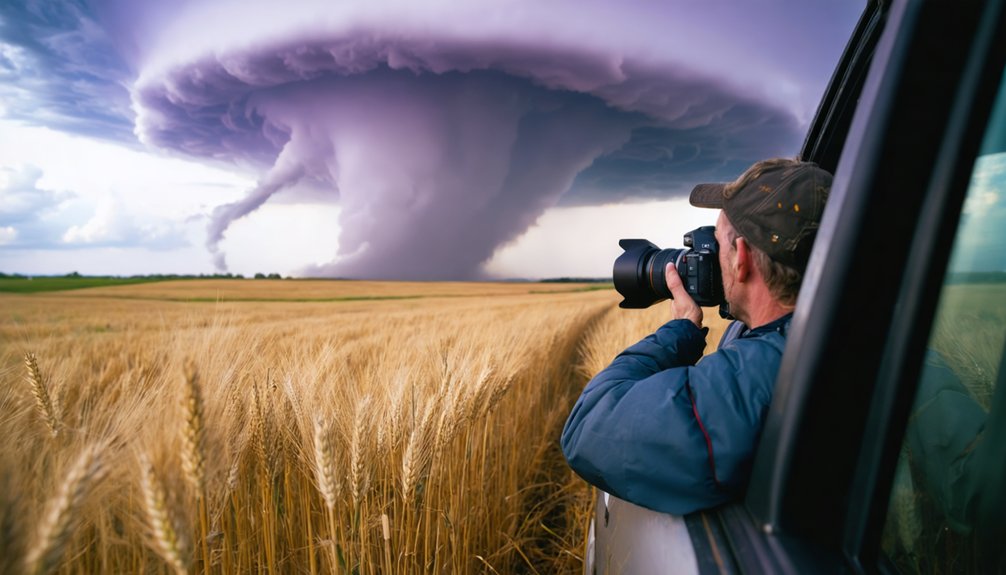
Storm chasing occupies a distinctive position in the spectrum of extreme outdoor pursuits, with risk metrics that challenge conventional assumptions about adventure sport dangers.
Storm chasing defies traditional adventure sport risk categories, presenting danger profiles that contradict common perceptions about extreme outdoor activities.
Comparative Risk Analysis:
- Skydiving: 1 fatality per 154,929 jumps versus storm chasing’s uncertain person-days calculation
- Skiing: 1 death per 944,444 person-days, likely exceeding chase-related mortality rates
- Technical climbing and scuba diving: Generally register higher fatality frequencies than documented chase incidents
- Whitewater rafting: 50 annual deaths, mainly among unguided participants
Your primary threat isn’t the tornado—it’s vehicular operation during severe weather while mastering situational awareness across multiple data streams. Unlike fixed-location adventures, you’re constantly traversing ethical dilemmas: intercept proximity versus safety margins, data collection versus self-preservation. This mobility-dependent pursuit demands meteorological expertise, split-second forecasting, and disciplined risk assessment that separates competent chasers from casualties.
The Personal Drive: Adventure Meets Purpose
Your motivation to chase storms likely stems from a convergence of physiological arousal-seeking behaviors and goal-directed purpose rather than reckless risk-taking alone. Research indicates that participants engage in this high-sensation activity to develop meteorological expertise through empirical observation while simultaneously experiencing the psychological rewards of voluntary challenge navigation.
This dual framework—where adrenaline response mechanisms intersect with professional skill development and community belonging—defines the contemporary storm chasing profile documented across recreational and scientific cohorts.
Adrenaline and Challenge Seeking
Although risks accompany severe weather pursuit, psychological research demonstrates that storm chasers primarily exhibit sensation-seeking traits rather than pure risk-taking behavior. You’re driven by adrenaline fueled exploration of novel, intense experiences where nature driven escapism meets intellectual challenge.
Sensation-seeking scales consistently differentiate you from general populations through specific behavioral patterns:
- Challenging experiences that integrate emotional, intellectual, and adventurous engagement simultaneously
- Atmospheric phenomena that evoke profound feelings of being alive during successful intercepts
- Immersion in natural forces providing aesthetic, creative, and spiritual dimensions unmatched by conventional activities
- Learning objectives where storms function as atmospheric teachers delivering insights into weather dynamics
Your pursuit transcends simple thrill-seeking—it’s multifaceted satisfaction from confronting nature’s mind-boggling power while maintaining freedom from personal limitations.
Building Professional Storm Expertise
While sensation-seeking drives initial tornado intercepts, transforming your passion into professional expertise requires systematic skill acquisition across meteorological theory, field operations, and emergency response protocols.
You’ll need practical hands-on training through SKYWARN spotter programs and field mentorships with experienced chasers who’ll teach radar interpretation, velocity products analysis, and real-time decision-making under pressure. Collaboration with meteorologists through National Weather Service networks enables you to relay critical observations that formulate advanced warnings and prevent casualties.
Master mesoscale analysis using MetEd’s satellite and radar modules, then apply your knowledge as field assistants collecting atmospheric data. CPR certification addresses lightning risks, while superb driving skills guarantee safe navigation through hazardous conditions.
This systematic approach converts adrenaline pursuits into meaningful contributions toward public safety and severe weather research.
Real-time collaboration mechanisms include:
- Livestream broadcasts reaching tens of thousands of simultaneous viewers during active severe weather events
- Minute-by-minute meteorological updates distributed across YouTube, Facebook, and TikTok networks
- Comparative documentation analysis enabling data-driven tornado formation research
- Cross-background participation integrating meteorologists, weather enthusiasts, and independent observers
This collaborative information-sharing network extends storm chasing’s impact beyond individual documentation. You’re not merely pursuing tornadoes independently—you’re contributing observational data to collective scientific understanding while participating in voluntary risk-taking culture that values firsthand confrontation with nature’s extremes.
Frequently Asked Questions
What Equipment and Technology Do Storm Chasers Typically Use in the Field?
You’ll deploy weather monitoring devices like mobile Doppler radars, anemometers, and lightning detectors alongside advanced communication systems including satellite messengers and ham radios. RadarScope Pro, high-resolution cameras, and 4WD vehicles complete your essential field toolkit.
How Much Does It Cost to Start Storm Chasing as a Hobby?
You’ll need $5,000-$8,000 initially for equipment costs including cameras, weather instruments, and vehicle modifications. Safety precautions require radar subscriptions ($100/year), communication devices, and emergency supplies. Annual operational expenses exceed $10,000 with mileage and accommodations.
What Training or Certifications Are Recommended Before Chasing Storms Independently?
You’ll need SKYWARN certification for hazardous weather assessment and necessary risk management skills. Complete NWS spotter training, study convective meteorology fundamentals, and consider amateur radio licensing. These qualifications guarantee you’re equipped to chase independently and safely.
How Do Storm Chasers Coordinate With Emergency Services During Severe Weather Events?
You’ll coordinate through emergency response protocols by reporting directly to National Weather Service and local Emergency Managers, while weather data sharing occurs via amateur radio networks. This enables real-time ground truth validation of radar signatures for timely warnings.
What Legal Restrictions Exist for Storm Chasing in Different States or Regions?
You’re traversing uncharted territory—most states lack storm chasing restrictions. Oklahoma’s Bill 158 proposes licensing for closed-area access, affecting mobile radar unit regulations and local tornado warning protocols. You’ll face background checks, insurance requirements, and potential $500 fines if enacted.