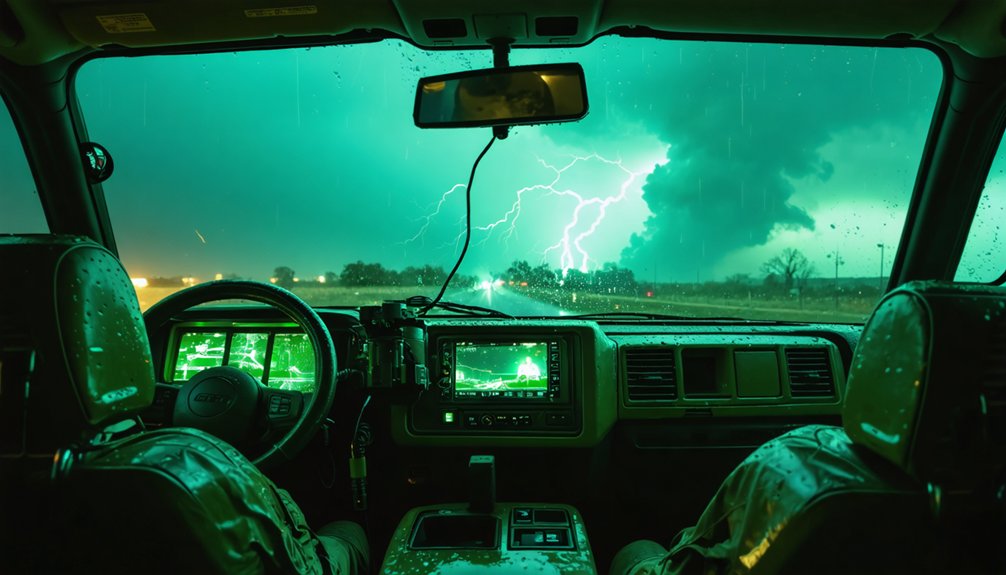
Multi-functional tools consolidate your storm-chasing equipment into weather-hardened devices that’ll reduce vehicle load, stretch your budget, and maintain critical connectivity where cellular networks collapse. You’ll preserve cargo space while ensuring communication redundancy through combined GPS, satellite, and cellular technologies—eliminating single-point failures during close-proximity intercepts. These integrated systems transform raw atmospheric variables into tactical decisions for pressure gradients, lightning strikes, and wind shifts, maximizing your operational freedom without compromising safety margins when conditions deteriorate rapidly.
Key Takeaways
- Multi-functional tools reduce equipment weight and bulk, enhancing mobility during rapid storm intercepts and tactical repositioning.
- Consolidating sensors and communication systems stretches budgets while maintaining essential data acquisition and safety capabilities.
- Integrated devices minimize single-point failures by combining cellular boosters, satellite communication, and GPS tracking in unified systems.
- Multi-functional weather instruments transform raw atmospheric data into actionable tactical decisions for safe positioning and risk assessment.
- Combined technologies maximize operational freedom while preserving safety margins through redundant communication and threat detection protocols.
Withstanding Extreme Weather During Active Pursuits
When storm chasers venture into severe weather environments, their equipment must withstand conditions that routinely destroy consumer-grade electronics. You’ll need waterproof construction that handles heavy rain and flooding, while drop-tested designs survive turbulent vehicle impacts. Improving shock absorption becomes critical when hail and debris strike at velocities exceeding 100 mph.
Maintaining physical durability requires corrosion-resistant materials and sealed housings that prevent dust infiltration along storm paths. Your gear must endure wind forces equivalent to 200 mph while preserving operational integrity.
Extreme temperature variations demand components that won’t fail during rapid atmospheric shifts. This durability isn’t optional—it’s essential for capturing meteorological data when conditions intensify. Your freedom to pursue severe weather depends on equipment engineered to function precisely when conventional devices fail catastrophically.
Reducing Equipment Load Without Sacrificing Capability
While ruggedized equipment guarantees survival in hostile atmospheric conditions, operational efficiency deteriorates when storm chasers carry redundant systems across multiple platforms. Multi-functional integration addresses this constraint through consolidated technology.
GPS-enabled radar applications merge navigation and precipitation analysis into single hand device operability, eliminating separate tablets for tracking functions. Cellular boosters combined with satellite communication systems reduce rooftop antenna configurations while maintaining connectivity redundancy. Weather instrument suites consolidate temperature, wind speed, and barometric sensors into unified roof installations rather than distributed mounting points.
This consolidation strategy achieves minimizing electronics weight without compromising data acquisition capabilities. You’ll maintain full meteorological monitoring, real-time communication, and navigational precision through streamlined equipment arrays. The reduced physical burden translates to enhanced mobility during rapid intercept scenarios, allowing faster deployment positioning without sacrificing observational or safety infrastructure.
Stretching Your Budget Across Essential Technologies
Although atmospheric research demands sophisticated instrumentation, strategic procurement guarantees operational capability within constrained financial parameters. You’ll maintain functional readiness through personal budgeting strategies that prioritize essential technologies: $153.28 baseline deployments combine radar access ($9.99 RadarScope), weather monitoring ($33.71 La Crosse radio), and connectivity infrastructure.
Power independence requires 24,000 mAh battery banks supporting extended field operations without grid dependency.
Your financial autonomy increases through low cost repair options—DIY laptop mounts ($15) replace commercial systems exceeding $100, while RAM mounting platforms transfer across vehicle platforms. Tour participation ($1,500 four-day packages) distributes fuel, lodging, and insurance costs across multiple operators.
Data redundancy protocols combining Starlink mobility systems with dual-carrier hotspots confirm continuous telemetry acquisition during precipitation attenuation events. Optional GRLevel3 software ($79.95) remains discretionary until operational experience justifies advanced analytical requirements.
Maintaining Connectivity Where Cell Towers Are Sparse
Strategic equipment investment loses operational value without reliable connectivity infrastructure in the remote deployment zones where severe convective systems develop. You’ll need cellular signal boosters like WeBoost Drive Reach with magnetic mount antennas to achieve ideal signal coverage when towers are 30+ miles distant.
Deploy multiple carrier hotspots—Verizon Jetpack MiFi 8800L paired with AT&T devices—ensuring consistent data throughput through automatic tower switching. Bonding solutions from ISPTek combine cellular and Starlink satellite into unified connections with seamless failover capability.
This redundancy architecture delivers mission-critical radar access, real-time video transmission to stations, and emergency communication channels. Without these systems, you’re operating blind during critical intercept phases.
The freedom to pursue developing mesocyclones anywhere requires eliminating single-point connectivity failures that compromise both operational effectiveness and life-safety margins.
Protecting Yourself and Your Team in Dangerous Situations
Storm chasing exposes you to multiple simultaneous hazards—lightning strikes, hail cores, flash flooding, and tornadoes—requiring layered detection systems that monitor threats in real time.
You’ll need integrated radar analysis, lightning detection networks, and atmospheric electric field meters to quantify danger levels within your immediate vicinity. Dependable location-sharing protocols and redundant communication channels safeguard your team’s situational awareness even when cellular infrastructure fails during severe convective events.
Real-Time Threat Detection Systems
Modern tornado detection relies on sophisticated algorithms and advanced radar technologies that process atmospheric data in real-time to identify imminent threats. NTDA’s machine learning evaluates dual-polarization radar criteria, calculating tornado probability for each detection with operational precision.
You’ll access super-resolution Level II data through RadarScope, delivering NEXRAD updates that reveal visual storm signatures like hook echoes at 99 percent reliability. Phased array radar scans complete storm structures in under 60 seconds, exposing developing tornado indicators before traditional systems detect them.
Mobile Threat Net ingests radar updates every five minutes via XM antenna, enabling automated threat detection under 60,000-foot towering cumulus. These integrated systems provide the same data velocity National Weather Service forecasters receive, empowering you with real-time threat identification capabilities essential for independent storm observation and rapid tactical decisions.
Location Sharing and Communication
Advanced detection systems prove ineffective when communication infrastructure collapses during severe weather events. You’ll need signal diversity through multi-carrier mobile phones, satellite communicators like Garmin inReach Mini 2, and GMRS radios to sustain operational connectivity.
Transmission range optimization requires combining cellular boosters, two-way radios, and satellite internet devices such as Starlink for unrestricted data access.
Deploy redundant GPS location sharing systems including ZOLEO Satellite Communicator and dedicated terminals that transmit coordinates independent of terrestrial networks. When pursuing storms autonomously, you’re free from reliance on single-point infrastructure failures.
Satellite-enabled SOS capabilities provide emergency signaling with precise positioning data, while high-frequency radios enable direct team coordination. Multi-carrier hotspots from Verizon and AT&T maintain continuous meteorological data reception.
This layered communication architecture preserves your operational independence throughout severe weather encounters.
Lightning and Field Monitoring
Atmospheric electricity poses lethal risks that demand predictive monitoring rather than reactive detection. You’ll need systems like Thor Guard that measure atmospheric static electricity before lightning strikes occur, providing critical warning time unavailable through traditional detection networks. Electric field monitoring devices such as the Boltek EFM-100 identify high-voltage conditions up to 24 miles away, enabling shelter-seeking decisions before electrical discharge manifests.
Lightning prediction capabilities distinguish these tools from delayed-response systems—you’re tracking electromagnetic field gradients rather than waiting for confirmed strikes. Long-range Boltek detectors extend your situational awareness to 300 miles, while real-time data integration through RadarScope Pro delivers thorough threat assessment. Professional operations including SpaceX utilize identical technology at Cape Canaveral, validating field-proven reliability for autonomous storm-chasing missions.
Documenting Storms Across Multiple Media Formats
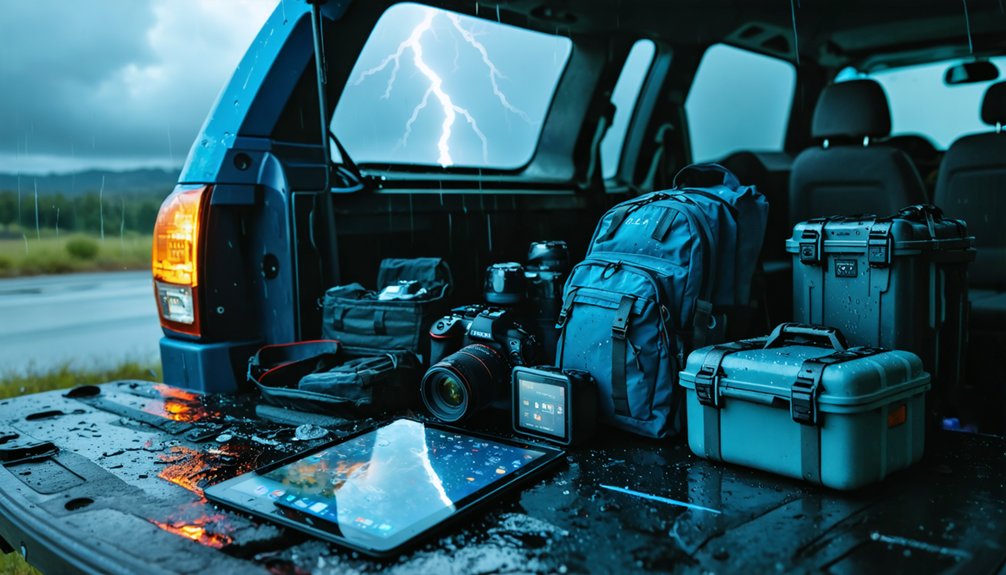
When storm chasers encounter severe weather phenomena, they capture multi-format data streams that serve both operational and scientific purposes. You’ll integrate probe telemetry, rapid-scan radar observations, and high-resolution video footage into cohesive documentation that demands no institutional gatekeeping.
Storm chasers merge telemetry, radar scans, and video into accessible scientific documentation requiring no institutional approval or credentials.
Data aggregation occurs through platforms like Storm Assist and Spotter Network, where you’ll upload timestamped images and videos alongside precise geographic coordinates. Your reports must specify event location distinct from observer position—critical for warning verification.
Digital Atmosphere enables NEXRAD archiving for qualitative analysis of tornadogenesis sequences. You’re documenting WHAT occurred, WHERE it happened, WHEN it developed, plus duration and damage metrics.
Scientific papers now routinely incorporate crowd-sourced chaser videography with dual-polarization radar data, validating your field observations as essential research contributions that bypass traditional academic barriers.
Simplifying Vehicle Integration and Portability
Storm chasing vehicles transform into mobile data platforms through systematic integration of instruments, cameras, and computing hardware that must withstand vibration, thermal extremes, and rapid deployment cycles. Secure vehicle integration eliminates equipment sprawl through centralized laptop trays, dash-mounted DSLRs, and hard-wired Blackvue DR750X-2CH cameras that maintain operational readiness.
RAM Mounts Twist-Lock suction cups and universal action camera adapters enable rapid mount deployment across sedans, 4WD vehicles, and SUVs without permanent modification. You’ll achieve quick device extraction in supercell environments using Manfrotto quick-release systems and reusable base plates.
Roof-mounted anemometers with GPS data loggers subtract vehicle movement for accurate measurements, while organized tablet and phone mounting prevents tangled wires and device damage during high-speed intercepts on unpaved rural roads.
Maximizing Data Collection in Limited Time Windows
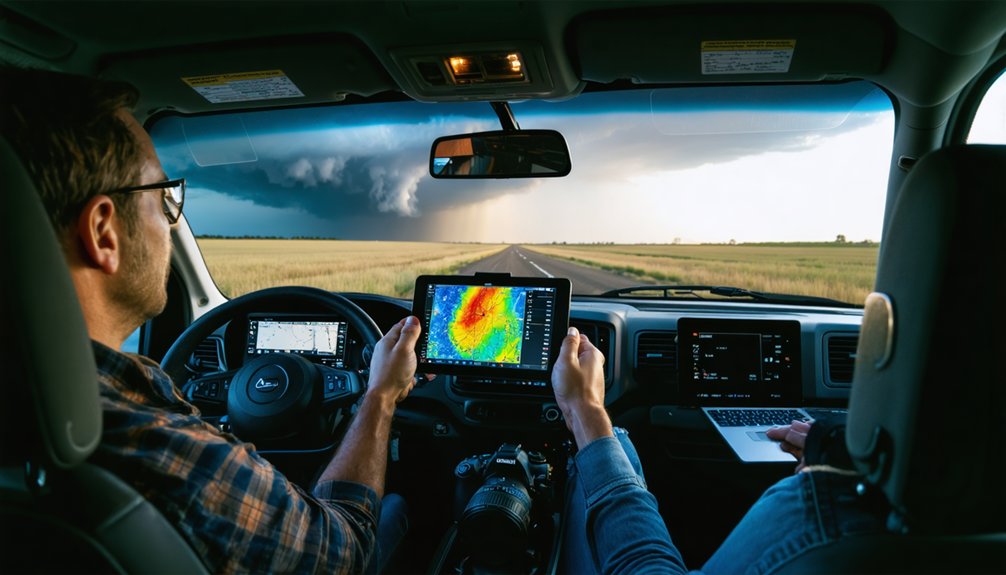
Once vehicle systems achieve operational readiness, the temporal constraints of supercell lifecycles—often measured in mere minutes between mesocyclone formation and tornadogenesis—demand orchestrated deployment of complementary sensing technologies.
Supercell lifecycles compress critical decision windows into minutes, requiring immediate coordination of multiple sensing platforms across rapidly evolving atmospheric conditions.
Maximizing measurement integration requires you to coordinate phased array radar‘s sub-minute scanning with dual-Doppler networks mapping circulation at multiple altitudes simultaneously. You’ll position mobile units strategically, placing instrumented pods in tornado paths while drones penetrate storm cores for real-time atmospheric profiling.
Leveraging technological synergies means coupling rapid-scan dual-polarization data with weather balloon temperature gradients and crowd-sourced videography to validate circulation signatures instantly. Machine learning algorithms process multi-radar MRMS data streams, generating tornado probability assessments that liberate you from computational delays.
This synchronized approach captures complete storm evolution—wind, temperature, humidity, pressure—enabling autonomous decision-making when seconds determine mission success.
Ensuring Redundancy When Primary Systems Fail
When primary storm data collection systems fail during severe weather events, your mission-critical operations depend on pre-established redundancy protocols across three core infrastructure domains.
You’ll need backup internet connectivity through dual-carrier configurations (fiber/LTE or satellite failover), redundant power architectures combining UPS systems with generator capacity, and parallel communication networks utilizing UCaaS platforms or alternative radio systems.
These layered redundancies eliminate single points of failure that cause 43% of weather-related operational outages, ensuring continuous data acquisition throughout storm intercepts.
Backup Internet Connection Options
Multiple redundant Internet connection pathways form the critical backbone of reliable storm chasing operations, as single points of failure can eliminate data transmission capabilities during the most essential observation periods. ISP redundancy through dual-WAN routers enables automatic failover between fiber, cable, and DSL providers without manual intervention.
Dual carrier connectivity amplifies resilience—pairing terrestrial services with cellular options like Cradlepoint routers or 5G/4G LTE networks that leverage tower battery backups during infrastructure failures. Starlink satellite systems ($349 hardware, $120 monthly) provide location-independent connectivity requiring only power and clear sky access.
Bonding solutions such as ISPTek’s storm chaser packages ($20-$250 monthly) achieve packet-level aggregation across multiple carriers, delivering 1-5Mbps streams sufficient for 720p-1080p transmission from remote locations. You’ll maintain operational autonomy when conventional networks collapse.
Redundant Power Supply Systems
Power failures during critical storm intercepts can knock out entire observation capabilities within seconds, making redundant electrical architectures non-negotiable for professional chase operations. You’ll need dual air suspension systems backing primary configurations, while custom electrical buses distribute load across antennas, drone networks, and satellite uplinks.
EcoFlow Delta Pro units deliver portable power conversion monitoring when vehicle systems fail, and Anker 737 PowerCore banks (24,000 mAh) prevent equipment brownouts during multi-day deployments. Battery life indicators track discharge rates across weather instruments and imaging arrays.
Your 2026 OTUS vehicle upgrades should integrate these backups with 6×4 drivetrains and secure communications infrastructure. SwRI-designed aircraft meteorology systems demonstrate how isolated power architectures eliminate electromagnetic interference while maintaining data collection continuity through violent convective phenomena.
Dual Device Communication Networks
Storm prevention protocols and managed switches prevent broadcast storms while SDN controllers intelligently redirect traffic around compromised segments.
Adapting Quickly to Changing Storm Environments
When convective dynamics shift unexpectedly, you’ll need tools that deliver actionable data within seconds rather than minutes. Real-time radars like RadarScope Pro display mesocyclone rotation and lightning strikes simultaneously, enabling rapid threat assessment while coordinating field reconnaissance.
Kestrel 5700 meters log pressure gradients and wind shifts that signal intensification, giving you quantifiable metrics for balancing risk versus reward during close-proximity intercepts. Satellite communicators like Garmin inReach Mini 2 maintain GPS tracking when cellular networks collapse, preserving your escape route intelligence.
Cellular boosters such as WeBoost Drive Reach Overland sustain radar connectivity on remote rural roads where towers are sparse. Portable lightning detectors provide strike-distance calculations that inform safe positioning thresholds. This integrated toolkit transforms raw atmospheric variables into tactical decisions, maximizing your operational freedom without compromising safety margins.
Frequently Asked Questions
How Do I Choose Between Kestrel 5500 and Competing Weather Meters?
Choose the Kestrel 5500 by evaluating portable weather sensors’ measurement accuracy, data logging capacity, and high altitude monitoring capabilities. You’ll need superior environmental parameter integration, rugged construction ratings, and wireless connectivity that competing meters can’t match for independent field operations.
What Insurance Coverage Protects Multi-Functional Storm Chasing Equipment From Damage?
“Better safe than sorry”—you’ll need thorough equipment coverage with specialized calibration services protection. This policy safeguards your multi-functional meteorological instruments against weather-related damage, theft, and transit losses, ensuring your storm-chasing operations remain uninterrupted and financially secure.
Which Certification or Training Programs Teach Proper Multi-Functional Tool Deployment?
You’ll find field-specific training through SKYWARN’s meteorological protocols and Gabe Garfield’s masterclass, which emphasizes chase-day deployment techniques. NWS offers hands-on workshops for damage assessment toolkit integration, while MetEd provides standardized sensor operation fundamentals for autonomous field operations.
How Often Should Multi-Functional Devices Be Calibrated for Accurate Measurements?
You’ll need annual calibration for storm chasing due to harsh environmental impact factors like extreme weather exposure. Proper calibration intervals guarantee measurement accuracy when drift occurs from humidity, temperature fluctuations, and rugged field conditions affecting your multi-functional devices’ performance.
Can Multi-Functional Tools Interface With University Research Data Collection Networks?
Yes, you’ll find multi-functional tools seamlessly interface with university networks through real-time data integration protocols. Remote monitoring capabilities let you transmit atmospheric measurements wirelessly, enabling independent field operations while contributing valuable datasets to collaborative research platforms autonomously.