For storm chasing, you’ll need a dedicated NOAA weather radio tuned to VHF frequencies between 162.400 and 162.550 MHz—something standard AM/FM radios can’t access. Top picks for 2026 include the Midland ER310PRO, C. Crane Skywave, and Midland WR400, each offering SAME county-level programming, multiple power sources, and loud alert tones that cut through field noise. Keep exploring to find the exact setup that keeps you informed when conditions turn dangerous.
Key Takeaways
- The Midland ER310PRO offers three power sources, strong NOAA alerts, and a built-in flashlight, making it ideal for storm chasers.
- SAME programming lets chasers filter county-specific alerts, ensuring only relevant warnings trigger along the storm’s path.
- Standard AM/FM radios cannot receive NOAA’s dedicated 162.400–162.550 MHz VHF frequencies, making a dedicated emergency radio essential.
- Battery backup options, including solar and hand-crank, keep radios operational when grid power and charging access are unavailable.
- The C. Crane Skywave combines NOAA weather alerts with shortwave and air traffic reception, offering broad situational awareness in the field.
Why Regular Radios Fail Storm Chasers When It Matters Most
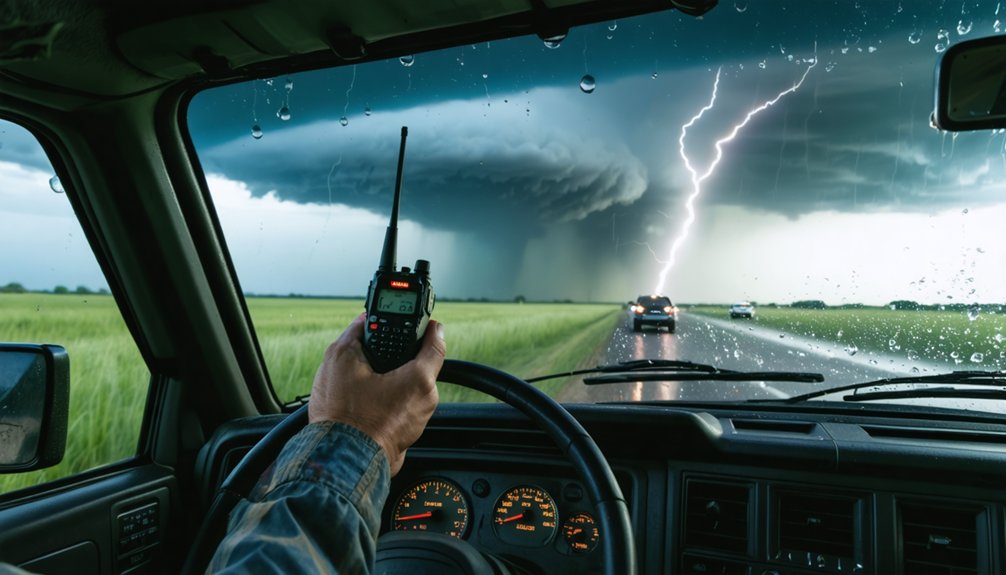
When you’re chasing a tornado-warned supercell, a standard AM/FM radio won’t cut it. Regular broadcast stations can’t receive NOAA Weather Radio frequencies, which operate on dedicated VHF bands between 162.400 and 162.550 MHz. That gap in weather detection leaves you blind to National Weather Service warnings the moment conditions escalate.
Standard AM/FM radios can’t receive NOAA Weather Radio frequencies — leaving chasers blind when conditions escalate.
Signal interference compounds the problem. Electrical activity from nearby lightning, heavy precipitation, and terrain features all degrade standard broadcast reception. You’ll lose the signal exactly when you need it most.
NOAA-dedicated emergency radios bypass these vulnerabilities entirely. They receive continuous hazard transmissions directly from NWS transmitters, activate automatically in alert mode, and don’t depend on local broadcast infrastructure.
For chasers operating independently in the field, that distinction isn’t a preference — it’s a tactical necessity.
Home Station vs. Field Unit: Choosing the Right Radio Type First
Knowing your radio fails on standard AM/FM bands is only half the equation — the other half is matching the right emergency radio type to your actual use case before you buy.
Home stations prioritize fixed antenna placement and wall power for maximum alert sensitivity.
Field units demand portability, backup power, and rugged durability.
- Home base: Midland WR120 or WR400 — AC-powered, SAME-programmable, wall-mountable
- Field/mobile: Midland ER310 — three power sources, portable, loud alerts
- Backpacking: Midland ER210 — compact, lightweight, trail-ready
- Budget field option: RadioShack Portable Multi-Band Radio — affordable NOAA reception
- Broad-coverage portable: C. Crane Skywave — weather, shortwave, and air traffic combined
Choose your deployment environment first. Your radio type determines everything downstream.
SAME, Battery Backup, and the Features That Actually Matter in the Field
Once you’ve matched your radio type to your deployment environment, the specific features you prioritize within that category will determine whether your unit performs when conditions deteriorate.
Matching your radio to the environment is step one. Prioritizing the right features is what keeps you alive in step two.
SAME programming delivers weather alert customization at the county level, filtering irrelevant broadcasts and surfacing only the warnings that affect your exact position. That precision matters when you’re repositioning fast and can’t afford alert fatigue.
Radio signal strength separates functional units from failures when you’re deep in a storm corridor with degraded atmospheric conditions.
Battery backup—ideally combining rechargeable cells, hand-crank generation, and solar input—keeps your unit operational when grid power and vehicle charging both fail.
Loud, attention-grabbing alert tones cut through wind and rain.
Prioritize these specs over brand loyalty, and you’ll have a radio that actually protects you.
Best NOAA Emergency Radios for Storm Chasers in 2026
Choosing the right NOAA emergency radio in 2026 comes down to a short list of tested models that consistently deliver on alert reception, backup power, and field durability. Signal clarity and emergency power resilience separate reliable tools from gear that fails when conditions turn dangerous.
- Midland ER310PRO – Three power sources, strong NOAA alert mode, built-in flashlight
- C. Crane Skywave – NOAA weather alerts plus shortwave and air traffic reception
- Midland WR400 – SAME programming for county-specific targeting
- RunningSnail Emergency Crank Radio – Best portable option for fast repositioning
- Midland ER210 – Compact backpacking build with dependable alert reception
Each model earns its place through verified performance criteria: alert activation speed, emergency power runtime, audibility under severe conditions, and portability you can actually use in the field.
How to Program and Position Your Radio Before a Chase
Getting your radio dialed in before you leave the staging area is as critical as any other pre-chase checklist item. Program SAME codes for every county along your projected storm path, not just your starting location. Conditions shift fast, and county-specific alerts won’t fire if you haven’t pre-loaded the relevant FIPS codes.
Set your alert volume to maximum before you’re inside the vehicle. Wind, rain, and engine noise will swallow a weak alarm before it reaches you. Test it.
For antenna placement, mount externally if your radio supports it, positioning it away from metal obstructions that degrade signal reception. A dash-mounted internal antenna is a fallback, not a preference. Lock your settings, verify alert mode is active, and roll out confident.
Frequently Asked Questions
Can Emergency Weather Radios Receive Alerts Outside the United States?
Like a traveler crossing borders, your radio’s international compatibility isn’t guaranteed. NOAA alerts are U.S.-specific, so you’ll need devices supporting global alert systems to receive warnings outside the United States effectively.
How Loud Are NOAA Alert Tones on Dedicated Emergency Weather Radios?
Dedicated emergency weather radios produce loud, attention-grabbing alert tones designed to cut through wind and vehicle noise. You’ll find alert volume on quality units reaches levels that guarantee you never miss a critical weather frequency warning.
Are Weather Radios Waterproof Enough for Use During Active Storms?
Like a trusted field tool, most dedicated emergency radios offer splash resistance, not full waterproofing. For storm preparedness, you’ll want to prioritize radio durability by choosing models with weather-resistant housing and keeping them shielded during active storms.
Can Two Chasers Share One Radio Signal Across Separate Vehicles?
You can’t share one radio signal across separate vehicles for real-time vehicle communication. Each chaser needs their own dedicated receiver to independently capture NOAA broadcasts, ensuring you both receive critical radio signal sharing simultaneously without dependency.
How Often Should Emergency Weather Radio Batteries Be Replaced or Tested?
Test your battery maintenance routine monthly and replace batteries annually. You should verify all power sources—including backup batteries—before every chase, ensuring your radio’s ready when severe conditions demand immediate, reliable alert reception.
References
- https://www.nytimes.com/wirecutter/reviews/best-emergency-weather-radio/
- https://gearjunkie.com/technology/best-emergency-radio
- https://www.amazon.com/Best-Sellers-Weather-Radios/zgbs/electronics/6893245011
- https://www.weather.gov/mob/nwrhelp
- https://www.cnn.com/cnn-underscored/reviews/best-emergency-radios
- https://fieldandstream.com/outdoor-gear/camping-and-outdoor-rec/camping-gear/best-weather-radios
- https://www.bobvila.com/articles/best-emergency-radio/
- https://thegoodatheist.net/best-noaa-weather-alert-radios/
- https://midlandusa.com/collections/emergency-pro
- https://theprepared.com/gear/reviews/emergency-radio/