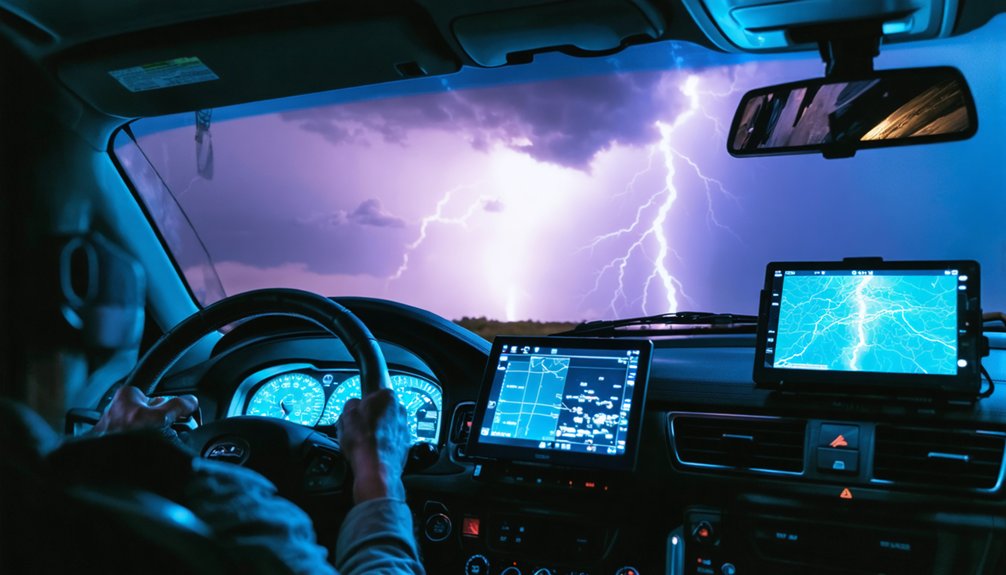
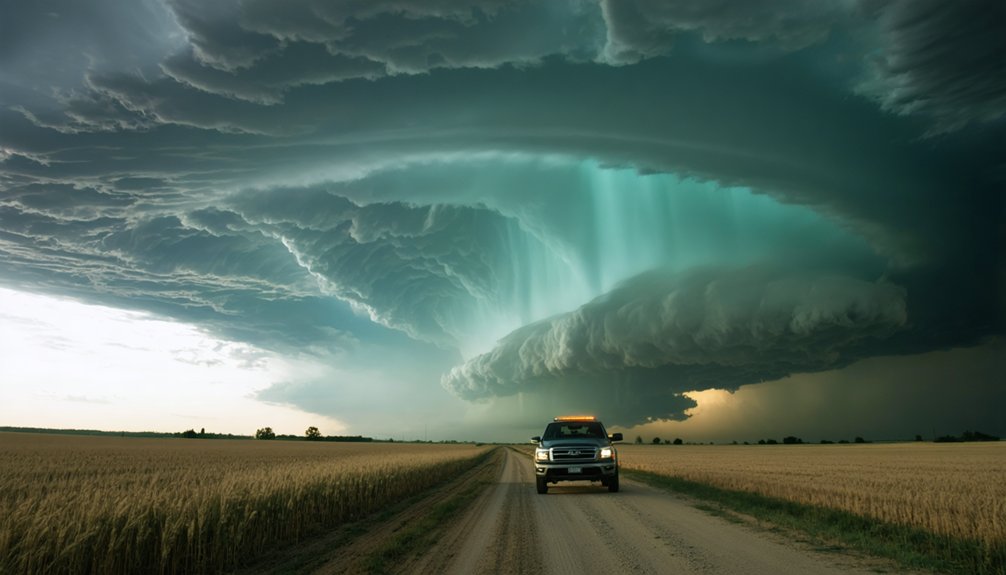
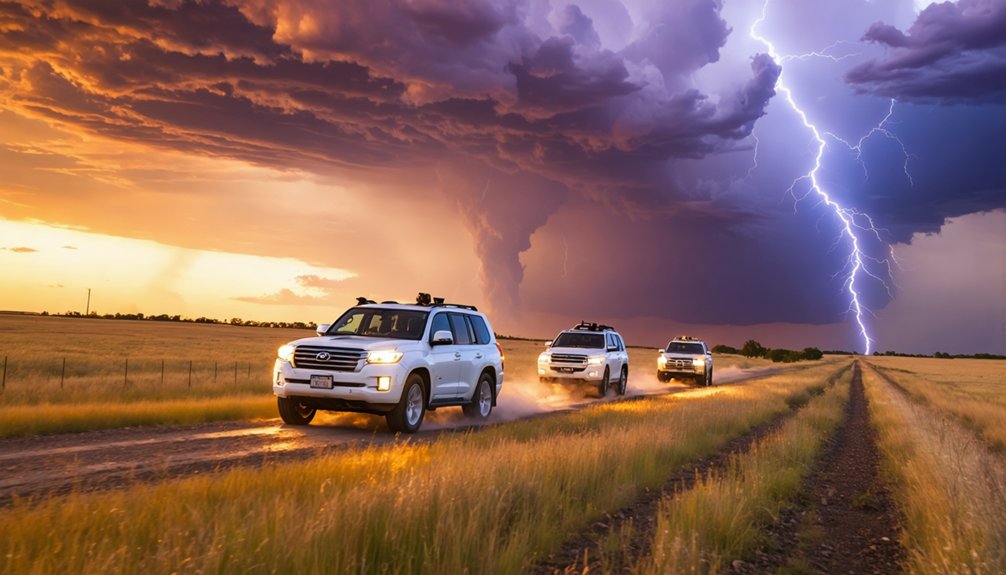
Storm chaser reality shows are popular because they combine authentic scientific credibility with psychological unpredictability. You’re watching real meteorologists interpret live radar, deploy field probes, and analyze CAPE data under genuine atmospheric pressure. The outcomes are never scripted—a storm can produce an F5 tornado or collapse entirely—triggering the same variable-ratio reinforcement that makes gambling compelling. Add viral social media amplification and parasocial bonds with recurring chasers, and you’ve got a format that’s nearly impossible to replicate. There’s much more driving this phenomenon beneath the surface.
Key Takeaways
- Storm chasing footage captures real, unscripted atmospheric events, creating authentic high-stakes content that scripted shows cannot replicate.
- Unpredictable weather outcomes generate psychological tension similar to variable-ratio reinforcement, keeping viewers consistently engaged and returning.
- Recurring storm chasers develop parasocial bonds with audiences, driving emotional investment and long-term viewer loyalty.
- High-contrast visuals like rotating funnels and lightning perform strongly on streaming platforms, enabling rapid viral sharing and reach.
- Real-time scientific analysis, including radar interpretation and probe deployment, adds technical credibility that elevates the format beyond pure spectacle.
The Raw Appeal of Storm Chasing Footage
Storm chasing footage succeeds where scripted television can’t compete: the weather doesn’t follow a script, and that unpredictability is exactly what drives viewer engagement.
You’re watching real atmospheric mechanics unfold — rotating supercells, golf-ball hail, and ground-scraping funnels that no production budget can replicate.
Real atmospheric mechanics don’t answer to a budget — supercells, hail, and ground-scraping funnels simply can’t be faked.
The aesthetic contrast between an eerie green sky and a violent, churning vortex creates visual tension that holds your attention without manufactured drama.
Sound design amplifies this further; the shift from dead silence to freight-train-level roar signals danger your nervous system responds to instinctively.
These aren’t staged moments — they’re high-stakes meteorological events captured in real time.
That authenticity removes the psychological distance between viewer and event, making the footage feel immediate, uncontrollable, and genuinely consequential.
You can’t look away because the outcome is never guaranteed.
Why Uncertainty Makes Storm Chaser Shows Addictive
Unlike scripted reality formats where producers engineer tension through editing and casting conflict, storm chaser shows derive their suspense from a variable that no writer controls: atmospheric behavior.
Weather prediction operates within probability ranges, never certainties. A supercell you’re tracking might dissipate, rotate violently, or produce a photogenic wedge tornado ideal for storm photography — you won’t know which until it happens.
That unpredictability transfers directly to your viewing experience. You’re watching real-time decision-making under genuine meteorological pressure, where chasers interpret radar data, wind shear measurements, and cape values without a guaranteed outcome.
No script protects them. That cognitive tension — knowing conditions exist for a significant event but lacking confirmation — mirrors exactly what behavioral researchers identify as variable-ratio reinforcement, the same mechanism that makes outcomes feel compulsively worth waiting for.
How *Twister* and *Storm Chasers* Created a Cultural Obsession
Together, these two properties built a feedback loop: media exposure drove participation, participation generated more footage, and more footage sustained demand.
What began as niche science became a mainstream cultural fixture you could follow across seasons.
Why Life-or-Death Risk Keeps Storm Chasing Audiences Watching
What makes storm chasing television uniquely gripping isn’t just spectacle—it’s that the risk is unscripted and quantifiable. When you watch a crew position within a quarter-mile of a wedge tornado, your brain processes genuine threat, not manufactured drama.
That risk perception activates the same neurological response as direct danger—cortisol spikes, attention sharpens, and disengagement becomes difficult.
That risk perception triggers real neurological responses—cortisol spikes, attention sharpens, and disengagement becomes nearly impossible.
The adrenaline rush you experience as a viewer mirrors what chasers report in the field. Research on extreme-risk media consistently shows that audiences sustain higher engagement when outcomes remain statistically uncertain.
Storm chasing delivers exactly that. No script controls whether a tornado shifts toward the crew. That unpredictability functions as a biological hook, keeping you locked into each decision, each intercept, and each narrow escape in real time.
The Real Science That Makes Storm Chaser Shows Feel Legitimate
The danger is what hooks you, but the science is what makes you trust what you’re seeing. Storm chaser shows earn scientific credibility through real meteorological accuracy — not staged drama. You’re watching actual field data collection unfold in real time.
- Chasers reading live radar loops while a supercell rotates overhead
- Deployed weather probes measuring pressure drops inside a tornado’s path
- On-screen forecasters explaining mesocyclone formation using atmospheric models
- Field teams triangulating storm position using GPS and spotter networks
- Scientists documenting hook echoes that confirm rotation before touchdown
That technical layer transforms raw footage into verifiable observation. When you see chasers interpret wind shear data mid-pursuit, you’re not watching entertainment manufactured in a studio — you’re watching meteorological research executed under pressure.
How Social Media Turned Storm Chasing Into a Viral Phenomenon
Before social media scaled storm chasing into a mass-audience phenomenon, footage took days or weeks to reach viewers through news broadcasts or documentary edits. Now, you’re watching a wedge tornado touch down within minutes of it forming.
Before social media, tornado footage took weeks to reach you. Now you’re watching it form in real time.
Platforms reward storm aesthetics algorithmically. High-contrast supercell structures, rotating wall clouds, and lightning strikes generate high engagement metrics, driving rapid distribution. Weather symbolism—nature’s raw, uncontrollable power—resonates with audiences who value freedom from manufactured content.
Live streaming eliminated editorial gatekeepers entirely. You access unfiltered field footage directly from chasers running dual radar displays and dashcam rigs.
Viral mechanics compound reach exponentially; a single dramatic clip can accumulate millions of views within 24 hours.
This distribution model transformed storm chasing from a niche pursuit into a scalable, monetizable media category driven by real-time audience demand.
The Psychology Behind Following the Same Storm Chasers for Years
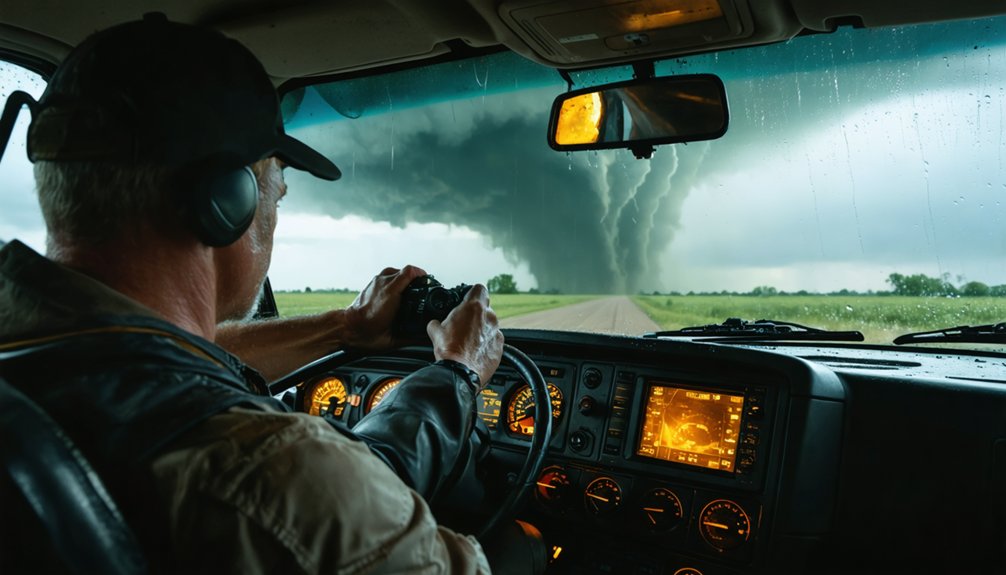
When you follow the same storm chasers across multiple seasons, you form parasocial bonds that function similarly to real relationships, triggering familiarity responses and emotional investment even without direct interaction.
These recurring personalities become narrative anchors, and your brain processes their high-stakes decisions as shared experiences, which compounds loyalty over time.
The element of shared risk intensifies this attachment further, because watching someone repeatedly face life-threatening conditions activates the same threat-response empathy mechanisms that strengthen bonds in real-world relationships.
Parasocial Bonds Build Loyalty
Parasocial relationships form when audiences develop one-sided emotional bonds with media personalities, and storm-chasing reality shows are structurally designed to accelerate this process. You’re not just watching weather—you’re tracking specific people across seasons, building familiarity that mimics real connection.
Celebrity endorsements and audience testimonials reinforce these bonds externally, validating your loyalty to particular chasers.
- A chaser’s hands gripping the wheel as a wedge tornado crosses the highway
- Radar screens glowing green while the team debates intercept routes
- A spotter’s voice breaking when a confirmed EF4 touches down
- Dust and debris walls swallowing the horizon ahead of the vehicle
- Post-chase debriefs revealing exhaustion, relief, and raw human reaction
These recurring micro-moments compound across episodes, converting casual viewers into invested followers who return regardless of storm outcomes.
Recurring Characters Create Attachment
Recurring characters function as cognitive anchors in storm-chasing reality programming, and their effectiveness is measurable in retention data, social engagement, and multi-season viewership patterns.
When you follow the same chasers across seasons, you’re tracking character development alongside meteorological accuracy, which compounds your investment. Producers leverage this by structuring narratives around individual decision-making styles, risk tolerance, and interpersonal conflict.
Research on parasocial attachment confirms that familiarity with recurring figures increases emotional response and return viewership. You don’t just watch the storm—you watch how a specific person navigates it. That distinction drives loyalty.
Named chasers with documented histories and visible expertise create stronger audience bonds than anonymous field teams, because identity persistence gives you something continuous to follow regardless of the storm’s outcome.
Shared Risk Deepens Connection
Why does following the same storm chaser for three consecutive seasons feel qualitatively different from watching a new cast each episode? Shared risk creates psychological investment. You’ve tracked their decisions, absorbed their storm metaphors, and internalized their threat-assessment logic.
Repeated exposure builds parasocial bonds reinforced by genuine danger — not scripted tension.
- Radar screens flickering red and green as supercells rotate overhead
- A chaser’s hands gripping the wheel while hail hammers the windshield
- Lightning illuminating flat plains in sudden, brutal clarity
- Chase vehicles repositioning frantically against shifting weather symbolism — the storm as adversary
- Dust walls consuming the horizon while sirens sound miles away
You’re not observing strangers anymore. You’re reading familiar people against high-stakes atmospheric conditions, which intensifies emotional response and sustains long-term audience retention.
Why Storm Chasing Content Dominates Extreme Weather Media
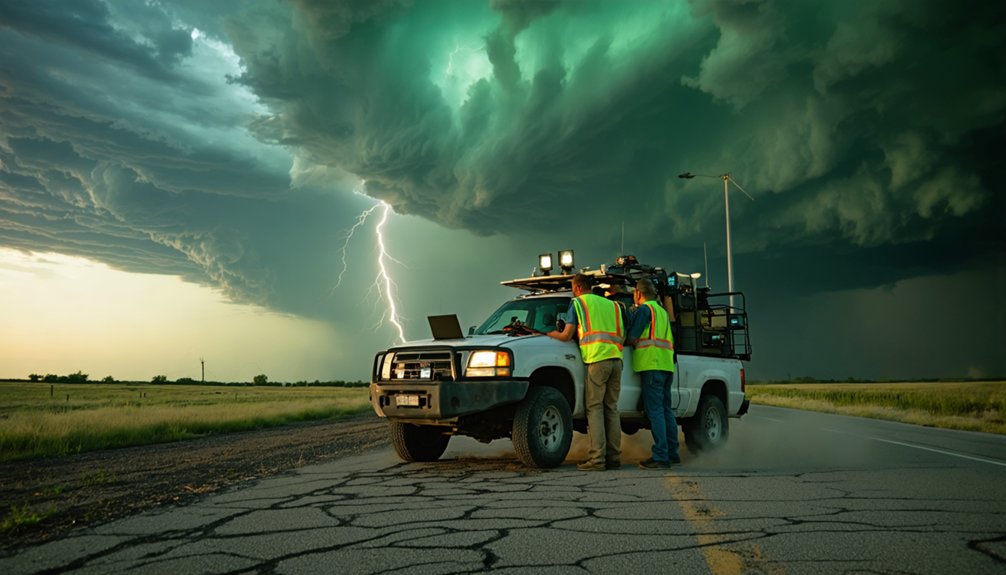
Storm chasing content dominates extreme weather media because it combines unpredictable outcomes, high-stakes visual drama, and technical credibility in a format that’s difficult to replicate.
You’re watching real-time decision-making against systems that carry deep weather symbolism — forces that humanity has never fully controlled or predicted. That tension drives engagement in ways scripted content can’t manufacture.
Storm symbolism amplifies this further. Supercells and tornadoes aren’t just meteorological events; they represent raw, ungoverned power, which resonates with audiences who value autonomy and natural forces over controlled environments.
Streaming platforms and viral mechanics reward dramatic footage instantly, accelerating distribution.
On-screen radar analysis and field forecasting add analytical weight, separating storm-chasing content from pure spectacle.
That combination — scientific structure paired with unscripted danger — is what keeps this format dominant across extreme weather media.
Frequently Asked Questions
Can Storm Chasers Legally Drive Through Active Tornado Warning Zones?
You can legally drive through active tornado warning zones—there’s no federal chasing regulations prohibiting it. You’re responsible for your own tornado safety, as warnings are advisories, not enforced road closures, granting you full autonomous movement.
How Much Money Do Professional Storm Chasers Typically Earn Annually?
You’ll find storm chasing careers rarely guarantee stable income—most earn $25,000–$50,000 annually combining footage sales, tours, and weather forecasting skills. Reliable monetization’s uncommon; you’re fundamentally trading financial security for operational independence and atmospheric freedom.
What Insurance Coverage Do Storm Chasers Carry for Equipment Damage?
You chase freedom, yet you’re bound by risk—insurance policies vary widely. You’ll typically secure equipment protection through inland marine coverage, safeguarding cameras and gear against storm-related damage, theft, and accidents during active chasing operations.
Are Storm Chasing Tour Experiences Available for Members of the Public?
You can book public storm chasing tours through 30+ operators active by 2010. Tour booking procedures vary by provider, so you’ll want to verify storm chasing safety protocols, liability waivers, and meteorological expertise before committing.
How Do Storm Chasers Coordinate With Local Emergency Services During Events?
While coordination isn’t always formalized, you’ll find storm chasers actively engage in storm prediction collaboration and follow emergency communication protocols, sharing real-time data with local agencies via radio networks, keeping response teams informed without compromising your operational independence.
References
- https://en.wikipedia.org/wiki/Storm_Chasers_(TV_series)
- https://stormtrack.org/threads/has-storm-chasing-become-an-entertainment-industry.33186/
- https://www.reddit.com/r/stormchasing/comments/167h5ny/why_are_there_so_many_professional_storm_chasers/
- https://en.wikipedia.org/wiki/Storm_chasing
- https://www.imdb.com/title/tt0907833/
- https://crazystormchasers.com/exploring-evolution-of-storm-chasing-competitions/
- https://hull-repository.worktribe.com/preview/4415817/Hunter_ Nicolle – Storm Chasing in Contemporary American Society and Culture.pdf
- https://www.foxnews.com/science/scientists-warn-storm-chasers-are-hurting-research-causing-danger.print