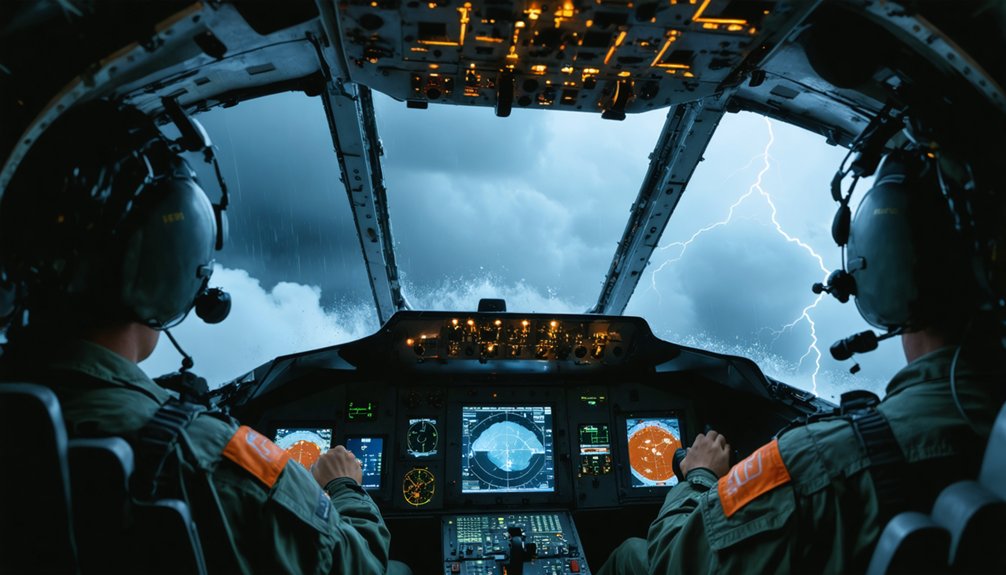
You’ll find Atlantic hurricane research transformed through five pivotal missions: Colonel Duckworth’s 1943 storm penetration near Galveston established reconnaissance protocols, the 1956 National Hurricane Research Project systematized data collection via instrumented aircraft, Hurricane Carla’s 1961 genesis-to-dissipation tracking revolutionized cyclone development understanding, Project STORMFURY’s 1969 Hurricane Debbie seeding experiments achieved 31% wind reduction, and the HURDAT database’s 2013 enhancement validated 150 years of Atlantic records. These campaigns employed progressively sophisticated methodologies—from visual flight techniques to numerical prediction models—that quantified meteorological factors previously considered unmeasurable. Further exploration reveals how these missions established modern tropical cyclone forecasting frameworks.
Key Takeaways
- Colonel Joseph Duckworth’s 1943 Galveston penetration established operational frameworks for hurricane reconnaissance missions using instrumented aircraft.
- Hurricane Carla’s 1961 complete life cycle documentation from tropical depression to Category 4 revolutionized understanding of cyclone development.
- Project STORMFURY’s 1969 Hurricane Debbie seeding experiments achieved measurable 18-31% wind speed reductions through cloud modification attempts.
- National Hurricane Research Project’s 1956 formation institutionalized systematic data collection through aircraft penetrations and radar observations.
- HURDAT database reanalysis extended Atlantic hurricane records to 1851, incorporating previously undocumented cyclones from historical sources.
The Formation of the National Hurricane Research Project in 1956
Responding to catastrophic losses from the 1954-1955 hurricane seasons, the U.S. Weather Bureau established the National Hurricane Research Project in 1956 under the Department of Commerce. You’ll find this initiative represented a decisive shift toward systematic hurricane data collection through instrumented aircraft penetrations and radar observations.
The project’s headquarters in Miami enabled real-time analysis of tropical systems affecting Gulf and Atlantic coastlines. Scientific collaboration between NOAA/AOML and military entities like the Corps of Engineers provided the operational framework you’d need for advancing numerical weather prediction models.
Report No. 1 outlined specific objectives: quantifying meteorological factors reducing property damage, analyzing spiral band structure, and creating mean atmosphere soundings for West Indies regions. This methodological precision established protocols that evolved into sustained NOAA hurricane research operations through 1964.
Pioneering Multi-Aircraft Hurricane Penetration Flights
While systematic hurricane observation remained theoretical until the early 1940s, Colonel Joseph Duckworth’s July 27, 1943 penetration of a Category 1 storm near Galveston, Texas established the operational framework for reconnaissance missions you’d recognize today. His AT-6 Texan proved aircraft durability under severe conditions, launching deliberate hurricane investigation programs.
Early technique development by 1944 standardized low-level penetrations at 300-800 feet, traversing with surface wind on port wing toward the eye. You’d experience heavy turbulence and instrument flight through rain squalls, maximizing surface weather data collection.
Ground based radar advancements paralleled these visual flight techniques.
Hurricane Carla: First Complete Life Cycle Documentation
How did meteorologists achieve complete documentation of a hurricane’s entire existence? Hurricane Carla in 1961 became the first tropical cyclone monitored from genesis through dissipation. You’ll find U.S. Weather Bureau DC-6 aircraft penetrated the system on September 4 while still a depression in the Caribbean, establishing unprecedented meteorological observation capabilities.
Multiple research platforms—two DC-6s, a B-57 high-altitude jet, and a B-54—tracked intensity fluctuations as Carla evolved from tropical depression to Category 4 status. These coordinated missions recorded the storm’s northwest progression through the Gulf of Mexico, measuring 125 mph winds on September 8 and documenting its expansion into the Atlantic’s largest hurricane recorded at that time.
This thorough surveillance revolutionized your understanding of tropical cyclone development mechanics and structural dynamics.
Project STORMFURY’s Hurricane Debbie Modification Experiments
Project STORMFURY represented the first systematic attempt to artificially modify tropical cyclone intensity through cloud seeding technology. Operating from 1962 to 1983, this government initiative targeted Hurricane Debbie in August 1969 with silver iodide seeding effectiveness tests. You’ll find the experimental framework theorized that freezing supercooled water would trigger convection, creating secondary eyewalls that’d choke primary circulation.
Key Experimental Results:
- August 18 seeding reduced peak winds from 98 to 68 knots (31% decrease)
- August 20 operations dropped winds from 99 to 84 knots (18% reduction)
- Observable eyewall replacement matched theoretical predictions
Despite promising data, scientific methodology limitations proved terminal. Natural hurricane variations couldn’t be distinguished from seeding effects. Researchers discovered hurricanes contained insufficient supercooled water—challenging core assumptions. The project terminated in 1983 without establishing causation.
HURDAT Database Extension: Unlocking 150 Years of Atlantic Hurricane History
The Atlantic Hurricane Database Re-analysis Project systematically reconstructs and validates tropical cyclone records extending back to 1851, providing researchers with nearly 170 years of North Atlantic hurricane activity through the HURDAT2 format.
You’ll find data quality improvements addressing systematic errors in landfall locations, wind interpolations, and track extrapolations using Kaplan and DeMaria methodologies. The project incorporates previously undocumented cyclones from historical newspapers and meteorological logs while adding tropical depression stages and extratropical conversions.
Basin wide reanalysis impacts reveal a tripling of major hurricanes from the mid-19th century to recent decades, though this increase reflects improved monitoring rather than climate change. The 2013 format enhancement includes non-synoptic times, wind radii, and extended inland tracking, enabling you to explore secular changes in hurricane frequency and intensity.
Frequently Asked Questions
What Happened to the National Hurricane Research Project After 1969?
You’ll find the National Hurricane Research Program faced funding challenges after 1969, shifting from modification experiments to theoretical modeling. It merged with the Experimental Meteorology Laboratory in 1975, forming NHEML while Project STORMFURY continued until 1982.
How Did Hurricane Hunters Stay Safe During Multi-Plane Penetration Missions?
Through rigorous flight planning considerations—altitude standardization, crew resource management, and real-time communication protocols—you’d execute multi-plane penetrations safely. Safety precautions implemented included simulator training, experienced crew pairing, turnaround protocols for equipment failure, and strict airspace restrictions.
Did Project Stormfury’s Cloud Seeding Actually Reduce Hurricane Wind Speeds?
No, cloud seeding effectiveness was illusory. While you’d observe 10-30% wind drops, scientists later proved hurricane wind reduction strategies failed because natural eyewall replacement cycles mimicked seeding results, debunking human intervention claims by the 1980s.
Which Atlantic Hurricane Was the Deadliest Before Modern Forecasting Began?
The Great Hurricane of 1780 killed 22,000-27,501 people, making it the deadliest pre-modern Atlantic hurricane. Historical hurricane damage assessments confirm you’ll find no higher pre-modern hurricane intensity event documented before forecasting systems began post-1900.
How Do Researchers Today Validate Historical Hurricane Data From the 1800S?
Ironically, you’re verifying 19th-century storms with modern precision. Researchers employ historical data verification methods through archival document analysis, cross-referencing Army fort observations, ship logs, and statistical hindcasting against climate reanalysis data—liberating accurate hurricane reconstructions from observational bias.