To master meteorological data analysis in storm chasing, you’ll need to integrate three core practices. First, read radar data at Level 2 super-resolution to identify rotation and precipitation structure. Second, use satellite imagery to detect threats radar misses, like hidden hail cores and velocity couplets. Third, combine surface charts with multi-level wind analysis to pinpoint high-probability target zones. Each method builds on the others, and there’s much more to unpack with each technique.
Key Takeaways
- Combining Level 2 radar with satellite imagery creates a comprehensive atmospheric picture, improving storm identification and situational awareness during chases.
- Surface charts pinpoint drylines, warm fronts, and convergence zones where storms are most likely to develop and intensify.
- Analyzing wind patterns at 500mb and 850mb levels reveals steering flow and vertical shear critical for supercell prediction.
- Boundary intersections between drylines and warm fronts create high-probability target zones with localized lift and shear maxima.
- Cross-referencing multiple data streams, including radar, satellite, and surface analysis, maximizes targeting precision and overall chase success rates.
Read Radar Data Like a Storm Chaser
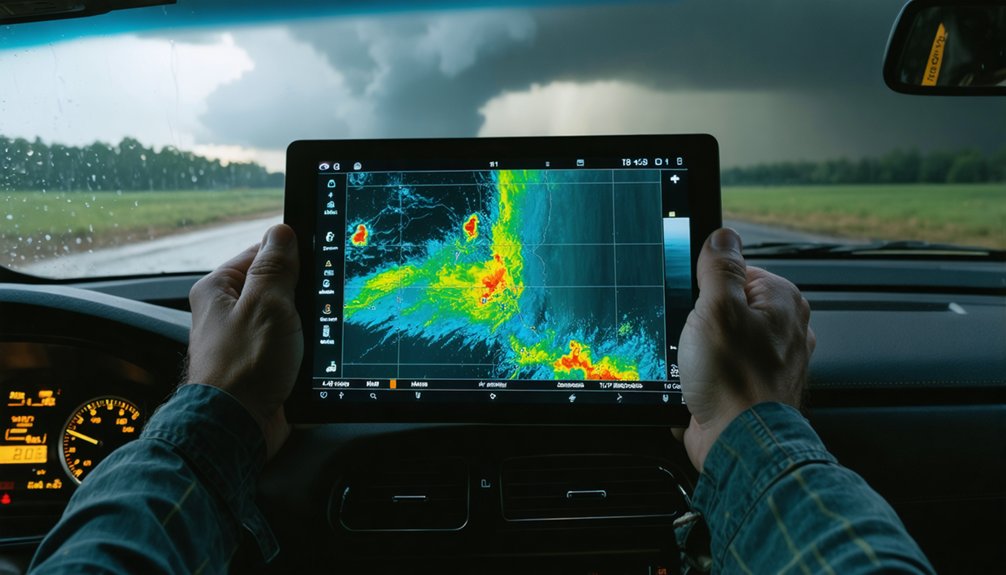
Reading radar data effectively is one of the most critical skills a storm chaser can develop. You’ll want to understand the distinction between Level 2 and Level 3 data feeds provided by the National Weather Service. Level 2 offers superior resolution, making it ideal for super-resolution radar interpretation when you’re near a storm with visual confirmation.
Level 3 delivers near real-time output, better suited for immediate sensing when download speeds are limited by rural cellular constraints.
Effective data integration means combining radar with satellite imagery to uncover hail cores and velocity couplets concealed within heavy precipitation. You’re not just reading one data stream — you’re synthesizing multiple inputs simultaneously.
Mastering this skill gives you the situational awareness needed to position yourself precisely and escape safely.
Use Satellite Imagery to Spot Threats Storm Chasers Miss
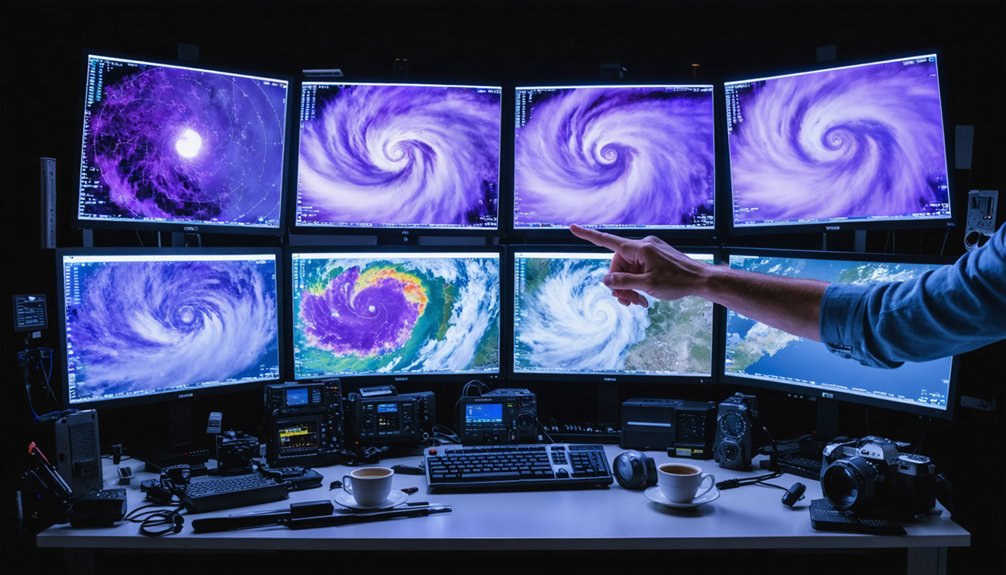
Radar gives you velocity and reflectivity, but satellite imagery fills the gaps radar can’t reach. Satellites observe the atmosphere across multiple wavelengths in near real-time, giving you independent threat detection capabilities radar alone won’t provide.
Visible light channels function like an orbital camera, letting you identify cold fronts, outflow boundaries, and drylines critical for precise chase positioning. These satellite advantages become mission-critical when boundaries are otherwise invisible on radar.
Visible light channels expose cold fronts and drylines radar misses — positioning you ahead of threats before they escalate.
Combined with radar, satellite imagery reveals hail cores and velocity couplets concealed within heavy precipitation. You’ll identify developing convective boundaries before they escalate into radar-confirmed threats.
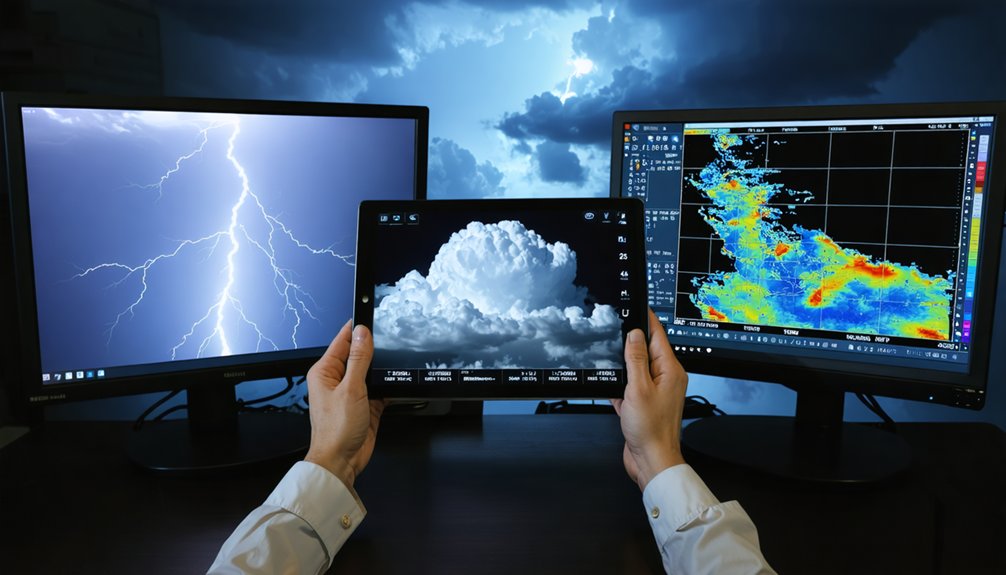
When you’re chasing, don’t rely on a single data source. Integrating satellite feeds with radar gives you a fuller atmospheric picture, keeping your threat detection sharp and your positioning strategically ahead of developing storms.
Use Surface and Wind Charts to Lock In Your Chase Target
Surface and upper air charts give you the targeting precision radar and satellite can’t deliver alone.
Surface analysis exposes drylines, warm fronts, and outflow boundaries—the convergence zones where storms fire most aggressively. You’ll identify moisture boundaries and pressure gradients that define exactly where atmospheric lift concentrates.
Wind patterns at multiple levels reveal the vertical shear structure determining storm character and motion.
Examine 500mb and 850mb charts to assess steering flow and hodograph geometry. When surface winds veer sharply with height, supercell potential increases greatly.
Cross-reference your surface analysis with upper air data each chase morning.
Boundary intersections where drylines meet warm fronts create localized lift and shear maxima—your highest-probability target zones.
Position yourself ahead of these intersections before convective initiation, and you’ll maximize your intercept opportunities while maintaining critical escape routes.
Frequently Asked Questions
How Far in Advance Should Storm Chasers Begin Monitoring Weather Models?
You should begin monitoring storm model timing two to three days out, giving you early warning to assess moisture, instability, lift, and wind shear before committing to a target area.
What Ingredients Must Combine to Produce Severe Thunderstorm Development?
You’ll need moisture levels, atmospheric instability, wind shear, and convective triggers combining simultaneously. Temperature gradients sharpen boundaries while topographical influences enhance lift, giving you the precise ingredient convergence necessary for severe thunderstorm development and ideal chase targeting.
Why Should Storm Chasers Observe From Four-Way Intersections During Chases?
You’ll maximize your escape options by positioning at four-way intersections, as their intersection advantages let you pivot in multiple directions instantly. Factor in traffic considerations to guarantee you’re never trapped when a storm’s path shifts unexpectedly.
How Should Rotating Clouds Be Reported to the National Weather Service?
When reporting cloud rotation to the NWS, you’ll need to document the duration, funnel organization, persistence, and rotation intensity. Follow established reporting procedures to guarantee your cloud rotation observations support critical warning decisions effectively.
What Safety Protocols Should Paired Storm Chasing Teams Follow on Roads?
When chasing in pairs, you’ll maximize road safety by assigning your driver solely to navigation while your observer tracks storms. Maintain clear team communication, avoid storm cores with heavy rain or hail, and position at four-way intersections for multiple escape routes.
References
- https://www.stormtours.com/information/nowcasting-explained/
- https://stormtrack.org/threads/basic-storm-chasing-process.29691/
- http://www.stormeyes.org/tornado/chasing/FAQ/
- https://www.weather.gov/media/bis/Weather_Spotter_Field_Guide.pdf
- https://weather.cod.edu/?trk=public_post_main-feed-card_reshare-text
- https://artsci.tamu.edu/news/2025/11/texas-am-atmospheric-sciences-storm-chasing-part-3-chase-data-in-the-future.html
- https://www.youtube.com/watch?v=w-5nJ61umeA