Predicting storm formation requires you to track several critical atmospheric variables simultaneously. You’ll need to monitor CAPE values above 2,500 J/kg, dewpoints exceeding 60°F, and sea surface temperatures surpassing 26.5°C. Low vertical wind shear preserves storm organization, while upper-level divergence drives intensity. Boundary interactions like drylines and cold fronts trigger convective initiation. Each factor compounds the others, and understanding how they interact gives you a far more precise picture of what’s developing overhead.
Key Takeaways
- High CAPE values, especially above 2,500 J/kg, indicate significant atmospheric instability and strong updraft potential critical for storm development.
- Sea surface temperatures exceeding 26.5°C provide essential heat energy, driving evaporation and latent heat release that intensify storm systems.
- Low vertical wind shear preserves storm organization, while high shear disrupts updrafts and weakens convective structure significantly.
- Dewpoints above 60°F and consistent moisture across atmospheric layers fuel condensation processes, sustaining storm energy and growth.
- Boundaries like drylines and cold fronts force low-level convergence, lifting air parcels and triggering explosive convective development.
Why Moisture Levels Make or Break Storm Formation
When it comes to storm formation, moisture isn’t just a contributing factor—it’s the fuel that drives the entire system. You need high dewpoints in the planetary boundary layer, as dewpoint significance directly reflects vapor pressure and available latent heat.
Moisture transport across atmospheric layers feeds condensation processes that release energy, intensifying updrafts throughout the storm lifecycle.
Evaporation effects work against you—dry mid-level air erodes developing convection by depleting humidity impacts critical to sustained growth.
Moisture sources, particularly warm ocean surfaces exceeding 26.5°C, continuously replenish this energy cycle. As water vapor condenses, latent heat releases explosively, driving powerful vertical motion.
Without adequate moisture across all atmospheric layers, even the most dynamically favorable environment collapses into nothing.
Monitor your dewpoints relentlessly—they’re your earliest warning signal.
Sea Surface Temperatures and the 26.5°C Threshold
When you’re analyzing tropical storm potential, the 26.5°C sea surface temperature threshold is non-negotiable—below it, the ocean simply can’t transfer enough heat energy to sustain convective development.
You’ll find that warmer SSTs drive stronger evaporation rates, feeding the low-level moisture flux that powers latent heat release within the storm’s core.
To measure these critical SST values, you can rely on a combination of geostationary satellite retrievals, drifting buoys, and ship-based sensors that together produce the high-resolution thermal data NWP models require for accurate storm forecasts.
Why 26.5°C Matters
Sea surface temperatures (SSTs) of at least 26.5°C (79.7°F) represent a critical threshold for tropical cyclone formation, as this temperature level provides the minimum heat energy and evaporative flux necessary to sustain organized convection.
Below this threshold, the ocean simply can’t generate sufficient storm energy to support persistent thunderstorm activity. The temperature impact extends beyond surface heating—warmer SSTs drive higher evaporation rates, increasing low-level moisture flux into the planetary boundary layer.
This process elevates latent heat release during condensation, amplifying updraft intensity. You’ll also notice that ocean heat content at depth matters considerably; shallow warm layers deplete rapidly under storm circulation, weakening intensity.
Sustained SSTs above 26.5°C across deeper ocean layers consequently directly correlate with stronger, more resilient tropical cyclone development.
Heat Energy Transfer Dynamics
The ocean drives tropical cyclone intensification through a continuous exchange of heat and moisture at the air-sea interface, a process that becomes self-sustaining only when SSTs meet or exceed 26.5°C. Below this threshold, heat transfer rates are insufficient to sustain organized convection.
Once you’ve crossed it, the energy dynamics shift dramatically—latent and sensible heat flux accelerates, feeding vigorous updrafts that draw more warm, moist air upward from the surface.
As water vapor rises and condenses, it releases latent heat, amplifying atmospheric instability and driving further pressure drops. This feedback loop demands consistent oceanic heat content through depth, not just surface readings.
Without sustained thermal input at the air-sea boundary, the storm’s convective engine starves, weakens, and ultimately collapses.
SST Measurement Techniques
Accurately measuring SSTs requires integrating data from multiple collection platforms—each with distinct spatial and temporal resolution trade-offs.
You’ll rely on three primary SST data sources: geostationary satellites, polar-orbiting satellites, and in-situ instruments like buoys and hurricane hunter aircraft. Geostationary satellites deliver high temporal resolution but suffer from cloud contamination, reducing measurement accuracy in active convective regions.
Polar-orbiting systems provide superior spatial coverage but sample any given location less frequently. In-situ buoys compensate by delivering continuous, direct-contact readings, anchoring calibration of remotely sensed data.
Fusing these sources through bias-corrected blended analyses—like NOAA’s OISST product—produces the most reliable SST fields. You need that precision because even 0.5°C deviations near the 26.5°C threshold critically impact intensity forecasts and development probability assessments.
How CAPE Values Signal Atmospheric Instability
Convective Available Potential Energy (CAPE) measures the amount of positive buoyancy energy available to a rising air parcel, and high CAPE values directly signal strong atmospheric instability.
When you’re conducting instability analysis, CAPE indicators above 2,500 J/kg suggest significant energy release potential, while values exceeding 4,000 J/kg indicate extreme conditions.
These atmospheric measurements confirm that buoyancy effects drive updraft strength proportionally—stronger updrafts correlate directly with larger hail and greater tornado potential.
For accurate storm forecasting, you’ll want to cross-reference CAPE with Lifted Index, K Index, and Total Totals data.
Negative Lifted Index values reinforce high-CAPE readings, giving you a clearer picture of convective threat levels.
Together, these parameters let you assess instability with precision and make informed, confident predictions about severe weather development.
What Wind Shear Does to a Developing Storm
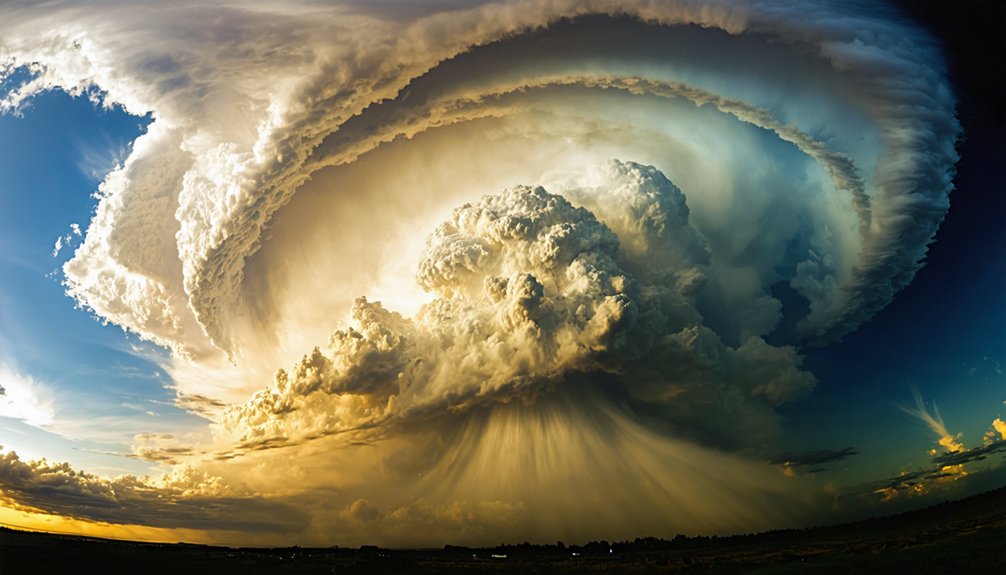
Wind shear’s influence on a developing storm can either sustain or destroy it, depending on where and how it acts in the vertical profile.
You’ll find that low vertical wind shear preserves storm organization by allowing updraft maintenance without structural disruption. When shear profiles show minimal directional and speed changes with altitude, the storm’s core remains intact.
Conversely, high upper-level shear introduces severe storm disruption by tilting the storm and separating updrafts from downdrafts, collapsing vertical instability.
Directional shear within the planetary boundary layer requires wind veering exceeding 45 degrees, while speed shear demands winds increasing with height.
These shear effects directly govern storm dynamics—average PBL winds must surpass 20 knots for tornado potential. Understanding these precise thresholds gives you predictive leverage over developing convective systems.
Why Upper-Level Winds Both Build and Destroy Storms
Upper-level winds extend the shear discussion beyond the planetary boundary layer, operating at storm tops where their effects split into two competing roles.
When you’re analyzing storm dynamics, recognize that strong upper-level winds simultaneously sustain and threaten a storm’s lifecycle.
On the constructive side, these winds create a vacuum effect at storm tops, maintaining updraft intensity and verticality. Strong upper-level troughs drive positive vorticity advection, feeding convective development from above.
Destructively, excessive upper-level wind shear physically dismantles storm structure. You’ll see this clearly in hurricane forecasting—strong upper-level winds rip apart vertical organization, preventing the warm-core development that sustains tropical systems.
Your forecast accuracy depends on quantifying this dual role precisely: enough upper-level support to sustain updrafts, but not enough to destroy structural integrity.
Drylines, Fronts, and the Boundaries That Start Storms
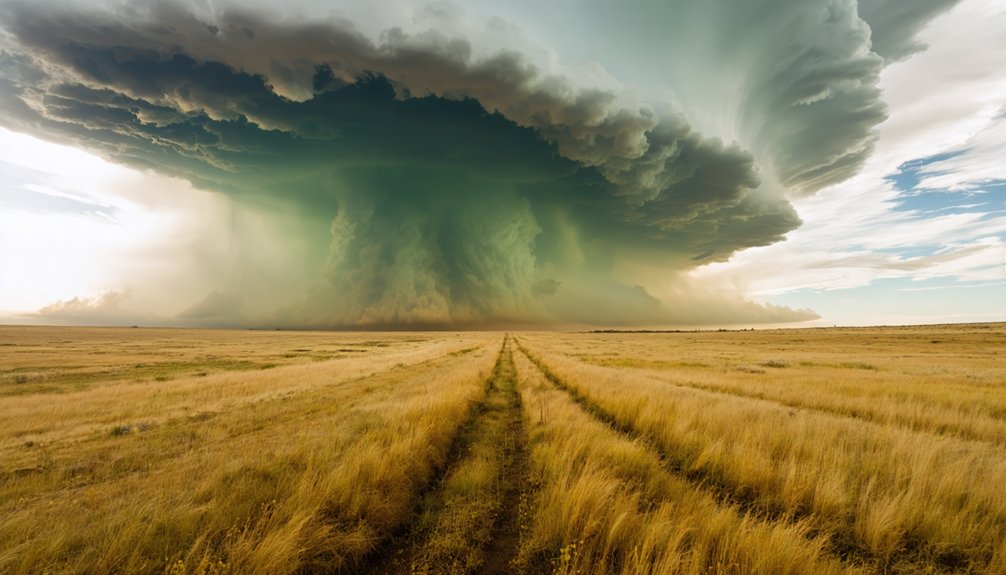
Even with ideal moisture, instability, and wind shear in place, storms won’t fire without a dynamic trigger to initiate convective development.
Drylines—sharp boundaries separating moist Gulf air from dry continental air—force low-level convergence that lifts air parcels to their Level of Free Convection (LFC), allowing CAPE to release explosively.
Cold and warm fronts similarly function as surface boundaries, generating the forced ascent necessary to overcome convective inhibition (CIN) and set off organized convective development.
Drylines Triggering Convective Development
When all the ingredients for storm development are in place—ample moisture, strong instability, and favorable wind shear—storms still won’t fire without a dynamic trigger mechanism to lift air parcels to their Level of Free Convection (LFC).
Drylines represent one of the most powerful such mechanisms available.
Dryline mechanics involve the sharp boundary separating moist Gulf air from dry continental air masses. As surface heating intensifies throughout the afternoon, this boundary focuses convergence, forcing low-level moisture upward until parcels breach convective thresholds.
Once air parcels exceed the LFC, positive buoyancy takes control, and you’ve got explosive convective development.
Without dryline forcing, even textbook atmospheric setups remain dormant. Identifying dryline position and timing isn’t optional—it’s the decisive factor separating significant severe weather outbreaks from quiet afternoons.
Frontal Boundaries Initiating Storm Formation
Drylines don’t operate in isolation—cold fronts, warm fronts, and outflow boundaries function through the same fundamental principle: forcing surface air upward until parcels reach their Level of Free Convection (LFC).
Understanding frontal interactions gives you decisive forecasting advantages across boundary layers.
Each boundary type delivers distinct forcing mechanisms:
- Cold fronts drive dense air beneath warm sectors, producing sharp lift and intense CAPE release.
- Warm fronts generate slower, broader ascent, favoring elevated convection.
- Outflow boundaries create mesoscale collision zones when intersecting other surfaces.
- Surface confluences concentrate low-level moisture, maximizing instability potential.
When multiple boundaries intersect simultaneously, storm initiation probability increases dramatically.
You’re fundamentally identifying where forced ascent overcomes convective inhibition—the precise moment atmospheric conditions surrender control to convective development.
How Scientists Measure the Conditions That Form Storms
To forecast storms accurately, scientists rely on an interconnected network of observational tools that continuously gather atmospheric and oceanic data.
Geostationary and polar-orbiting satellites deliver real-time storm observation data, capturing cloud patterns and sea surface temperatures critical for moisture analysis.
Hurricane Hunter Aircraft penetrate active storms directly, recording wind speeds, pressure readings, and humidity levels with precision.
Buoys and surface weather stations monitor oceanic heat content and boundary layer conditions simultaneously.
Numerical Weather Prediction models then integrate these data streams, simulating atmospheric physics to project storm evolution.
You can appreciate how each instrument fills a specific data gap—no single tool provides complete situational awareness.
Together, they construct a thorough atmospheric picture, enabling forecasters to identify dangerous instability before storms threaten lives and infrastructure.
How Forecast Models Predict Whether Conditions Will Produce Storms

Forecast models translate raw atmospheric observations into storm probability assessments by simulating the physical processes governing convective development.
When you’re analyzing atmospheric modeling outputs, you’ll find that storm prediction relies on integrating multiple data streams simultaneously:
- CAPE values quantify positive buoyancy, directly indicating updraft potential
- Wind shear profiles reveal whether vertical structure can sustain organized convection
- Moisture fields identify dewpoint concentrations and mid-level humidity deficits
- Vorticity advection patterns expose dynamic forcing mechanisms driving storm initiation
NWP models ingest real-time satellite, buoy, and aircraft reconnaissance data, then project atmospheric evolution across defined timeframes.
You can assess confidence by comparing ensemble model runs—greater agreement means higher predictability.
Diverging solutions signal volatile atmospheric states where small variable changes produce dramatically different storm outcomes.
Which Storm Formation Factors Matter Most to Forecasters?
When models converge on a high-probability storm solution, you still need to know which atmospheric variables carry the most forecasting weight. CAPE values directly govern convection processes and updraft strength, making them non-negotiable benchmarks.
Monitor moisture sources carefully—dewpoints above 60°F and sea surface temperatures exceeding 26.5°C drive critical heat exchange that sustains storm lifecycle progression.
Atmospheric pressure gradients reveal organizational potential, while low vertical wind shear preserves structural integrity.
Wind patterns, particularly directional veering exceeding 45 degrees within the PBL and average winds surpassing 20 knots, determine rotational capacity.
For storm intensity and storm tracking accuracy, prioritize upper-level divergence and positive vorticity advection.
These variables, cross-referenced against real-time observational data, give you the sharpest, most defensible forecast possible.
Frequently Asked Questions
Can Storm Formation Factors Differ Between Ocean and Land Environments?
Yes, you’ll find formation factors fundamentally differ: ocean currents drive humidity levels and temperature gradients over water, while land topography triggers convection differently, altering moisture availability, boundary layer dynamics, and instability indices across contrasting environments.
How Long Does It Typically Take for a Storm to Fully Develop?
You’ll find a storm’s lifecycle spans 2-7 days, progressing through distinct development stages—tropical disturbance, depression, storm, and peak intensity—depending on CAPE values, moisture levels, wind shear, and sea surface temperatures exceeding 26.5°C.
Do Seasonal Changes Significantly Alter Which Storm Formation Factors Matter Most?
Yes, seasonal cycles drastically shift which factors you’ll prioritize. Summer’s elevated humidity levels and ocean currents dominate, while winter’s temperature fluctuations and shifting wind patterns take precedence. Atmospheric pressure differentials you’re tracking also redistribute considerably across seasons.
Can Multiple Trigger Mechanisms Simultaneously Influence the Same Developing Storm?
Yes, you’ll often see multiple trigger mechanisms creating simultaneous influences on a single storm. Drylines, fronts, and low-level jets interact through complex atmospheric dynamics, amplifying storm complexity beyond what any single trigger mechanism could independently generate.
How Accurately Can Forecasters Predict Storm Formation Days in Advance?
Like peering through a foggy lens, you’ll find forecasting techniques and predictive models can reliably detect storm formation 3-5 days out, though precision sharpens dramatically within 24-48 hours as atmospheric data density increases.
References
- https://www.weather.gov/source/zhu/ZHU_Training_Page/thunderstorm_stuff/Thunderstorms/thunderstorms.htm
- https://www.battlbox.com/blogs/outdoors/how-to-predict-a-hurricane-a-comprehensive-guide
- https://www.herculeslifting.com/blogs/news/6-factors-behind-hurricane-formation-unveiling-nature-s-fury
- https://mynasadata.larc.nasa.gov/basic-page/hurricane-dynamics
- https://science.howstuffworks.com/nature/natural-disasters/how-does-a-hurricane-form.htm