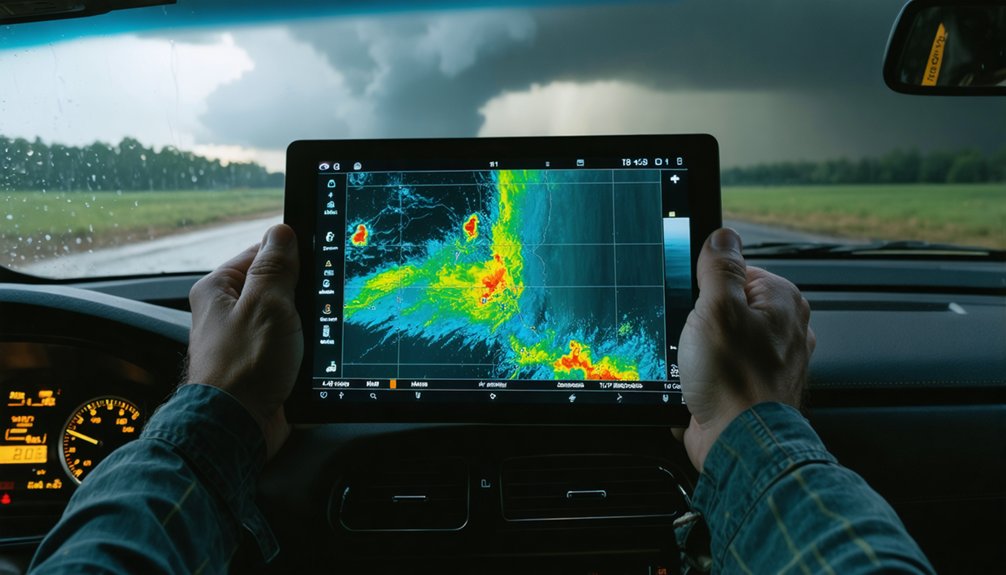
Predicting tornado formations accurately means you’re analyzing wind shear profiles, evaluating supercell ingredients like CAPE and CIN, interpreting NWP model outputs, and running radar detection algorithms that flag rotation signatures early. You’ll also leverage mobile radar systems with LIDAR, apply deep learning models trained on datasets like TorNet, and cross-reference multi-source data streams simultaneously. Each technique sharpens your confidence in issuing warnings before touchdown — and there’s far more precision hidden within each method.
Key Takeaways
- Analyzing wind shear across atmospheric layers, with 0-6 km bulk shear exceeding 40 knots, significantly increases tornado probability detection accuracy.
- Monitoring key instability parameters like CAPE above 2,500 J/kg and precipitable water over 1.5 inches identifies high-probability tornado corridors.
- Phased array radar and TORUS systems using drones, mobile radars, and LIDAR capture real-time storm data for earlier warnings.
- Deep learning models trained on 200,000+ radar images classify tornado threats with over 85% accuracy at 15-minute lead times.
- Cross-referencing polarimetric radar, Skew-T soundings, and satellite water vapor loops eliminates uncertainty through converging multi-source signals.
How Wind Profiles Reveal Tornado Spin Hours Before It Starts
When conditions align for tornado development, wind profiles reveal the atmospheric spin hours before a storm touches down. You can identify tornado precursors by analyzing wind shear across low, middle, and upper levels. A veering wind profile drives atmospheric rotation, while jet stream winds aloft supply the energy needed for spin up mechanisms.
Pre-storm analysis using wind profilers and satellite water vapor imaging detects favorable weather patterns 1-7 hours ahead. You’re fundamentally watching wind shear build the structural foundation for tornado dynamics before convection initiates.
In the Northern Hemisphere, you’ll observe a clockwise wind shift signaling developing rotation.
Forecasters actively monitor instability regions, temperature gradients, and jet stream positioning. These wind profiles give you a critical head start—turning raw atmospheric data into actionable tornado warnings before dangerous rotation reaches the surface.
How Supercell Ingredients Narrow Tornado Location and Timing
To narrow tornado location and timing, you must first identify atmospheric lift sources—fronts, drylines, and outflow boundaries—that trigger thunderstorm development.
You then assess near-ground and aloft moisture levels alongside temperature gradients to determine whether storm sustenance is viable.
Finally, you locate specific wind structures that enable supercell rotation, combining all three ingredients to produce a precise, data-driven estimate of where and when tornado production becomes probable.
Identifying Atmospheric Lift Sources
Identifying where a tornado will touch down hinges on locating the atmospheric lift sources that trigger and sustain supercell thunderstorms.
You’ll focus on three primary mechanisms: frontal boundaries, drylines, and outflow boundaries. Each creates sharp thermal gradients that force warm, moist air upward with enough energy to initiate rotation.
Monitor atmospheric pressure differentials along these boundaries using real-time surface station data, satellite imagery, and balloon soundings. Where pressure drops sharply and moisture convergence intensifies, storm initiation becomes highly probable.
Drylines separating moist Gulf air from dry continental air are particularly reliable lift sources across the Great Plains.
Overlapping boundaries dramatically increase tornado potential. When a cold front intersects a dryline, you’re tracking a high-risk corridor where supercell development and tornadogenesis concentrate within a relatively precise geographic window.
Assessing Moisture And Instability
Once lift sources are confirmed, three moisture and instability parameters sharpen your tornado location and timing forecast: precipitable water, convective available potential energy (CAPE), and convective inhibition (CIN).
Analyze moisture profiles from radiosondes and satellite water vapor imagery to pinpoint dewpoint convergence zones. Precipitable water values exceeding 1.5 inches signal sufficient atmospheric moisture for sustained supercell development.
Cross-reference instability indices—particularly CAPE values above 2,500 J/kg—against CIN thresholds between -25 and -75 J/kg. That narrow CIN range keeps storms capped until forcing mechanisms trigger explosive development.
Real-time surface station data and model soundings via Skew-T diagrams refine these assessments hourly. You’re targeting grid points where high CAPE, adequate moisture, and breakable CIN overlap—that intersection defines your highest-probability tornado corridor.
Locating Favorable Wind Structures
With moisture and instability parameters locked in, wind structure becomes your next discriminating variable—separating environments that merely support supercells from those that actively produce tornadoes.
You’ll assess wind shear across multiple atmospheric layers, targeting veering profiles where surface southerlies shift to southwesterly flow aloft. This directional change drives rotation patterns critical for mesocyclone development.
Monitor jet stream positioning carefully—strong high-altitude winds stretching 50+ knots overhead amplify storm dynamics by enhancing tilting and stretching of vertical vorticity.
Wind profilers deliver real-time shear data, while 0-6 km bulk shear values exceeding 40 knots greatly raise tornado probability.
Clockwise wind veering through low and mid-levels concentrates spin near the surface, narrowing your forecast toward specific corridors where tornadogenesis becomes structurally inevitable rather than merely possible.
What NWP Models Show Forecasters About Tornado Risk
Numerical weather prediction (NWP) models give forecasters a thorough vertical snapshot of atmospheric conditions, calculating everything from surface-level humidity to upper-level wind patterns using globally sourced data.
You’re getting real-time calculations that span the entire atmospheric column, directly informing tornado risk assessments before storms develop.
Ensemble forecasting strengthens prediction reliability by running multiple model iterations with varied starting conditions, producing a range of possible outcomes rather than a single forecast.
Ensemble forecasting runs multiple model iterations with varied starting conditions, delivering a spectrum of outcomes beyond a single prediction.
You can identify high-confidence scenarios where most ensemble members agree on tornado-favorable setups.
Model validation uses past events, like the 2007 Greensburg tornado, to confirm accuracy against documented outcomes.
High-resolution radar data integrates directly into NWP frameworks, sharpening short-term thunderstorm predictions and giving you precise, actionable intelligence on evolving atmospheric conditions before tornado threats materialize.
How Radar Detection Algorithms Spot Tornado Signatures Early

Radar detection algorithms give you precise, early warnings by identifying tornado signatures before touchdowns occur. The Tornado Vortex Signature detects intense rotation several kilometers above ground, signaling tighter, stronger circulation than a standard mesocyclone.
You’ll gain detection sensitivity through the New Tornado Detection Algorithm, which applies machine learning to evaluate dual-polarization data, improving algorithm efficiency across varying storm conditions.
Radar polarimetry strengthens signature analysis by measuring raindrop density differences within supercells, sharpening your probability assessments.
Phased array radar completes full storm scans in under one minute, maximizing early warning potential. Data fusion integrates these outputs with real-time observations, giving you a multi-layered picture of developing rotation.
Together, these technologies let you act decisively before a tornado reaches the ground.
How Drones, LIDAR, and Mobile Radars Capture Live Storm Data
Ground-level storm observation has transformed through TORUS, a multi-platform system deploying four drones, mobile radars, mesonets, and LIDAR to generate 360-degree views of active supercells.
You’re now working with real-time data streams that integrate aerial surveys, lidar applications, and mobile radar feeds simultaneously.
Key observational techniques capturing storm behavior include:
- Drone technology penetrating dangerous inflow regions, transmitting wind velocity and pressure gradients directly from the tornado’s immediate environment
- LIDAR applications measuring precise atmospheric boundary layers, detecting invisible wind shear structures milliseconds before rotation intensifies
- Mobile radar units repositioning within minutes, tracking storm tracking signatures at ground-level angles fixed installations can’t achieve
Data integration across these platforms eliminates observational blind spots, giving forecasters unprecedented resolution for predicting tornadogenesis with measurable accuracy improvements.
How Deep Learning Models Classify Tornado Threats in Real Time

Deep learning models now classify tornado threats in real time using the TorNet dataset, which contains over 200,000 radar images trained to detect rotation signatures across multiple severity levels.
You’re working with model accuracy that correctly identifies over 85% of EF-2 or higher tornadoes. These systems generate real time predictions at 5-, 10-, and 15-minute lead times using pre-tornadogenesis radar integration, giving you actionable intelligence before touchdown occurs.
With 85%+ accuracy on EF-2 tornadoes, AI delivers actionable warnings up to 15 minutes before touchdown.
AI techniques through explainable outputs guarantee forecaster alignment by matching model decisions to established warning criteria. Tornado classification operates across severity tiers, letting you prioritize response resources efficiently.
Data preprocessing standardizes raw radar inputs, reducing noise that degrades prediction reliability. Model parameters are publicly available, so you can audit, replicate, and build on existing deep learning architectures without restriction.
How Forecasters Combine All Methods to Call a Tornado Threat
When forecasters call a tornado threat, they pull every data stream simultaneously rather than sequentially. Data integration across radar signatures, wind profiles, and numerical model output sharpens threat assessment into a precise, actionable call.
You’re watching forecasters cross-reference:
- Polarimetric radar debris signatures confirming rotation tightening near ground level
- Skew-T soundings and Significant Tornado Parameter overlays quantifying instability, shear, and helicity thresholds
- Satellite water vapor loops and wind profiler data tracking jet stream positioning and low-level veering
No single tool drives the decision. Instead, converging signals from each layer eliminate uncertainty systematically.
When radar rotation intensifies, sounding parameters spike, and surface boundaries align, forecasters issue warnings with confidence grounded in real-time, multi-source evidence rather than intuition alone.
Frequently Asked Questions
What Is the Average Warning Time Residents Receive Before a Tornado Strikes?
You’ve got roughly 13 minutes—warning systems currently average that lead time before tornadoes strike. Maximize your response times immediately: evacuate low-lying areas, seek reinforced shelter, and monitor alerts continuously. Every second you act decisively increases your survival probability considerably.
How Accurate Are Tornado Predictions Compared to Hurricane Predictions Overall?
Tornado predictions aren’t as accurate as hurricane predictions. You’ll find prediction models achieve 85%+ accuracy for strong tornadoes, but hurricanes benefit from more historical data, longer lead times, and broader atmospheric tracking systems.
Can Tornado Prediction Techniques Differ Between Rural and Urban Environments Significantly?
Yes, they differ markedly. Over 70% of tornadoes strike rural areas, creating rural challenges with sparse sensors. You’ll find urban complexities amplify data variability, while technology access improves radar density, sharpening detection precision considerably.
How Do Forecasters Communicate Tornado Threats to Emergency Management Officials Quickly?
You’ll leverage alert systems and communication protocols to instantly relay radar-confirmed rotation data, ensemble model outputs, and TVS signatures to emergency management officials, ensuring they’ve got precise, actionable tornado threat intelligence within critical lead-time windows.
What Role Does Public Reporting Play in Improving Tornado Prediction Accuracy?
Like town criers of old, you’re boosting public awareness by reporting tornado sightings, directly enhancing data collection. Your real-time observations validate radar algorithms, refine prediction models, and sharpen forecasting accuracy for everyone’s freedom and safety.
References
- https://www.ll.mit.edu/r-d/projects/intelligent-tornado-prediction-engine
- https://www.britannica.com/science/tornado/Prediction-and-detection-of-tornadoes
- https://www.nssl.noaa.gov/education/svrwx101/tornadoes/detection/
- https://www.youtube.com/watch?v=VkpadCUGaVA
- https://www.nssl.noaa.gov/education/svrwx101/tornadoes/forecasting/
- https://www.discovery.com/science/tornado-science–predicting-the-whirlwind-
- https://profession.americangeosciences.org/society/intersections/faq/how-do-you-forecast-tornadoes/
- https://www.weather.gov/spotterguide/tor_life