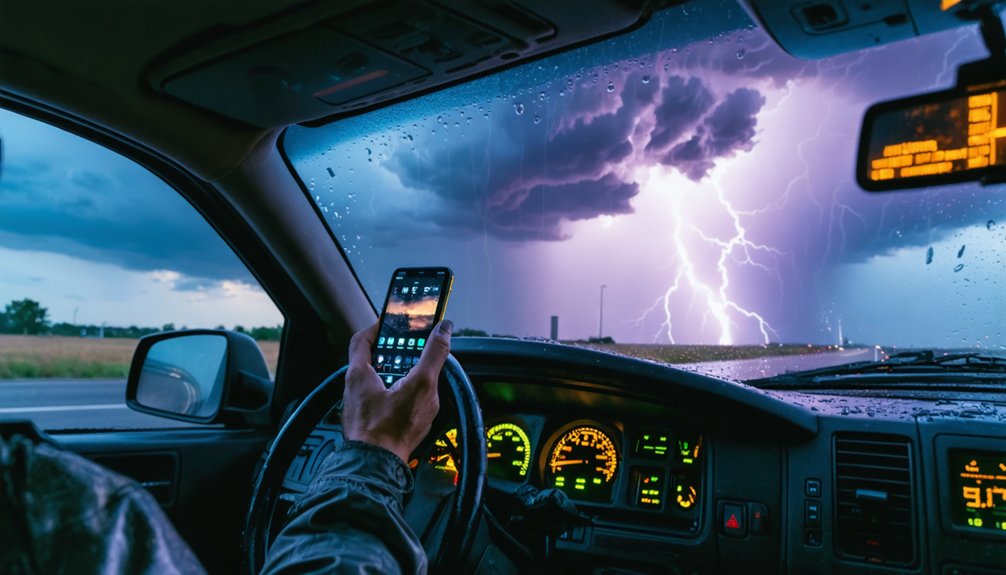
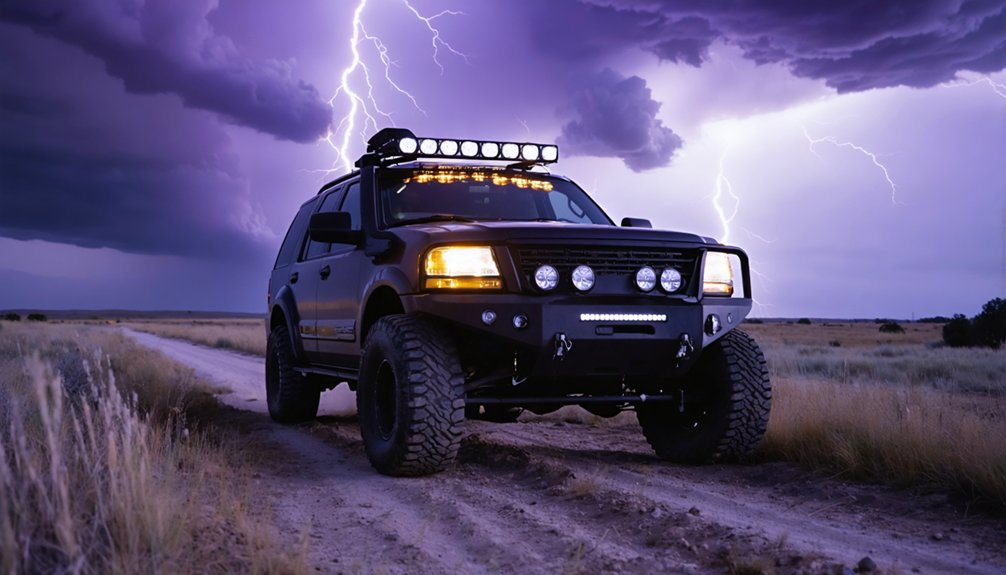
Before every chase season, you’ll need to run a full mechanical inspection covering brakes, fluids, tire tread, and AWD/4WD engagement. Verify your mud tires are inflated between 28–32 PSI on pavement, confirm spare tires and fix-a-flat kits are accessible, and test all communication gear including two-way radios and signal boosters. Check camera mounts, safety equipment, and navigation tools like offline GPS units. Every checkpoint here protects you when conditions deteriorate fast — and there’s much more to cover.
Key Takeaways
- Conduct a thorough pre-season vehicle inspection covering brakes, fluid levels, tire tread depth, and AWD/4WD system engagement testing.
- Install mud-terrain tires, maintain proper PSI for terrain type, and carry two mounted spare tires plus fix-a-flat kits.
- Equip communication gear including two-way radios, a cellular signal booster, and a VHF/UHF transceiver for NWS frequency access.
- Use a GPS device like the Garmin Overlander, download offline maps, and carry paper atlases as backup navigation tools.
- Mount all equipment 12+ inches from airbag panels using RAM Mount systems, and document configurations annually for safety compliance.
Pre-Season Vehicle Inspection Every Storm Chaser Should Run
Before you chase a single storm this season, your vehicle needs a thorough inspection that covers mechanical systems, safety equipment, and gear mounting points.
Your vehicle maintenance routine should include brake inspection, fluid levels, tire tread depth, and AWD/4WD engagement testing.
Brake systems, fluid levels, tire tread, and AWD engagement testing belong on every pre-season vehicle checklist.
Run through your inspection checklist systematically: verify mud tire pressure, check spare tires, and confirm fix-a-flat kits are accessible.
Test all storm equipment mounting brackets away from airbag deployment zones.
Seasonal preparation demands performance tuning beyond factory specs.
Confirm your emergency procedures documentation is current and stored within reach.
Safety protocols require functioning communication gear, updated weather readiness supplies, and verified fuel capacity.
Don’t skip this process. Your freedom on the road depends entirely on mechanical reliability before conditions deteriorate.
AWD vs. 4WD : Which Drivetrain Is Right for Storm Chasing?
When selecting your storm chasing vehicle’s drivetrain, you’ll need to weigh AWD’s automatic, on-the-fly traction distribution against 4WD’s superior low-range torque on severely compromised terrain.
AWD systems like those in the Subaru Outback or Ford Escape continuously monitor wheel slip and redistribute power without driver input, making them practical for mixed pavement and light off-road conditions common in Plains chasing.
However, if your intercept routes regularly take you across muddy fields, flooded creek crossings, or rutted dirt roads, a part-time 4WD system with low-range gearing—such as those found in the Toyota 4Runner or Ford Bronco—delivers the mechanical advantage AWD simply can’t match.
AWD Versus 4WD
Choosing the right drivetrain for storm chasing directly impacts your vehicle’s performance on unpredictable terrain, so understanding the mechanical differences between AWD and 4WD isn’t optional—it’s operational.
AWD systems deliver continuous drivetrain performance across all four wheels automatically, making them ideal for shifting between paved highways and sudden muddy pulloffs without driver input.
4WD systems, however, offer superior low-range torque when you’re maneuvering through deeply rutted dirt roads or flooded creek crossings.
Weather resilience demands both traction consistency and mechanical reliability under stress. AWD wins in dynamic, fast-changing surface conditions. 4WD wins in extreme off-road recovery scenarios.
Your chase territory determines which system you prioritize. Many experienced chasers select trucks with selectable 4WD, giving them both operational flexibility and terrain-specific control when conditions deteriorate rapidly.
Best Drivetrain Choice
Mechanical differences between AWD and 4WD matter less than matching drivetrain behavior to your specific chase environment.
If you’re pursuing storms across paved highways and occasional muddy two-tracks, AWD’s automatic torque distribution keeps you moving without manual intervention. You maintain speed and focus on the storm, not the drivetrain.
If your intercepts regularly push you onto remote unpaved roads, river crossings, or saturated fields, selectable 4WD’s locking differentials deliver superior traction where AWD systems struggle.
Drivetrain performance degrades fast when torque distribution can’t compensate for extreme surface inconsistency.
Evaluate your primary chase territory honestly. Plains chasers working paved grids favor AWD. Chasers penetrating backcountry terrain need 4WD.
Match the drivetrain to your operational reality, not to marketing claims.
Tires, Spare Kits, and Recovery Gear for Storm Chasers
Tire selection and recovery preparedness directly affect your survival margin when roads deteriorate mid-chase.
Install mud-terrain tires rated for mixed surfaces, maintaining tire pressure between 28–32 PSI on paved roads and dropping to 18–22 PSI on loose terrain for improved grip. Carry two mounted spare tires, not one — blowouts cluster under extreme conditions. Include fix-a-flat canisters for temporary field repairs and a 12V air compressor for pressure restoration.
For recovery techniques, equip your vehicle with a kinetic tow rope rated above 20,000 lbs, a hi-lift jack, and traction boards like MAXTRAX.
A front-mounted winch adds independent extraction capability when no second vehicle’s available. Pre-position recovery gear for immediate access — you won’t have time searching under gear mid-emergency.
Radar, Anemometers, and Lightning Detectors for Your Chase Rig
Weather instrumentation separates reactive driving from proactive positioning. You’re not guessing when you’ve got real-time radar technology feeding you live supercell data through Baron Mobile Threat Net or RadarScope Pro.
Pair that with an anemometer and barometer, and you’re reading atmospheric shifts before they dictate your movement.
Lightning detection keeps you operationally free rather than pinned down by uncertainty. Devices like Thor Guard or StrikeAlert HD give you actionable strike data instantly.
Prioritize these three instruments:
- Real-time radar app — Baron Mobile Threat Net or RadarScope Pro for live storm-cell tracking
- Anemometer — measures wind speed changes preceding tornadogenesis
- Lightning detector — StrikeAlert HD for precise strike proximity alerts
Own your data. Own your position.
Safe Equipment Mounting in Your Storm Chasing Vehicle
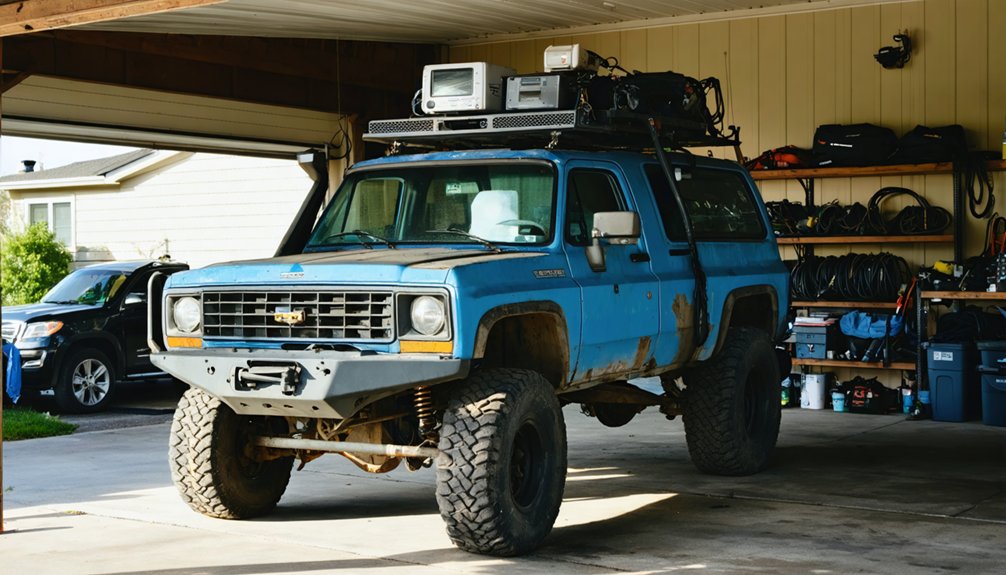
When mounting equipment in your storm chasing rig, you’ll need to map the exact locations of all airbag deployment zones before securing any hardware, since impact-triggered airbags can turn improperly placed mounts into lethal projectiles.
RAM Mount systems give you a modular, vibration-resistant solution that locks cameras, tablets, and radios into precise positions without drilling into airbag-critical panels.
Cross-reference your vehicle’s airbag deployment diagram with each mount’s placement, and torque every RAM component to manufacturer specifications to eliminate shifting under high-speed chase conditions.
Avoiding Airbag Interference
Mounting equipment inside your storm chasing vehicle demands careful attention to airbag deployment zones, since a misplaced bracket or RAM mount can become a lethal projectile during a crash.
Understanding airbag placement protects both you and your equipment safety protocols.
Before securing anything, verify these critical zones:
- Check your owner’s manual for all side-curtain and frontal airbag deployment paths.
- Keep mounts 12+ inches clear of dashboard airbag panels and door-mounted curtain zones.
- Never route cables or attach hardware to steering column covers or A-pillars.
Use RAM mounts bolted to factory anchor points like seat rails or roll cages.
Avoid adhesive-only solutions on surfaces near deployment zones.
Document your mounting configuration with photos annually, ensuring nothing shifts between chase seasons.
Secure RAM Mount Systems
RAM Mount systems anchor your gear through a ball-and-socket design that tolerates vibration, sudden directional changes, and the jarring terrain common in storm chasing scenarios.
You’ll want to select appropriate mounting techniques based on surface type—suction-cup bases for windshields, bolt-through bases for dashboards, and strap clamps for roll bars. Each configuration delivers measurable equipment stability across unpaved roads and creek crossings alike.
Torque every connection to manufacturer specifications using a proper torque wrench. RAM’s composite materials resist corrosion, UV degradation, and temperature extremes you’ll encounter across chase corridors.
Position mounts to preserve sightlines and maintain airbag clearance zones established during your previous setup phase. Test each mount under simulated load before departing.
Reliable anchoring keeps your GPS, cameras, and laptops operational precisely when conditions demand maximum situational awareness.
Storm chasing demands navigation tools that adapt as fast as conditions change, so relying solely on a single system is a liability.
Navigation challenges intensify when cell towers fail or routes shift mid-chase, making tech reliability non-negotiable.
Prioritize these layered offline strategies:
- Install the Garmin Overlander 2025 Edition for dedicated GPS route planning without cellular dependency.
- Download offline maps through Google Maps and TomTom as primary app recommendations before leaving your staging area.
- Carry paper atlases as map alternatives when every digital system fails simultaneously.
Pivotal Weather and College of DuPage supplement navigation by clarifying storm movement vectors, helping you anticipate road changes between paved and unpaved terrain before you’re committed to a compromised position.
Communication Gear You Can’t Afford to Chase Without
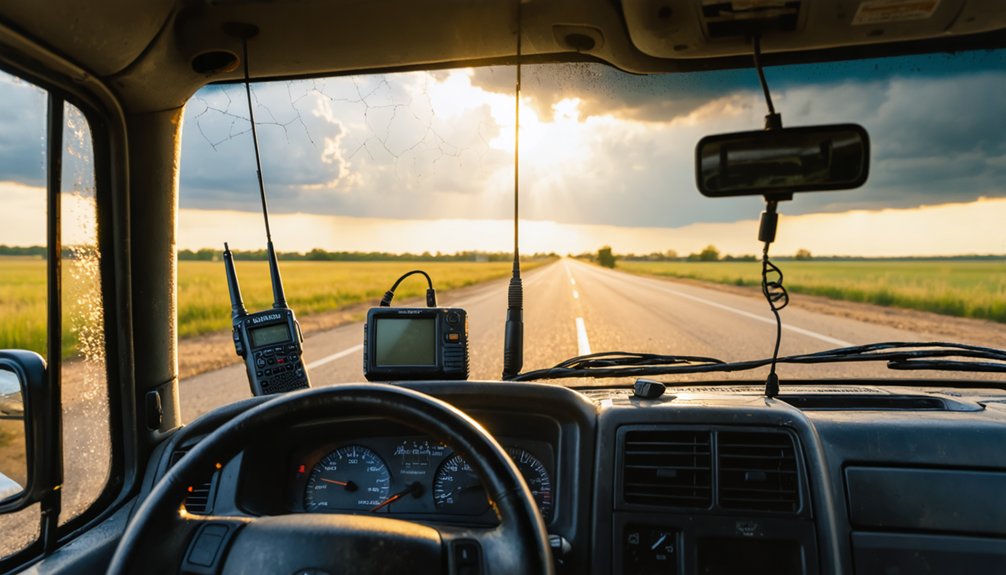
When cell networks fail during a fast-moving storm, two-way radios give you direct, interference-resistant communication with other chasers or ground teams without relying on infrastructure.
A cellular signal booster paired with a high-gain external antenna pulls in weak carrier signals, giving your data connection enough bandwidth to stream real-time radar in dead zones.
If you hold a ham radio license, a VHF/UHF transceiver ties you into local repeater networks and NWS spotter frequencies, adding a redundant, FCC-regulated communication layer that neither cell carriers nor consumer radios can replicate.
Two-Way Radio Reliability
Two-way radios remain your most reliable fallback when cell towers go down—a near-certainty in rural chase corridors where infrastructure is sparse and storm damage compounds signal loss.
Prioritize these two way radio features before every season:
- Minimum 5-watt output with NOAA weather band reception built in
- Waterproof rating of IP67 or higher for rain and debris exposure
- VOX hands-free capability so you stay focused on the storm
Two way radio maintenance keeps your unit field-ready when conditions deteriorate fast.
Test battery life monthly, clean contacts with isopropyl alcohol, and verify channel programming against your team’s frequency plan.
Don’t assume your radio works because it worked last season. Conditions degrade equipment fast, and you can’t afford a communication gap mid-intercept.
Cellular Signal Boosters
Even with a reliable two-way radio in your kit, you’ll hit dead zones where cellular data becomes the bottleneck—cutting off RadarScope feeds, NWS alerts, and team coordination the moment you need them most.
A cellular signal booster amplifies weak carrier signals, restoring usable upload and download speeds when towers are distant or overloaded.
Know your booster types before purchasing: vehicle-mounted units like the WeBoost Drive Reach OTR target single-user setups, while multi-device boosters support full chase teams sharing one hotspot.
Signal strength gains are measured in dB; target units delivering 50dB gain or higher for rural plains environments.
Pair your booster with a high-gain external antenna mounted on your roof for maximum tower acquisition and maintain a USB modem as a redundant fallback.
Ham Radio Benefits
Ham radio gives storm chasers 3 capabilities no cellular or commercial radio system can match: long-range voice communication on VHF/UHF bands, access to the SKYWARN spotter network, and emergency fallback when infrastructure collapses during a severe weather event.
The ham radio advantages extend beyond convenience—they represent operational independence. When towers fail and boosters go dark, your Technician or General class license keeps you transmitting.
Prioritize these emergency communication protocols:
- Program local SKYWARN repeater frequencies before each chase season
- Store simplex fallback frequencies for direct radio-to-radio contact without repeater dependency
- Pre-load APRS tracking to broadcast your GPS position to the spotter network automatically
You’re not just chasing storms—you’re operating in a dynamic, infrastructure-hostile environment. Ham radio guarantees you maintain contact on your terms, not the network’s.
Camera and Drone Setup for Storm Chasing Documentation
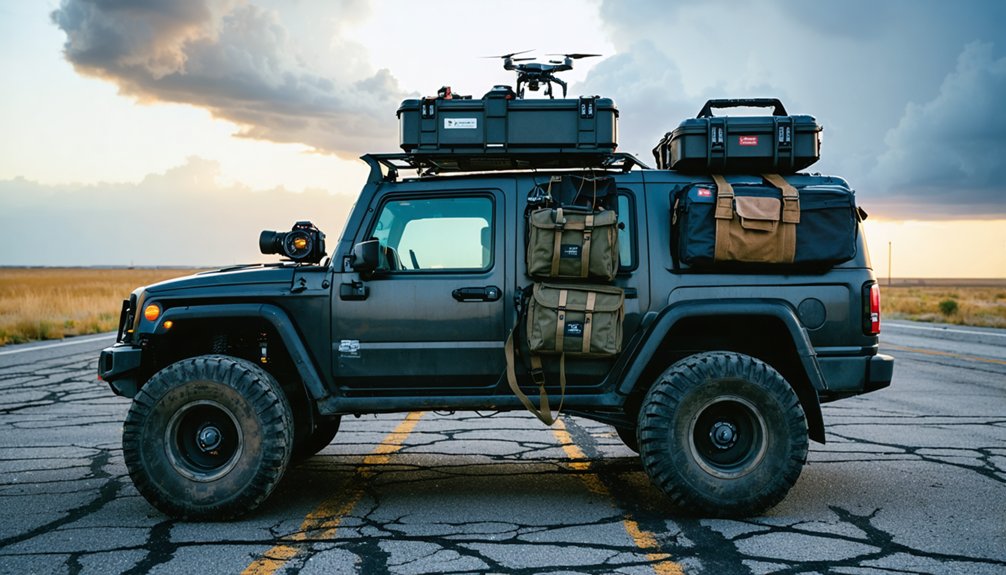
Capturing a violent storm on film demands purpose-built gear and deliberate setup choices. You’ll want a professional camera body paired with weather-sealed lenses, RAM-mounted securely to eliminate vibration blur.
Dial in your camera settings before deployment — high shutter speeds freeze rotation, while wide apertures retain detail in low-light supercell environments.
Pre-set your camera before the storm arrives — shutter speed and aperture decisions made in chaos cost you the shot.
For aerial documentation, the Autel Robotics Evo Lite+ and DJI Air 3S both deliver stabilized 4K footage, but drone safety requires strict wind-threshold discipline; suspend flights above 25 mph sustained winds.
GoPro action cameras mounted externally capture continuous wide-angle data without occupying your attention. Store footage redundantly across multiple drives.
Your documentation serves scientific record-keeping, spotter reporting, and personal accountability — treat every setup decision as mission-critical.
First Aid, Fuel, and Survival Gear Every Storm Chaser Needs
Storm chasing strips away every safety buffer civilization provides, so your vehicle must function as a self-contained emergency platform before you leave the driveway.
Your first aid essentials should address trauma, not minor inconveniences. Pack your survival kit with ruthless intentionality.
Prioritize these three categories:
- Medical – bandages, antiseptics, splints, tourniquet, and trauma shears for field-level wound management
- Fuel and Recovery – extra fuel canisters, tow ropes, fix-a-flat, and a portable air pump for remote terrain escapes
- Environmental Protection – emergency blankets, waterproof jacket, gloves, hail goggles, and a helmet rated for debris impact
You’re operating outside guardrails by choice. That freedom demands accountability.
Every item listed above represents a calculated decision to bring yourself home operational, not just alive.
Hail Protection Upgrades Worth Adding to Your Chase Vehicle
Hail doesn’t discriminate between a $500 hood and a $3,000 camera setup bolted to your roof, so protecting your chase vehicle requires layered physical hardening across every exposed surface.
Start with hail-resistant materials like reinforced polycarbonate panels across high-impact zones. Apply protective coatings such as LineX or Rhino-liner to your hood and roof for energy absorption.
Upgrade to impact-resistant windows rated for 2-inch hailstone strikes minimum. Add roof reinforcements using steel or aluminum framing before mounting any equipment.
Install enhanced lighting systems recessed into protected housing to prevent stone strikes from disabling your visibility.
Finally, custom bodywork modifications—including contoured deflector panels along your A-pillars—redirect debris away from your windshield.
Every upgrade compounds your protection, keeping you operational when storms intensify.
Frequently Asked Questions
What Insurance Coverage Do Storm Chasers Typically Need Before Each Season?
You’ll need specialized insurance types covering high-risk vehicle use, liability, and equipment. Review your coverage limits annually—ensure they’re adequate for storm damage, drone operations, and medical emergencies before you’re chasing active severe weather systems.
Do Storm Chasers Need Special Permits or Licenses to Operate Legally?
You don’t need a million permits to chase storms, but storm chaser regulations vary by location. You’ll face legal requirements for drone operation, ham radio licensing, and private property access—always research local laws before chasing.
How Do Storm Chasers Typically Fund Their Equipment and Chase Operations?
You’ll typically secure funding through sponsorship opportunities with weather tech companies and crowdfunding strategies via Patreon or GoFundMe. You can also monetize footage, sell data subscriptions, and leverage grant programs targeting atmospheric research initiatives.
What Mental Health Preparation Should Storm Chasers Consider Before Chasing?
You’re carrying the weight of a thousand storms mentally! Prioritize stress management through structured debriefs, journaling, and peer support networks. Develop coping strategies like mindfulness protocols and pre-chase psychological readiness assessments, ensuring you’re mentally fortified before pursuing nature’s most volatile phenomena.
Are There Professional Storm Chasing Organizations Chasers Should Join Beforehand?
Yes, you should join storm chasing organizations like SKYWARN or Storm Prediction Center networks. Membership benefits include real-time data sharing, structured spotter training, and coordinated field communication protocols that enhance your operational efficiency and situational awareness during active chase deployments.
References
- https://store.sirui.com/blogs/guides/essential-equipment-for-storm-chasing-guide-for-2025
- https://svinews.com/2024/featured/97765/things-every-storm-chaser-needs-in-their-truck/
- https://stormtrack.org/threads/recommended-chaser-equipment-list.23013/
- https://rammount.com/blogs/product-tips-tricks/copy-storm-chasing-tool-kit-an-evolution-in-must-have-tech
- https://www.youtube.com/watch?v=Sr2lz72ZYwM
- https://www.stormchase.us/Articles/VehiclePrep.html