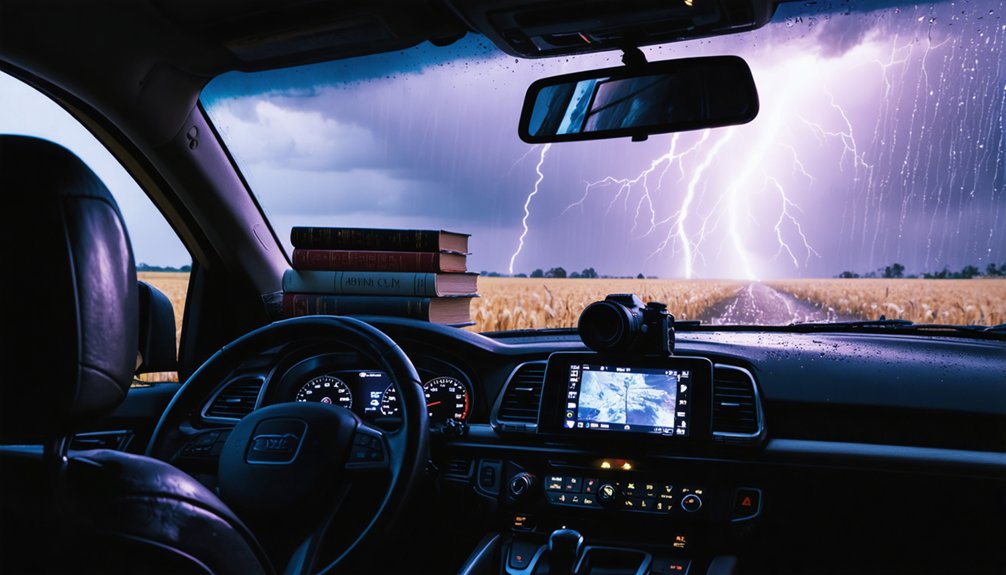
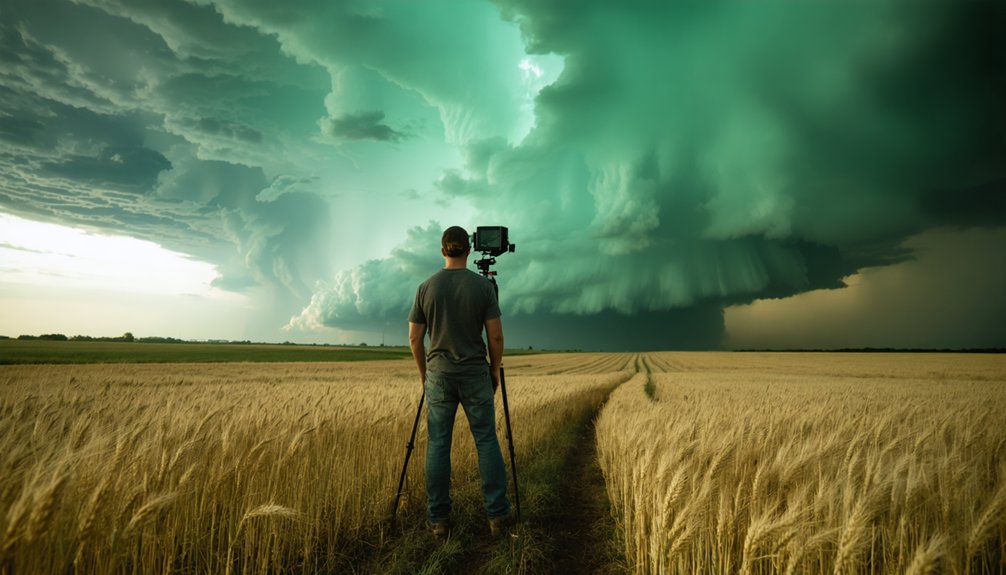
You’ll find the most remarkable tornado footage spans from 1933’s first-ever film capture in Cuba to modern 4K intercepts like Sean Casey’s TIV2 surviving 150-175 mph winds near Lebanon, Kansas in 2013. James Spann’s live broadcast of Cullman’s 80.3-mile EF4 tornado on April 27, 2011 demonstrated unprecedented real-time documentation, while today’s armored vehicles equipped with 360° IMAX turrets position within 100 yards of active vortices. The technological evolution from grainy historical recordings to broadcast-ready 4K footage reveals compelling insights into these phenomena.
Key Takeaways
- The 1933 Cuban rope tornado was the first ever filmed, though poor quality limits its impact compared to modern footage.
- The April 27, 2011 Cullman EF4 tornado broadcast by James Spann captured an 80.3-mile path with unprecedented live analysis.
- Sean Casey’s TIV2 captured extreme footage surviving 150-175 mph winds near Lebanon, Kansas on May 27, 2013.
- Modern storm chasers use 4K cameras and armored vehicles to film within 100 yards of active tornadoes safely.
- High-definition equipment like Sony FDR-AX700 and Canon EOS R systems now deliver broadcast-quality 4K tornado documentation.
The Dawn of Tornado Documentation: 1930s-1950s
Before sophisticated weather radar and storm-chasing networks existed, documenting tornadoes required extraordinary luck and primitive filming equipment. The 1933 British Pathé footage from Santa Cruz del Sur, Cuba captured the first tornado on film—a rope formation traveling 30 mph toward the Caribbean Sea. Despite its historical significance, the video quality remained poor.
Photographic clarity improvements emerged dramatically by 1953, when the Warner Robins, Georgia tornado footage demonstrated unprecedented visual fidelity, capturing homes being torn from foundations with remarkable detail. The Corn, Oklahoma documentation further showcased these advances. These emerging storm documentation techniques transformed scientific understanding, though filmmakers still struggled with the phenomenon’s unpredictability.
Even *The Wizard of Oz* (1939) relied on a 35-foot muslin cone with pumped dust rather than authentic footage, highlighting the scarcity of genuine tornado documentation during this pioneering era.
Modern Storm Chasing Technology and Techniques
Today’s storm chasers deploy specialized armored intercept vehicles equipped with reinforced frames, hail-resistant plating, and hydraulic ground anchors that enable teams to position within 100 yards of active tornadoes.
You’ll find these mobile research platforms integrate high-definition camera systems—including SIRUI anamorphic lenses on Sony bodies and RAM-mounted GoPros—that capture 4K footage at 60fps while maintaining stable shots through severe turbulence.
Real-time GPS positioning systems now combine multi-network cellular devices, satellite communicators like the Garmin inReach Mini 2, and dual-screen radar apps such as RadarScope Pro to deliver sub-5-minute data updates that pinpoint tornado locations within 50-meter accuracy.
Armored Intercept Vehicle Evolution
Sean Casey’s Tornado Intercept Vehicle (TIV) revolutionized storm chasing by transforming a Ford F450 Super Duty truck into a mobile fortress capable of driving directly into tornadoes. The TIV1 featured 1/4-inch steel plating, reinforced I-beams, and a 360° rotating IMAX turret, achieving 90 mph despite heavy armor.
TIV2 advanced the design with critical upgrades:
- Mobile scientific laboratory integration measuring humidity, air pressure, wind speed, and direction in real-time
- Hydraulic stabilization systems including ground-anchoring spikes and deployable skirts preventing vehicle flipping
- Composite armor combining steel, aluminum, Kevlar, and polycarbonate layers engineered for 250 mph wind survival
TIV2’s strongest intercept recorded 150-175 mph winds near Lebanon, Kansas on May 27, 2013. The 625-horsepower Cummins diesel engine powers this 14,300-pound vehicle past 100 mph, enabling unprecedented tornado documentation.
High-Definition Camera Equipment
Modern storm chasers deploy sophisticated camera systems capturing tornadoes in unprecedented detail, with equipment choices dictated by specific filming scenarios and scientific documentation requirements. You’ll find Sony FDR-AX700 and CX900 models dominating dashboard setups, delivering 1080p60 fps with stable zoom focus during pursuit.
Canon EOS R mirrorless systems paired with Sigma 24-105mm f/4.0 and 150-600mm f/5-6.3 lenses provide 4K resolution flexibility. Full-frame sensors on Nikon D750s minimize low-light noise in deteriorating atmospheric conditions.
Bolt Hunter triggers compensate for shutter lag by analyzing return stroke timing, scheduling subsequent exposures within milliseconds of lightning events. Ruff-Ride PTZ cameras output broadcast-ready 59.9 fps footage via SDI connections, while monitors enable real time footage transfer to backseat computers.
Camera storage limitations necessitate strategic file management during extended chase operations.
Real-Time GPS Positioning Systems
While sophisticated cameras record tornado structures in vivid detail, GPS technology determines where chasers position those cameras relative to rapidly evolving storm systems. Precise GPS based tracking revolutionized storm chasing when civilian access began in 1996, transforming navigation from guesswork into calculated intercepts.
Modern integrated tracking platforms like Street Atlas and Spotter Network plot your real-time position against storm movements, enabling strategic positioning for ideal footage while maintaining escape routes.
Core GPS capabilities enhancing tornado documentation:
- Real-time position awareness synced with radar data lets you anticipate storm paths and adjust positioning within seconds
- GPS dropwindsondes from Hurricane Hunters provide detailed atmospheric measurements, improving forecast accuracy for intercept planning
- Mobile applications display live chaser networks, preventing overcrowding at intercept points while identifying perfect vantage positions
You’ll navigate Tornado Alley’s complex road grids with precision unavailable to earlier generations.
The Historic Super Outbreak of April 27, 2011
You’re witnessing history when James Spann’s ABC 33/40 broadcast captures Cullman’s violent EF4 tornado live on April 27, 2011—the first time meteorologists tracked a major tornado in real-time across continuous television coverage.
The footage shows the wedge tornado‘s 80.3-mile path through northern Alabama, with Spann providing uninterrupted analysis as the storm intensified. This broadcast revolutionized severe weather coverage by demonstrating how live radar integration and chase footage could save lives during an outbreak that generated 62 tornadoes across Alabama in a single day.
Live Broadcast Breakthrough Moment
Debris ball signatures appearing on radar during the Phil Campbell tornado’s path
James Spann’s “tornado emergency” declaration for a half-mile to three-quarter-mile wide vortex
WTVA News identifying obvious debris signatures in the Smithville EF5
These breakthrough moments demonstrated how live radar analysis combined with visual confirmation could save lives through immediate, specific warnings.
Cullman’s Violent EF4 Tornado
As Alabama’s first violent tornado of the 2011 Super Outbreak began its destructive 47-mile journey at 2:40:30 pm CST, meteorologists recognized they were witnessing something extraordinary. The multi-vortex EF4 tornado reached maximum width of 1,440 yards with wind speeds approaching 160 mph.
You’ll understand its severity when examining downtown Cullman’s devastation: ten of fifteen businesses demolished within five seconds, while 867 residences sustained damage. Power transmission infrastructure damage left entire communities dark as the wedge-shaped funnel carved through three counties.
All 21 mobile homes at Ruth Mobile Home Park disintegrated, with frames tossed 150 yards. This 57-minute monster killed six people and injured 148 others, demonstrating why tornado emergency preparedness remains critical for your survival during severe weather events.
El Reno 2013: The Widest Tornado Ever Recorded
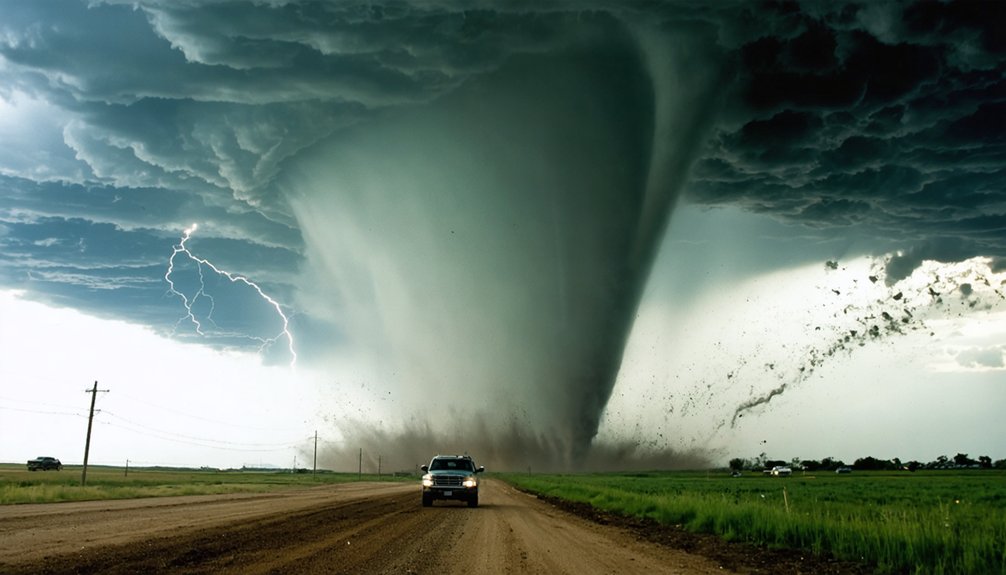
On May 31, 2013, the El Reno tornado achieved a maximum width of 2.6 miles, officially establishing it as the widest tornado ever recorded in United States history since systematic record-keeping began over six decades prior.
Mobile Doppler radar measured wind speeds exceeding 313 mph, prompting the National Weather Service to reclassify it as EF-5. The tornado’s rapid intensification and erratic movement pattern demonstrated the inherent risks of dangerous storm chasing, claiming eight lives including veteran researchers Tim Samaras, Paul Samaras, and Carl Young.
Key characteristics included:
- Record dimensions: 2.6-mile width, 16.2-mile ground path
- Extreme intensity: 313+ mph winds measured by mobile radar
- Scientific significance: Critical data revealed unpredictable supercell behavior patterns
You’ll find this event fundamentally changed understanding of tornado dynamics.
Armored Intercept Vehicles in the Heart of the Storm
On May 27, 2013, the TIV survived 150-175 mph winds inside Lebanon, Kansas’s tornado core—its strongest intercept. The 360° rotating turret captured IMAX footage while meteorological instruments recorded scientific data, advancing your understanding of tornadic wind dynamics through direct measurement rather than remote observation.
Devastating EF4 and EF5 Tornadoes Caught on Camera
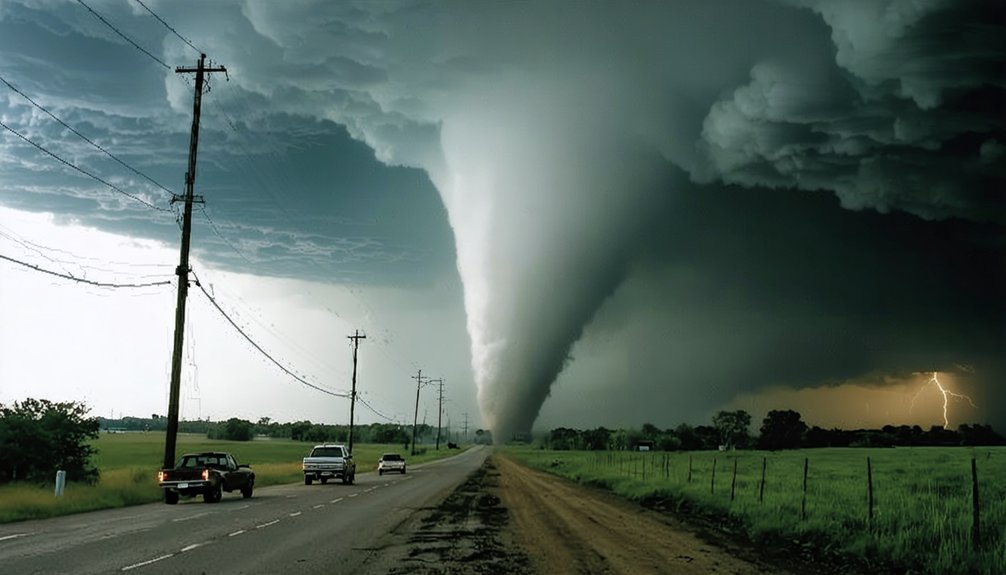
The most violent tornadoes on Earth—those rated EF4 and EF5—produce winds exceeding 166 mph and inflict near-total destruction on everything in their paths. You’ll witness nature’s raw power through footage documenting these catastrophic events, where radar analytics and wind vorticity analysis reveal unprecedented meteorological extremes.
The 2011 El Reno tornado achieved 295 mph winds via University of Oklahoma RaXpol measurements—the highest ever recorded. The 2013 Moore EF5 swept concrete foundations clean across Oklahoma. Most recently, 2024’s Greenfield Iowa tornado calculated winds at 309-318 mph, yet controversially received only EF4 classification.
Critical EF5 documentation includes:
- Charles Gafford III’s cell phone footage through shelter hole during Moore’s direct hit
- Multiple satellite vortices captured during El Reno’s mile-wide expansion
- Anthony Kamusa’s unobstructed core footage showing unfathomable ground motion at Greenfield
Personal Accounts: Surviving Violent Tornadoes on Film
Beyond wind speed measurements and structural damage assessments, survivor-recorded footage provides irreplaceable data on tornado behavior at ground level—documenting the rapid onset sequences, acoustic signatures, and physical forces that scientific instruments can’t fully capture. You’ll observe victims describing structures disintegrating within 30 seconds, bodies lifted from the ground, and debris penetrating buildings like projectiles.
Their accounts quantify human vulnerability: individuals trapped under rubble for 15 minutes, sustaining injuries doctors labeled “should have been fatal.” These recordings document the emotional toll of tornado survivors traversing nail-scattered landscapes barefoot while hearing neighbors’ screams.
Yet footage also reveals community resilience—volunteer organizations arriving within days, entire neighborhoods surviving against probability, families immediately focused on rebuilding lives after devastation rather than material losses.
Frequently Asked Questions
How Do Storm Chasers Know When to Evacuate From a Dangerous Tornado?
You’ll know it’s time to evacuate through tornado warning systems and weather pattern monitoring that detect rotation and debris. When you observe darkening skies with visible rotation, act immediately—your freedom depends on recognizing these critical visual cues.
What Camera Equipment Is Best for Filming Tornadoes Safely?
Tornadoes average under 10 minutes, so you’ll need reliable full-frame cameras with telephoto lens considerations for safe-distance shooting and proper camera stabilization techniques using tripods—enabling you to capture quality footage while maintaining essential mobility and quick evacuation capabilities.
Can Tornadoes Be Predicted Days in Advance With Current Technology?
You can’t pinpoint exact tornado formation patterns days ahead, but you’ll track atmospheric pressure fluctuations and identify high-risk periods 1-3 weeks out. Current extended-range forecasting gives you probabilistic outlooks, not specific tornado warnings.
How Much Does It Cost to Build an Armored Storm Chasing Vehicle?
You’ll spend $81,000–$750,000 building your armored chaser, depending on specifications. Factor in storm chasing insurance costs and specialized tornado resistant gear—medieval-thick polycarbonate windows, reinforced steel frames, and hydraulic ground anchors guarantee you’re protected during extreme intercepts.
Are There Ethical Concerns About Profiting From Tornado Footage?
Yes, you’ll face ethical concerns beyond compensation. Privacy concerns arise when filming disaster victims without consent, and you’re potentially profiting from others’ suffering. You must balance documentation value against exploiting tragedy for revenue.