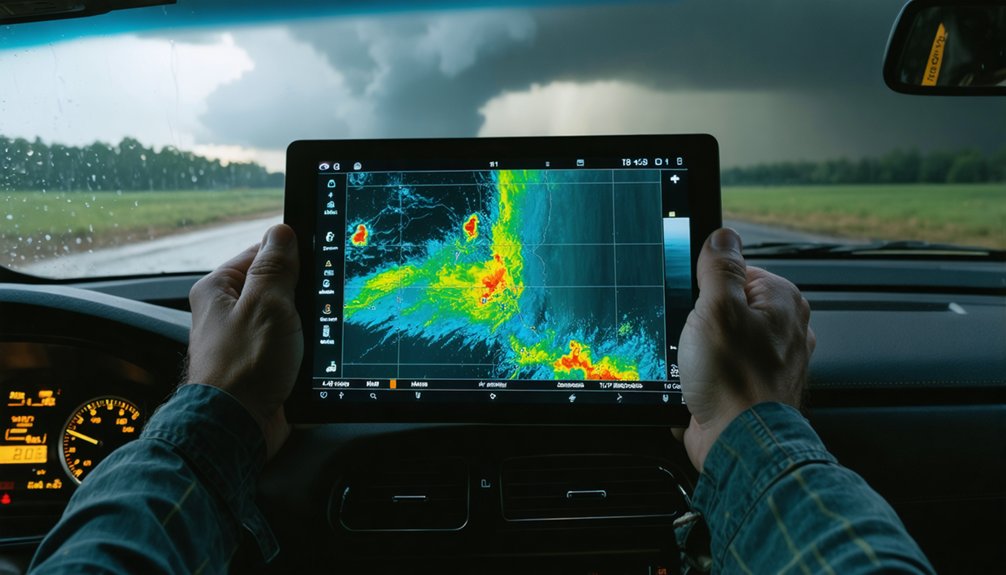
You’ll maximize storm interception success by leveraging dual-polarimetric radar’s critical variables—reflectivity, differential reflectivity, and correlation coefficient—to identify precipitation characteristics with unprecedented precision. Level 2 data feeds deliver 0.5° resolution for detecting mesocyclone velocity couplets and hail cores, though they require 45-90 seconds transmission time versus Level 3’s 3-8 second delivery. Super-resolution analysis enables 250-meter feature detection, revealing rotation signatures invisible at standard 1-kilometer resolution. Comprehending how network availability, cellular infrastructure limitations, and dynamic capacity allocation affect real-time data access guarantees you’re strategically positioned when conditions rapidly evolve.
Key Takeaways
- Dual-polarimetric radar measures precipitation particle size, shape, and type to improve weather prediction accuracy and reduce false alarms.
- Level 2 data provides high-resolution storm structure analysis, while Level 3 enables rapid severe weather assessment with lower bandwidth requirements.
- Super-resolution analysis detects hidden hail cores and mesocyclone rotation signatures at 250-meter resolution using dual-polarization algorithms.
- Network capacity and predictive analytics ensure real-time data feeds maintain sufficient temporal resolution during peak demand spikes.
- Advanced detection algorithms including MESH, HCA classification, and CNN-based techniques maximize hail identification accuracy for strategic storm positioning.
Dual-Polarimetric Radar Technology Transforms Target Detection Capabilities
While traditional single-polarization radar transmits and receives electromagnetic waves in only one plane, dual-polarimetric radar technology revolutionizes target detection by simultaneously transmitting horizontally and vertically polarized waves. You’ll gain access to critical polarimetric variables including reflectivity, differential reflectivity, correlation coefficient, and specific differential phase.
This multi-dimensional analysis enables precise measurement of precipitation particle size, shape, and type—distinguishing rain from hail, snow, and graupel with unprecedented accuracy.
The technology processes horizontal and vertical cross-sections to extract exhaustive precipitation characteristics, eliminating the guesswork inherent in conventional systems. By analyzing scattered wave properties from both polarizations, you’ll achieve superior weather prediction accuracy while reducing false alarms through signal redundancy.
This advancement represents the most significant NEXRAD enhancement since Doppler radar installation in the 1990s, empowering meteorologists with autonomous, reliable data for critical decision-making.
Understanding Level 2 Versus Level 3 Data Feed Options
When selecting radar data feeds for storm interception operations, you’ll encounter two fundamentally distinct NEXRAD output types that determine your analytical capabilities and response timing. Level 2 data delivers raw radar moments—reflectivity, radial velocity, spectrum width—at original resolution with minimal latency as individual scans release. You’ll access fine-grained controls for correlating atmospheric phenomena with land surface parameters through 160 NEXRAD sites.
Level 3 data provides processed algorithmic products after complete volume scans: hail probabilities, storm movement vectors, dual-pol echo classifications. These derived products reveal temporal variations in precipitation type and accumulation rates.
Level 2 excels for advanced structural analysis requiring high-resolution base data, while Level 3 enables rapid severe weather assessment through pre-computed storm cell metrics and visualization-ready images.
Matching Data Resolution to Field Conditions and Network Availability
You’ll encounter fundamental trade-offs when selecting between Level 2 base reflectivity data (0.5° resolution) and Level 3 derived products (1-4 km composite grids), as higher spatial resolution increases bandwidth demands by 8-12× while cellular networks in rural storm environments typically sustain only 512 kbps to 5 Mbps during severe weather events.
Cellular capacity constraints force operational decisions: Level 2 data enables precise storm structure analysis at 250 m radial resolution but requires 45-90 seconds per volume scan transmission, whereas Level 3 products transmit in 3-8 seconds yet sacrifice mesocyclone-scale features critical for intercept positioning.
Your network availability directly determines whether you can maintain real-time data feeds at sufficient temporal resolution (1-2 minute updates) to track rapidly evolving supercells moving at 15-25 m/s across the intercept corridor.
Level 2 Vs Level 3 Trade-Offs
- Processing overhead: Level 2 delivers sub-microsecond latency for intra-VLAN traffic, while Level 3 adds 15-30% CPU utilization for IP header inspection
- Scalability constraints: Level 2 limits you to single broadcast domains; Level 3 enables inter-VLAN routing without external hardware
- Field resilience: Level 2’s simplified duplex negotiation withstands harsh environmental interference better than complex Layer 3 protocols
- Availability architecture: Level 3 provides 10G uplink aggregation and DoS prevention for high-density mobile deployments
Match your architecture to actual field mobility patterns and network coverage density for ideal storm data collection.
Cellular Capacity Operational Constraints
Your cellular network’s data resolution capabilities don’t exist in a vacuum—they’re bounded by the physical infrastructure that connects storm-tracking vehicles to backend processing systems. BSC-MSC link capacity constraints and switch fabric limitations directly impact your ability to transmit high-resolution radar data during critical intercept windows.
When backbone links allocate only partial capacity to cellular traffic, dynamic capacity allocation becomes essential—routing 50% of traffic to redundant nodes during failures maintains availability without sacrificing resolution. Network latency considerations intensify during peak demand spikes; a 20% utilization surge from concurrent storm events can breach capacity thresholds.
Spectrum availability, fiber capacity, and equipment degree limits constrain operational scalability. You’ll need predictive analytics detecting anomalies before capacity breaches occur, ensuring storm data transmission isn’t throttled when atmospheric conditions demand maximum resolution.
Identifying Hidden Storm Features Through Super-Resolution Analysis
Super-resolution radar analysis allows you to detect hail cores and rotation signatures that conventional 1 km resolution data can’t resolve, similar to how STORM microscopy reconstructs sub-diffraction features through advanced signal processing.
You’ll identify mesocyclone velocity couplets with 250 m resolution using dual-polarization algorithms that differentiate tornadic from non-tornadic signatures through enhanced gate-to-gate shear calculations.
Compressed sensing techniques applied to Level II radar data increase your detection threshold for embedded vortices and hail shafts by reconstructing high-density storm features from sparse sampling intervals.
Hail Core Detection Methods
Modern radar systems employ multiple complementary approaches to penetrate storm structures and reveal the hail cores that determine intercept success. You’ll leverage dual polarimetric signatures to distinguish hail from rain by analyzing particle shape and density characteristics that single-polarization methods miss. This advancement delivers unprecedented capability for maximizing hail detection accuracy in severe convective environments.
Your detection arsenal includes:
- MESH algorithms integrating vertical reflectivity profiles with temperature data to estimate maximum hailstone diameter
- HCA classification distinguishing rain-hail mixtures across three size categories using dual-pol metrics
- CNN-based detection processing 30 km × 30 km reflectivity grids, outperforming traditional POSH methods by reducing false alarms
- VIL density thresholds discriminating severe hail events with optimized POD, FAR, and CSI performance statistics
These integrated methodologies provide the tactical intelligence necessary for strategic storm positioning.
Velocity Couplet Recognition Techniques
The velocity couplet manifests as concentrated radial winds creating opposing flow signatures—red-yellow pixels indicating outbound motion adjacent to blue-green pixels showing inbound motion—that reveal mesocyclone rotation beneath supercell updrafts. You’ll identify these rotational dynamics identification markers perpendicular to the radar beam axis, often collocated with hook echoes on the southwest storm flank.
Super-resolution analysis exposes hidden storm features invisible in standard data, while SAILS-3 technique captures 0.5° scans more frequently for enhanced low-level detection. Synthetic Dual-Doppler retrieval methods extract core vertical velocity profiles around mesocyclone cores, tracking mesovortex evolution through single-Doppler storm-relative velocity measurements.
Tight red-green pixel spacing signals strong rotation preceding tornado vortex signatures. Counter-rotating vortex couplets display divergent motion patterns, with cyclonic mesovortices generating stronger damage potential than their anticyclonic counterparts.
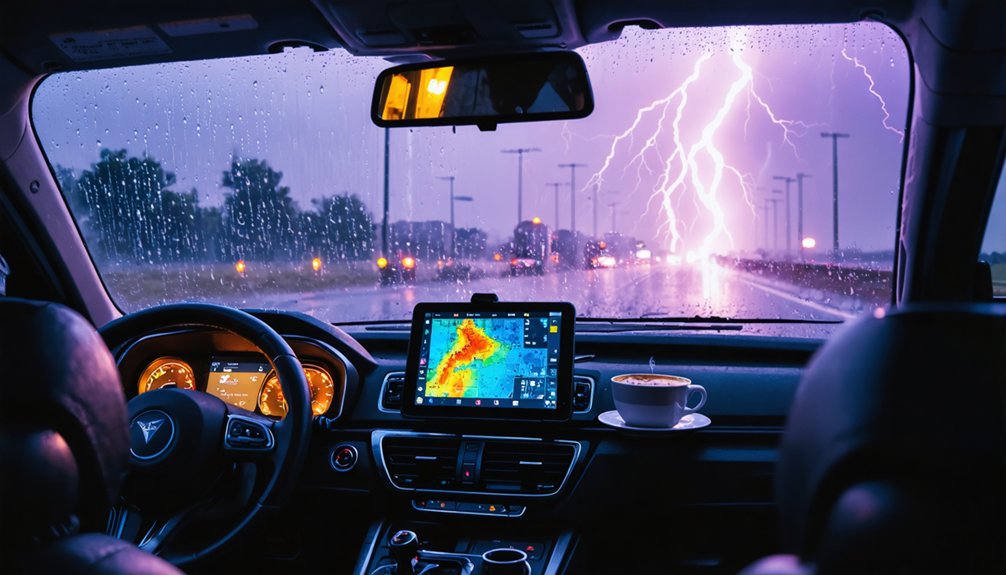
Mastery of velocity couplet interpretation transforms storm interception from reactive guesswork into strategic navigation. You’ll identify rotating storm intensity through multi-level couplet persistence, where 10+ minute signatures signal mesocyclone identification and potential tornado development.
Storm-relative velocity displays clarify internal wind patterns, revealing rotational cores while eliminating motion artifacts that compromise decision-making.
Strategic positioning around hail cores demands recognition of key velocity signatures:
- Storm top divergence exceeding 75 knots sustains severe hail production through persistent updrafts
- Counter-rotating mesovortex pairs exhibit divergent motion requiring increased separation distances
- Midlevel convergence signatures precede downburst development by 5-15 minutes
- Peak velocities at core edges mark maximum wind zones for boundary positioning
Downburst prediction algorithms detecting microbursts above 35 mph provide critical timing for approach adjustments, ensuring you maintain operational freedom while minimizing exposure to rapidly evolving hazards.
Cellular Infrastructure Challenges in Rural Chase Environments
Rural storm chasers confront a critical operational paradox: severe weather concentrates in America’s Great Plains corridor where cellular infrastructure remains sparse and vulnerable. You’ll encounter 80% tower failure rates during storms, compounded by rural tower placement economics that discourage provider investment across vast, sparsely populated terrain.
Installation costs exceeding $27,000 per fiber mile create deployment barriers, while hilly topography complicates signal propagation. Emergency power redundancy proves inadequate when backup generators fail from waterlogging and fuel depletion. Hurricane Maria demonstrated catastrophic consequences—six-month outages in remote territories. Geographic isolation delays restoration, with remote communities serviced last.
You’re forced toward alternative communication methods: satellite phones, mesh networks, and amateur radio systems that bypass conventional infrastructure dependencies during critical chase operations when real-time data transmission determines interception success.
Balancing Download Speed Against Image Quality Requirements

Beyond infrastructure reliability, you’ll face immediate technical decisions about data transmission once connectivity exists. Optimizing image compression ratios determines whether you’ll capture critical storm structure details or sacrifice quality for transmission speed. Your choice impacts operational effectiveness when seconds matter.
Key compression trade-offs:
- Raw imagery at 20-30MB per frame delivers maximum meteorological detail but requires 15-45 seconds over typical 4G connections
- JPEG compression at 80% quality reduces file size to 3-5MB while preserving essential mesocyclone features
- Aggressive compression below 60% quality introduces artifacts that compromise scientific analysis of rotation signatures
- Monitoring bandwidth utilization trends reveals when network congestion demands dynamic quality adjustment
You’ll need automated protocols that adapt compression based on real-time bandwidth availability, ensuring critical observations reach forecasters while maintaining analytical integrity for post-event research.
Strategic Data Selection for Real-Time Interception Decisions
When milliseconds separate successful tornado interception from missed opportunities, your data prioritization framework determines mission outcomes. Your data ingestion workflow must ruthlessly filter signal from noise—prioritizing Doppler-detected rotation signatures, overshooting top temperatures below -60°C, and convergence lines over peripheral atmospheric parameters.
Training machine learning models on historical interception datasets enables automated threat ranking, freeing you from manual analysis paralysis. Cross-reference radar reflectivity above 60 dBZ with lightning frequency spikes and moisture convergence zones to identify imminent tornado genesis.
Web-based integration tools deliver near-real-time satellite, radar, and model analysis simultaneously, but selective overlay thresholds prevent information overload. Strategic exclusion of low-priority datasets accelerates decision velocity—your autonomous storm chase depends on ruthless data curation that preserves only actionable intelligence for path-adjustment decisions.
Frequently Asked Questions
What Backup Power Solutions Work Best for Extended Radar Monitoring Sessions?
You’ll need lithium-ion battery systems delivering ≥95% efficiency for sessions under 9 hours, paired with HyMax Fuel Cells providing 5+ days runtime. These portable power options surpass backup generator reliability while ensuring zero-emission operation in remote locations.
Which Mobile Applications Provide the Most Reliable Dual-Polarimetric Data Access?
You’ll find NOAA Dual Radar and WeatherFront Radar deliver unfiltered dual-polarimetric access. Both apps excel in weather app integration and radar quality assessment, offering detailed ZDR, CC, and KDP products—empowering your independent storm analysis without restrictions.
How Do Storm Chasers Calibrate Radar Data With Ground Truth Observations?
You’ll validate calibrating radar accuracy by analyzing ground observations like hail reports, precipitation measurements, and damage surveys. Cross-reference reflectivity values with actual conditions, then apply correction factors to compensate for beam height, attenuation, and sampling biases in real-time chase operations.
What Costs Are Associated With Accessing Level 2 Versus Level 3 Feeds?
Traversing radar options resembles choosing between binoculars and telescopes. You’ll encounter feed subscription costs of $250 for Level 2 versus $79.95 for Level 3, with data analysis expenses escalating dramatically when requiring real-time broadcasting systems exceeding $50,000.
Can Satellite Data Supplement Radar When Cellular Networks Fail Completely?
Yes, you’ll maintain storm tracking through satellite network redundancy when cellular fails. Geostationary and polar-orbiting satellites operate independently via dedicated ground stations, ensuring remote sensor connectivity without relying on commercial cellular infrastructure for data transmission.