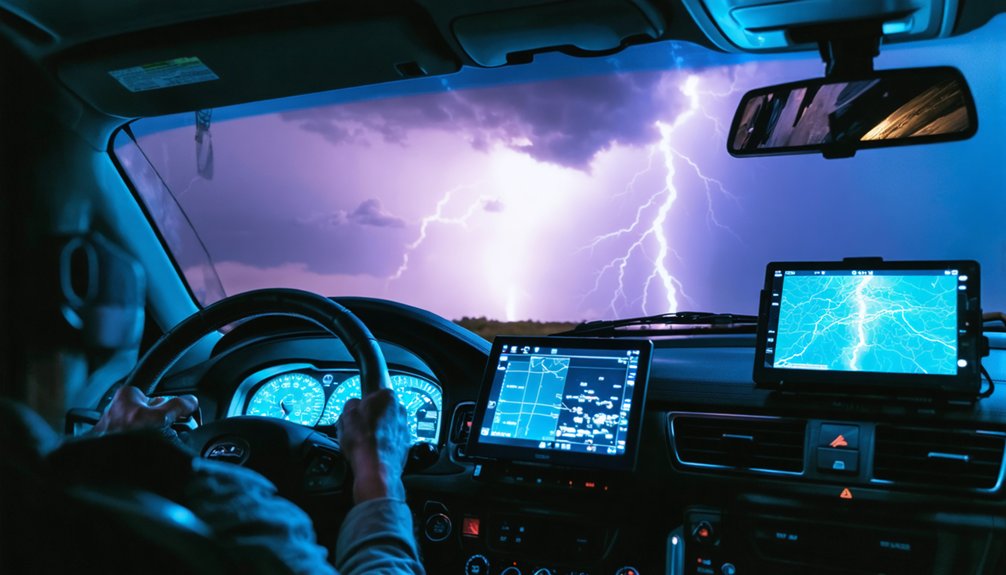
You’ll maximize media impact of storm chaser rescue operations by maintaining simultaneous documentation streams: GPS-stamped video footage, radio communication logs, and real-time coordination with National Weather Service and emergency management. Position cameras to capture both rescue interventions and atmospheric conditions while your designated team member posts safety-critical updates across YouTube, Facebook, and Twitter. Establish credibility by pairing heroic footage with verified weather data and fatality statistics that demonstrate your operational protocols. The sections below outline specific techniques for transforming documented rescues into compelling public education while maintaining evidentiary integrity for professional handoff.
Key Takeaways
- Document rescue operations through synchronized atmospheric data, radio logs, and victim tracking records for professional agency handoffs.
- Capture georeferenced video evidence linking visual sequences to radar scans while maintaining safe observer positions during interventions.
- Establish pre-storm communication protocols with National Weather Service, emergency management, and local media outlets for coordinated reporting.
- Deploy dedicated social media team to share verified rescue footage across multiple platforms while protecting victim privacy.
- Build media credibility using verified safety statistics and data-driven metrics demonstrating storm chasing protocols and rescue effectiveness.
Documenting Real-Time Rescue Events During Severe Weather Emergencies
When severe weather strikes and rescue operations launch, three critical data streams must activate simultaneously: atmospheric monitoring equipment positioned at strategic intervals around the developing storm system, continuous radio communication linking field personnel to centralized command operations, and systematic documentation protocols that track every victim location, structural collapse, and search pattern completion.
Your field resource coordination depends on real-time satellite imagery and radar feeds that inform tactical repositioning decisions as conditions evolve. Situational awareness management requires marking protocols—slash marks indicate active searches, X marks confirm completed areas—preventing dangerous duplication of efforts.
You’ll maintain notebook logs documenting plan modifications, victim removals, and trapped individuals. These records enable seamless handoff to professional agencies while your eye observations locate casualties and hazards that instruments can’t detect.
Capturing Compelling Visual Evidence of Storm Chaser Interventions
During high-stakes rescue interventions, your visual documentation system must balance operational safety with evidentiary integrity—position cameras to capture funnel dynamics while maintaining stationary observer status relative to the moving vortex, enabling accurate wind speed calculations from base rotation patterns. Your equipment setup demands muscle memory operation, freeing attention for life-saving decisions while maintaining cinematographer perspectives that serve dual purposes: immediate tactical assessment and post-event analysis.
Storm documentation ethics require you to integrate unique landmarks—fence posts, highway markers—into frames, establishing precise geospatial coordinates for emergency response coordination. Record verbal metadata linking each sequence to radar volume scans and active warnings. This protocol-driven approach guarantees your visual evidence supports both rescue operations and subsequent scientific analysis, transforming chaotic intervention moments into actionable intelligence without compromising your freedom to maneuver during critical situations.
Coordinating With Local News Outlets and Emergency Services
Your visual documentation becomes exponentially more valuable once integrated into official emergency response networks, where your firsthand observations can save lives beyond immediate rescue situations.
Submit severe weather reports directly to the National Weather Service to expedite warning distribution. Coordinate with emergency management directors through centralized communication systems at Emergency Operations Centers, where your ground truth information supports resource allocation planning alongside formal meteorological data.
Establish contact protocols with local media outlets before storm events, ensuring your footage reaches communities requiring immediate alerts. Complete training on emergency procedures addressing liability concerns and cross jurisdictional communication standards.
Share real-time intelligence through dedicated group chats connecting shelter networks, county departments, and field personnel. Your collaboration with official agencies strengthens community preparedness while maintaining operational independence throughout response activities.
You must establish a multi-platform presence before rescue operations occur, prioritizing YouTube for long-form documentation, Facebook for community reach, and Twitter for real-time updates.
During active rescues, designate a team member to capture verified footage and post immediate safety-critical information using standardized hashtags like #StormRescue and location tags.
Your content strategy should balance heroic documentation with operational security—never compromise victim privacy or emergency responder coordination for engagement metrics.
Platform Selection Strategy
When emergency rescue footage demands maximum public impact, platform architecture determines whether heroic actions reach thousands or millions of viewers.
YouTube’s long-form capability suits exhaustive rescue documentation—Freddy McKinney’s Hawley tornado family save demonstrated this when FOX Weather amplified the “GET INSIDE HURRY” moment through extended coverage. Platform performance metrics show YouTube subscribers provide sustained visibility, with McKinney gaining 25,000 followers through chase content.
TikTok accelerates immediate heroic action sharing through short-form distribution, though its algorithm pushes toward extreme close-ups rather than complete rescue narratives.
Twitter enables real-time coordination during active operations, while Instagram builds visual credibility portfolios.
Cross-platform distribution maximizes reach—live streams aggregate multiple chaser feeds, ensuring collaborative rescue efforts achieve recognition beyond fragmented communities. Strategic platform selection transforms isolated heroic moments into documented public service achievements.
Real-Time Documentation Techniques
During active tornado intercepts, multi-device documentation systems capture rescue operations with forensic precision—mount your primary smartphone on the dashboard for continuous wide-angle coverage while a secondary device records close-up victim interactions.
Deploy weatherproof action cameras with proper sensor calibration to maintain exposure accuracy despite rapidly changing storm lighting conditions. Your audio quality demands noise-controlled headsets that isolate victim communication from wind roar.
Performance benchmarking protocols require:
- Stationary recording positions until rescued subjects traverse the full frame, establishing scale for incident reconstruction
- Foreground landmark inclusion like damaged structures or debris markers for post-event geolocation verification
- Timestamp synchronization across all devices, broadcasting event occurrence times rather than upload times for accurate emergency response coordination
Stream live feeds through LoRa networks when cellular coverage fails, ensuring uninterrupted documentation.
Hashtag and Tagging Best Practices
Strategic hashtag deployment transforms rescue documentation into discoverable content that educates the public while establishing your credibility as a first responder.
You’ll maximize reach by combining high-traffic tags like #stormchaser (234,705 posts) with event-specific identifiers. The ideal hashtag length balances discoverability and specificity—blend popular tags (#storm, #stormchasing) with precise rescue descriptors. Platform algorithms favor 8-12 tags on Instagram, while TikTok responds to 3-5 focused selections.
Your hashtag repetition strategies should maintain consistency across posts documenting single operations. Use #supercell (2,525,027 posts) and #thunderstorm (2,213,855 posts) as foundational anchors, then rotate secondary tags between updates. This approach builds searchable threads without triggering spam filters.
Document responsibly—prioritize victim privacy and operational security over viral potential. Your content establishes life-saving protocols, not entertainment value.
Building Credibility Through Accurate Weather Data and Safety Metrics
You’ll establish immediate credibility with media outlets by presenting verified fatality statistics: storm chasing averages less than one death per year over 14 years, while NOAA documents 80 annual tornado deaths and significant flash flood casualties nationwide.
These metrics demonstrate you’re trained to assess risk systematically, not operating recklessly in dangerous conditions. When you frame rescue operations against documented safety protocols and actual threat data, journalists recognize you as a reliable source rather than an adrenaline-seeking liability.
Storm Chaser Fatality Rates
When rescue operations involve storm chasers, you’ll need accurate fatality data to counter media sensationalism and support evidence-based decision protocols. Since 2005, storm chasing deaths average less than one per year, with sixteen total fatalities—four direct weather deaths and twelve from road accidents. Understanding these metrics informs your chasing safety protocols and resource allocation decisions.
Critical statistics include:
- Road fatalities exceed tornado deaths, with nearly half from hydroplaning in post-chase conditions
- The 2013 El Reno incident remains the only direct tornado fatality event, killing three researchers
- Fatality rate calculates to 1 in 944,444 person days—significantly lower than comparable outdoor activities
Your weather forecast accuracy and evidence-based risk assessment prevent unnecessary interventions while ensuring legitimate emergencies receive appropriate response. Road hazards, not tornadoes, represent the primary threat requiring your operational focus.
Annual Tornado Impact Statistics
Road accident prevention builds on understanding the broader tornado landscape that shapes your operational environment. You’re operating in a historic period: 2025’s 1,558 tornadoes exceeded the 15-year average, with eight (EF)F4+ events—the most violent activity since 2013.
Your storm chaser safety considerations must account for concentrated threat zones: Texas, Illinois, Missouri, Mississippi, and Alabama logged the highest counts. The 68 fatalities this year—up from 54 in 2024—underscore real consequences.
When you’re traversing 550 tornado warnings in a single week like March 29–April 6, your protocols determine survival. Post disaster community aid depends on your team’s disciplined response.
The late-season inactivity (172 tornadoes August–December versus 1,106 March–June) reveals ideal timing for operations and resource deployment.
Flash Flood Death Data
Flash floods kill more people than any other flood type, and half of those fatalities happen inside vehicles. When you’re covering storm chaser rescue operations, accurate flash flood prevention messaging can save lives. Understanding flash flood risk mapping helps you communicate critical data without government-mandated delays.
Key Flash Flood Fatality Data You’ll Need:
- The 1972 Rapid City disaster killed 237 people when 15 inches of rain fell in 5 hours—demonstrating why rapid response matters
- Vehicle-related deaths account for 50% of flash flood fatalities, making road coverage essential
- Flash floods cause more U.S. flood deaths than any other category, prioritizing your coverage decisions
You’ll need these statistics when coordinating with rescue teams and broadcasting warnings. Share flash flood risk mapping data immediately—don’t wait for official channels. Your independence allows faster, potentially life-saving communication.
Transforming Rescue Stories Into Public Education Opportunities
Every storm chaser rescue operation contains critical lessons that can save lives during future disasters. You’ll maximize impact by partnering with verified media outlets to distribute factual accounts immediately after operations conclude.
Storm chaser rescue operations provide invaluable lessons—partner with verified media to share factual accounts and maximize life-saving impact.
Document specific protocols that succeeded—navigation methods during 100+ mph winds, communication systems that functioned when infrastructure failed, and victim location techniques that worked in zero-visibility conditions.
Transform raw footage into targeted educational content using FEMA’s Disaster Multimedia Toolkit. Focus audience engagement on actionable intelligence: evacuation timing, shelter-in-place decisions, and emergency supply priorities.
With SAR missions down 22% yet injuries up 35%, your documented experiences fill critical knowledge gaps. Partner with meteorological organizations to contextualize rescue scenarios within broader disaster patterns, ensuring communities understand both immediate threats and long-term preparedness requirements.
Frequently Asked Questions
What Legal Liability Concerns Exist When Storm Chasers Intervene in Rescue Situations?
You’ll face potential negligence suits if rescue attempts cause harm, despite Good Samaritan protections. Guarantee you’ve secured legal liability waivers beforehand and follow ethical rescue protocols demonstrating good faith. Your intervention must show proper training and reasonable care standards.
How Do Storm Chasers Maintain Equipment Functionality During Severe Weather Rescues?
You’ll protect your gear through rigorous equipment durability testing before deployments and proactive storm chaser equipment maintenance during operations—waterproofing electronics, securing mounts against vibrations, and keeping backup power systems ready guarantees you’re never compromised when lives depend on functionality.
What Insurance Coverage Do Storm Chasers Need for Rescue Operations?
You’re chasing storms to save lives, yet you’ll need liability insurance coverage and medical expense reimbursement to protect yourself. Without proper protocols, your rescue freedom becomes financial bondage when accidents strike during critical operations.
How Should Storm Chasers Handle Traumatized Victims During Post-Rescue Interviews?
Prioritize victim privacy above media coverage. Approach interviews sensitively only after medical clearance, letting survivors control timing and location. Don’t pressure responses. Provide support resources, obtain clear consent, and guarantee they’re never retraumatized for content.
What Compensation or Recognition Programs Exist for Civilian Storm Chaser Rescuers?
You’ll find limited formal compensation exists for civilian rescuers. Government aid programs typically target victims, not responders. However, community recognition programs may honor your efforts through awards, though they don’t provide financial compensation for rescue activities.