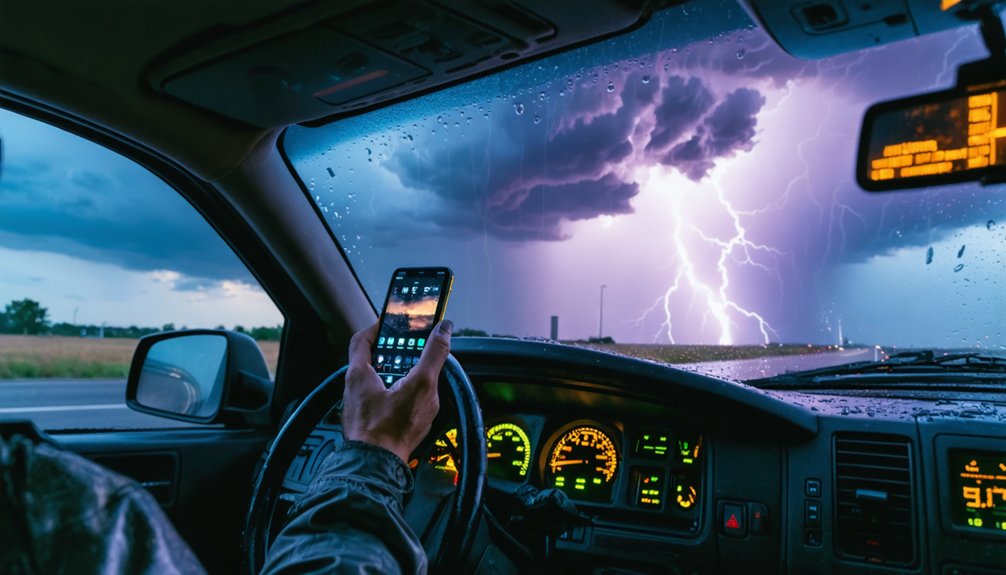
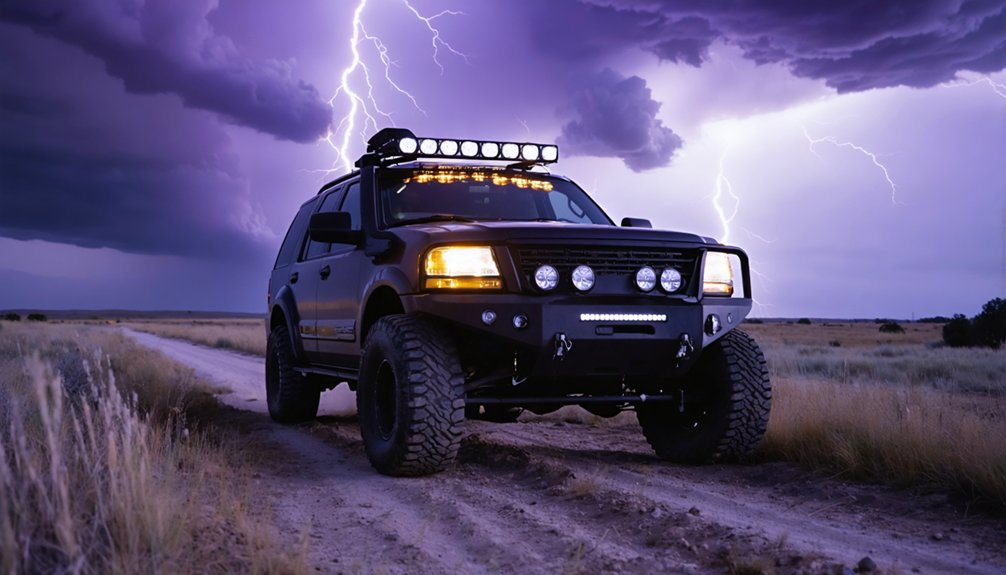
Professional storm chasers engineer their vehicles as mobile command centers built for reliability, speed, and survival. You’ll want all-wheel drive, solid ground clearance, and all-terrain tires for unpredictable roads. Inside, organize critical gear into quick-access zones and power everything through fused 12V circuits backed by auxiliary batteries. Layer your communications across GMRS, ham radio, and dual-carrier hotspots. Every system you build into your setup increases your margin for safety — and there’s far more to each component worth knowing.
Key Takeaways
- Professional storm chasers prioritize reliable, fuel-efficient vehicles with all-wheel drive, adequate ground clearance, and interiors optimized for quick equipment access.
- All-terrain tires, maintained inflation, and a properly mounted spare tire prepare chasers for unpredictable, deteriorating roads near active storms.
- Critical devices are organized in quick-access zones, powered by fused 12V circuits and auxiliary batteries to protect the starter battery.
- Layered communication systems combining GMRS radios, ham radios, dual-carrier hotspots, and satellite messaging prevent total connectivity failure in the field.
- Professional-grade radar tools like RadarScope, paired with multi-camera setups, provide situational awareness and comprehensive storm documentation during chases.
What Makes a Good Storm Chase Vehicle?
Choosing the right vehicle sets the foundation for every other decision in your chase setup. Vehicle reliability comes first — breakdowns in remote areas cost you time, positioning, and safety.
The right vehicle isn’t just transportation — it’s the decision every other chase decision depends on.
Fuel efficiency matters because you’ll cover hundreds of miles targeting active storm cells across wide corridors.
All-wheel drive improves your traction on wet or gravel roads, though you’ll trade some fuel economy. Ground clearance determines where you can go when roads deteriorate near storm-affected areas.
Beyond the chassis, tire selection directly affects control on unpredictable surfaces. Interior layout shapes how quickly you access navigation tools and communication systems without exiting the vehicle.
Power management keeps every device running throughout extended chase days. Each decision compounds — your vehicle either expands your operational freedom or limits it.
How Storm Chasers Choose Tires for Unpredictable Roads?
When you’re choosing tires for storm chasing, traction type matters more than most chasers initially expect, since all-season tires often fail to perform adequately on the muddy, debris-covered, or rain-soaked rural roads you’ll encounter near active storm environments.
You’ll also need to maintain proper tire condition and inflation consistently, because traction degrades quickly on unpredictable surfaces when tread is worn or pressure is off.
Finally, you should always carry a spare tire in serviceable condition alongside basic repair tools, since a flat on a remote chase road can strand you far from any service facility at the worst possible moment.
Prioritizing Tire Traction Types
Tires take on a different level of importance in storm chasing because road surfaces shift without warning—dry asphalt can give way to rain-slicked pavement, muddy field access roads, or hail-covered highways within the same chase day.
Standard all-season tires often lack the tire tread depth and weather adaptability needed for genuine terrain challenges. All terrain options deliver stronger road grip across mixed surfaces, improving off road capability without sacrificing highway performance.
You’ll want tires that handle seasonal performance demands—wet, loose, and debris-covered roads—without requiring constant swaps.
Monitor tire pressure consistently; cold fronts and temperature drops affect inflation quickly, reducing contact efficiency.
Choosing a tire rated for variable conditions gives you the traction control and flexibility that unpredictable chase environments demand.
Maintaining Proper Tire Condition
Selecting the right tire type gets you only halfway there—keeping those tires in reliable condition determines whether your traction advantage holds up across a full chase day.
Consistent tire maintenance tips and routine tire pressure checks aren’t optional—they’re operational necessities when rural roads shift from paved to gravel to mud without warning.
Before every chase, verify these three non-negotiables:
- Inflation levels: Carry a portable compressor and adjust pressure based on terrain—lower PSI increases surface contact on loose ground.
- Tread depth: Worn tread eliminates wet-road grip precisely when storms demand maximum control.
- Spare readiness: A mounted, properly inflated spare plus a basic plug kit keeps you mobile when service stations don’t exist for fifty miles.
Neglecting any one of these compromises your entire field operation.
Preparing Spare Tire Essentials
A single flat tire fifty miles from the nearest service station ends your chase day faster than any storm ever will. Your spare tire must be chase-ready — properly inflated, structurally sound, and accessible without dismantling your entire storage setup.
Integrate smart storage solutions that keep your spare secured yet retrievable within minutes. Carry tire tools including a quality lug wrench and portable jack rated for your vehicle’s weight.
Your emergency kit should include a plug-and-patch kit alongside inflation options like a 12V compressor for rapid field repair techniques. Verify tire pressure weekly — consistent tire maintenance prevents avoidable failures.
Don’t rely on roadside assistance when you’re operating deep in rural coverage gaps. Breakdown preparedness and practiced safety protocols keep you mobile, independent, and ready to reposition when conditions demand it.
How to Organize the Interior of a Chase Car for Safe, Fast Access?
Organizing a chase car’s interior around three principles—reachability, security, and cable discipline—cuts decision time when conditions deteriorate rapidly. Your interior layout should position every critical device within arm’s reach, eliminating exits during dangerous situations.
Prioritize equipment placement so radar, communication tools, and emergency supplies stay accessible without compromising driver visibility.
- Quick access zones: Mount laptops low, keep GMRS radios at shoulder height, and store emergency supplies behind the passenger seat.
- Organized storage: Use velcro straps, cargo nets, and rigid bins to prevent gear shifts during hard braking or rough roads.
- Cable management: Route and secure every cable along door panels or under floor mats to eliminate dangerous cockpit tangles.
Safety considerations demand that nothing loose becomes a projectile when you’re pushing hard through deteriorating weather.
How Storm Chasers Power All Their Equipment on the Road?
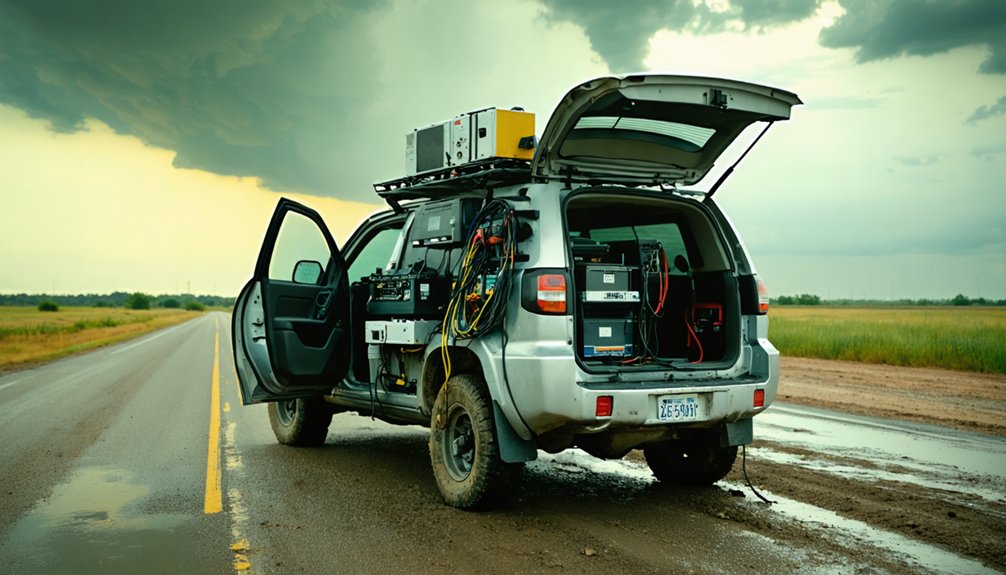
When you run laptops, radios, cameras, cellular boosters, and navigation devices simultaneously, your vehicle’s stock electrical system often can’t meet the combined load without careful planning.
You’ll typically need a fused 12V accessory circuit, a power inverter, or a secondary battery setup to distribute current reliably across all active devices.
Mapping your total amperage draw before you build out your system lets you identify weak points and prevent blown fuses or brownouts in the field.
Mobile Power System Essentials
Running a full suite of chase equipment—laptops, radios, cameras, hotspots, and navigation devices—puts a serious continuous load on your vehicle’s electrical system.
So understanding how to build a reliable mobile power setup isn’t optional; it’s foundational.
Effective battery management prevents mid-chase failures that no forecast can compensate for.
Your core power architecture should prioritize:
- Fused 12V accessory circuits wired directly to your battery for stable, low-resistance power delivery
- Power inverter options ranging from compact 150W units for single-device needs to 1,000W+ inverters supporting full workstation loads
- Auxiliary or lithium battery banks that isolate draw from your starter battery, protecting your ability to exit a situation quickly
Match your inverter capacity to your actual load, not your theoretical maximum, and monitor draw continuously.
Managing Electrical Load Demands
Every device in your chase rig draws current simultaneously, and without a clear picture of your total electrical load, you’re flying blind on power management.
Start by calculating the amperage of every connected device — laptops, radios, hotspots, cameras, and inverters. Add those figures together to determine your sustained draw versus your available capacity.
Effective battery optimization means matching your auxiliary battery bank to your peak and average load requirements, not guessing.
Prioritize energy efficiency by powering down non-essential devices during repositioning legs when data demand drops. Use fused circuits to isolate high-draw equipment and prevent cascading failures.
Monitor your system voltage in real time with a dedicated battery monitor.
Voltage drops below 12.2V signal trouble before equipment starts failing, giving you time to react.
The Radios and Communication Gear Storm Chasers Rely On
Staying connected during a chase isn’t optional—it’s a core operational requirement. You need layered communication systems that cover multiple radio frequencies and adapt to rapidly shifting conditions.
Relying on a single channel leaves you blind to emergency channels, chase networks, and public-safety traffic when it matters most.
Build your communication stack around these essentials:
- GMRS radios handle convoy coordination and support clear communication protocols between vehicles with strong audio clarity.
- Ham radios and scanners let you monitor emergency channels and track developing ground-level reports across active storm zones.
- Signal boosters paired with mobile antennas extend your cellular and radio range through weak-coverage rural corridors.
Equipment integration keeps everything accessible without pulling focus from positioning decisions.
Every component you add should serve a precise, functional role within your broader chase network.
Staying Connected When Cell Service Fails on a Chase
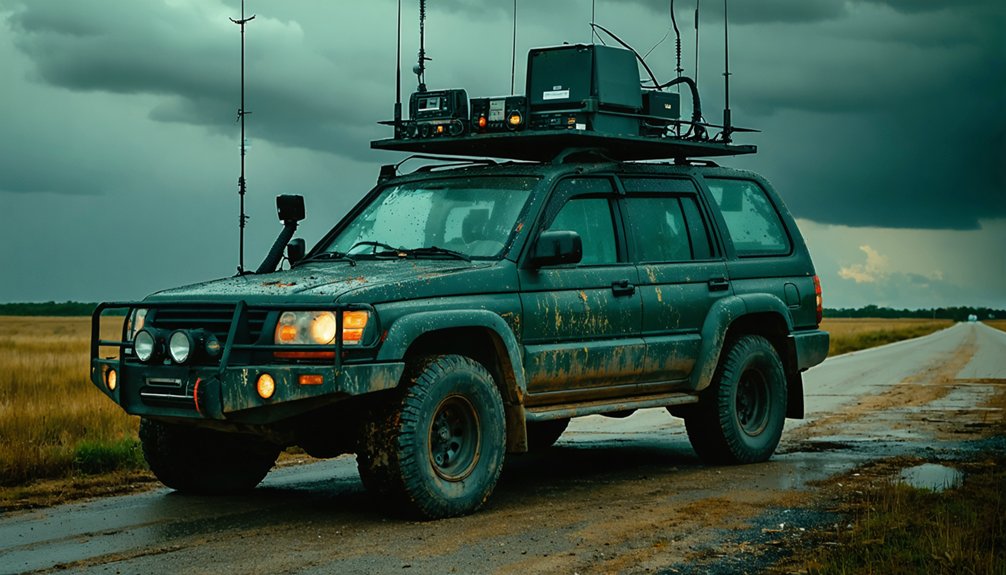
Cell service drops without warning in rural chase corridors, and when it does, your data pipeline collapses unless you’ve built redundancy into the system from the start.
A dual-carrier cellular backup strategy — pairing Verizon and AT&T hotspots — reduces single-network failure risk considerably.
Mount signal boosters with external antennas to amplify weak signals before they die completely.
When cellular fails entirely, satellite communication fills the gap. Devices like Garmin inReach provide two-way messaging and position tracking independent of terrestrial networks, giving you operational continuity when towers go dark.
Establish emergency protocols before each chase day. Know which backup system activates first, which contacts receive check-ins, and at what interval.
Freedom in the field depends on preparation you’ve already locked in before departure.
Radar Apps and Weather Data Tools Storm Chasers Actually Use
Radar quality determines your situational awareness in the field, so the tools you choose matter as much as how well you understand them.
Radar accuracy separates informed decisions from dangerous ones, and storm tracking demands layered data, not just a single source.
Most chasers build their toolkit around these core options:
- RadarScope – professional-grade radar accuracy with dual-pol products and storm tracking overlays
- Pivotal Weather or College of DuPage – model analysis and upper-air data for target refinement
- GR2Analyst – deep radar interrogation for mesocyclone structure and storm-mode analysis
Run your laptop for complex model work and your phone for quick positional checks.
Redundant data sources keep you operational when one platform lags or loses connection during a fast-moving chase.
How Storm Chasers Film and Document What They Chase?
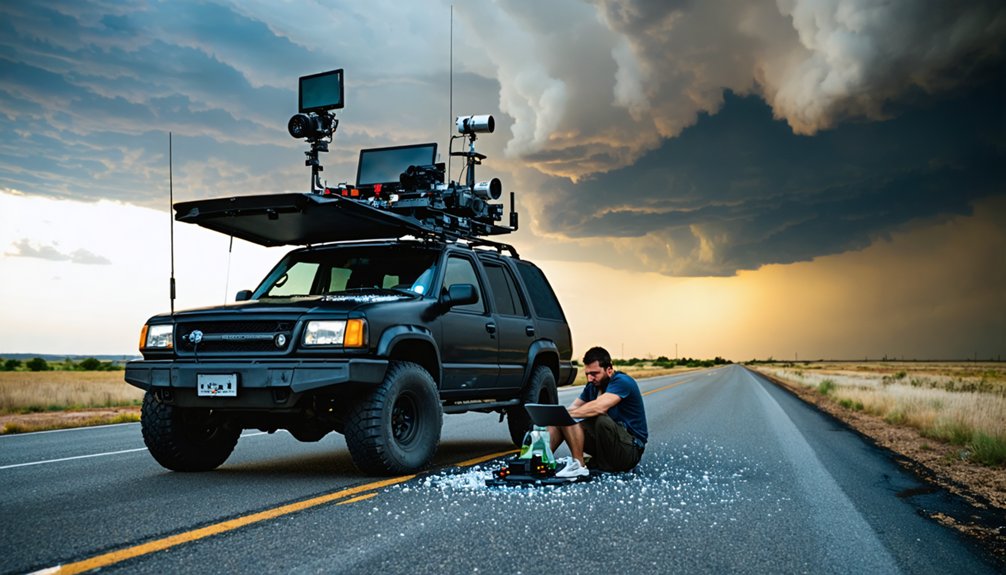
Capturing usable storm footage demands more than pointing a camera at a supercell—you need a layered imaging setup that covers multiple angles while keeping your hands on the wheel and your eyes on the storm.
Your equipment choices typically combine a forward-facing dash cam, a mounted DSLR, and rear or side angles for full situational coverage.
A multi-camera approach—dash cam up front, DSLR mounted, and rear angles covered—gives storm chasers true 360-degree situational awareness.
Filming challenges multiply fast—shifting lighting conditions, hail interference, and vibration all degrade footage quality.
You’ll manage data through structured file systems that support quick post-chase review.
Documentation techniques matter beyond raw capture; your visual storytelling depends on consistent angles and clean metadata.
Editing software like DaVinci Resolve or Premiere Pro lets you cut usable sequences efficiently.
Treat every chase as a data collection mission, not just a recording opportunity.
What a Storm Chaser Vehicle Setup Costs at Every Budget Level?
Whether you’re a weekend observer or a full-time professional chaser, your budget determines how far your setup stretches across vehicle readiness, imaging gear, communication hardware, and data infrastructure.
A clear budget breakdown helps you prioritize safety considerations before spending on advanced tools.
- Entry-level ($500–$2,000): DIY solutions like PVC mounts, a used dash cam, and smartphone apps cover equipment essentials without overextending finances.
- Mid-range ($2,000–$8,000): Cost-effective upgrades include a cellular booster, GMRS radio, laptop mount, and all-season tire replacement for improved vehicle modifications.
- Professional ($8,000+): Value comparisons favor investing in dual-carrier hotspots, dedicated cameras, inverter systems, and roof-mounted antennas.
Financing options exist through gear installment plans, but prioritizing mechanical reliability over novelty always delivers stronger long-term field performance.
Frequently Asked Questions
How Do Storm Chasers Safely Exit Their Vehicles Near Active Tornadoes?
You don’t exit near active tornadoes—it’s rarely safe. Prioritize tornado safety by mastering vehicle positioning first: keep escape routes clear, maintain distance, and you’ll minimize situations requiring you to abandon your vehicle entirely.
What Insurance Coverage Do Professional Storm Chasers Typically Carry for Their Vehicles?
You’ll want extensive and commercial vehicle protection beyond standard policies. Coverage options typically include high-risk riders, equipment endorsements, and liability extensions—ensuring your chase rig and onboard gear stay financially protected during active operations.
How Do Storm Chasers Manage Fatigue During Multi-Day Chasing Trips?
Like a battery that needs recharging, you must prioritize fatigue management through disciplined sleep strategies—schedule short naps, rotate driving duties, monitor alertness levels, and avoid pushing beyond safe operational limits during multi-day chasing trips.
Do Storm Chasers Need Special Licenses or Permits to Operate Professionally?
You don’t need special licensing requirements or permit regulations to chase storms professionally. You’ll however need a valid driver’s license, proper vehicle insurance, and any state-specific commercial filming permits if you’re monetizing your footage.
How Do Storm Chasers Coordinate With Emergency Services During Active Weather Events?
Like a radio tower in a storm, you’ll use ham radios and GMRS communication methods to relay real-time updates directly to emergency services, keeping responders informed while you’re actively tracking dangerous weather conditions.
References
- https://www.reddit.com/r/stormchasing/comments/1ayy2nq/chase_vehicle_ideas/
- https://www.youtube.com/watch?v=qi8ffPqDkFE
- https://stormtrack.org/threads/cheap-chasing-setup.30734/
- https://www.youtube.com/watch?v=Sr2lz72ZYwM
- http://forums.radioreference.com/threads/what-are-some-common-storm-chaser-radio-setups-like.102620/
- https://www.benholcomb.com/storm-chasing/equipment/
- https://www.meteor.iastate.edu/~ckarsten/chase/setup.html
- https://www.facebook.com/groups/1821133111780534/posts/2021413615085815/
- https://www.youtube.com/watch?v=KjXOG9e9KkY
- https://www.facebook.com/mikesweatherpage/videos/the-storm-chaser-upgrade-is-complete-now-equipped-with-the-most-advanced-lightin/2065672387507202/