To stay legal while chasing storms, you’ll need to maintain proper liability insurance, follow all traffic laws, and avoid installing unauthorized emergency equipment on your vehicle. If you’re pursuing professional status, you must obtain the required meteorologist endorsements, pass background checks, and secure appropriate licensing in your state. You can’t access closed roads or use emergency lights without official credentials. Compliance with local law enforcement directives remains mandatory regardless of your certification level, and understanding these distinctions will help you operate within legal boundaries.
Key Takeaways
- Professional storm chasers must obtain required licenses, liability insurance, and meteorologist endorsement letters to operate legally during severe weather.
- Avoid installing unauthorized emergency equipment like light bars or sirens that could imply official law enforcement status.
- Comply with all traffic laws, including speed limits and road closures, unless holding valid emergency responder designation.
- Follow directives from emergency personnel and law enforcement, even when holding professional storm chasing credentials.
- Document severe weather observations with precise location, timing, and duration data for official reporting purposes.
Understanding Oklahoma’s Severe Weather Tracker License Requirements
Licensed status grants you emergency responder designation, authorizing flashing light activation, red light passage, and closed road access during severe weather events—privileges unavailable to unlicensed chasers.
Background Checks and Insurance Documentation for License Applicants
You’ll need to pass a criminal background check that examines your credit history, conflicts of interest, and any prior criminal activity before obtaining your severe weather tracker license.
Your application must include proof of professional liability insurance that meets Oklahoma’s minimum coverage standards for operating in hazardous weather conditions.
You’re also required to submit a meteorologist endorsement letter from a certified atmospheric scientist or National Weather Service representative who can verify your technical competency and training credentials.
Criminal Background Check Requirements
Under Oklahoma SB 158, professional storm chasers must clear a criminal background check before Service Oklahoma will issue a severe weather tracker license. You’ll submit background check details alongside vehicle insurance proof and a meteorologist’s endorsement letter during your application. The screening verifies your eligibility for professional severe weather tracker status—failure disqualifies you from licensure.
The application processing timeline requires coordination between your background check submission and documentation review by Service Oklahoma. You’ll need a clean criminal record to qualify, as violations can trigger $500 fines or license revocation. Remember, this requirement only affects media-contracted or educational chasers; amateur enthusiasts remain exempt. The bill takes effect July 1, 2025, establishing Oklahoma-specific licensing standards that don’t exist nationally. Driving record reviews accompany criminal screenings given the role’s vehicle-intensive nature.
Professional Insurance Coverage Standards
Before Service Oklahoma approves your severe weather tracker license, you must demonstrate adequate professional insurance coverage that protects both yourself and the public during storm chasing operations. You’ll need workers’ compensation insurance, public liability coverage, bodily injury protection, and property damage policies at state-mandated minimums. Your application requires written proof from your insurer, specifying policy types per Section 8 and exact coverage limits.
The accrediting body verifies you’ve maintained all insurances in full force and effect. They’ll confirm your local physical office exists alongside valid coverage. Since storm tracking often involves self employment tax requirements and contractual work considerations, you can’t operate without these protections. Failure to possess required insurance violates state law, triggering penalties between $500 and $1,000 per violation.
Meteorologist Endorsement Letter Process
When applying for storm chaser licensing through Service Oklahoma, securing an endorsement letter from a qualified meteorologist becomes a critical component of your application package. The endorsement letter details must verify your meteorological knowledge, radar interpretation skills, and field experience in severe weather documentation.
Your endorsing meteorologist must meet stringent qualifications through the meteorologist credentialing process: they’ll need a bachelor’s degree in meteorology or atmospheric science, minimum five years of professional experience, and 20 semester credit hours in meteorological studies. You’ll submit this endorsement alongside your criminal background check results and proof of personal liability insurance covering vehicle and equipment during chases.
These requirements aren’t bureaucratic obstacles—they’re verification that you possess legitimate expertise while maintaining autonomy in pursuing atmospheric phenomena legally and responsibly.
Securing Required Endorsements From Meteorologists and Academic Officials
Storm chasing credentials gain legitimacy through formal endorsements from meteorological authorities and academic institutions, particularly if you’re pursuing research-affiliated opportunities or partnerships with government agencies. You’ll need advanced meteorology degrees and demonstrable instrument expertise to secure university or NOAA affiliations. Your academic qualifications become verifiable through international credential evaluation services, ensuring employers recognize your background.
Research project participation complements theoretical knowledge, strengthening endorsement applications with the Storm Prediction Center and similar organizations.
You can build endorsement pathways by volunteering with weather spotter networks, which bridges academic credentials with field experience. Scientific collaborations typically require English proficiency alongside your meteorological education. While no universal licensing exists, combining NWS spotter certification with mentorship from experienced chasers creates recognized qualifications that satisfy institutional requirements without unnecessary bureaucratic constraints on your operational freedom.
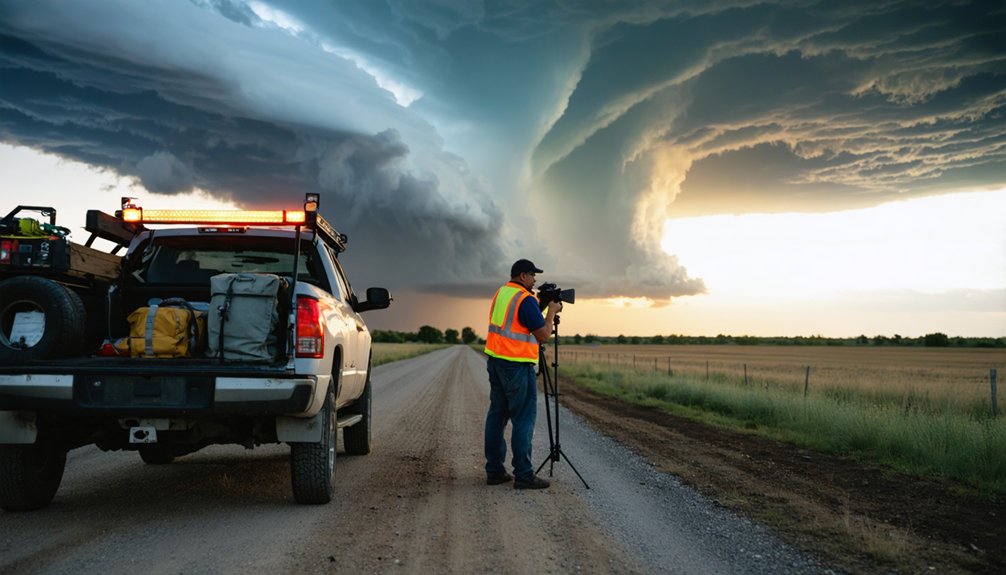
You’ll encounter different legal frameworks depending on whether you operate as a professional or amateur storm chaser.
Professional chasers who monetize their work through media sales, research contracts, or television stations must secure business licenses and maintain liability insurance in most jurisdictions.
Amateur chasers pursuing storms recreationally face fewer regulatory requirements but should verify their activities don’t trigger commercial classification under state revenue codes.
Licensing Requirements for Professionals
How does one shift from amateur weather enthusiast to professional storm chaser in regulatory terms? Currently, no federal licensing mandate exists for storm chasers, despite ongoing debates advocating for formal requirements. You’ll find that professional status hinges on specialized training beyond SKYWARN’s basic certification, which requires only an official certification program completion—a free 2-3 hour class for those 18 and older.
The distinction lies in operational roles rather than government-issued licenses. You don’t need weather monitoring technology or amateur radio licenses to start. However, professionals typically demonstrate advanced expertise in severe weather recognition and reporting protocols.
While licensing proposals continue circulating within the community, you’re currently free to pursue storm chasing without federal credentials, maintaining autonomy in your meteorological pursuits while adhering to local traffic and safety regulations.
Amateur Chaser Legal Status
While federal law imposes no licensing requirements on amateur storm chasers, you’ll encounter state-level distinctions that separate hobbyists from credentialed professionals. Oklahoma’s proposed legislation targets media-affiliated and university-sponsored chasers, leaving you unaffected unless you’re seeking special privileges like emergency light usage or closed-road access. You’ll maintain your freedoms by adhering to existing traffic laws, trespassing prohibitions, and impersonation statutes.
Professional designations grant blocked-road access and vehicle modifications—privileges you won’t receive without media credentials or research affiliation. However, voluntary chasing safety protocols and community engagement efforts through programs like NWS storm spotting classes enhance your capabilities without mandatory compliance.
Critics argue new regulations restrict personal freedoms unnecessarily when current law enforcement addresses reckless behavior. You’re responsible for lawful parking, respecting closures, and avoiding official impersonation while pursuing storms independently.
Legal Guidelines for Vehicle Equipment and Emergency Light Displays
Before equipping your chase vehicle with specialized lighting or communication systems, you must verify compliance with federal, state, and local regulations governing emergency vehicle equipment. Unlawful emergency lighting that mimics law enforcement configurations can result in serious legal consequences, including impersonation charges.
You’re prohibited from installing light bars, sirens, or equipment that implies official status without proper authorization. Unauthorized pursuit tactics, such as high-speed intercepts or aggressive driving maneuvers, violate existing traffic laws regardless of your chase objectives.
Standard headlights during reduced visibility conditions satisfy legal requirements without drawing regulatory scrutiny. Currently, no mandatory equipment standards exist for storm chasers, allowing you operational flexibility within established vehicle codes.
Focus on legitimate safety upgrades rather than attempting to circumvent emergency vehicle restrictions through questionable modifications.
Accessing Restricted Areas During Active Weather Events
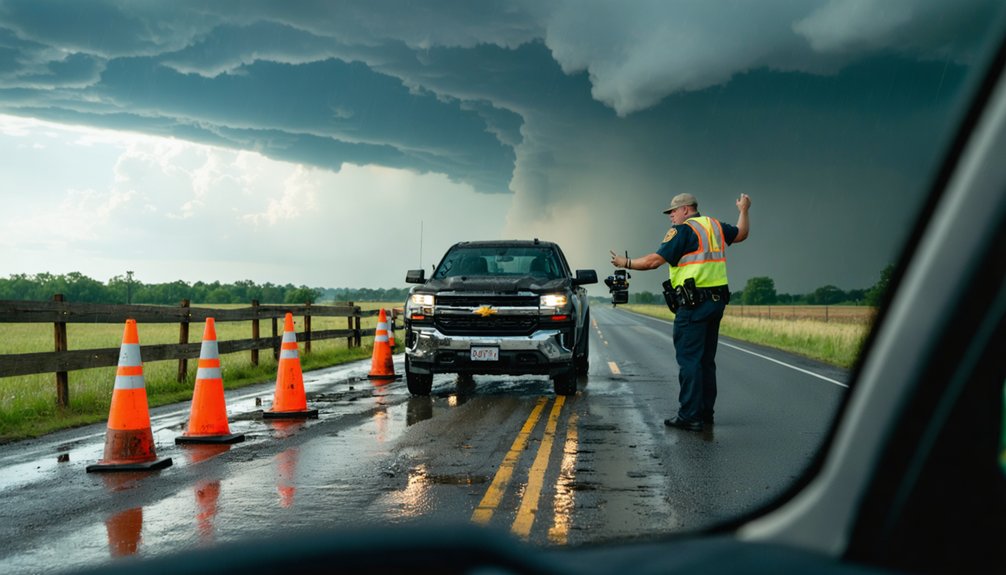
When law enforcement establishes roadblocks during severe weather events, your ability to proceed depends on verifiable professional credentials and explicit authorization from emergency management authorities. Licensed media representatives, university-affiliated researchers, and National Weather Service-accredited operators can navigate restricted access protocols through proper identification and vehicle registration. You’ll need clearly visible credentials—including NWS-issued operator documentation and organizational decals—to demonstrate legitimate affiliation with recognized entities.
Emergency personnel evaluate each access request based on operational necessity and authorized information sharing agreements between your organization and local agencies. Professional storm chasers maintaining partnerships with meteorological institutions, research facilities, or licensed broadcasters receive preferential consideration. However, even credentialed operators must comply with emergency personnel directives. Reckless driving charges apply universally, and unauthorized entry into cordoned zones triggers immediate penalties regardless of professional status.
Road Safety Compliance and Proper Parking Protocols
Storm chasing operations demand rigorous adherence to traffic safety regulations that govern speed reduction, visibility enhancement, and hazard response protocols. You must reduce speed when weather compromises visibility or traction, activating headlights during rain or dust conditions.
Lawful parking procedures require positioning your vehicle completely off the right-of-way with verified legal authorization for that specific location. You’ll need to account for door-opening radius to prevent traffic interference. Appropriate hazard signaling through turn indicators alerts other drivers before executing stops, starts, or roadway shifts.
Defensive driving practices—maintaining safe following distances and heightened awareness of construction zones, animals, and stopped vehicles—prove essential. Never attempt crossing flood waters; just twelve inches of rushing water can sweep away most cars, making immediate route changes mandatory.
Reporting Standards for Severe Weather Observations
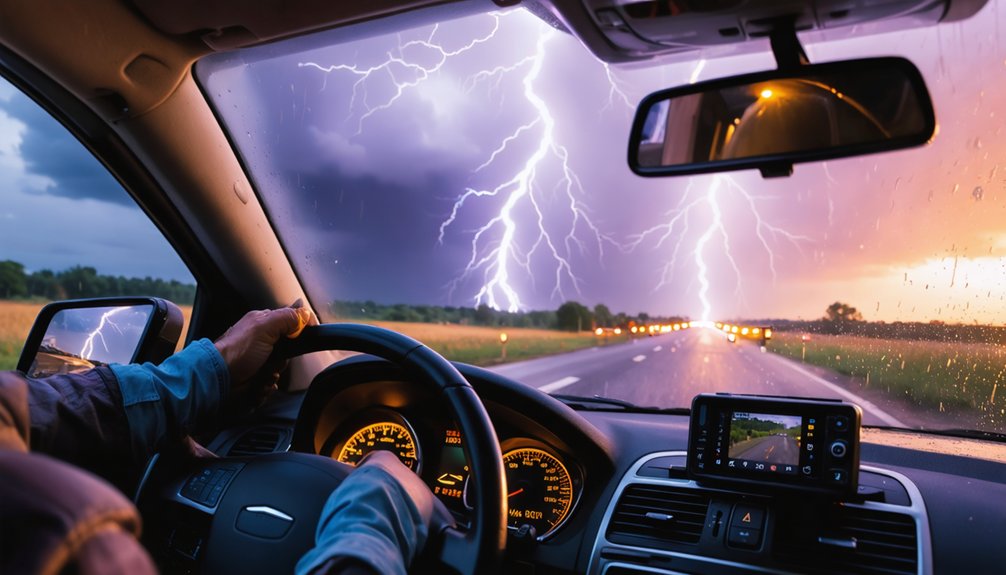
While traversing severe weather events, you’ll encounter specific reporting thresholds that trigger National Weather Service notification requirements. You must document tornado sightings, wind gusts exceeding 58 mph, severe-sized hail, structural wind damage, and freezing precipitation impacts. Reporting accuracy depends on precise location data—preferably coordinates, alternatively street addresses, minimally distance-direction from cities. Distinguish your observer position from the actual event location. Include occurrence time, not submission time, with event duration when possible.
Your verification practices should confirm social media content before sharing. Submit reports via NWS phone lines (405-325-3816), online forms, or social platforms. Detail what happened, where, when, plus damage specifics. Use standardized terminology and acknowledge uncertainty levels. Quality reports remain detailed, accurate, concise, and timely—critical for real-time warning operations serving your community’s safety needs.
Frequently Asked Questions
What Happens if My License Expires During an Active Storm Season?
You’ll lose emergency vehicle privileges immediately, risking $500 fines if you operate. Follow renewal procedures promptly to restore your status. Meanwhile, seek licensed partner assistance to continue storm operations legally without violating right-of-way restrictions during active weather.
Can Out-Of-State Chasers Operate Legally in Oklahoma Without This License?
You’re in a gray zone—amateur out-of-state chasers can legally operate without licensing, but professionals face chaser liability concerns. Local jurisdictional requirements demand FCC/university endorsement, background checks, and insurance regardless of residency for commercial operations.
How Long Does the License Application Process Typically Take to Complete?
The Oklahoma severe weather tracker license application processing time isn’t specified in HB2426, but you’ll need to factor in background checks and credential verification. Plan ahead since renewal timeline follows standard two-year certification cycles for operational readiness.
Are There Continuing Education Requirements to Maintain an Active License?
No, you won’t face continuing education requirements under SB 158. The licensing renewal procedures only mandate your $250 annual fee and active sponsorship verification. However, continuing education opportunities through your sponsor help maintain credibility and demonstrate ongoing competency.
What Appeal Process Exists if My License Application Gets Denied?
The background information doesn’t specify an appeal process for appealing license denials beyond general judicial review. You’d need to contest the Department’s decision through standard court channels while managing license expiration timelines and reapplication requirements.