When you spot a tornado, you report it immediately to your local NWS office via their public service line, county dispatch, or 911. You’ll provide your spotter code, exact location relative to the nearest town, event time, and whether the tornado has ground contact or is a funnel cloud. If cell networks fail, you switch to amateur radio. There’s much more to the reporting chain you’ll want to know.
Key Takeaways
- Storm chasers dial 911 immediately upon confirming a tornado, requesting dispatchers notify the local National Weather Service office.
- Chasers provide their spotter code, exact location relative to the nearest town, and distinguish event time from report time.
- The NAWAS network relays critical tornado information directly to federal emergency management when needed.
- Amateur radio serves as a backup communication method when cellular infrastructure fails during severe weather events.
- Chasers submit observations to Spotter Network, aggregating data for broader emergency management situational awareness.
What Storm Chasers Report to Emergency Management
When a storm chaser confirms a tornado, the report must include specific, actionable data: rotational debris or ground spray confirming touchdown, funnel cloud existence without visible ground contact, or a rotating wall cloud with upward motion.
Tornado verification depends on what you directly observe, not what you assume.
Your emergency communication must also include hail size exceeding one inch in diameter and flash flooding covering roads or low water crossings.
These details aren’t optional—they’re the foundation of accurate, timely response.
You’re the eyes on the ground. Emergency management can’t act on vague descriptions.
Report exactly what you see, precisely when you see it. Clear, structured data gives authorities the freedom to deploy resources effectively, protect communities, and make decisions that save lives.
NWS, Dispatch, and Spotter Networks: Who Storm Chasers Report To
Once you’ve confirmed a reportable event, knowing exactly who receives that report determines how fast emergency response activates. Your storm communication flows through five primary channels, each serving a distinct function within established reporting protocols.
Knowing who receives your report determines how fast emergency response activates—every second counts.
Direct your tornado or severe weather reports to your local National Weather Service office via their public service line.
Contact local law enforcement for immediate community-level response.
Route urgent data through county dispatch centers, which coordinate emergency resources across jurisdictions.
The NAWAS network relays critical information upward to federal emergency management.
Finally, submit observations to the Spotter Network‘s central collection point for broader data aggregation.
Each recipient operates independently yet interconnects with the others. Targeting the correct channel eliminates delays, guarantees your data reaches decision-makers, and directly strengthens the protective infrastructure your community depends on.
When Storm Chasers Report and Why Timing Matters
Timing your report correctly separates useful data from noise. When you observe a tornado, funnel cloud, or rotating wall cloud, you report immediately — not after the storm passes. Storm timing determines whether NWS can issue warnings before lives are at risk.
You must distinguish event time from report time. If you spotted rotation at 6:42 PM but reached communications at 6:51 PM, you state 6:42 PM as the event time. Report accuracy depends entirely on this distinction.
During ongoing tornado events, you provide continuous updates rather than a single transmission. If uncertainty exists about ground contact, you still report. Incomplete data beats no data.
Don’t wait for confirmation when lives are potentially at stake — transmit what you’ve observed and let NWS analysts interpret it.
Phone, Radio, and Digital: How Storm Chasers Send Reports
Transmitting your observation quickly requires knowing which communication method fits your situation. Call the NWS public service line when you’ve confirmed a tornado or funnel cloud — telephone delivers the fastest direct contact.
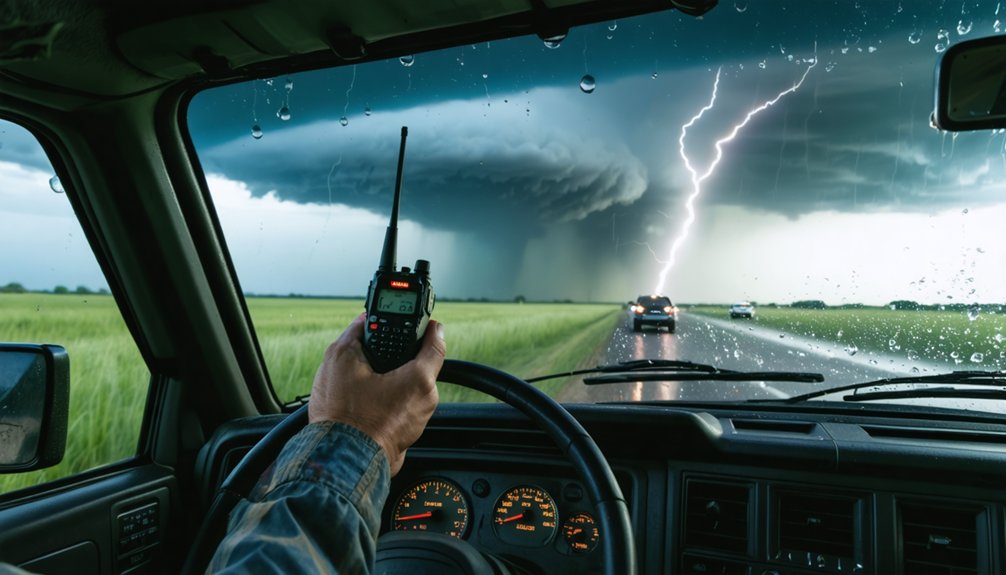
Amateur radio connects you to trained spotter networks when cell infrastructure fails, keeping report accuracy intact even during severe outages. Cellular phones reach county dispatch or central collection points efficiently in coverage areas.
When cell networks collapse, amateur radio keeps spotter reports flowing accurately to those who need them most.
For non-urgent documentation, submit online reports through NWS social media pages or email attachments with images and damage details. Each communication method carries specific advantages depending on terrain, signal availability, and threat severity.
Match your method to your conditions, and always prioritize direct human contact over digital submission when a life-threatening tornado is actively developing.
What to Do When a Tornado Is Right in Front of You
When a tornado is directly in front of you, your reporting window narrows to seconds — dial 911 immediately and request the dispatcher to notify the National Weather Service.
Tornado safety depends on executing this protocol without hesitation.
Provide your spotter code, exact location relative to the nearest town using compass bearing and distance, and distinguish event time from report time.
Situational awareness means you’re tracking the tornado’s movement, not just its presence.
State whether you’re observing ground contact, rotating debris, or a funnel cloud only.
Immediate actions must stay brief — dispatchers relay your data fast when you’re precise.
Storm preparedness means you’ve rehearsed this sequence before you’re in the field.
When it counts, execute the protocol, then reposition for your safety.
Frequently Asked Questions
Do Storm Chasers Need Official Certification Before Reporting Tornado Events?
You don’t need official certification to report tornado events. However, storm chaser training sharpens your accuracy. Meeting certification requirements via Spotter Network or NWS programs guarantees your data gains credibility with emergency management agencies.
Can Storm Chasers Report Tornadoes While Driving Toward the Storm?
You can report tornadoes while driving toward a storm, but prioritize safety. Use hands-free devices for real-time communication, ensuring storm tracking data reaches NWS or dispatch immediately upon observing confirmed rotation, debris, or funnel cloud activity.
What Legal Liability Do Storm Chasers Face When Submitting Tornado Reports?
You don’t face significant legal liability when submitting tornado reports, but liability concerns rise with reporting accuracy. If you intentionally falsify data, you risk legal consequences. Accurate, timely submissions protect both you and communities.
How Do Storm Chasers Stay Safe While Observing and Reporting Tornadoes?
Coincidentally, your survival and your report’s accuracy both depend on the same discipline: you maintain safety protocols before each chase, complete equipment checks, position yourself at safe angles, and you’re never closer than necessary.
Are Storm Chaser Reports Used After the Tornado for Damage Assessment?
Yes, your reports fuel post-tornado damage verification by cross-referencing ground truth with radar data. Your report accuracy helps meteorologists confirm storm paths, refine intensity ratings, and improve future warning systems—giving communities actionable, data-driven insights.
References
- https://en.wikipedia.org/wiki/Storm_chasing
- http://nwafiles.nwas.org/digest/papers/2004/Vol28/Pg59-Pietrycha.pdf
- https://www.reddit.com/r/meteorology/comments/1k3rjiz/how_would_i_report_severe_weather_to_other_nws/
- http://www.stormeyes.org/tornado/chasing/FAQ/
- https://www.youtube.com/watch?v=0pnUthd_FH8
- https://www.stormtours.com/information/storm-chasing-technology/
- https://w9lw.farlowconsulting.com/2017/11/06/why-do-some-storm-chasers-call-911-vs-nws/
- https://www.weather.gov/oun/stormspotting
- https://www.reddit.com/r/stormchasing/comments/lvub71/how_important_are_storm_chasers_in_giving_data_or/
- https://w4ehw.fiu.edu/spotter guide basic noaa.pdf