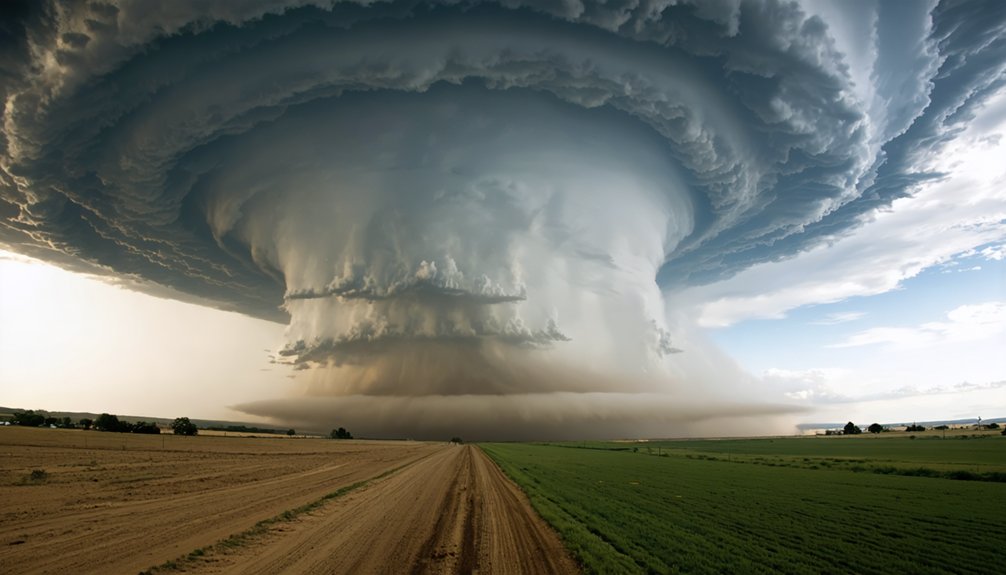
Climate change is reshaping the atmospheric conditions you’d associate with hail formation. Rising temperatures strengthen updrafts, elevate moisture levels, and destabilize vertical atmospheric profiles — all of which energize convective systems. You’re not seeing a straightforward global increase in hailstorm frequency; instead, you’re seeing a regional redistribution, with fewer but larger, more destructive hailstones becoming the dominant trend. The full picture of what this means economically and geographically is considerably more complex.
Key Takeaways
- Climate change increases atmospheric instability and updraft strength, creating conditions that theoretically favor more intense hail formation.
- Global warming raises the melting layer altitude, potentially reducing hail frequency while increasing hailstone size.
- Evidence supports regional redistributions of hail activity rather than a uniform global increase in frequency.
- The U.S. Great Plains and European regions report increasing large-hail events despite slight overall frequency declines.
- Models project fewer but more severe hail events under high-emission scenarios, with shifting storm corridors affecting regional vulnerability.
How Climate Change Alters the Conditions That Form Hail
Climate change reshapes the atmospheric dynamics that drive hailstorm formation by simultaneously increasing instability and altering moisture availability. As temperatures rise, you’ll observe intensified atmospheric instability, which directly amplifies updraft strength—the critical mechanism suspending ice particles long enough to accumulate mass.
Temperature fluctuations destabilize the vertical atmospheric profile, creating conditions where severe weather events become more energetically charged.
Elevated moisture levels, driven by increased evaporation, inject additional latent energy into convective systems. You’re fundamentally watching climate variability recalibrate the essential parameters governing hail formation.
Predictive modeling consistently demonstrates that warmer base temperatures don’t suppress hail—they transform its characteristics, potentially producing larger, more destructive stones while shifting geographic distribution patterns.
Understanding these mechanisms demands rigorous, data-driven analysis rather than simplified assumptions.
Is Hailstorm Frequency Actually Increasing Worldwide?
Whether hailstorm frequency is genuinely increasing worldwide remains one of meteorology’s most contested empirical questions. When you examine hailstorm trends across datasets, you’ll find contradictory signals: some regions report increased hail events while others show measurable declines.
Global warming intensifies atmospheric instability and moisture content, theoretically favoring hail formation, yet it simultaneously raises the melting layer altitude, causing hailstones to melt before reaching the surface.
Observational records carry significant detection biases—population density, radar coverage expansion, and reporting inconsistencies distort raw frequency counts. Climate models project poleward shifts in hail-prone zones rather than uniform global increases.
You should thus interpret frequency claims cautiously: the evidence supports regional redistributions of hail activity more convincingly than it supports a straightforward worldwide increase.
Which Regions Are Experiencing the Most Dramatic Hail Shifts?
When you examine regional hail trends, North America’s central corridor—particularly the U.S. Great Plains—shows intensifying large-hail events even as overall hail frequency slightly declines.
Europe’s hail patterns are shifting poleward, with the Mediterranean basin recording more severe convective outbreaks while traditional Alpine hail zones see altered seasonality.
Across the Asia-Pacific, you’re seeing emerging hail hotspots in eastern China and Australia’s eastern seaboard, where rapid warming is restructuring convective instability thresholds.
North America Hail Hotspots
Across North America, hail activity isn’t shifting uniformly—certain regions are absorbing disproportionately intense changes in both frequency and severity.
North America trends show “Hail Alley”—spanning Texas, Oklahoma, and Colorado—registering accelerating hailstorm statistics, with events exceeding 2-inch diameter stones increasing measurably since 1990.
Regional impacts extend beyond property: agricultural effects compound annually as crop insurance claims surge across the Great Plains.
Urban vulnerability intensifies as Denver, Dallas, and Calgary face infrastructure exposure previously uncharacterized in historical comparisons.
You’re seeing insurance implications materialize through premium escalations averaging 20–30% in high-frequency zones.
Without targeted mitigation strategies—including improved building codes, early-warning systems, and adaptive agricultural practices—your exposure compounds alongside warming atmospheric conditions that thermodynamically favor larger, more destructive hailstone formation across these documented hotspot corridors.
European Hail Trend Shifts
While North America’s hail hotspots draw significant attention, Europe’s hail climatology is shifting with comparable intensity—and in some zones, greater structural complexity.
European hail patterns now reflect measurable poleward displacement, with Alpine and Mediterranean corridors absorbing intensified convective activity. Historical hail data confirms increasing large-hail frequency across northern Italy, Austria, and southern Germany—regions where regional hail variability once remained moderate.
You’re seeing agricultural impacts accelerate as crop exposure windows expand seasonally. Urban infrastructure risks compound this threat, particularly across densely built Central European metros.
Insurance implications are escalating, with loss ratios climbing in previously low-risk zones. Climate adaptation strategies must now integrate hail-specific parameters, while emergency response planning demands faster deployment frameworks.
Europe’s hail restructuring isn’t marginal—it’s a systemic, measurable climate signal demanding immediate policy recalibration.
Asia-Pacific Hail Changes
The Asia-Pacific region’s hail climatology is undergoing some of the most structurally significant shifts observed globally, with eastern China, northern India, and southeastern Australia emerging as primary zones of accelerating hail activity.
Asia Pacific patterns indicate intensifying convective instability driven by rising sea surface temperatures and altered monsoon dynamics. You’re seeing hailstorm impacts compound across agricultural and infrastructure sectors, demanding rigorous economic assessments to quantify escalating losses.
Regional vulnerability varies sharply by elevation, land use, and storm-track displacement. Hail monitoring networks remain critically underdeveloped across many sub-regions, limiting data resolution.
Climate adaptations require you to integrate technological advancements—dual-polarization radar, satellite retrieval algorithms—into operational frameworks.
Policy implications are direct: without coordinated regional governance, adaptation deficits will widen, exposing populations to unmitigated, quantifiable risk.
Why Larger, More Destructive Hailstones Are Becoming the Norm
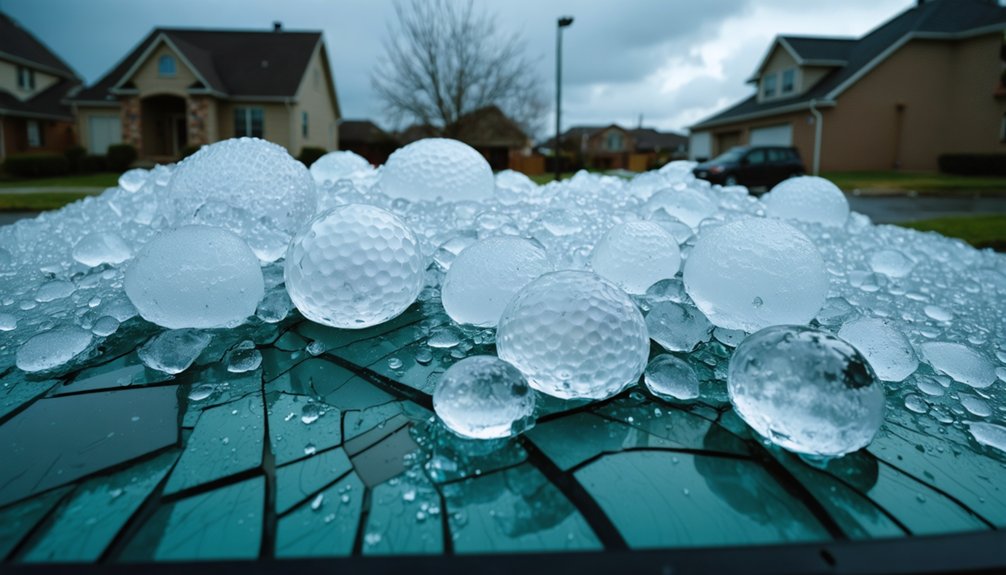
As global temperatures rise, the atmosphere’s capacity to hold moisture increases, fueling more energetic convective updrafts that suspend hailstones aloft longer—allowing them to accumulate additional ice layers and grow to larger diameters before falling.
You’re witnessing a measurable shift: climate variability is intensifying storm dynamics, elevating atmospheric instability, and amplifying precipitation intensity across multiple regions. Higher moisture content provides abundant supercooled water, accelerating hail formation cycles.
Temperature fluctuations between atmospheric layers strengthen updraft velocities, directly correlating with increased hailstone size. These compounding factors produce destructive patterns previously considered statistically rare.
Observational data confirms that severe weather events now generate larger, denser hailstones with greater kinetic impact energy. Understanding these mechanisms empowers you to assess infrastructure vulnerabilities and advocate for evidence-based adaptation policies before damage escalates further.
The Rising Economic Toll of Climate-Driven Hail Damage
Escalating hail damage costs reflect a compounding intersection of larger hailstones, expanding urban infrastructure, and rising asset valuations across vulnerable regions.
You’re facing economic impacts that insurers struggle to model accurately, creating significant insurance challenges as loss frequencies outpace premium adjustments.
Agricultural losses compound annually, undermining food security and producer autonomy across hail-prone corridors.
Infrastructure vulnerabilities in densely built environments amplify replacement costs exponentially.
Effective risk assessment demands integrating climate projections with actuarial frameworks, giving you clearer exposure metrics.
Policy responses must prioritize deregulated mitigation strategies—incentivizing resilient construction standards, adaptive land-use planning, and decentralized agricultural risk-sharing mechanisms.
Urban resilience hinges on proactive capital allocation rather than reactive recovery spending.
Without structural reforms, climate-driven hail damage will continue eroding economic freedom across exposed communities.
What Climate Models Predict About Future Hailstorm Patterns
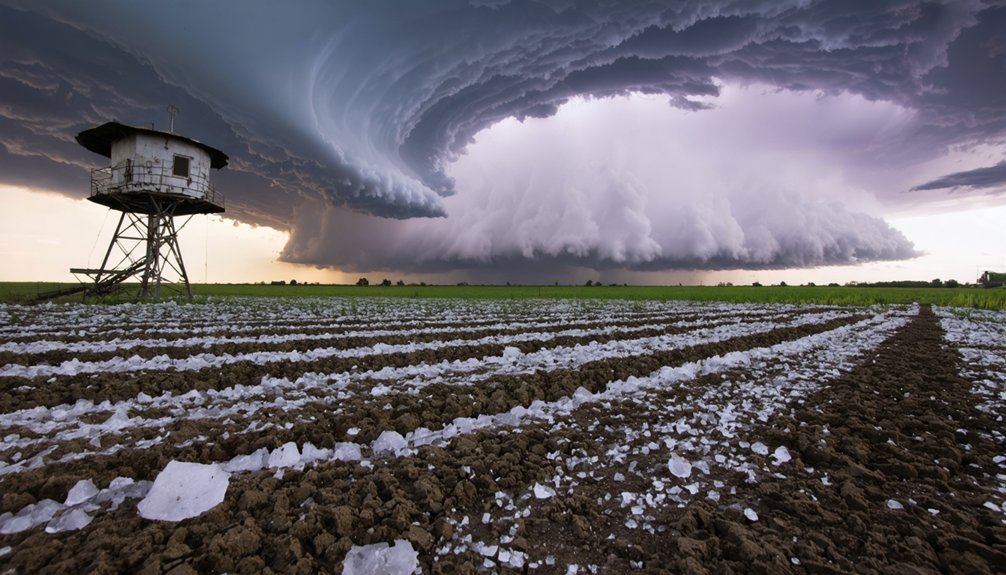
Understanding what drives future economic exposure requires examining what climate models actually project for hailstorm behavior. Climate model accuracy has improved markedly through remote sensing techniques and storm tracking advancements, giving you sharper insight into atmospheric instability trends.
Models consistently project:
Models consistently project intensifying hailstone size, shifting storm corridors, and fewer but more severe hail events globally.
- Hailstone size dynamics will intensify regionally, with larger stones becoming more probable under high-emission scenarios, amplifying economic impact studies’ damage estimates.
- Precipitation patterns analysis reveals shifting hail corridors poleward, altering regional vulnerability assessments across previously low-risk zones.
- Hail formation research confirms that warmer, moisture-laden atmospheres favor fewer but more severe events.
You can’t ignore these future hailstorm projections when evaluating infrastructure resilience.
The data demands that policymakers and insurers integrate these findings into forward-looking risk frameworks immediately.
Frequently Asked Questions
Can Hailstorms Occur During Winter Months in Typically Warm Climates?
Yes, you can experience hailstorms during winter months in warm climates. Winter weather doesn’t prevent hail formation; you’ll find that atmospheric instability and moisture still drive convective storms capable of producing hail year-round.
How Do Farmers Currently Protect Their Crops From Unexpected Hailstorms?
You protect crops by deploying protective nets, utilizing hailstone sensors for early detection, securing crop insurance against losses, and integrating seasonal planning to anticipate storm patterns—giving you autonomous, data-driven control over agricultural resilience.
Are Certain Building Materials More Resistant to Hail Damage Than Others?
You’ll discover that yes—certain hail resistant materials, like impact-rated metal roofing and Class 4 shingles, shield your property far better. Updated building codes now empower you to choose these superior materials freely, maximizing protection independently.
How Long Does a Typical Hailstorm Last From Start to Finish?
You’ll typically experience a hailstorm lasting 5–15 minutes. Storm duration varies with hailstorm formation intensity—stronger convective cells extend events. Climate shifts you’re witnessing can alter these patterns, potentially increasing severity within compressed timeframes.
Can Animals and Wildlife Be Seriously Harmed by Falling Hailstones?
Coincidentally, as storms intensify, you’ll find wildlife adaptations often fall short—yes, animals can suffer serious injuries or death from large hailstones. Hailstorm recovery for wildlife populations demands significant time and ecological resources.
References
- https://ormir.giesbusiness.illinois.edu/docs/librariesprovider9/pdf/the-effects-of-climate-change-on-hailstorms.pdf?Status=Master&sfvrsn=ef8a53e0_3
- https://www.nature.com/articles/s43017-020-00133-9
- https://nhess.copernicus.org/articles/25/3693/2025/
- https://www.metoffice.gov.uk/about-us/news-and-media/media-centre/weather-and-climate-news/2025/climate-change-reshaping-european-hailstorms
- https://www.munichre.com/en/insights/natural-disaster-and-climate-change/hail-research-2025.html
- https://www.bbc.com/future/article/20220314-how-big-can-hailstones-grow
- https://www.sciencedaily.com/releases/2021/03/210329094837.htm
- https://journals.ametsoc.org/view/journals/clim/37/2/JCLI-D-23-0181.1.pdf
- https://www.nature.com/articles/s41561-025-01868-0
- https://www.sciencedirect.com/science/article/abs/pii/S0928765509000517