If you trace storm chasing’s history, you’ll see technology reshape it completely. Chasers once relied on cloud patterns, wind shifts, and instinct alone. Then radar systems in the early 1950s delivered positioning data beyond visual limits. WSR-88D Doppler radar in 1994 revealed internal storm rotation and tornado indicators. Mobile broadband, GPS, and real-time NOAA feeds turned vehicles into precision data platforms. Every technological leap added capability that earlier chasers couldn’t have imagined, and there’s much more to unpack.
Key Takeaways
- Early storm chasers relied solely on visual observation, paper maps, and instinct before radar systems emerged in the early 1950s.
- Doppler radar revolutionized chasing by revealing internal storm rotation signatures, shifting decision-making from guesswork to precise, data-driven analysis.
- Mobile labs debuted in 1969, transforming vehicles into rolling data-collection platforms equipped with barometric pressure gauges and anemometers.
- The 1996 film “Twister” and reality television propelled storm chasing into mainstream culture, dramatically increasing public interest and chaser participation.
- Smartphones, GPS, mobile broadband, and real-time NOAA alerts modernized chasing operations, enabling live data feeds and high-definition storm documentation.
What Chasers Relied On Before Radar or Instruments Existed
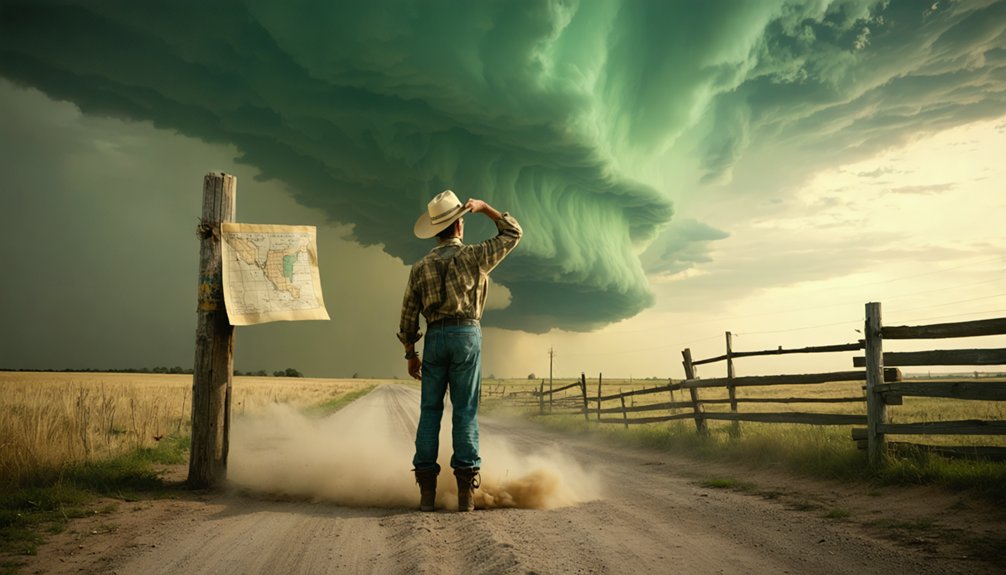
Before radar systems emerged in the early 1950s, storm chasers relied entirely on direct visual observation, paper maps, and raw instinct to locate and track severe weather. Your only tools were your eyes, local knowledge, and whatever atmospheric clues the sky offered.
Early chasing demanded sharp observation techniques — you’d read cloud formations, wind shifts, and pressure changes without any electronic assistance. David Hoadley pioneered this raw approach when he began chasing in North Dakota in 1956, steering purely through personal judgment.
No instruments guided your decisions. No radar operator radioed your position. You operated on pattern recognition and environmental awareness alone.
These foundational observation techniques, though primitive by today’s standards, established the core discipline that would define storm chasing’s scientific evolution for decades ahead.
How Radar Gave Storm Chasers Their First Real Technological Edge
Radar systems emerged in the early 1950s as the first technological tool capable of detecting storm conditions beyond your line of sight, fundamentally shifting how chasers could locate and monitor severe weather.
These radar advantages gave you access to storm positioning data that simple observation never could.
During the 1969 Alberta Hail Studies, radar operators guided vehicle-mounted teams directly toward hail-producing storms via radio communication, establishing chaser communication as a critical operational standard.
The National Weather Service installed WSR-74 radar in 1978, letting you look vertically into storm structure rather than just tracking surface-level indicators.
Then WSR-88D arrived in 1994, delivering targeting capability, movement direction, horizontal and vertical data, and ice content analysis, transforming radar from a basic detection tool into your most powerful decision-making asset.
The Instruments That Turned Storm Chasing Vehicles Into Mobile Labs
When you trace storm chasing’s technological leap from simple observation to systematic data collection, the 1969 Alberta Hail Studies project stands as the critical turning point — the first time vehicles carried actual meteorological sensors and instruments into the field.
That project established a community-wide instrumentation standard that persists today, transforming chase vehicles from transportation into rolling data-collection platforms.
As you’ll see, the equipment fitted to those early mobile labs would evolve dramatically over the following decades, reshaping both the science and the operational practice of storm interception.
Early Vehicle Sensor Integration
The 1969 Alberta Hail Studies marked a turning point in storm chasing methodology, as vehicles carried meteorological sensors and instruments into the field for the first time. This breakthrough in vehicle instrumentation established a community-wide standard that storm chasers still follow today.
During the project, radar operators guided drivers directly toward hail-producing storms via radio, while onboard sensor technology collected real-time atmospheric data. You’re basically seeing the birth of the mobile weather laboratory here — a concept that fundamentally shifted how researchers intercepted and measured severe weather systems.
Before this milestone, chasers relied purely on visual observation and basic communication tools. Vehicle-mounted instruments changed everything, giving chasers quantifiable, precise data rather than subjective assessments, and permanently integrating scientific measurement into active storm pursuit.
Mobile Lab Equipment Evolution
Once vehicles entered the field as active data-collection platforms in 1969, the instruments inside them grew steadily more sophisticated, reshaping what chasers could measure, record, and transmit in real time.
Early sensor integration techniques relied on basic meteorological sensors mounted externally, feeding raw atmospheric data directly into onboard recording systems. As mobile lab innovations accelerated, vehicles gained barometric pressure gauges, anemometers, hygrometers, and temperature probes capable of capturing rapid environmental shifts near storm boundaries.
You’d find chasers cross-referencing multiple instrument readouts simultaneously, extracting precise data that stationary networks couldn’t supply. Doppler radar advancements in the late 1970s further expanded mobile instrumentation demands, pushing engineers to develop compact, field-hardened equipment.
Each technological addition converted ordinary chase vehicles into self-sufficient laboratories, giving chasers unprecedented freedom to collect critical severe weather data independently.
How Doppler Radar Transformed Storm Chasing and Prediction Forever
Doppler radar’s arrival in the late 1970s fundamentally rewired how meteorologists and storm chasers tracked severe weather. Before this radar evolution, you were basically guessing at internal storm dynamics.
Doppler advantages gave you unprecedented velocity data, revealing rotation signatures hidden inside dangerous supercells.
The WSR-88D system, deployed in 1994, delivered capabilities that redefined independent chasing operations:
- Track target movement direction with precision
- Measure horizontal and vertical storm structure simultaneously
- Detect ice content within developing storm systems
- Identify rotation signatures indicating tornado formation
You could now make data-driven intercept decisions rather than relying purely on visual observation.
Warning lead times increased dramatically, directly saving lives. This technological shift transformed storm chasing from educated guesswork into a disciplined, science-backed pursuit that continues driving meteorological advancement today.
How TV Turned Storm Chasing Into a National Obsession
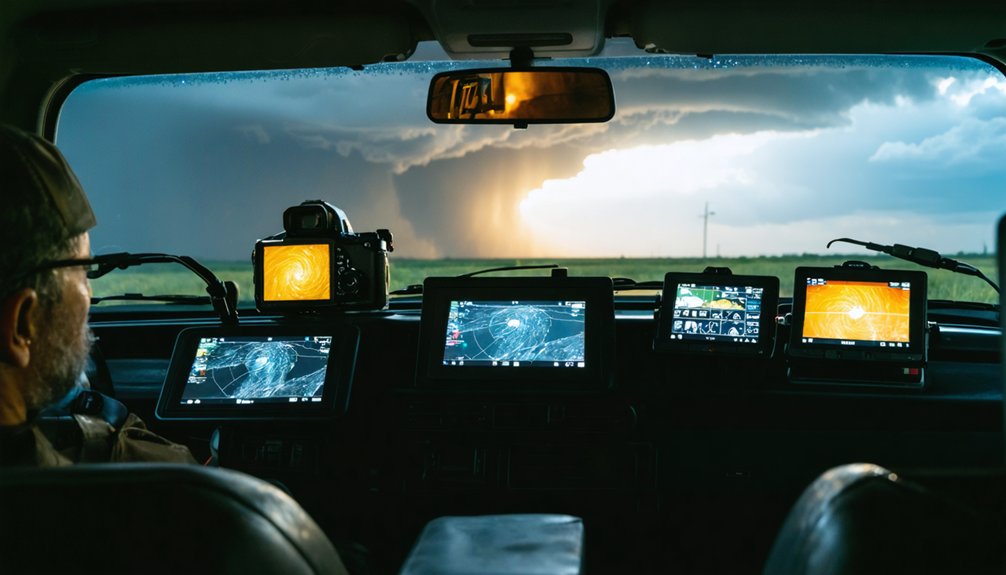
While Doppler radar was reshaping storm prediction behind the scenes, television was doing something equally powerful above ground — pulling millions of Americans into the storm chasing world from their living rooms.
The September 28, 1978 nationwide broadcast marked the first major TV influence on public awareness, exposing viewers to raw storm chaser culture. That single broadcast ignited national obsession, transforming chasers from obscure field scientists into recognizable figures.
Tornado documentaries amplified entertainment value, driving viewer engagement to unprecedented levels. Then Twister hit theaters in May 1996, accelerating media impact dramatically — chaser fame exploded overnight.
Reality shows followed, cementing storm chasing as mainstream American culture. You weren’t just watching weather anymore; you were watching freedom, danger, and discovery collide at 200 mph.
How Storm Chasers Used Video Technology to Document and Fund Field Work
Television fame gave storm chasers a spotlight, but it didn’t pay for fuel, equipment, or the thousands of miles logged each season. You needed a funding strategy, and video journalism became the answer.
By the late 1990s, chasers were selling footage directly to news agencies, operating independently, and building sustainable field operations.
Storm documentation evolved into a revenue model built on speed and quality:
- Stringers uploaded field footage within hours using mobile internet
- Networks paid for stringer content to avoid costly field crew deployments
- Video libraries generated passive income between active chase seasons
- Raw storm footage established credibility for securing future contracts
This system gave chasers financial freedom while raising chasing ethics questions about risk tolerance when profit, not pure science, drove decisions into dangerous storm positions.
How Early Internet Access Changed What Storm Chasers Could See in the Field
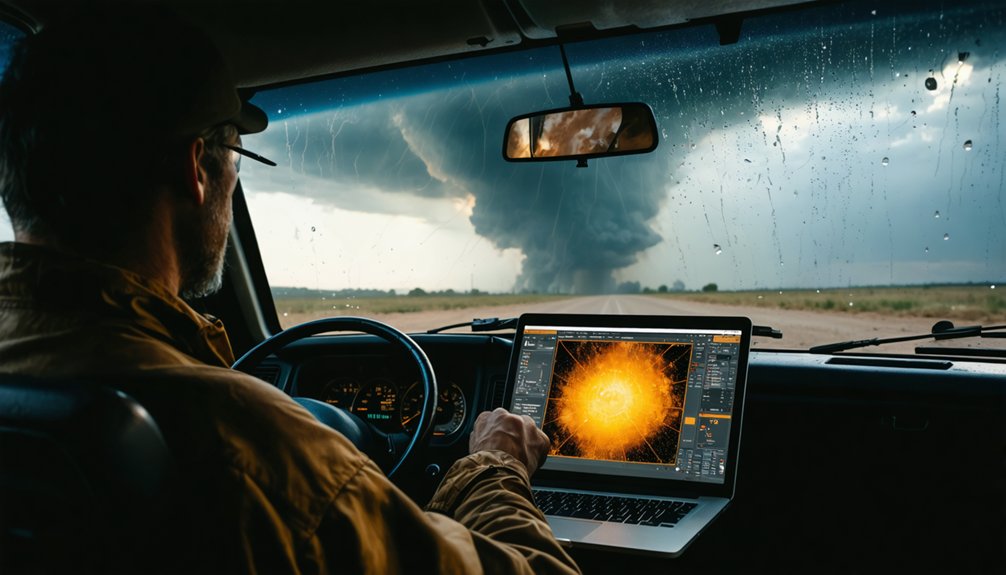
Before mobile broadband existed, you relied on dialup internet at home and NOAA Weather Radio broadcasts to piece together a picture of storm activity before heading into the field.
That early internet impact fundamentally shifted what data you could access before departure—radar composites, surface analysis charts, and upper-air soundings became downloadable resources rather than exclusive institutional tools.
You’d pull forecast model output overnight, print critical charts, and carry that static intelligence into the field.
These field visibility enhancements weren’t real-time, but they gave independent chasers analytical capabilities previously reserved for university researchers.
You weren’t dependent on a single radio frequency anymore.
You controlled your own pre-chase intelligence cycle, building situational awareness from multiple data streams and entering the field with sharper, more autonomous decision-making capacity.
How Mobile Technology Put Live Storm Data in Chasers’ Hands
The shift from pre-loaded static charts to live data feeds redefined how you operated in the field. Mobile apps delivered real time updates directly to your device, replacing radio-dependent communication networks with instant data sharing across entire chaser networks.
Cloud computing processed radar returns faster than any dial-up connection could manage, pushing weather alerts to your phone within seconds of detection.
GPS tracking eliminated guesswork from positioning, letting you plot intercept routes dynamically against live storm movement data.
Key mobile capabilities that transformed field operations:
- Radar streaming through dedicated mobile apps
- Crowdsourced storm reports via social media platforms
- Real-time GPS tracking shared across chaser teams
- Instant weather alerts pushed directly from NOAA systems
You went from reacting to storms to intercepting them with surgical precision.
The Vehicles, Gadgets, and Teams Behind Modern Storm Chasing
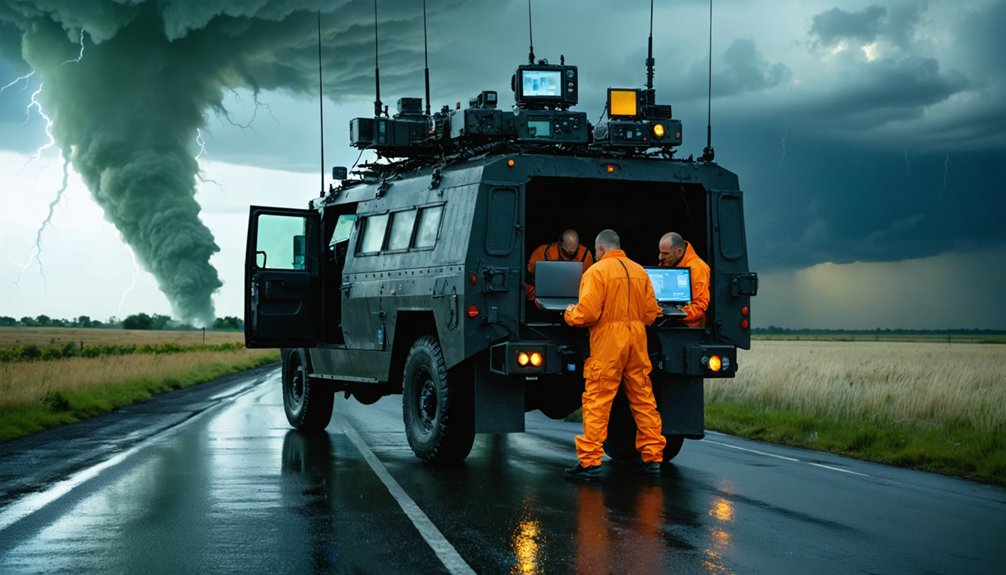
When you picture a modern storm chaser’s vehicle, you’re looking at a far cry from the simple passenger cars that pioneers like David Hoadley used in 1956.
Today’s purpose-built chase vehicles carry mounted cameras, mobile radar displays, GPS units, and real-time data terminals that transform a truck into a rolling meteorological lab.
You now have access to instrumentation that was once confined to fixed research stations, compressed into a mobile platform capable of intercepting a supercell within minutes of a forecast update.
Specialized Storm Chasing Vehicles
Modern storm chasing relies on three core components: specialized vehicles, advanced gadgetry, and coordinated teams. Storm chasing innovations have transformed standard trucks and SUVs into mobile command centers through aggressive vehicle customization.
Your chase vehicle typically features:
- Reinforced steel frames and roll cages for structural protection
- Roof-mounted weather stations capturing real-time atmospheric data
- Integrated GPS and dual-monitor display systems for live radar tracking
- Hardened, tinted windows rated for high-velocity debris impact
These modifications aren’t optional luxuries — they’re operational necessities. Chasers running intercept missions depend on vehicles engineered to withstand extreme conditions while maintaining mobility across rough terrain.
From armored Doppler-on-Wheels units to nimble pursuit trucks, each build reflects a precise balance between protection, data collection capability, and the freedom to reposition quickly as storm dynamics shift.
High-Tech Gadget Evolution
Beyond the vehicles themselves, the gadgets packed inside and mounted on top have redefined what storm chasing can accomplish. You’re no longer limited to paper maps and raw observation.
Today’s high tech gadgets give you real-time radar feeds, mobile internet connectivity, and satellite data streams directly in the field.
Cell phones transformed chasers into nowcasters, delivering live storm positioning to entire networks simultaneously. Videotape cameras evolved into smartphone video systems, capturing high-definition footage and real-time audio within seconds of a storm event.
WSR-88D radar technology added vertical storm structure data, ice content readings, and precise movement tracking.
Storm chasing now operates through coordinated teams sharing continuous data feeds, replacing isolated solo pursuits with organized, intelligence-driven intercepts that maximize both scientific value and your personal safety.
How Chaser Data Shapes the Forecasts That Save Lives
The ground-level data storm chasers collect feeds directly into the forecasting systems that issue life-saving warnings to millions of people. Chaser psychology drives the pursuit of precise observations, while community dynamics amplify data-sharing networks that strengthen forecast accuracy.
Storm chasers don’t just chase storms — they feed the forecasting systems that keep millions of people alive.
Researchers integrate chaser-reported data to refine:
- Tornado intensity estimates and damage path verification
- Supercell morphology models used in operational forecasting
- Hurricane intensity algorithms developed from satellite remote sensing
- Real-time nowcasting that extends warning lead times
Since the 1974 Super Tornado Outbreak exposed critical forecasting gaps, chaser-contributed observations have directly shaped improved warning systems. Algorithms built from field data are now utilized by forecasting agencies worldwide.
You’re witnessing a system where independent chasers functioning outside institutional constraints deliver frontline intelligence that centralized networks simply can’t replicate.
Frequently Asked Questions
What Personal Risks Do Storm Chasers Face During Active Tornado Intercepts?
You’re dancing with death when intercepting tornadoes. You’ll face flying debris, sudden path shifts, and zero visibility. Storm safety demands risk management, personal preparedness, and sharp weather awareness to survive nature’s most violent, unpredictable forces.
How Do Storm Chasers Legally Access Private Land During Active Chase Operations?
You don’t have automatic rights to private land during chases—you must respect legal boundaries and secure landowner permissions before entry. Most chasers stick to public roads, maximizing operational freedom while staying legally compliant.
What Formal Education or Certifications Are Recommended for Aspiring Storm Chasers?
Your compass points toward meteorology degrees from accredited universities and safety certifications like storm spotter training. You’ll sharpen forecasting skills, master radar interpretation, and build the technical foundation you need to chase storms effectively and responsibly.
How Do Storm Chasers Coordinate With Emergency Management Officials During Disasters?
You coordinate storm communication through real-time cell networks, sharing radar data and field observations directly with emergency collaboration teams. You’ll relay critical position reports, storm intensity readings, and ground-truth verification to officials, enabling faster, more accurate disaster response decisions.
What Psychological Effects Does Repeated Storm Chasing Exposure Have on Chasers?
While it’s not just excitement, repeated exposure reshapes your adrenaline response and distorts risk perception. You’ll develop heightened stress tolerance, but also desensitization to danger, increasing impulsive decision-making under extreme conditions you’d previously avoided.
References
- https://science.wisc.edu/2019/06/25/the-evolution-of-storm-chasing/
- https://www.youtube.com/watch?v=rTKooMGK7h4
- https://www.rmets.org/metmatters/history-storm-chasing
- https://stormtrack.org/threads/an-era-of-storm-chasing-vanishing-late-1990s-late-2000s.28010/
- https://gatewayjr.org/storm-chasing-in-the-21st-century/
- https://makezine.com/article/science/storm-chasers-real-twister-tech/
- https://stormhighway.com/30-years-of-storm-photography.php
- https://www.gabegarfield.com/tornadocourse