The VORTEX Project launched in 1994 and completely transformed how you understand tornado science. Deploying 18 instrumented vehicles, VORTEX1 documented a tornado’s complete life cycle for the first time, revealing formation occurs on smaller time and space scales than models predicted. VORTEX2 later expanded to 40+ vehicles and 10 mobile radars, producing the most intensely studied tornado in history. Everything discovered reshaped warning systems, forecasting methodology, and storm chasing itself — and there’s far more to uncover.
Key Takeaways
- Launched in 1994, VORTEX deployed 18 instrumented vehicles to study tornado formation and supercell thunderstorm evolution scientifically.
- VORTEX1 documented a tornado’s complete life cycle for the first time, shifting storm research from guesswork to evidence-based methodology.
- VORTEX2 deployed over 40 vehicles and 10 mobile radars, conducting the most intensely studied tornado observation in history.
- Key discoveries revealed that small-scale dynamics, wind shear, and thermodynamic boundaries govern tornado formation within minutes.
- VORTEX improved tornado warning accuracy by exposing rapid, small-scale formation processes that broader atmospheric models previously failed to capture.
What Was the VORTEX Project?
The VORTEX Project — short for Verification of the Origins of Rotation in Tornadoes EXperiment — launched in 1994 as the largest scientific field research project of its kind, running through 1995 to investigate tornado formation and supercell thunderstorm evolution.
You’re looking at a groundbreaking initiative that redefined storm research through rigorous field methodologies and precise data integration.
The project deployed roughly 18 instrumented vehicles, directly measuring atmospheric dynamics within tornadic environments.
Eighteen instrumented vehicles penetrated tornadic environments, capturing raw atmospheric data at the heart of violent storm systems.
Collaborative efforts among multiple institutions drove scientific advancements in understanding tornado behavior, including the first documented full tornado life cycle.
VORTEX legacy extends beyond initial findings — it revealed that tornado formation occurs at smaller time and space scales than previously understood, fundamentally reshaping how researchers approach supercell analysis and ultimately improving tornado warning accuracy.
How VORTEX1 Changed Tornado Science in the 1990s
When VORTEX1 wrapped up its two-year field campaign in 1995, it had fundamentally restructured how researchers understood tornado dynamics. Using 18 instrumented vehicles, the project delivered four critical breakthroughs in storm research:
- Documented a tornado’s complete life cycle for the first time
- Revealed that tornado formation occurs on smaller time and space scales than previously theorized
- Established that not all supercells or mesocyclones produce tornadoes, redirecting tornado forecasting priorities
- Generated atmospheric datasets that distinguished violent tornadoes from weak ones
You can trace modern warning systems directly back to these findings. VORTEX1’s data forced meteorologists to abandon broad assumptions and replace them with precision-driven models.
The project’s 18-month operational window permanently shifted storm research from observational guesswork toward evidence-based, scalable scientific methodology.
The VORTEX Fleet: Radar Trucks, Sticknets, and Mobile Mesonets
Capturing tornado data requires purpose-built tools deployed with surgical precision, and VORTEX’s instrument arsenal reflected exactly that demand. VORTEX technology advancements transformed mobile instrument deployment from basic vehicles into sophisticated data-collection platforms.
Capturing tornado data demands precision—and VORTEX’s sophisticated instrument arsenal delivered exactly that.
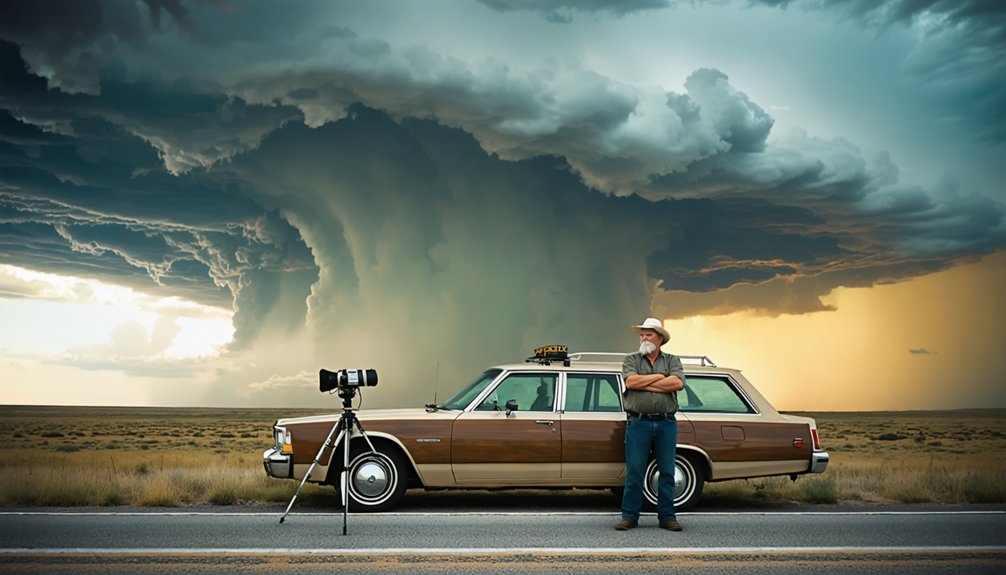
VORTEX1 fielded 18 instrumented vehicles, including radar trucks and Ford Tempos carrying custom atmospheric sensors.
VORTEX2 escalated collaborative research efforts markedly, deploying 10 mobile radars alongside 70 additional instruments integrating cutting-edge communications technology.
Twenty-four portable Sticknets, standing 2 meters tall, captured wind fields, atmospheric readings, and acoustic hail data. Mobile KA-band radars drove radar innovation impacts forward, enabling direct storm interior observation and real-time data direction.
Weather balloons extended atmospheric measurement techniques vertically, profiling temperature, humidity, and wind. This coordinated field project logistics framework fueled tornado research evolution and advanced storm data analysis capabilities considerably.
How VORTEX Teams Deployed Instruments Within Half a Mile of a Tornado
Deploying instruments within half a mile of an active tornado demanded precise coordination across multiple vehicle teams operating under extreme time pressure.
You’d position each asset strategically, beginning 20 minutes before tornado formation and maintaining data collection through dissipation.
Instrument deployment at this tornado proximity required executing four critical steps:
- Position ground-based mobile radars directly into rain-free notch areas ahead of rotating wall clouds.
- Launch weather balloons to capture vertical temperature, humidity, and wind profiles.
- Deploy Sticknets to record wind fields, atmospheric readings, and acoustic data.
- Collect airspeed, temperature, and pressure measurements from less than half a mile away.
NC State’s four-vehicle units exemplified this coordinated approach.
Each team operated independently yet synchronized, ensuring complete coverage of a tornadic supercell‘s most critical atmospheric data points.
VORTEX2: Bigger, Faster, and More Precise
VORTEX2 scaled up every dimension of its predecessor, transforming tornado research from an 18-vehicle operation into a fully nomadic fleet of more than 40 science and support vehicles backed by over 100 scientists, students, and staff from around the world.
Running from May 1 to June 15, 2010, the project deployed 10 mobile radars alongside 70 additional instruments, giving you unprecedented insight into storm dynamics at resolutions previously unattainable.
Ten mobile radars. Seventy instruments. One mission: to see inside storms like never before.
Mobile KA-band radars let researchers penetrate storm interiors directly, while weather balloons captured vertical temperature, humidity, and wind profiles.
Data integration across platforms meant teams could redirect instruments in real time. The result? One tornado became the most intensely examined in history, and findings confirmed that tornado formation mechanisms operate on smaller time and space scales than anyone had anticipated.
The Most Intensely Studied Tornado in History
When VORTEX2 converged on a single tornadic supercell, it produced what scientists now recognize as the most intensely examined tornado in history. Every instrument in the fleet locked onto this storm, capturing storm dynamics at unprecedented resolution.
You’re looking at data that redefined tornado tracking standards worldwide.
The coordinated deployment achieved four critical milestones:
- Mobile KA-band radars penetrated the storm’s interior simultaneously.
- Sticknets recorded wind fields from under half a mile away.
- Weather balloons measured vertical atmospheric profiles in real time.
- Mobile mesonets captured pressure, temperature, and airspeed continuously.
This convergence gave researchers granular insight into formation mechanics across smaller time and space scales than previously measured.
That precision directly advanced warning systems, putting actionable data in the hands of those protecting vulnerable communities.
What VORTEX Revealed About How and Why Tornadoes Form
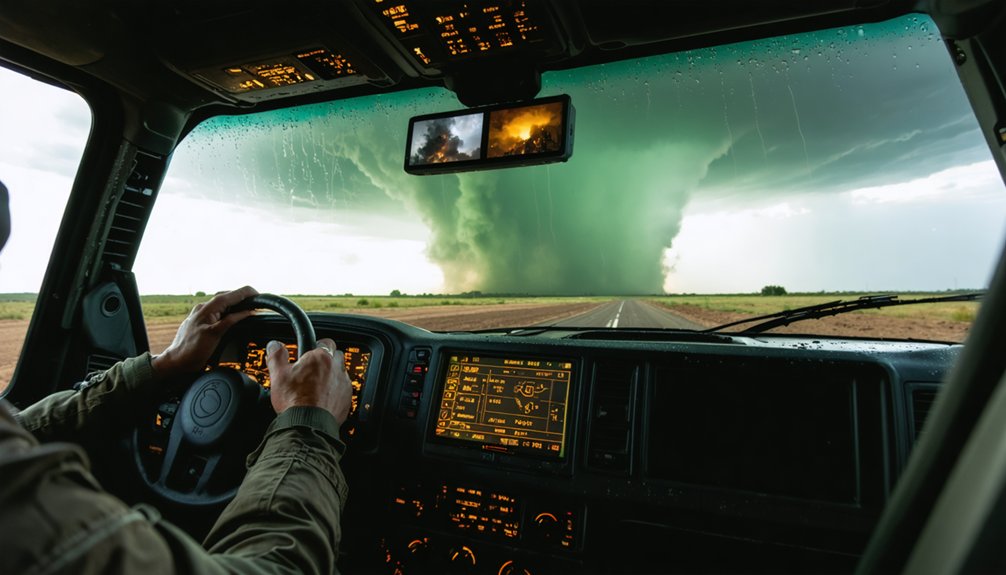
Through VORTEX, you’ll find that the most critical discoveries centered on tornado formation mechanisms operating at smaller time and space scales than scientists previously believed.
The data forced researchers to rethink how supercells generate tornadoes, particularly why some mesocyclones produce violent tornadoes while others produce weak ones—or none at all.
You can trace this understanding directly to the coordinated instrumentation strategies that captured precise atmospheric measurements from less than half a mile away from active tornado structures.
Tornado Formation Mechanisms Uncovered
One of VORTEX’s most notable contributions was revealing that tornado formation occurs on smaller time and space scales than scientists had previously believed.
Through rigorous data analysis and radar technology, researchers identified critical atmospheric conditions driving tornado dynamics.
Here’s what the research uncovered:
- Storm interaction between supercell characteristics and boundary layers triggers rotation far faster than models predicted.
- Wind patterns shift dramatically within minutes, accelerating tornadic development.
- Predictive modeling improved considerably once meteorological advancements incorporated finer-scale measurements.
- Research collaboration across 100+ scientists validated findings through coordinated radar technology deployment.
These discoveries directly challenged existing frameworks.
You can trace today’s warning systems back to VORTEX’s precise, ground-level measurements — data collected from less than half a mile away from active tornadoes.
Small-Scale Factors Identified
Before VORTEX, meteorologists assumed tornado formation unfolded across relatively broad spatial and temporal scales — an assumption the project’s data decisively dismantled.
What researchers discovered shifted the entire analytical framework: small scale dynamics, operating across compressed time windows and tight geographic footprints, actually govern whether a supercell produces a tornado.
You’re looking at processes unfolding within minutes, not hours, and across distances measured in hundreds of meters rather than kilometers.
Traditional observational networks simply couldn’t resolve those tornado indicators at sufficient resolution. VORTEX’s coordinated instrumentation — mobile radars, Sticknets, and mobile mesonets positioned within half a mile of active tornadoes — captured the precise atmospheric signatures that broader-scale tools missed entirely.
That granular data collection didn’t just refine existing models; it fundamentally restructured how researchers identify and interpret precursor tornado indicators.
Supercell Tornado Distinctions Explored
Among VORTEX‘s most consequential contributions was its systematic interrogation of a deceptively simple question: why do some supercells produce tornadoes while others don’t?
By deploying instruments across multiple supercell characteristics simultaneously, researchers isolated critical tornado dynamics variables.
VORTEX data revealed four distinguishing factors:
- Thermodynamic boundaries — subtle temperature and moisture contrasts separating tornadic from non-tornadic supercells
- Low-level wind shear intensity — stronger rotational gradients correlating directly with tornado production
- Cold pool characteristics — outflow temperature differentials determining whether rotation reaches the surface
- Vertical pressure gradients — pressure drops accelerating low-level convergence in tornadic storms
You’re looking at evidence-based distinctions that weren’t theoretically accessible before coordinated mobile instrumentation made simultaneous multi-point sampling possible.
VORTEX transformed supercell tornado forecasting from probabilistic guessing into data-anchored analysis.
How VORTEX Data Made Tornado Warnings More Accurate
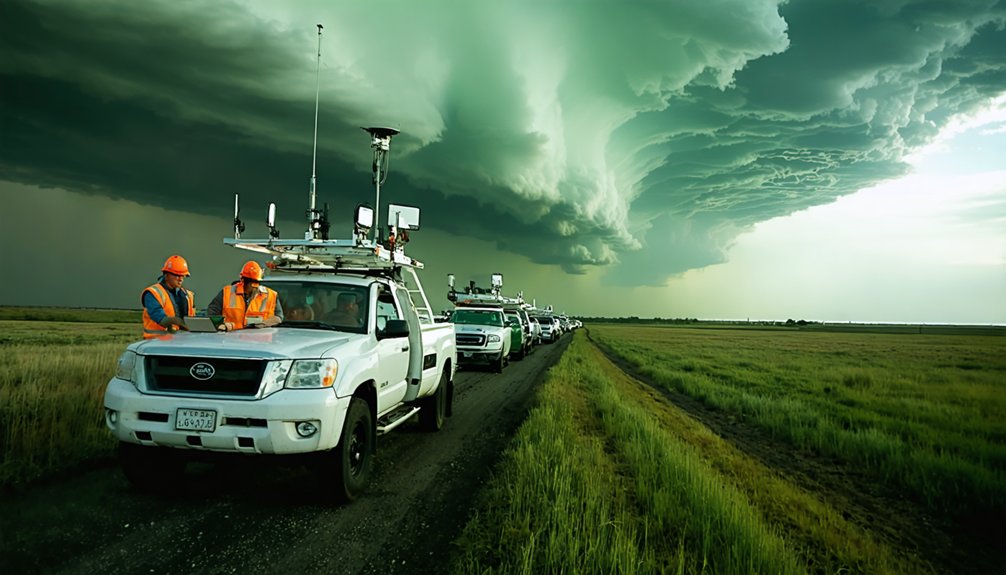
The VORTEX project‘s most consequential contribution to operational meteorology was improving tornado warning accuracy by revealing that tornado formation occurs on smaller time and space scales than previously understood.
Before VORTEX, forecasters relied on broader atmospheric models that couldn’t capture rapid, localized changes driving tornado development.
VORTEX’s dense instrumentation networks—mobile radars, Sticknets, and coordinated mesonets—delivered unprecedented data accuracy, allowing meteorologists to pinpoint formation triggers at finer resolutions.
That granular intelligence directly strengthened tornado prediction models, enabling earlier, more precise warnings.
You benefit from that research every time a warning reaches you minutes before a tornado strikes.
NOAA and NSF-backed scientists translated raw field data into operational tools that expanded your margin for response, demonstrating how rigorous scientific investment protects individual freedom by preserving your ability to act decisively under threat.
Frequently Asked Questions
How Were VORTEX Researchers Kept Safe During Dangerous Tornado Encounters?
The knowledge doesn’t detail specific safety protocols or emergency training used. You’d need additional sources to accurately understand how researchers maintained safety during dangerous tornado encounters within VORTEX operations.
What Were the Total Costs Involved in Funding Both VORTEX Projects?
The available knowledge doesn’t provide funding sources or budget breakdown details for either VORTEX project. You can’t find total cost figures here. Check NOAA’s official records or NSF grant databases for precise financial data.
Did Any VORTEX Equipment Ever Sustain Damage During Field Operations?
The available data doesn’t confirm specific equipment durability incidents or operational challenges during VORTEX field deployments. You’d need to consult primary research reports directly, as the documented knowledge doesn’t detail instrument damage sustained during storm operations.
How Were Participating Universities Selected to Join the VORTEX Research Teams?
The knowledge doesn’t reveal the university criteria or selection process. Like Sherlock without clues, you can’t deduce what isn’t there. You’d need to explore NOAA’s or NSF’s official documentation to uncover those specific details.
What Happened to VORTEX Instruments and Vehicles After Projects Concluded?
The knowledge base doesn’t specify what happened post-project. You’d likely find that instrument repurposing and vehicle maintenance decisions rested with individual institutions, letting researchers freely redirect cutting-edge tools toward new atmospheric science initiatives independently.
References
- https://www.youtube.com/watch?v=KDHOCyA8_B4
- https://en.wikipedia.org/wiki/VORTEX_projects
- https://www.nssl.noaa.gov/projects/vortex2/
- https://www.depts.ttu.edu/research/discoveries/posts/Spring-2017/vortex.php
- https://www.youtube.com/watch?v=uEFk5rJIadc
- https://news.ncsu.edu/2009/05/chasing-the-whirlwind-3/
- https://atoc.colorado.edu/~friedrik/PUBLICATIONS/PRESS/WashingtonPost.pdf
- https://www.youtube.com/watch?v=C8-C0epJX2M