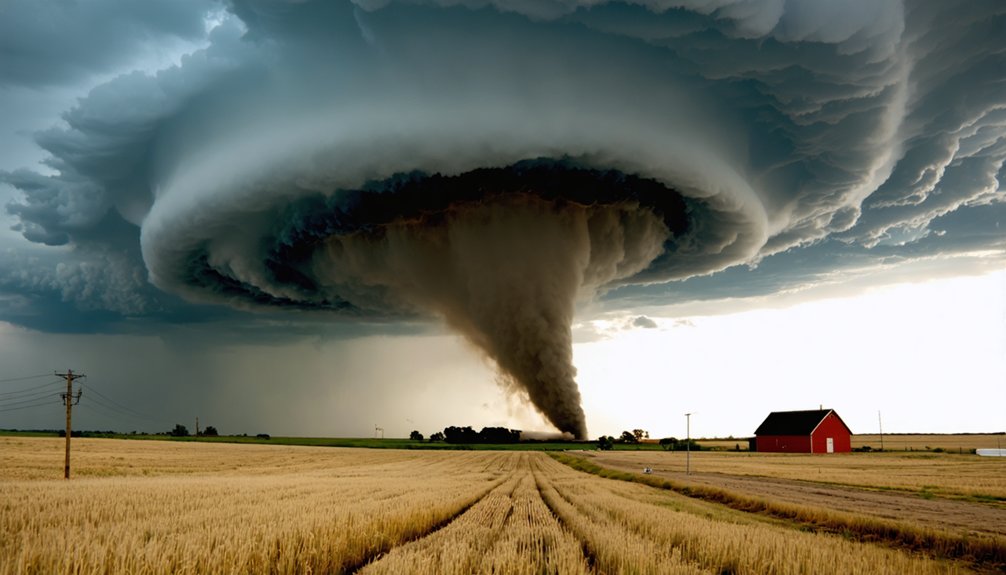
When you look at Tornado Alley’s deadliest storms, the numbers are staggering. The 1925 Tri-State Tornado killed 695 people across a 219-mile path. The 1936 Tupelo-Gainesville Outbreak claimed 450+ lives across two separate tornadoes. Even with modern systems, Joplin’s 2011 EF-5 killed 150+ despite a 24-minute warning. These storms reshaped entire communities and exposed critical gaps in disaster response that still affect how you’re protected today.
Key Takeaways
- The 1925 Tri-State Tornado remains the deadliest single tornado in U.S. history, killing 695 people across Missouri, Illinois, and Indiana.
- The tornado carved a 219-mile path over 3.5 hours, destroying 15,000 homes and displacing thousands of residents.
- Murphysboro, Illinois suffered the highest single-city death toll, with 234 fatalities during the Tri-State Tornado.
- The 1947 Woodward Tornado tore through Oklahoma for 100 miles, claiming 181 lives across its destructive path.
- The 2011 Joplin EF-5 tornado killed over 150 people despite a 24-minute warning, highlighting deadly dangers of public complacency.
The Deadliest Tornadoes Ever Recorded in Tornado Alley
When measuring tornado devastation strictly by death toll, a handful of storms stand above the rest. The 1925 Tri-State Tornado remains the undisputed leader in tornado statistics, killing 695 across Missouri, Illinois, and Indiana.
The 1840 Natchez Tornado follows with over 300 deaths, making it the second deadliest in recorded historical impacts.
The 1936 Tupelo-Gainesville Outbreak claimed 450+ lives across two separate storms, the only outbreak producing two tornadoes each exceeding 200 fatalities.
Oklahoma’s deadliest, the 1947 Woodward Tornado, killed 181 across a 100-mile path.
Even modern events like Joplin’s 2011 EF-5 claimed 150+ lives despite advanced warning systems.
These numbers aren’t abstract—they represent communities erased, freedoms stripped overnight, and the raw, unfiltered power nature holds over human life.
What Made the 1925 Tri-State Tornado So Catastrophic?
Among all the storms mentioned, none demand closer examination than the 1925 Tri-State Tornado. Its catastrophic winds and historical impact reshaped how Americans understood tornado risk forever.
You’re looking at a storm that defied every expectation:
- 695 deaths across Missouri, Illinois, and Indiana — the deadliest single tornado in US history
- 219-mile path sustained for 3.5 hours at nearly 60 mph, an unprecedented ground contact duration
- 15,000 homes destroyed, with iron sheets carried 50 miles by catastrophic winds
Murphysboro, Illinois absorbed 234 deaths alone — one city bearing a third of the total toll.
The storm’s speed prevented residents from receiving any meaningful warning. Its historical impact directly accelerated the development of modern tornado forecasting infrastructure across the nation.
Murphysboro and Annapolis: The Towns the Tri-State Tornado Erased
Two towns bore the Tri-State Tornado‘s worst concentrated destruction: Murphysboro, Illinois, and Annapolis, Missouri.
Murphysboro recorded 234 deaths — the highest single-city toll in U.S. tornado history. The storm demolished entire residential blocks, collapsed schools, and severed infrastructure. Murphysboro recovery stretched years, demanding coordinated rebuilding of over 15,000 displaced households across the region.
You can trace the city’s modern layout directly to post-disaster reconstruction decisions made under severe resource constraints.
Annapolis, Missouri faced near-total obliteration. With a smaller population, its losses represented a higher percentage of residents killed than almost any comparable community.
Annapolis memories persist through survivor accounts describing buildings stripped to foundations within seconds. Both towns demonstrate how concentrated path width, combined with high population density, transforms a single tornado into a community-ending event.
The 1936 Tupelo-Gainesville Outbreak: Two Tornadoes, 450 Dead
The 1936 Tupelo-Gainesville outbreak stands as the only tornado event in recorded U.S. history where two separate tornadoes from the same system each exceeded 200 fatalities — a statistical distinction that sets it apart from every other outbreak on record.
The tornado damage across both states reshaped entire communities, while the historical impact remains measurable in both human cost and structural loss.
Key data points you should know:
- Tupelo, Mississippi: 200+ homes destroyed, residents swept into Gum Pond
- Gainesville, Georgia: 203 killed, including 70 workers trapped inside Cooper Pants Factory
- Combined toll: 450+ deaths across two days, causing millions in regional damage
No other outbreak matches this dual-200-fatality threshold — making 1936 a defining benchmark in American tornado history.
Joplin 2011 and Why Modern Tornado Alley Warnings Still Fail
On May 22, 2011, an EF-5 multiple-vortex tornado nearly one mile wide tore through Joplin, Missouri, killing over 150 people and injuring more than 1,000 — despite a 24-minute warning window issued before impact. The tornado damaged 8,000 buildings and cut directly through the city’s core.
Warning effectiveness collapsed not from a technology failure but from a public response problem. You live in a culture where repeated false alarms erode trust. Joplin residents heard sirens regularly without consequence, breeding complacency that proved fatal.
Repeated false alarms bred fatal complacency — the real failure wasn’t the technology, it was public trust.
Studies confirmed many people delayed action, seeking visual confirmation before moving to shelter.
Modern Tornado Alley infrastructure delivers faster, more accurate warnings than ever before. Yet your survival depends on acting immediately when warnings issue — not when you personally verify the threat.
Frequently Asked Questions
What Was the Deadliest Tornado Year Recorded in Modern US History?
You’d think modern forecasting saves lives — it doesn’t always. In 1953, you’re looking at peak tornado fatalities in historical records: 519 deaths from 422 tornadoes, marking the deadliest year in modern U.S. history.
How Wide and Long Was the Destructive Path of the Woodward Tornado?
You’re looking at a tornado path stretching 100 miles long and nearly two miles wide. The Woodward Tornado’s destruction scale leveled over 100 city blocks, demonstrating how swiftly unchecked natural forces can strip communities of their freedom.
Which US Tornado Is Considered the Second Deadliest in Recorded History?
You’ll find storm intensity and historical impact collide in the Great Natchez Tornado of 1840. It struck Mississippi, swept the river, sank flatboats, and killed over 300, earning it America’s second deadliest tornado distinction.
How Many Deaths Did the 1947 Woodward Oklahoma Tornado Cause Overall?
You’ll find that the 1947 Woodward tornado’s overall impact claimed 181 lives, making it Oklahoma’s deadliest. Historical analysis confirms it leveled 100+ city blocks and destroyed 1,000 homes, devastating the community across its 100-mile destructive path.
Did the Great Natchez Tornado Affect Areas Beyond Mississippi’s Riverfront?
Like ripples from a stone, the Natchez aftermath extended beyond the riverfront — you’d find regional impact across the Mississippi River, where it sank flatboats and killed crews, spreading devastation into surrounding waterways and communities.
References
- https://www.aon.com/impactforecasting/attachments/UnitedStatesTornadoHistory.pdf
- https://www.thezebra.com/resources/home/worst-tornadoes-in-us-history/
- https://lincolnweather.unl.edu/top-ten-deadliest-us-tornadoes/
- https://en.wikipedia.org/wiki/Tornado_records
- https://www.tornadoproject.com/alltorns/worstts.htm
- https://www.weather.gov/arx/torndeadliest
- https://usafacts.org/articles/beyond-tornado-alley-which-states-have-the-most-tornadoes/
- https://nwafiles.nwas.org/file/nwafiles/digest/papers/2010/Vol34No2/Pg145-Gagan-etal.pdf