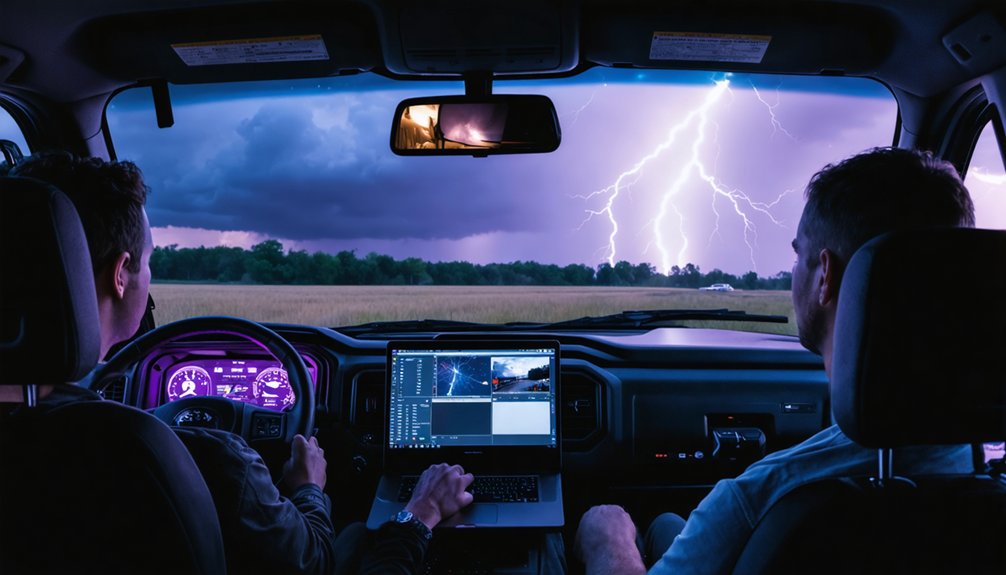
Optimizing your storm chaser vehicle for safety requires layered armor, mechanical readiness, and precision engineering working together. You’ll need steel plating, Kevlar composites, and bulletproof polycarbonate windows at minimum 1.63 inches thick. Hydraulic anchoring systems and body skirts prevent wind displacement and undercarriage lift. Pre-season inspections of your drivetrain and hydraulic systems aren’t optional — they’re survival-critical. Every system covered here directly determines whether your vehicle performs when conditions turn deadly.
Key Takeaways
- Conduct pre-season mechanical inspections to address drivetrain and hydraulic system weaknesses before storm conditions expose critical failures.
- Layer steel plating, Kevlar composites, and bulletproof polycarbonate windows for comprehensive protection against debris and pressure differentials.
- Maximize vehicle weight and deploy hydraulic ground anchors to resist EF3-EF4 wind forces and prevent displacement.
- Install hydraulic body skirts to seal the undercarriage, eliminating low-pressure zones that cause dangerous vertical lift forces.
- Equip crews with roll cages, safety harnesses, and noise-controlled headsets to maintain structural integrity and communication during tornadic contact.
Why Storm Chasing Vehicles Fail Before the Tornado Arrives
Most storm chasing vehicles don’t fail inside the tornado — they fail long before they ever reach it. Weak drivetrain components, neglected hydraulic systems, and deferred vehicle maintenance eliminate your operational window before conditions even turn severe.
Tornado forecasting demands rapid repositioning across unpredictable terrain, and a vehicle that hesitates mechanically costs you more than data — it costs you escape time. Your 6×4 drivetrain, hydraulic spike systems, and redundant air suspension circuits must all function under immediate deployment pressure.
Pre-season inspections aren’t optional preparation; they’re survival infrastructure. Every failed seal, worn hub locker, or degraded electrical connection represents a decision point where the storm wins.
Pre-season inspections aren’t preparation. They’re survival infrastructure. Let mechanical failures accumulate, and the storm wins by default.
Build your maintenance discipline before storm season, not during it.
Steel, Kevlar, and Polycarbonate: How Storm Chaser Armor Actually Works
When you’re engineering a storm chaser vehicle for tornado intercept, you’re combining three distinct materials—each solving a specific structural problem.
Steel plating at 1/8″ thickness mounted on 2″ square tubing frames delivers the rigid load-bearing foundation, while Kevlar composites absorb and distribute impact energy that rigid steel alone would transfer directly to the frame.
Your windows, built from bulletproof polycarbonate and glass at 1.63″ thick, handle the debris strikes and pressure differentials that would compromise any standard glazing system.
Steel Plating Fundamentals
Three distinct materials form the backbone of storm chaser vehicle armor: steel plating, Kevlar composite, and bulletproof polycarbonate.
Steel plating at 1/8″ thickness mounted on 2″ square tubing frames delivers your primary storm impact defense. This foundation resists debris penetration while maintaining structural rigidity under tornadic wind loads.
Vehicle durability depends on how you integrate these components rather than relying on steel alone. The 2″ square tubing frame distributes impact forces across the entire body rather than concentrating stress at single points.
Steel’s rigidity handles direct debris strikes effectively, but its limitations under flexing loads require reinforcement from complementary materials.
Understanding steel’s role as your structural foundation—rather than a complete solution—drives smarter armor decisions when you’re configuring protection for extreme storm environments.
Kevlar’s Energy Absorption Role
While steel handles direct debris strikes, Kevlar composite addresses the limitation steel can’t solve alone: energy absorption under flexing and dynamic loads. When tornado-driven debris impacts your vehicle’s armor, rigid steel alone transfers that force inward. Kevlar’s woven fiber structure dissipates kinetic energy laterally across the composite matrix instead.
The Kevlar advantages become measurable in real deployment conditions. Integrated into 2-inch square tubing frames alongside steel plating and aluminum, Kevlar absorbs vibration, flex stress, and repeated impact loading without fracturing.
You’re not relying on a single-material solution that fails catastrophically — you’re running a layered system where each material compensates for another’s weakness.
Energy absorption capacity means your structural integrity survives sustained tornadic contact, not just a single strike. That distinction keeps you operational when conditions escalate.
Polycarbonate Window Performance
Polycarbonate windows at 1.63 inches thick resolve the vulnerability that steel and Kevlar armor can’t address: transparent structural panels that must withstand extreme pressure differentials and high-velocity debris simultaneously.
Polycarbonate durability at this thickness delivers impact resistance comparable to your surrounding armor, without sacrificing the situational awareness you need to navigate tornado-adjacent positions safely.
Unlike glass, polycarbonate absorbs energy flexibly rather than shattering catastrophically, maintaining window clarity even after debris strikes.
You’re depending on those windows for visual confirmation when data feeds lag behind real-time conditions.
Bulletproof polycarbonate integrates directly into your vehicle’s structural frame, meaning the windows aren’t weak points — they’re active components of your protection system, holding pressure differentials that would destroy conventional automotive glass instantly.
How Thick Do Storm Chaser Windows Need to Be?
When selecting windows for a storm chaser vehicle, you need to meet a minimum thickness standard of 1.63 inches, which bulletproof polycarbonate and glass composites achieve to withstand extreme pressure and debris impact.
You’ll find that polycarbonate offers superior flexibility and energy absorption compared to laminated glass alone, making it the preferred option when tornado debris turns into high-velocity projectiles.
Both materials must resist not only direct impact forces but also the sustained pressure differentials that tornadic winds generate against any exposed surface of the vehicle.
Minimum Window Thickness Standards
Storm chaser windows aren’t just reinforced glass—they’re engineered barriers built to withstand catastrophic pressure differentials, high-velocity debris, and structural deformation under tornadic wind loads.
Meeting minimum safety standards requires bulletproof polycarbonate and glass composites measuring at least 1.63 inches thick. That specification isn’t arbitrary—it’s derived from real-world performance data collected during direct tornado intercepts.
You can’t compromise on window durability when debris becomes projectile material traveling at 200+ mph. Thinner configurations fail under sustained pressure loads and fragmentation impact, eliminating your primary visual interface with the storm environment.
Certified materials must maintain optical clarity while absorbing kinetic energy without shattering. Your operational survival depends on windows that hold structural integrity when everything outside is actively trying to breach your vehicle’s perimeter.
Polycarbonate Versus Glass Options
Choosing between polycarbonate and glass composites for storm chaser windows isn’t a simple preference decision—it’s a structural engineering calculation with life-or-death consequences.
Both materials appear in professional intercept vehicles, but they serve different mechanical roles.
Polycarbonate benefits include superior flexibility and impact absorption, allowing the material to deflect debris energy rather than shatter under sudden load.
It’s lighter than glass, reducing overall vehicle weight without sacrificing protection.
Glass durability, however, provides superior scratch resistance and optical clarity under prolonged field use.
Combined in layered composites reaching 1.63″ thickness, both materials reinforce each other’s weaknesses.
You’re not choosing one over the other—you’re engineering a laminated system where polycarbonate handles dynamic impact and glass maintains structural rigidity and visual precision throughout extended storm intercepts.
Pressure And Debris Resistance
Debris traveling at 200+ mph doesn’t knock on windows—it punches through them with the kinetic force of a small projectile. Your window glazing determines whether you’re collecting data or becoming a casualty.
Bulletproof polycarbonate and glass composites measuring 1.63″ thick deliver the pressure resilience and debris impact resistance serious intercept operations demand.
Here’s what that spec actually means for your build:
- 1.63″ thickness withstands extreme projectile forces and pressure differentials inside tornado cores
- Bulletproof-rated composites combine polycarbonate layering with glass for multi-threat absorption
- Pressure resilience prevents implosion when atmospheric pressure drops sharply inside vortex proximity
- Debris impact testing validates performance against high-velocity hail, wood fragments, and airborne materials
Thin glass isn’t a compromise—it’s a liability you can’t afford in the field.
How Storm Chaser Vehicle Weight Prevents Wind Displacement
When tornadic winds reach extreme velocities, raw vehicle mass becomes one of your most reliable defenses against lateral displacement and rollover. Vehicles like TIV2 leverage a 15,000-pound platform specifically because that weight distribution lowers the vehicle’s center of gravity, directly improving wind resistance against rotational and lateral forces.
Physics works in your favor here. Heavier vehicles require considerably greater force to displace, and when you combine substantial mass with hydraulic anchoring systems that penetrate two feet into the ground, you’ve created a resistance profile that tornadic winds struggle to overcome.
Your anchoring spikes, hydraulic skirts, and vehicle weight operate as an integrated system. Each component amplifies the others, collectively preventing the lift forces and lateral pushing that make lighter, unmodified vehicles dangerously vulnerable inside active tornado corridors.
Ground Anchoring Systems That Lock Storm Chasers in Place
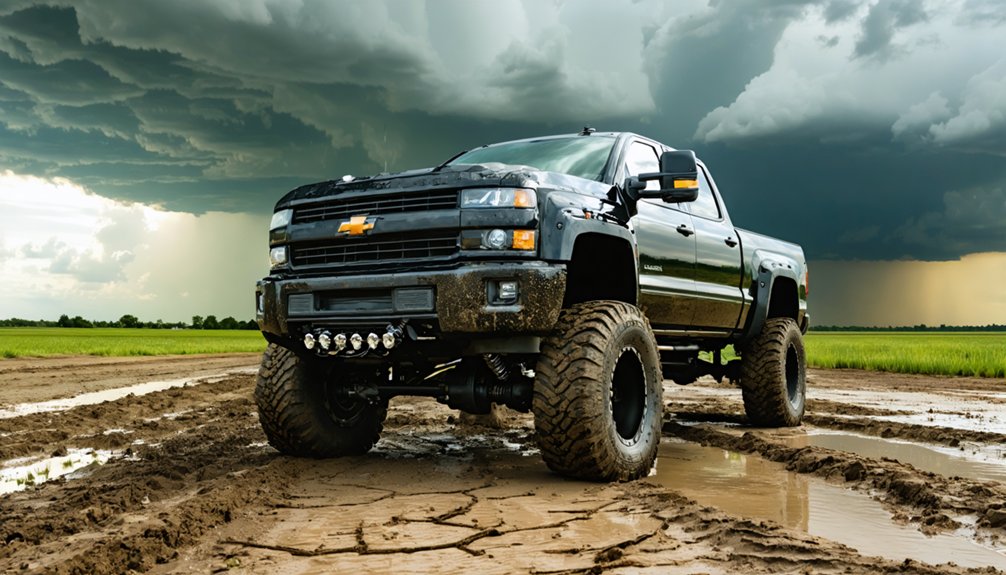
Vehicle mass resists displacement, but it’s the hydraulic anchoring system that actively locks your position when tornadic winds reach their most violent intensity.
Ground stabilization techniques combine hydraulic spike efficiency with body skirts to eliminate both lateral push and vertical lift simultaneously.
Your system deploys:
- Harpoon-tipped hydraulic spikes penetrating approximately 2 feet into soil or pavement on all four corners
- Hydraulic body skirts sealing three sides against ground level, blocking airflow beneath the chassis
- Synchronized dual-circuit pressure systems ensuring simultaneous four-corner spike deployment within seconds
- 15,000-pound vehicle weight working in concert with anchoring hardware to resist tornadic displacement
Together, these systems deliver EF3 resistance with documented EF4-level wind capability, giving you reliable positional control when atmospheric forces reach their most dangerous threshold.
Why Undercarriage Airflow Rolls Storm Chasing Vehicles
Undercarriage airflow creates lift forces that can roll even a 15,000-pound vehicle, because tornado-driven winds accelerating beneath your chassis generate a low-pressure zone that acts like an inverted wing.
Bernoulli’s principle works against you here — faster airflow underneath means reduced pressure, and that pressure differential lifts your vehicle off the ground regardless of its weight.
Maintaining vehicle stability requires eliminating this airflow pathway entirely.
Hydraulic body skirts deploy on three sides, dropping your chassis to ground level within seconds and sealing the undercarriage from wind intrusion.
When undercarriage airflow can’t develop, the low-pressure zone never forms, and lift forces disappear.
Don’t underestimate this threat.
Lateral wind resistance means nothing if tornadic winds simply lift your vehicle vertically and overturn it before displacement even occurs.
Which Wind Sensors Survive Inside a Storm Chaser’s Path?
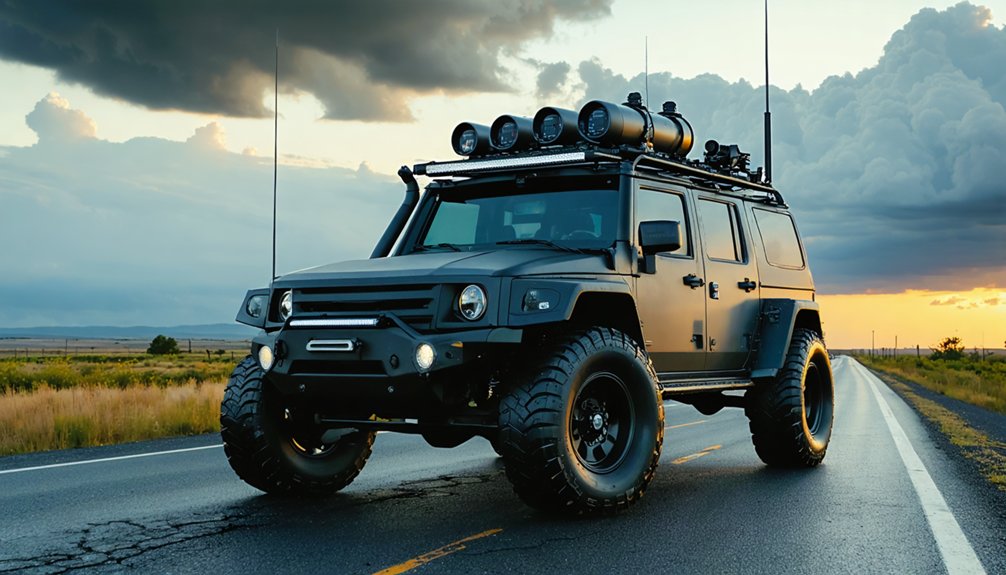
Most conventional anemometers fail catastrophically inside a tornado’s debris field — spinning cups shatter, vanes snap off, and moving parts jam under hail impact within seconds of deployment.
For storm data reliability, you need solid-state ultrasonic wind sensors, which eliminate mechanical vulnerabilities entirely.
These wind sensor types measure airflow using sound wave transit time between fixed transducers — no rotation, no fragile components.
Key performance advantages include:
- No moving parts to fracture under debris impact or hail strikes
- Japan Meteorological Agency certification validates survival at 108 m/s winds
- Reliable operation throughout high-vibration, extreme-temperature environments
- Accurate horizontal and vertical wind measurement from inside active tornadic circulation
You’re collecting irreplaceable atmospheric data.
Don’t compromise it with instrumentation that fails precisely when conditions demand peak performance.
How to Protect Storm Chaser Crews With Harnesses and Roll Cages
When a tornado strikes your vehicle at EF3 intensity or higher, passive structural armor alone won’t prevent crew injury — safety harnesses and roll cage construction become your last line of defense against violent displacement and interior impact.
Your roll cage design must distribute lateral and vertical wind resistance forces across the entire frame, not isolated points. Harness effectiveness depends on proper fit, regular vehicle maintenance inspections, and crew training that includes impact simulations before deployment.
Roll cage integrity means nothing if force concentrates at weak points — distribute load or risk total failure.
You can’t improvise these protocols mid-intercept. Run safety protocols that require harness confirmation before hydraulic systems deploy. Emergency communication through noise-controlled intercom headsets keeps your crew coordinated when wind noise exceeds operational thresholds.
Train deliberately, inspect rigorously, and treat every pre-intercept checklist as non-negotiable — your freedom to operate in extreme environments depends on disciplined preparation.
Can Your Drivetrain Keep Pace With a Moving Tornado?
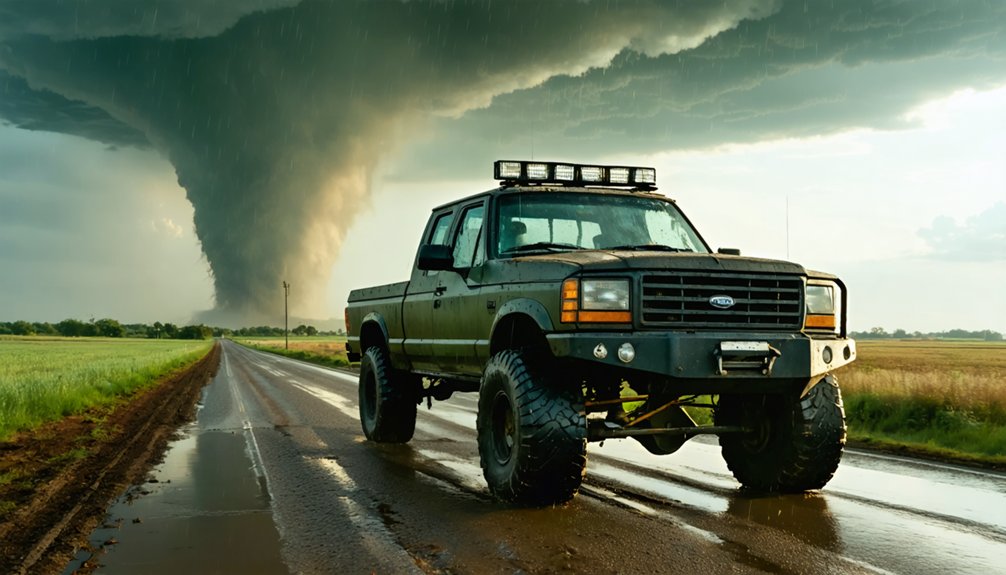
How fast a tornado moves determines whether your drivetrain keeps you in the game or leaves you stranded in its path. Tornado dynamics shift unpredictably, demanding drivetrain efficiency that responds instantly across varied terrain.
Your drivetrain configuration directly controls your survival margin:
- A 6×4 drive train with front hub lockers maintains traction on compromised road surfaces.
- Heavy-duty truck platforms support armor weight without sacrificing maneuverability.
- Reliable drivetrain performance lets you match storm speed while avoiding direct core intercepts.
- Road network knowledge combined with rapid repositioning capability keeps you ahead of path shifts.
You’re not chasing from a fixed position. You’re constantly repositioning against a moving, unpredictable system.
A compromised drivetrain eliminates that freedom entirely, transforming your tactical advantage into a liability when tornado dynamics change without warning.
Frequently Asked Questions
How Do Hydraulic Spikes Penetrate Pavement Without Damaging the Vehicle?
Your hydraulic technology channels immense downward force through harpoon-tipped spikes, enabling clean pavement penetration while the vehicle’s reinforced 2-inch square tubing frame absorbs operational stress, protecting structural integrity throughout deployment.
Can Storm Chaser Vehicles Deploy Anchoring Systems While Still Moving?
You can’t safely deploy anchoring techniques while moving — that’s a misconception. You must bring your vehicle to a complete stop first, then activate hydraulic spikes simultaneously for maximum moving safety and ground stabilization effectiveness.
What Communication Systems Keep Crews Connected Inside Deafening Tornado Winds?
You’ll rely on noise-controlled intercom headsets and radio technology to cut through deafening winds, ensuring team coordination stays sharp. Integrated sirens also alert your crew instantly, keeping everyone connected and operationally aware during active tornado intercepts.
How Quickly Can Hydraulic Systems Lower a Vehicle to Ground Level?
Contrary to assumptions about mechanical lag, your hydraulic efficiency proves remarkable—systems lower your entire vehicle to ground level within seconds. You’ll activate emergency protocols instantly, eliminating undercarriage wind access and securing your position before tornadic forces escalate.
Do Redundant Suspension Systems Operate Independently if One Circuit Fails?
Yes, your redundant air suspension systems operate across multiple independent circuits, so if one fails, the others maintain stability. You’ll benefit from built-in redundancy benefits ensuring continuous independent operation during extreme tornadic conditions without compromising your vehicle’s performance.
References
- https://makezine.com/article/science/storm-chasers-real-twister-tech/
- https://www.youtube.com/watch?v=qi8ffPqDkFE
- https://www.havis.com/case-study/extreme-storm-chasers-oklahoma-usa/
- https://fttechnologies.com/case-study/extreme-wind-measurement-storm-chasing-mesonet
- https://www.youtube.com/watch?v=q-aseZq99n4
- https://cowboystatedaily.com/2025/11/22/famous-mad-max-weather-tank-chases-tornadoes-across-wyoming-and-the-high-plains/
- https://www.weather.gov/gid/spotterinformation