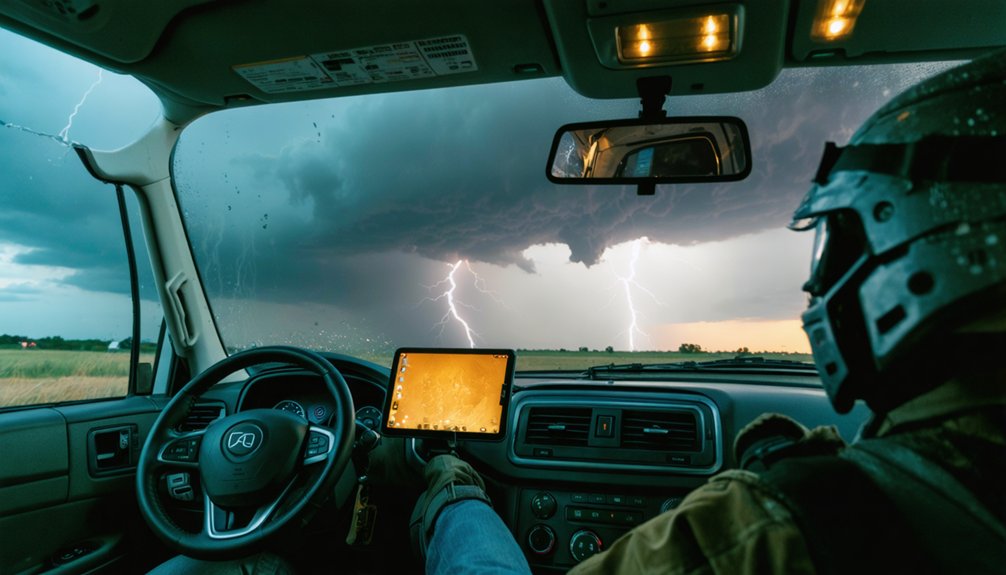
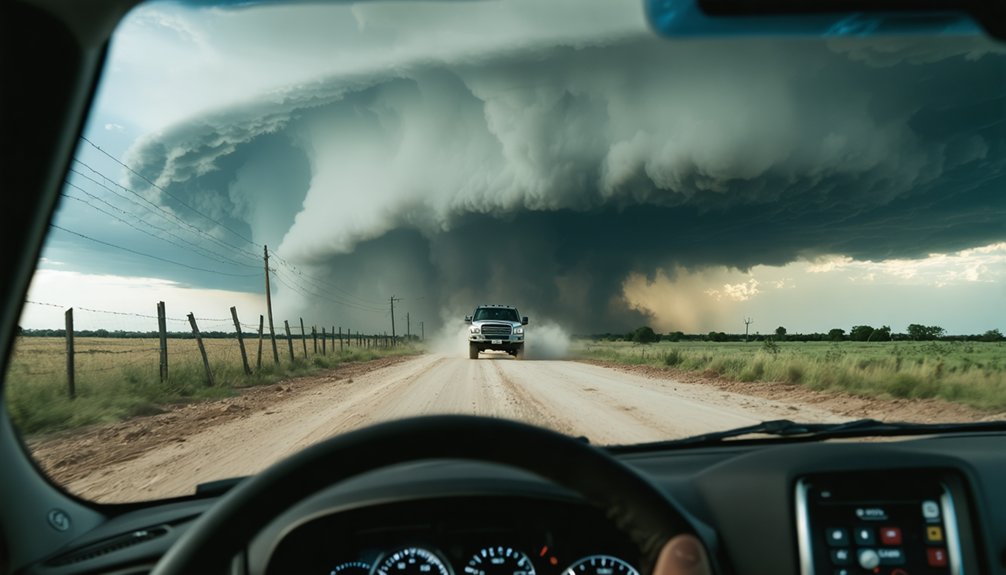
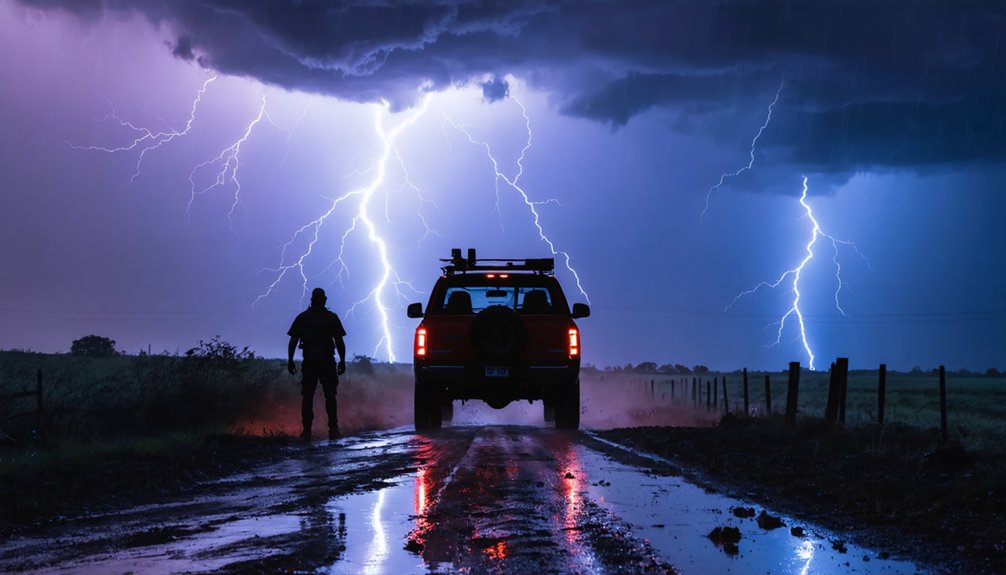
Storm chasing demands disciplined preparation before you ever leave. You’ll need to pre-map escape routes, inspect your vehicle’s critical systems, and maintain at least one mile of lateral distance from tornado-producing mesocyclones. Never cross flooded roads, and treat hail and lightning as immediate mobility threats. Broadcast your GPS coordinates regularly and switch to radio if mobile data fails. These seven guidelines cover the core practices that separate controlled observation from fatal exposure.
Key Takeaways
- Plan at least two escape routes before chasing, avoiding dead-end roads, bridges, and paths crossing the tornado’s projected track.
- Inspect your vehicle thoroughly, stocking emergency supplies including a spare tire, first aid kit, fuel, and jumper cables.
- Maintain at least one mile of lateral distance from tornado-producing mesocyclones to ensure adequate reaction time.
- Treat all flooded roads as impassable and reroute immediately when low visibility threatens escape options.
- Communicate real-time GPS coordinates, route updates, and tornado observations consistently using radio if mobile data fails.
Plan Your Route Before Every Chase
Before you leave for a chase, map out the road network in your target area and identify at least two viable escape routes. Don’t rely on guesswork or follow other chasers without your own exit plan locked in.
Review radar data, spotter networks, and weather briefings to assess storm motion, atmospheric instability, and structural development before you approach. Understand where storm surge risk and flash flooding may compromise roads you’re counting on.
Load backup navigation tools in case mobile data fails. Mark bridges, dead-end roads, and likely tornado paths on your map before you’re in the field. Your freedom to reposition quickly depends entirely on decisions you make before the chase begins, not during it.
Get Your Vehicle Storm-Ready Before You Leave
Your vehicle is a life-safety system during a chase, so inspect it the same way before every deployment. Check tires, brakes, battery, lights, defroster, and all power backup equipment before you leave.
Your vehicle is a life-safety system — inspect it thoroughly before every chase deployment.
Vehicle maintenance isn’t optional — a mechanical failure in a storm corridor can eliminate every exit option you’ve mapped. Confirm your alternator can handle continuous device loads from radar units, radios, and GPS systems running simultaneously.
Stock emergency supplies including a spare tire, jumper cables, basic tools, first aid kit, and extra fuel. You can’t predict when debris or detours will extend your timeline unexpectedly.
Fasten your seat belt before moving and keep it fastened throughout. Assign navigation and radar monitoring to a second person when possible, so the driver stays focused entirely on the road.
Position Yourself With an Escape Route Always Open
A road-ready vehicle means nothing if you’ve parked it in a position with no way out. Before entering any target area, map two viable emergency escape routes that don’t cross the tornado’s projected path. Route contingency planning isn’t optional—it’s operational discipline.
Track storm motion vectors and road orientation together. A perpendicular road grid gives you crosswind exits; a parallel one traps you. Know which you’re on before the storm closes distance.
Avoid committing to dead-end roads, narrow rural lanes, or routes dependent on a single bridge. If radar shows storm acceleration or a track shift, you need to move immediately—not search for alternatives under pressure. Your exit must already be open before you ever need it.
Avoid Flooded Roads and Low-Visibility Conditions
Flooded roads and low-visibility conditions kill storm chasers not because the storm catches them, but because compromised road surfaces and reduced sight lines remove every margin of error you’ve built into your route.
Standing water as shallow as six inches can cause hydroplaning, and twelve inches can carry most vehicles off-road entirely. You can’t judge depth accurately from a moving vehicle, so treat every flooded road as impassable.
Low visibility from heavy rain, blowing dust, or debris-filled outflow cuts your reaction window to near zero. Slow down immediately, activate your headlights, and reassess your position relative to the storm.
If your escape route crosses a flooded road or disappears into a zero-visibility corridor, you’ve already lost the freedom to maneuver. Reroute before conditions force your hand.
Keep a Safe Distance From the Tornado-Producing Storm
When positioning for observation, you’ll want to maintain a safe lateral distance from the tornado-producing mesocyclone, since proximity reduces reaction time and limits your escape options.
Avoid driving beneath or near rotating wall clouds, as rapid tornado development can occur with little warning and cut off your exit path.
Continuously monitor the storm’s projected track so your position never places a tornado’s anticipated path between you and your escape route.
Maintaining Safe Viewing Distance
Keeping a safe distance from the tornado-producing portion of a storm is one of the most critical decisions you’ll make during a chase. Position yourself far enough back to avoid storm shadowing, where heavy precipitation or structure blocks your view of the mesocyclone and tornado. Visual obstructions dramatically reduce your reaction time and can mask rapid tornado movement toward your location.
Most experienced chasers maintain at least one mile of lateral separation, though terrain, storm speed, and forward motion demand constant reassessment. Never sacrifice escape route integrity for a closer view. If your current position compromises two clear exit options, reposition immediately.
Distance isn’t timidity — it’s tactical discipline. Your ability to observe, report, and survive depends entirely on maintaining that calculated separation.
Avoid Rotating Wall Clouds
Distance management extends beyond the tornado itself — rotating wall clouds demand equal respect. A rotating wall cloud signals active mesocyclone organization, often preceding tornado touchdown by only minutes. You can’t afford to position yourself beneath or adjacent to one while conducting danger assessment, because descent rates and rotation intensification can outpace your escape window entirely.
Maintain lateral separation and keep your exit route perpendicular to the storm’s forward motion. Rotating wall clouds frequently produce sudden downdrafts, large hail, and lightning strikes independent of visible tornado formation. Your positioning discipline here determines whether you retain freedom of movement or surrender it.
Never treat a wall cloud as a static target. Treat it as an active threat requiring continuous reassessment, because its behavior defines the storm’s immediate production potential.
Monitor Tornado Projection Paths
Your escape window narrows fast once a tornado’s projection path crosses your position, so tracking storm motion vectors in real time isn’t optional — it’s the foundation of every positioning decision you make.
Tornado path prediction relies on integrating radar-derived storm motion, mesocyclone tracking, and ground-truth spotter data simultaneously. Treat any single data source as incomplete. Storm tracking accuracy degrades when mobile data lags, so cross-reference radar loops with visual confirmation and spotter network reports before committing to a position.
Never let your escape route intersect the projected forward track, even at the edges — tornado paths deviate unpredictably. Calculate your lateral distance from the projected track, factor in storm speed, and always maintain a position that keeps at least two unobstructed exit vectors perpendicular to that track.
Treat Lightning and Hail as Mobility Threats
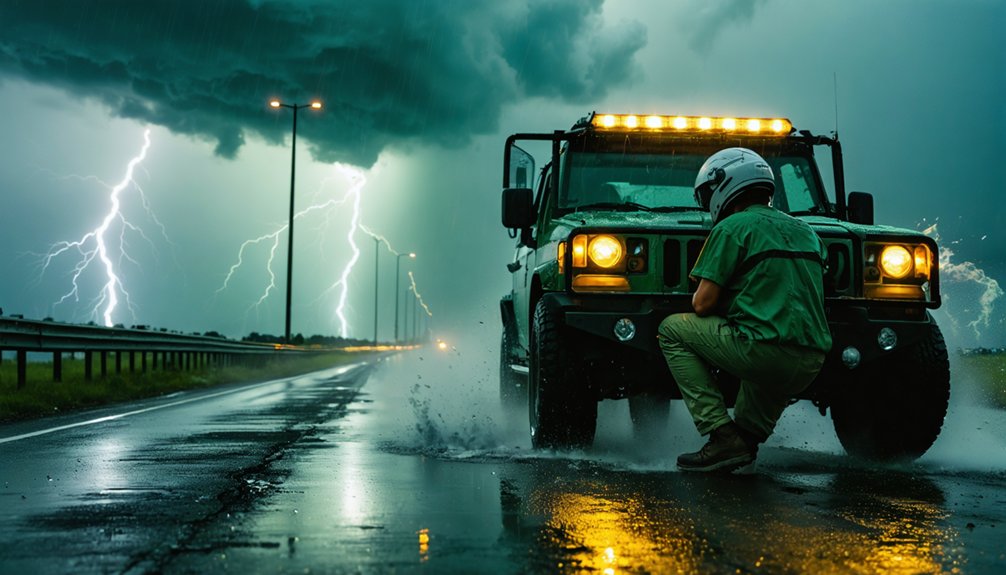
While tornadoes dominate a storm chaser’s attention, lightning and hail demand equal respect as direct threats to vehicle mobility and crew safety. Lightning hazards escalate rapidly when strikes occur within one mile of your position — retreat to a closed vehicle immediately and minimize contact with conductive metal surfaces.
Don’t underestimate hail threats; large hail cores can shatter windshields, damage tires, and strip visibility within seconds, leaving you immobile in an active storm environment. Watch radar closely for hail signatures and precipitation zones before repositioning.
Treat heavy hail accumulation like ice — traction degrades fast. Stay inside your vehicle when lightning activity is high, maintain engine-ready status for rapid exit, and never treat these hazards as mere observation opportunities. Your mobility is your survival margin.
Maintaining real-time communication with your team isn’t optional — it’s a core operational discipline. Broadcast your GPS coordinates at regular intervals, especially when storm tracking conditions change rapidly. If mobile data drops, switch immediately to radio or weather channels to maintain continuity.
Share your intended route, current position, and any observed tornado development with exact coordinates so emergency services can respond efficiently.
Cross-reference satellite imagery with spotter network reports to validate your positioning data before transmitting. Don’t assume your team knows your location — confirm it explicitly.
When you identify damage paths, downed infrastructure, or blocked roads, report those conditions immediately. Accurate field intelligence protects not only your crew but also responders and the public operating in the same corridor.
Discipline in communication is what separates effective chasers from dangerous ones.
Frequently Asked Questions
What Insurance Coverage Do Storm Chasers Typically Need for Their Activities?
While coverage needs vary, you’ll need specialized insurance policies that include liability coverage for vehicle damage, equipment loss, and third-party injuries—standard auto policies often exclude high-risk storm chasing activities entirely.
Are There Legal Permits Required to Chase Storms in Certain States?
Most states don’t require formal permit requirements for storm chasing, but you’ll encounter local storm chase regulations on private land, road closures, and emergency zones. Always verify jurisdiction-specific rules before you enter restricted areas.
How Do Storm Chasers Handle Fatigue During Multi-Day Chasing Expeditions?
You’ll battle a thousand miles of exhaustion management by rotating drivers, scheduling mandatory rest intervals, monitoring driver fatigue with alertness checks, maintaining hydration protocols, and limiting consecutive operational hours to sustain peak cognitive performance during multi-day chasing expeditions.
What Mental Health Impacts Do Storm Chasers Commonly Experience After Dangerous Events?
After dangerous events, you’ll likely face Post Trauma responses—anxiety, hypervigilance, or intrusive memories. Building Emotional Resilience through peer debriefs, psychological support, and structured recovery protocols helps you maintain operational effectiveness across future high-risk chasing expeditions.
Do Professional Storm Chasers Require Any Formal Certification or Training Credentials?
You don’t need formal certification, but you’ll sharpen your edge mastering weather forecasting models and operating storm chasing gear proficiently. Data-driven training, spotter courses, and field experience build the precise skills that keep you operationally free and safe.
References
- https://www.atms.unca.edu/cgodfrey/courses/swfex/pdf/ChasingSafety.pdf
- https://www.flame.org/~cdoswell/chasesums/Chase_safety.html
- https://www.reddit.com/r/stormchasing/comments/k89wnc/safety_tips_for_storm_chasing/
- https://www.youtube.com/watch?v=nxPSFg2R8YY
- https://midweststormchasers.org/safety-tips/
- https://en.wikipedia.org/wiki/Storm_chasing
- http://www.stormeyes.org/tornado/chasing/FAQ/
- https://www.stormchasingusa.com/storm-chasing-and-safety/
- https://crazystormchasers.com/essential-safety-checklist-for-storm-chasing-expeditions/
- https://www.youtube.com/watch?v=h28hru7UhY8