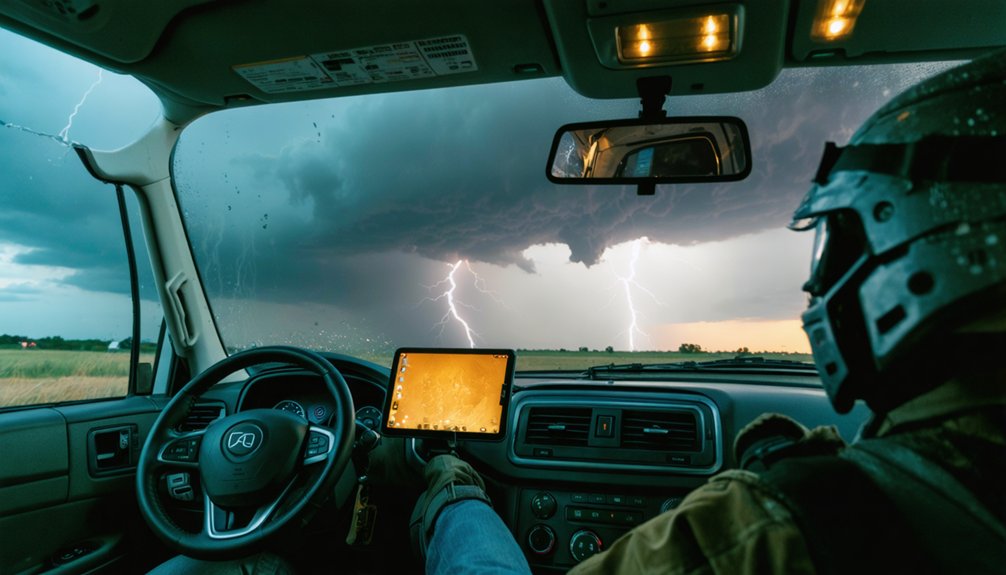
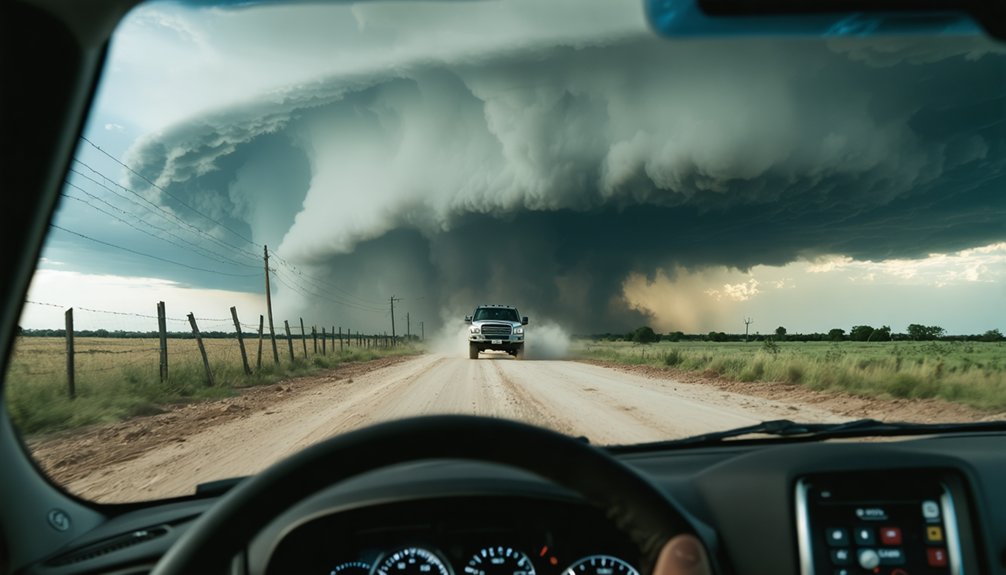
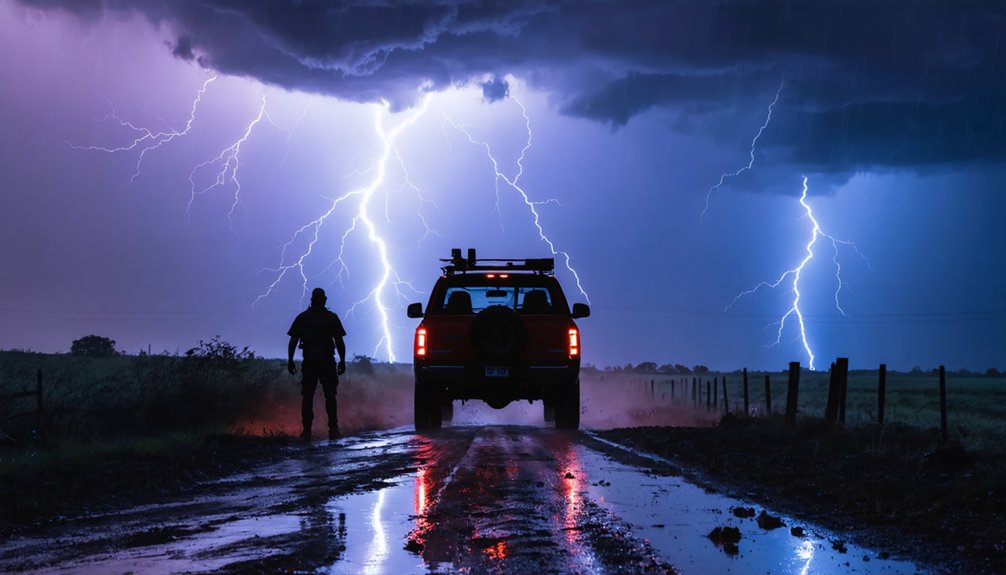
Storm chasing in isolated regions demands rigorous preparation before you leave. You’ll need offline maps, two confirmed escape routes, and a fuel tank above half—always. Stock your vehicle with 48 hours of water, a first aid kit, and layered communication tools like HAM radio and satellite devices. Confirm water depth before crossing standing water, since just 12 inches can float your vehicle. The guidelines ahead cover every critical variable in detail.
Key Takeaways
- Pre-load offline maps, confirm fuel above half, and stock 48 hours of water, food, and emergency supplies before deployment.
- Perform full vehicle maintenance—tires, brakes, fluids, and battery—ensuring operational independence in remote, resource-scarce environments.
- Always maintain two confirmed escape routes perpendicular to the storm’s track, repositioning early before margins are eliminated.
- Never cross standing water without confirming depth; six inches can shift a vehicle, twelve inches can float it.
- Use layered communication systems—NOAA radio, HAM radio, and satellite devices—with power banks fully charged before entering warned areas.
Pre-Chase Planning for Remote and Isolated Areas
Before heading into remote or isolated areas, you’ll need a solid pre-chase plan that accounts for limited infrastructure, sparse road networks, and reduced emergency response coverage.
Conduct thorough weather pattern analysis before departure, identifying storm trajectory, timing windows, and probable intercept zones.
Analyze weather patterns before departure — know your storm’s trajectory, timing, and where your paths will cross.
Map at least two escape routes per major phase, confirming surface conditions and accessibility.
Mark safe shelter coordinates in advance, since rural areas offer fewer real-time options.
Factor in wildlife encounters when selecting staging and repositioning points, as animals on roadways create serious hazards during low-visibility pursuit.
Pre-load offline maps, confirm fuel levels, and pack emergency supplies including water, first aid, and communication backups.
Remote chasing demands precise preparation before wheels roll.
Vehicle Readiness and Supplies for Remote Storm Chasing
When chasing in remote areas, your vehicle isn’t just transportation—it’s your primary safety system. Prioritize vehicle maintenance before every deployment—check tires, brakes, fluids, and battery integrity. Mechanical failure in an isolated region eliminates your escape options instantly.
Supply logistics demand equal precision. Keep your fuel tank above half at all times; rural stations are sparse and unpredictable. Stock your vehicle with a first aid kit, at least 48 hours of water and food, jumper cables, and basic repair tools.
Carry NOAA Weather Radio, a HAM radio, and fully charged power banks since cellular coverage frequently drops in remote corridors.
Every supply decision should reflect operational independence. Out there, no one’s coming quickly—your preparation determines your margin of survival.
Rural Road Hazards That Can Trap or Strand Storm Chasers
Rural roads introduce hazards that radar screens won’t show you—flooded crossings, washed-out shoulders, and mud-saturated surfaces can neutralize your vehicle faster than any storm feature.
Rural hazards develop rapidly and compound quickly when storm runoff overwhelms drainage infrastructure.
Treat standing water as impassable until you’ve confirmed depth. Six inches can shift a vehicle; twelve inches can float it.
Road obstructions including debris, downed power lines, displaced livestock, and abandoned vehicles appear without warning, particularly after wind-driven events.
Avoid unpaved routes when traction or egress options are uncertain.
Mud-locked wheels eliminate both your mobility and your escape window simultaneously.
Maintain at least two confirmed exit routes before committing to any rural segment, and recheck them continuously as storm motion evolves around your position.
Smart Positioning to Avoid Getting Cut Off by Storms
Before committing to any observation point, you’ll need to track real-time storm motion by cross-referencing radar velocity data with your current GPS position to calculate how quickly the storm can close your exit window.
You should always maintain at least two unobstructed escape routes, oriented perpendicular to the storm’s forward track, so a sudden acceleration or direction shift doesn’t cut off your withdrawal.
Choose strategic observation points on paved, elevated roads with clear sightlines to the storm’s forward flank, keeping enough distance that you can reposition before the inflow notch or precipitation core reaches your location.
Tracking Real-Time Storm Motion
How quickly a storm shifts direction can determine whether you escape cleanly or get cut off with no viable exit. Real time tracking of storm motion gives you the positional data needed to make split-second repositioning decisions before your routes disappear.
Pull radar updates at two-to-three-minute intervals minimum, cross-referencing storm velocity vectors against your current GPS position. Don’t rely on a single data source — layer spotter network reports over radar returns to confirm what delayed reflectivity data may miss.
Identify the storm’s forward speed and bearing, then calculate how that trajectory intersects your available road grid. If storm motion angles toward your primary escape corridor, initiate withdrawal immediately.
Waiting for visual confirmation often leaves you with zero margin and no functional exit remaining.
Maintaining Clear Escape Routes
Escape route management starts before you reach your intercept position — once you’re committed to a viewing point, your exit options narrow fast. Map at least two unobstructed exits perpendicular to the storm pathway before you stop. Storms translate unpredictably; a route that’s clear at intercept can close within minutes.
Prioritize roads allowing rapid withdrawal over roads offering the closest view. Avoid dead-ends, flooded crossings, and unpaved roads with uncertain traction — these eliminate flexibility when conditions escalate.
Identify one confirmed emergency shelter within your operational radius before committing to any position. Cross-reference real-time radar with direct visual observation; radar data lags, and that delay costs you critical seconds.
Keep fuel above half-tank. Freedom of movement depends entirely on prepared, deliberate positioning — not reactive decisions made under pressure.
Choosing Strategic Observation Points
Where you park determines whether you observe the storm or become part of it. Ideal vantage points sit southeast of a supercell’s primary circulation, giving you forward visibility while keeping the storm’s motion away from your position. You’re looking for elevated ground on paved roads with intersections nearby, never dead ends.
Environmental considerations matter here. Trees, hills, and structures can block your sightlines and mask rapid tornado development. Power lines overhead increase your lightning exposure immediately. Assess road surface conditions before committing; muddy shoulders eliminate your traction and your options simultaneously.
Keep storm motion vectors in mind constantly. If the cell accelerates or wobbles left, your current position can become compromised within minutes. Reposition early rather than react late.
How Do You Maintain Communication When Cell Service Fails?
When cell networks fail during a chase, you’ll need layered backup systems to maintain reliable communication. NOAA Weather Radio delivers continuous storm updates independent of cellular infrastructure. HAM radio lets you access spotter networks and coordinate directly with other chasers across wide coverage areas.
Satellite communication devices like SPOT or Garmin inReach provide two-way messaging and GPS tracking when no terrestrial signal exists, giving you true operational independence in remote regions.
Build emergency redundancy into every chase kit. Carry fully charged power banks to sustain devices through extended deployments. Push-to-talk platforms running on HAM frequencies keep team coordination intact when data networks drop.
Cross-check each communication layer before entering warned areas. Redundant systems aren’t optional equipment — they’re the infrastructure that keeps your operation functional and your decisions informed.
How to Chase Storms Without Breaking Laws or Blocking Roads
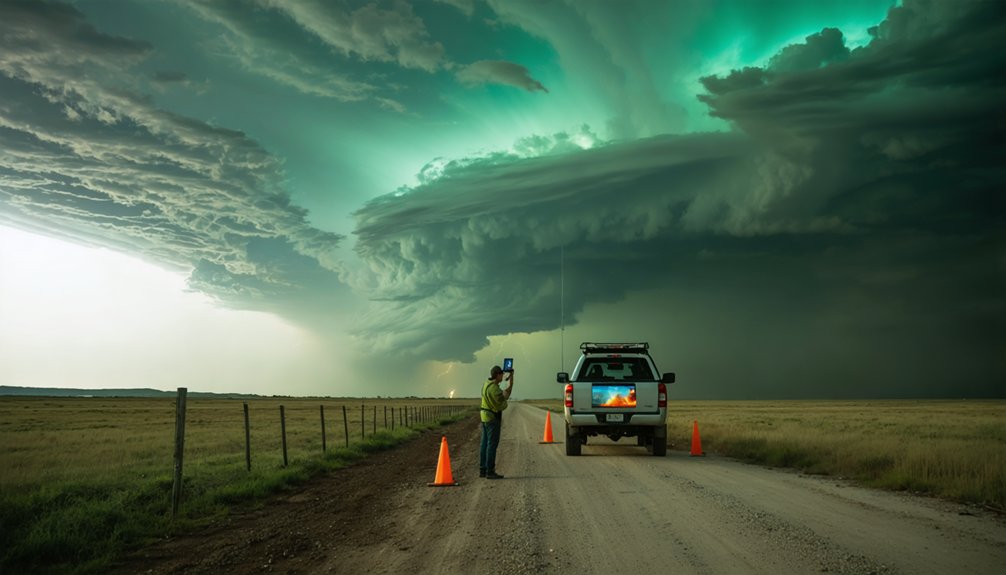
Reliable communication keeps your team coordinated, but it won’t protect you if your positioning violates traffic law or obstructs emergency access. Stay on public roads, respect active incident perimeters, and never block driveways, fire lanes, or emergency corridors.
- Pull completely off the road before stopping — partial lane occupation creates collision hazards during low-visibility conditions.
- Check local permits before entering restricted zones; some jurisdictions require documented authorization for extended roadside activity.
- Avoid wildlife disruption by keeping distance from refuge areas, drainage corridors, and field edges where animals flee storm conditions.
- Report tornado development or damage immediately using exact GPS coordinates, giving emergency responders accurate, actionable data.
Your freedom to chase depends on operating within legal boundaries. Violating access rules risks permit revocation, prosecution, and permanent loss of chase credibility.
Frequently Asked Questions
What Should Storm Chasers Do if a Team Member Becomes Incapacitated?
If a team member’s incapacitated, you must activate your emergency communication systems immediately, broadcasting GPS coordinates. Medical preparedness means you’ve already assigned CPR-certified roles—execute them now, halt the chase, and contact emergency services without delay.
How Do Storm Chasers Safely Manage Fatigue During Multi-Day Chasing Expeditions?
You’ll manage fatigue management by rotating drivers every two hours, maintaining sleep logs, and enforcing mandatory rest stops. Safety protocols demand you’re tracking alertness metrics, staying hydrated, and never compromising reaction time during active multi-day chasing expeditions.
Can Storm Chasing Experience Be Used Toward Professional Meteorology Certifications?
Your field hours are raw fuel for certification. Storm chase training logs and Weather monitoring tools data can support AMS or NWA credentials, but you’ll still need formal coursework, exams, and documented meteorological competency to qualify.
How Should Storm Chasers Handle Encounters With Aggressive or Frightened Livestock?
When you encounter livestock, prioritize animal behavior awareness — slow your vehicle, avoid sudden movements, and don’t block escape paths. Livestock safety depends on your calm response; wait for the animals to clear before proceeding.
What Insurance Coverage Options Exist Specifically for Storm Chasing Activities?
You’ll need specialized insurance policies beyond standard auto coverage. Seek liability coverage designed for high-risk field operations, commercial vehicle endorsements, and equipment protection riders—standard personal policies typically exclude storm chasing activities entirely.
References
- https://www.atms.unca.edu/cgodfrey/courses/swfex/pdf/ChasingSafety.pdf
- https://midweststormchasers.org/safety-tips/
- https://www.livingskytours.com/storm-chasing-101/
- http://www.stormeyes.org/tornado/chasing/FAQ/
- https://www.youtube.com/watch?v=nxPSFg2R8YY
- https://www.reddit.com/r/stormchasing/comments/k89wnc/safety_tips_for_storm_chasing/
- https://crazystormchasers.com/storm-chasing-safety-rules/
- https://weather.cod.edu/chasing/assets/documents/safety.pdf
- https://en.wikipedia.org/wiki/Storm_chasing
- https://medium.com/@paul_15500/storm-chasing-101-what-you-need-to-know-before-you-go-6a6a717ebcdd