You’ll need a bachelor’s degree in meteorology or atmospheric science, with proficiency in radar analysis tools like base reflectivity and velocity products. Master technical equipment including portable weather meters, GOES-16 satellite imagery interpretation, and High Resolution Rapid Refresh models. Develop four-wheel drive vehicle operation skills alongside safety protocols like lightning avoidance and the VAPOR escape route checklist. Many professionals enhance credentials with SKYWARN training and field observation programs. The extensive skill framework encompasses additional competencies that elevate hobbyists into career meteorologists.
Key Takeaways
- Strong educational foundation in meteorology or atmospheric science, with many professionals holding bachelor’s or advanced degrees.
- Technical proficiency in weather forecasting tools including radar analysis, satellite imagery interpretation, and atmospheric data modeling.
- Vehicle operation expertise with four-wheel drive capability and real-time navigation skills for challenging terrain and weather conditions.
- Advanced radar interpretation skills using base reflectivity, velocity data, and dual-polarization products to track storm development.
- Comprehensive safety protocols including lightning awareness, escape route planning, and emergency preparedness with proper certifications.
Educational Foundation and Academic Requirements
While storm chasing may appear as thrilling fieldwork capturing tornadoes and supercells, the profession demands rigorous academic preparation rooted in atmospheric science. You’ll need a bachelor’s degree in meteorology or atmospheric science as your baseline—expect $40,000-$100,000+ investment over four years.
Research positions require master’s degrees (held by 24.7% of chasers), while government agencies often demand PhDs (11.1% hold doctorates). Your interdisciplinary course work should span atmospheric physics, dynamics, chemistry, and climatology. Begin building your foundation early through advanced math and science coursework, then supplement with SKYWARN training and university field observation programs.
Continuing education requirements remain critical as forecasting models evolve. This academic rigor provides essential credibility when pursuing media contracts or research opportunities.
Mastering Technical Weather Forecasting Tools
Your academic credentials mean nothing without operational proficiency in the technical forecasting tools that distinguish professional storm chasers from amateurs. Master portable weather meters like the Kestrel 5500 for real-time field data collection methods, integrating LiNK Bluetooth technology with mobile radar apps such as RadarScope.
Deploy professional field stations equipped with MeteoWind anemometers and MeteoTemp sensors to capture microclimatic variations during active chases. Analyze High Resolution Rapid Refresh models and Skew-T log-P diagrams to assess atmospheric instability independently.
Hands on training programs teach you to interpret GOES-16 satellite imagery and synthesize tropospheric data from multiple sources. Establish redundant connectivity through cell boosters and dual-carrier hotspots, ensuring uninterrupted access to nowcasting tools when positioned in remote terrain where conventional networks fail.
Advanced Radar and Data Analysis Capabilities
Because radar technology forms the operational backbone of intercept strategy, you must develop expert-level proficiency in the core four radar products that reveal storm structure and tornado potential. Base reflectivity identifies precipitation intensity, while base velocity exposes mesocyclone rotation and rear flank downdrafts. VIL quantifies storm strength through vertically integrated liquid content, and echo tops measure convective height accounting for beam limitations.
Advanced parameters enhance your analytical capabilities. Differential reflectivity distinguishes hail cores, correlation coefficient confirms tornado debris signatures, and spectrum width highlights turbulence zones. You’ll integrate satellite data processing with storm modeling simulations to forecast evolution patterns. Mobile Doppler units positioned strategically capture full lifecycle dynamics, while dual-polarization algorithms like NTDA calculate tornado probabilities. Regional composites reveal mesoscale boundaries driving initiation, demanding continuous multi-source synthesis for ideal positioning decisions.
Intercepting storms requires translating meteorological analysis into precise field positioning, which depends entirely on your vehicle’s capabilities and your mastery of tactical navigation under hazardous conditions.
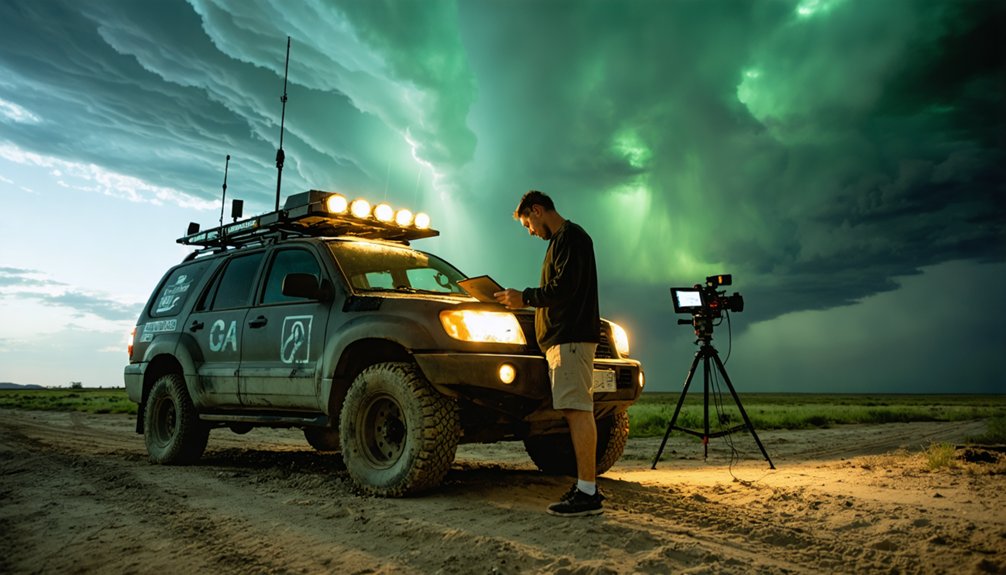
You’ll need four-wheel drive for muddy county roads and off road maneuverability when paved routes become impassable. Sport utility vehicles provide ideal terrain handling while maintaining multipurpose gear storage for electronics, safety equipment, and documentation systems.
Essential navigation skills include real-time route adjustment using GPS data, evaluating surface conditions for two versus four-wheel drive deployment, and maintaining situational awareness through 360-degree cameras. Your vehicle must support power-intensive equipment via heavy-gauge electrical systems and inverters exceeding 200W capacity.
Bull bars reduce collision damage by 20%, while LED light bars guarantee visibility during low-light intercepts. Master responsive handling on slick surfaces—predictable braking prevents fatal miscalculations.
Safety Protocols and Risk Management
You’ll mitigate storm chasing fatalities through systematic implementation of lightning safety protocols, core punching avoidance strategies, and the VAPOR escape route checklist developed from documented chaser accidents.
Your vehicle requires OSHA-certified equipment including fire extinguishers, first aid kits, and maximum-strength internet boosters to maintain uninterrupted radar data streams during repositioning maneuvers.
Team preparedness demands Red Cross CPR certification for at least one member per unit, pre-deployment safety briefings with meteorologists, and worker’s compensation coverage for all operational personnel.
Hazard Recognition and Avoidance
Storm chasing demands systematic hazard assessment protocols that extend beyond basic weather literacy into operational risk mitigation. You’ll need mastery of situational awareness techniques that integrate real-time radar analysis with mesoscale atmospheric discussions.
Weather observation best practices require continuous monitoring of Doppler velocity data, spotter network communications, and NOAA alert systems to track evolving threats.
Critical hazard recognition protocols:
- Lightning strike zones: Recognize first cloud-to-ground flashes can occur without warning—maintain vehicle isolation and avoid exposed terrain
- Hail corridors: Identify rotating wall clouds that produce baseball-sized projectiles capable of penetrating windshields
- Flash flood pathways: Turn around immediately on inundated roads where six inches of moving water compromises vehicle stability
You’ll coordinate HAM radio networks to share real-time GPS positions, wind shifts, and funnel reports with NWS databases while maintaining dual escape routes through pre-analyzed road networks.
Vehicle Safety and Maintenance
Professional chase operations collapse without rigorous vehicle preparedness protocols that address both mechanical reliability and operational safety systems. You’ll need proactive maintenance schedules targeting hydroplaning prevention through tire condition monitoring and alternator capacity verification for sustained electronics operation.
Implement redundancy checks on headlight functionality and emergency equipment accessibility—first aid kits, tire sealant, jumper cables. Your device mounting systems require swivel capabilities that prevent driver view obstruction while maintaining legal compliance.
High-profile tires suited for wet conditions minimize aquaplaning risks during precipitation events. Install power systems—cigarette lighter ports and USB chargers—rated for continuous high-draw applications.
Your backup power sources guarantee navigation and radar app functionality during primary system failures. This systematic approach to vehicle integrity directly correlates with operational autonomy and survival probability in extreme meteorological environments.
Emergency Communication Systems
When cellular networks fail during severe weather events, your operational continuity depends on layered communication architectures that integrate terrestrial radio, satellite uplinks, and protocol-driven reporting systems. You’ll need radio backup options like GXT1000VP4 walkie-talkies for real-time team coordination and MXT115 vehicle-mounted units with NOAA weather alerts.
A General Class FCC amateur radio license enables direct National Weather Service communication and emergency management coordination. Remote monitoring solutions include XM Weather’s 5-minute radar updates and 4GLTE systems for forecasting data transmission.
Critical Communication Protocols:
- Deploy multi-band radios to maintain contact across frequencies when commercial networks collapse
- Report tornado sightings directly to NWS offices using Spotter Network app numbers, bypassing 911 to prevent warning delays
- Maintain satellite internet capability for data transmission in cellular dead zones during intercept operations
Essential Soft Skills for Storm Chasers
You’ll need patience to endure hours of unsuccessful chases while maintaining operational readiness for rapidly developing convective systems. Your ability to execute split-second decisions—choosing escape routes, positioning strategies, or data collection priorities—directly impacts both your safety margins and research outcomes.
Storm chasing demands precise verbal coordination with team members during zero-visibility conditions and real-time data transmission to meteorological networks under extreme time constraints.
Patience During Unpredictable Conditions
Although storm chasing appears action-packed from media portrayals, the reality centers on extended waiting periods that test your mental endurance more than physical capability. You’ll spend countless hours monitoring atmospheric data while storms fail to materialize as forecasted. Coping with setbacks becomes essential when multiple chase days yield zero intercepts, yet these fruitless expeditions accumulate critical pattern recognition data.
Maintaining motivation during long wait periods distinguishes successful chasers from those who abandon the pursuit.
Your patience directly correlates with skill development through:
- Enduring 10-hour drives between forecasted cells that dissipate before formation
- Monitoring radar loops for six consecutive hours in vacant parking lots
- Logging atmospheric conditions during entire seasons with minimal tornado activity
Each unsuccessful chase refines your forecasting accuracy, transforming disappointment into empirical knowledge that enhances future intercept probability.
Quick Decision-Making Under Pressure
Storm intercepts demand split-second positioning choices where hesitation reduces your intercept probability by measurable margins. You’ll synthesize probabilistic threat data while maneuvering—26% of chasers activate protective protocols below 20% tornado likelihood thresholds.
Your multitasking under duress separates successful intercepts from missed opportunities across 48.8 notable severe weather days annually. Veterans who’ve documented over 100 tornadoes demonstrate intuitive situational awareness by identifying supercell features faster than stationary observers.
You’ll combine proximity and likelihood factors—85% of experienced chasers use this dual-metric approach. Hour-by-hour nowcasting refinements translate meteorological degrees into actionable storm positioning. Learning from field mistakes sharpens your risk judgment under uncertainty, transforming raw sensation-seeking into calculated decision protocols that maximize both intercept success and personal autonomy.
Effective Team Communication Skills
Rapid-fire decisions mean nothing if your chase partner misinterprets velocity couplets or fails to hear your navigation callouts over wind noise and static. You’ll need precision communication protocols that function under cognitive load—assigning roles, confirming hazard assessments, and maintaining situational awareness while operating vehicles at highway speeds.
Essential communication competencies include:
- HAM radio proficiency through Net Control Stations coordinating assets across 30-mile repeater networks
- Public speaking abilities for conference presentations and real-time data sharing with National Weather Service operations
- Media relations training enabling accurate hazard communication to emergency services and broadcast outlets
Document critical exchanges via email with proper disclaimers. Reserve phone communications for time-sensitive coordination only. Your ability to mentor junior chasers and deliver concise safety advisories directly impacts team survivability and operational effectiveness.
Building Experience Through Field Work
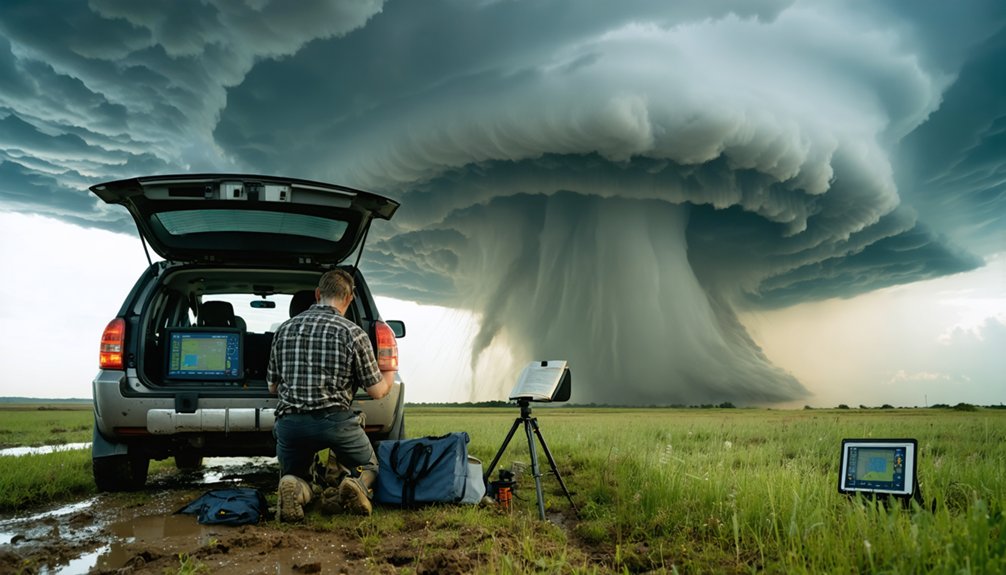
While theoretical knowledge establishes foundational meteorology principles, you’ll achieve competency in storm chasing only through systematic field deployment. Participate in storm chasing tours under experienced forecasters to observe real-time decision-making during severe weather pursuits.
Join volunteer spotter networks where you’ll contribute ground-level reports and develop data collection methodologies essential for pattern recognition.
University field programs like Hokie Storm Chasers provide structured Great Plains intercepts, enabling equipment deployment practice in tornadic conditions. Accumulate chase days consistently—experienced chasers starting from the 1990s demonstrate enhanced storm behavior pattern recognition through years of documented pursuits.
Ride-alongs with veteran chasers accelerate your learning curve by demonstrating safe positioning, radar interpretation, and vehicle operation during high winds. Progress from support roles to lead forecaster positions as you systematically evaluate past chases and refine interception strategies.
Communication and Documentation Proficiencies
Effective data transmission determines whether your field observations reach decision-makers during critical severe weather events. You’ll master thorough documentation procedures through email reports with data disclaimers, written analyses for scientific contributions, and formal submissions to NWS stations.
Real time data reporting protocols require two-way radios, satellite phones, and cellular hotspots for continuous streaming from remote locations.
Essential communication capabilities include:
- Field-to-Center Transmission: Stream thunderstorm intensity metrics directly to research facilities while maintaining concise radio protocols
- Professional Documentation: Craft technical reports with protective disclaimers, ensuring your observations contribute to meteorological databases without unauthorized redistribution
- Multi-Platform Coordination: Integrate social media reporting (#AcuRiteStormSpotter), broadcast partnerships, and emergency service liaison roles
You’ll develop these proficiencies through mentoring junior chasers and coordinating team operations during active deployments.
Frequently Asked Questions
What Is the Average Salary for a Professional Storm Chaser?
Contrary to popular belief, you’ll earn $45,000-$90,000 annually as a professional storm chaser. However, opportunities for storm chasing income remain limited, and risks of storm chasing as a career include inconsistent pay and dangerous conditions that threaten your independence.
Do Storm Chasers Need Special Insurance for Their Vehicles?
You don’t need special vehicle insurance coverage for storm chasing, but you’ll want detailed protection since standard policies cover storm damage liability. However, insurers may deny claims if they discover you’re actively pursuing severe weather events.
What Is the Best Season to Start Storm Chasing?
You’ll find late May through early June delivers ideal conditions—no horse-and-buggy guesswork needed. Storm prediction models peak accuracy then, while perfect weather conditions concentrate across Kansas, maximizing your chase freedom with highest tornado probabilities and photogenic supercell encounters.
Can You Become a Storm Chaser Without a Degree?
Yes, you can become a storm chaser without a degree. You’ll need hands-on experience through spotter programs like SKYWARN, strong meteorological knowledge, and practical skills in radar interpretation—your academic background matters less than proven field competence.
How Do Storm Chasers Generate Income From Their Work?
You’ll generate income through monetizing content creation by selling footage and photography to media outlets, while pursuing corporate sponsorships from weather-related brands. Most chasers maintain supplementary employment, as research positions and freelance sales create diversified revenue streams.