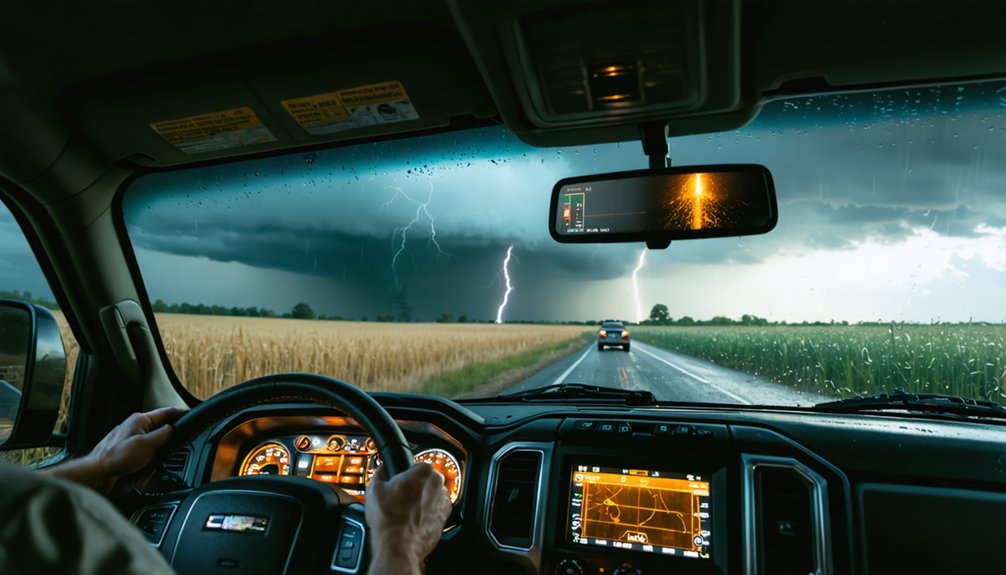
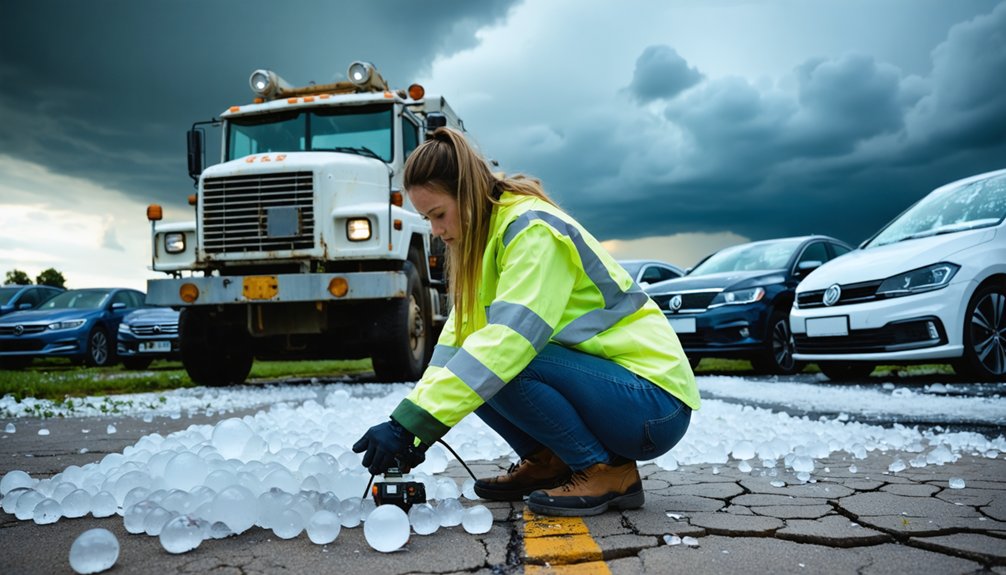
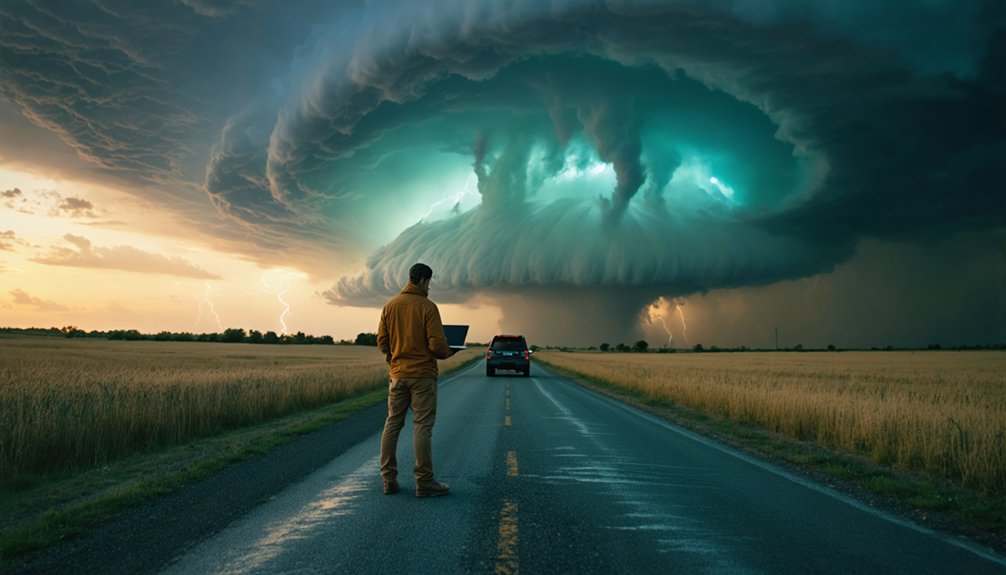
Staying safe while intercepting severe thunderstorms requires constant situational awareness and strict protocol adherence. You must monitor NOAA Weather Radio continuously, act immediately when warnings cover your intercept zone, and never underestimate rapid storm intensification. Reset your 30-minute timer whenever you hear thunder, avoid elevated terrain and isolated trees during lightning, and disengage the moment flash flooding or tornado warnings threaten your escape routes. The details ahead can sharpen every decision you’ll make in the field.
Key Takeaways
- Act immediately upon severe thunderstorm warnings, as large hail, damaging winds, and embedded tornadoes pose confirmed threats within your intercept zone.
- Reset a 30-minute timer after hearing thunder, since trailing cells may be invisible and returning early significantly increases safety risks.
- Avoid elevated terrain and isolated trees during lightning, instead seeking lower open ground or enclosed sturdy structures immediately.
- Use a hard-top vehicle with windows up, and ensure tires, brakes, and engine are reliable for rapid escape.
- Disengage when equipment fails, flash flooding threatens escape routes, or storm fatigue reduces your reaction time and decision-making ability.
Read These Warning Signs Before Your Next Storm Intercept
Before you head out to intercept a severe thunderstorm, you need to understand the warning system that governs when and how fast conditions can turn lethal. A severe thunderstorm watch means storm patterns are favorable for severe activity; a warning means weather radar or a reliable report has already confirmed it. Act immediately when a warning covers your intercept zone.
Large hail, damaging winds, and embedded tornadoes are all confirmed threats under a severe thunderstorm warning. If you hear thunder, lightning’s already within strike range—you’re out of buffer time. Monitor NOAA Weather Radio and local alerts continuously, because storm patterns shift fast.
Don’t rely on visual cues alone; weather radar gives you the ground truth you need before conditions outpace your ability to respond.
Why Storm Intercepts Turn Deadly Without Warning
Storm intercepts turn lethal when conditions accelerate faster than your situational awareness can track. A single missed rotation, one overlooked wind shift, or a delayed radar update can compress your escape window to zero.
Storm complacency kills experienced chasers precisely because familiarity breeds underestimation. You start reading patterns confidently, then you stop reading them critically.
False alarms compound this problem differently. When repeated warnings produce no significant outcomes, you unconsciously discount future alerts. That cognitive drift is dangerous.
Severe thunderstorms can generate large hail, damaging winds, and tornadoes within minutes of warning issuance. Warnings often cover limited areas for short durations, meaning rapid action isn’t optional—it’s survival.
Your freedom to intercept storms depends entirely on your discipline to respect their unpredictability.
Lightning Hazards That Put Storm Chasers at Highest Risk
When you position yourself on elevated terrain like hills, ridges, or peaks during an intercept, you dramatically increase your lightning exposure. You must evacuate those areas immediately.
Seeking cover beneath a tall, isolated tree compounds the danger further, as these structures act as natural lightning rods. They also present a falling hazard in high winds.
You should treat both scenarios as critical threat multipliers that demand immediate repositioning to lower, open ground away from any singular tall object.
Elevated Terrain Lightning Risks
Elevated terrain ranks among the most dangerous positions a storm chaser can occupy during active thunderstorm activity. Ridges, peaks, and hillcrests dramatically increase your lightning exposure because they reduce the distance between you and the storm’s charge centers. Lightning amplification intensifies across open summits where no competing tall structures exist to redirect strike probability elsewhere.
Mountain shadows create a deceptive tactical problem. You might assume a shadowed slope signals reduced storm activity overhead, but charge buildup doesn’t follow visible light patterns. Lightning can strike terrain well outside the storm’s visible core.
Evacuate elevated positions immediately when thunder becomes audible. Every second you remain on high ground compounds your strike risk exponentially. Descend to lower terrain, seek a hard-top vehicle or enclosed structure, and don’t reattempt elevated observation until thunder has been absent for 30 minutes.
Isolated Trees And Strikes
Leaving high ground removes one lightning hazard but drops you directly into another if you take cover beneath isolated trees. Tall, solitary trees are priority strike targets because they present the tallest conductive path above open ground. Lightning strikes follow the path of least resistance, and an isolated tree gives the discharge exactly that.
Tree safety isn’t just about avoiding the trunk — ground current radiates outward from the strike point and can incapacitate you from several feet away. Side flash can jump laterally from the tree to your body.
When you’re intercepting storms, treat any isolated tree as a live electrical conductor during active lightning. Maintain significant lateral distance, stay low, and prioritize reaching a hard-top vehicle or enclosed structure immediately.
Choose the Right Vehicle for Storm Intercept Safety
Your vehicle choice directly determines your margin of safety during a storm intercept. A hard-top automobile with windows rolled up provides meaningful protection from lightning, debris, and hail that open or convertible vehicles simply can’t offer. You’re fundamentally creating a mobile Faraday cage, reducing your direct lightning exposure substantially.
Beyond vehicle type, vehicle maintenance is non-negotiable. Compromised tires, failing brakes, or a malfunctioning engine can strand you directly in a storm’s path. Inspect critical systems before every intercept.
Additionally, verify your insurance coverage accounts for hail damage, flash flood scenarios, and high-wind debris impacts — all documented severe thunderstorm hazards. Standard policies frequently exclude storm-related damage without specific riders.
Choosing correctly and maintaining your vehicle rigorously keeps your exit options open when conditions deteriorate rapidly.
When to Pull Out of the Intercept and Find Shelter

Knowing when to abort an intercept is as critical as any pre-mission decision you make. Storm fatigue degrades your situational awareness faster than most chasers acknowledge — when your reaction time slows and decision-making feels labored, you’ve already stayed too long.
Storm fatigue doesn’t announce itself — by the time decisions feel hard, you’ve already overstayed your welcome.
Equipment malfunctions compound that risk; if your GPS, radio, or weather data feed fails, you’re operating blind in a dynamic threat environment.
Pull out immediately when lightning is striking nearby, flash flooding threatens your escape route, or a tornado warning is issued for your position. Don’t negotiate with those triggers.
Locate a sturdy, fully enclosed building and stay put until thunder has been silent for at least 30 minutes. Your freedom to chase another day depends entirely on your discipline to disengage today.
How to Escape When Flash Flooding Cuts Off Your Route
Flash flooding can isolate your position faster than any other hazard a storm intercept produces, so you need an exit strategy before water starts moving. Study floodplain awareness maps before deployment and identify which roads cross low-lying drainages or sit within mapped inundation zones.
Urban infrastructure—culverts, storm drains, and underpasses—overwhelms quickly, turning familiar streets into channelized flows within minutes.
When water appears on your route, treat it as impassable. One foot of moving water sweeps a vehicle away; don’t test that threshold.
Select your alternate route before conditions deteriorate, moving perpendicular to flow direction and toward higher ground.
If every exit is compromised, stop on elevated pavement, stay inside your hard-top vehicle, and monitor NOAA Weather Radio until the flooding recedes.
How Long Should You Wait Before Returning to the Field?
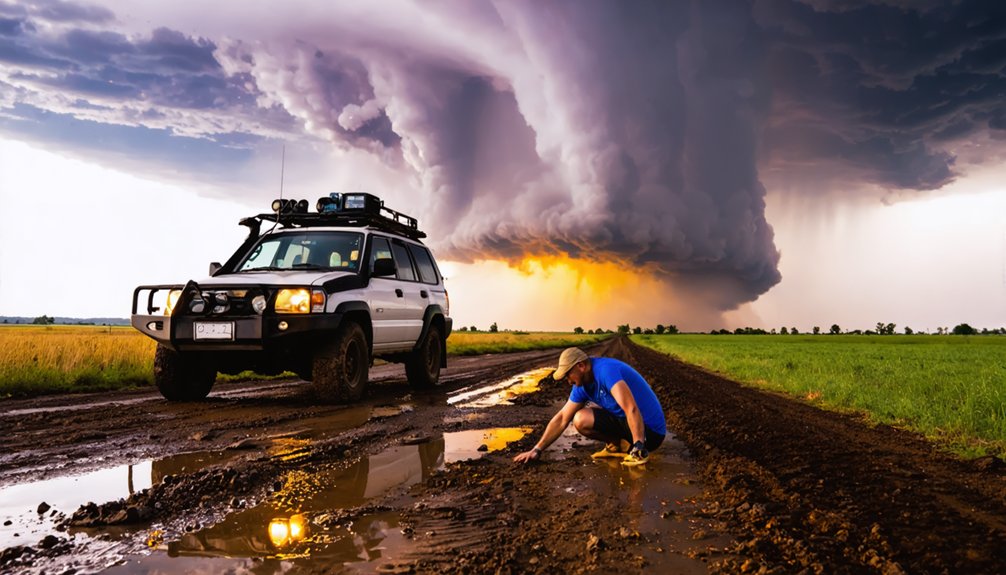
Once the last rumble of thunder fades, you still can’t return to the field immediately—wait at least 30 minutes before resuming any outdoor activity. Storms can regenerate quickly, making post storm assessment critical before you move.
Follow this protocol:
- Monitor NOAA Weather Radio and confirm no active warnings remain in your intercept zone.
- Conduct weather pattern analysis by reviewing radar trends to verify the storm cell has fully cleared your area.
- Reset your 30-minute timer if any thunder is heard during your waiting period.
Severe thunderstorms can produce trailing cells that aren’t immediately visible. Returning early compromises your safety and your mission.
Discipline during this phase separates calculated storm interceptors from reckless ones. Stay sharp, stay patient, and move only when conditions are confirmed clear.
Frequently Asked Questions
Can Pets Safely Accompany Storm Chasers During Active Severe Thunderstorm Warnings?
Don’t bite off more than you can chew — pet safety demands you leave storm chaser pets at home. During active severe thunderstorm warnings, you should bring pets inside, not expose them to dangerous conditions.
What Indoor Plumbing Risks Should Chasers Know When Sheltering in Unfamiliar Buildings?
Avoid all indoor water hazards—don’t shower, wash dishes, or use plumbing fixtures. Lightning travels through plumbing integrity systems, delivering lethal strikes. Stay clear of any water-connected sources until thunder’s completely silent for 30 minutes.
Should Storm Interceptors Avoid Concrete Structures During Active Lightning Threats Nearby?
Yes, you should avoid concrete floors and walls during active lightning threats—they’re structural hazards because metal reinforcement conducts electricity. Prioritize lightning safety by selecting interior, windowless rooms, keeping you away from conductive building materials entirely.
How Can Whole-House Surge Protectors Benefit a Storm Chaser’s Base Equipment?
Whole-house surge protectors shield your base equipment by providing surge protection against lightning-induced power spikes. They’ll reinforce your electrical grounding system, reducing appliance damage and keeping your critical forecasting and communication gear operational during active storm interception missions.
What Crouching Posture Reduces Risk When No Vehicle or Shelter Is Available?
Though it feels exposed, you’re actually reducing risk: crouch low using safe posture crouching techniques — balance on the balls of your feet, minimize ground contact, and stay low to limit lightning’s conduction path through your body.
References
- https://www.cdc.gov/lightning/safety/index.html
- https://www.redcross.org/get-help/how-to-prepare-for-emergencies/types-of-emergencies/thunderstorm.html
- https://www.dhses.ny.gov/thunderstorm
- https://www.weather.gov/safety/thunderstorm-during
- https://www.ready.gov/thunderstorms-lightning
- https://www.weather.gov/bmx/sps_svrsafetyrules
- https://www.weather.gov/safety/thunderstorm
- https://www.weather.gov/ind/LightningSafetyAwareness
- https://www.weather.gov/ama/SEVERESAFETYTIPS
- https://www.weather.gov/safety/lightning-tips