When you look at storm chaser fatalities, the data tells a clear story. Christopher Phillips died in 1984 after swerving to avoid a rabbit — no tornado involved. Vehicle accidents, hydroplaning, and road hazards kill chasers at three times the rate of direct tornado contact. The 2013 El Reno tornado broke that pattern, claiming Tim Samaras, Paul Samaras, and Carl Young through direct contact. Each death reshaped protocols in ways worth understanding fully.
Key Takeaways
- Christopher Phillips, the first recorded storm chaser fatality, died April 26, 1984, when his vehicle rolled into a ditch avoiding a rabbit.
- Tim Samaras, Paul Samaras, and Carl Young died May 31, 2013, marking the first confirmed storm chaser deaths from direct tornado contact.
- Jeff Wear, Fabian Guerra, and Andy Gabrielson died from vehicle accidents during repositioning, not tornado contact.
- Indirect vehicle-related deaths outnumber direct tornado fatalities three to one among storm chasers.
- Nearly half of indirect storm chaser deaths involved hydroplaning on high-speed highways during poor visibility conditions.
The First Recorded Storm Chaser Death
Although storm chasing carries an obvious association with tornado contact as its primary lethal threat, the first recorded fatality in the field had nothing to do with a tornado. On April 26, 1984, 21-year-old University of Oklahoma meteorology student Christopher Phillips died in Logan County, Oklahoma, after his vehicle rolled into a ditch while swerving to avoid a rabbit. No extreme weather struck him directly. That data point matters.
It established early that road travel itself posed fatal risk, independent of storm proximity. Before meteorology advancements refined chasing methodology, safety protocols were minimal, and this death exposed that gap clearly.
Phillips’ case remains the baseline reference for understanding how chasing fatalities actually distribute across causes — tornado contact being only one variable in a far more complex risk profile.
How Storm Chasers Died Before El Reno
Before El Reno claimed three chasers in 2013, you’d find that road hazards — not tornadoes — defined the fatality record.
Jeff Wear hydroplaned near Kilgore, Texas, in 2005.
Fabian Guerra swerved for a deer in Iowa in 2009.
Andy Gabrielson died in a wrong-way collision near Sapulpa, Oklahoma, in 2012.
The data makes clear that the road itself was the primary killer, long before any tornado made direct contact with a chasing vehicle.
The First Known Death
For nearly sixty years before the El Reno disaster, road accidents—not tornadoes—were killing storm chasers. Historical context matters here: the first documented in-field fatality wasn’t a tornado strike—it was a rollover.
On April 26, 1984, Christopher Phillips, a 21-year-old University of Oklahoma meteorology student, died in Logan County, Oklahoma. He swerved to avoid a rabbit, his vehicle rolled into a ditch, and he was killed. No tornado contact. No equipment failure.
That incident forced the field to confront a critical gap in safety protocols—the danger existed beyond the storm itself. Phillips’ death confirmed that road behavior, situational awareness, and vehicle control weren’t secondary concerns. They were primary survival factors that every chaser operating in the field had to take seriously.
Road Hazards Claimed Lives
Between 1984 and the 2013 El Reno disaster, road hazards—not tornadoes—defined the fatality profile of storm chasing. You’d expect weather patterns to be the primary killer, but the data tells a different story.
Jeff Wear hydroplaned near Kilgore, Texas, in 2005, striking a flatbed truck head-on. Fabian Guerra died in 2009 after swerving to avoid a deer and colliding with a tractor-trailer in Iowa. Andy Gabrielson was killed in 2012 by a wrong-way drunk driver near Sapulpa, Oklahoma.
Each case reflects a consistent pattern: vehicle safety failures during repositioning, not tornado contact, ended lives. Nearly half of indirect chasing deaths involved hydroplaning. High-speed highways, poor visibility, and heavy rain transformed the return trip into the most statistically dangerous phase of any chase.
Crashes Before Tornadoes Did
Until El Reno, tornadoes hadn’t killed a single storm chaser—crashes had. Christopher Phillips died in 1984 when his car rolled into a ditch after he swerved to avoid a rabbit. Jeff Wear hydroplaned near Kilgore, Texas, in 2005. Fabian Guerra swerved for a deer in Iowa in 2009. Andy Gabrielson met a wrong-way drunk driver near Sapulpa, Oklahoma, in 2012.
Despite decades of meteorology advancements and rapidly evolving chasing technology, the road remained the primary killer. You could track a supercell with precision instruments, position yourself most favorable, and still die on the drive home.
The data makes this clear: indirect road fatalities dominated the chasing death record for nearly sixty years before a tornado finally claimed its first chasers directly.
The El Reno Tornado Deaths That Shocked the Field
On May 31, 2013, the El Reno tornado killed Tim Samaras, Paul Samaras, and Carl Young near Reuter Road in Oklahoma—marking the first confirmed instance of storm chasers dying from direct tornado contact.
On May 31, 2013, the El Reno tornado claimed three storm chasers—the first confirmed fatalities from direct tornado contact.
The TWISTEX team’s deaths reshaped meteorologist safety protocols across the field. Four critical factors defined this event:
- The tornado’s path shifted unpredictably, compromising vehicle dynamics and escape routes.
- The storm expanded rapidly, outpacing standard repositioning calculations.
- Experienced researchers with advanced equipment still couldn’t outmaneuver the system.
- Road geometry on Reuter Road limited directional options under pressure.
You can’t chase freedom from risk by relying solely on expertise. This event proved that data collection and field experience don’t guarantee survivability when tornado behavior defies predictive models.
Why the El Reno Chasers Never Made It Out
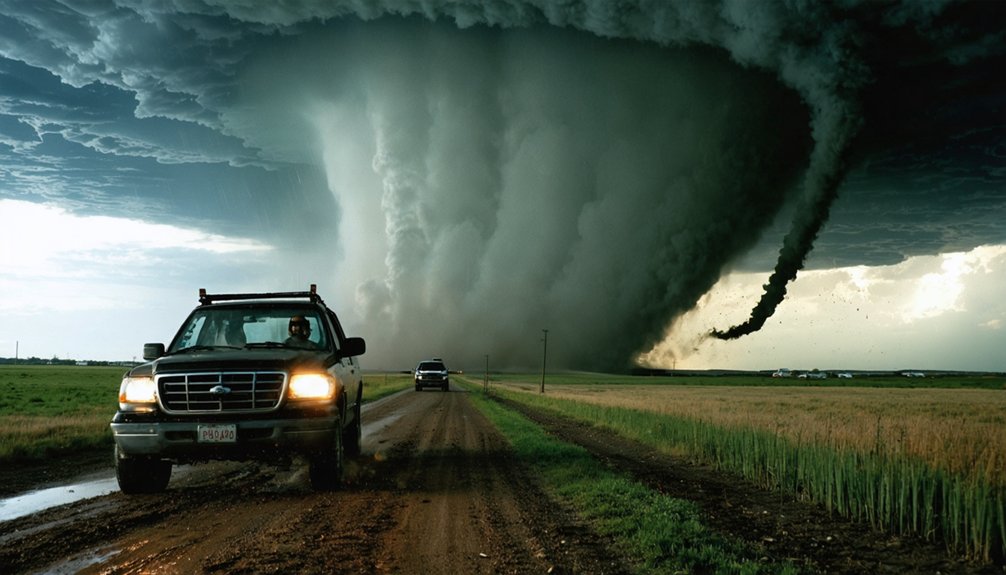
When the El Reno tornado struck on May 31, 2013, it wasn’t behaving like a predictable system—it was expanding at an anomalous rate, growing to a record 2.6-mile width while simultaneously shifting its forward track southward.
Tim Samaras, Paul Samaras, and Carl Young were caught on Reuter Road when that track change eliminated their escape window entirely.
Weather unpredictability was the defining variable here. The tornado’s rapid intensification outpaced any calculated repositioning.
Even experienced teams operating with professional-grade equipment couldn’t compensate for a storm that rewrote its own behavior mid-event.
Equipment failure under extreme inflow conditions further compressed their decision time.
You can hold every credential, run every calculation correctly, and still face a system that simply refuses to conform. That’s the brutal arithmetic of direct tornado contact.
Why Driving Kills More Storm Chasers Than Tornadoes
Though tornadoes dominate the public image of storm-chasing risk, the fatality record tells a different story: indirect deaths—those caused by vehicle crashes during or after a chase—outnumber direct tornado-contact deaths by a ratio of three to one. Vehicle safety and weather preparedness aren’t optional—they’re survival variables.
The data reveals four recurring crash mechanisms:
- Hydroplaning in post-storm rainfall
- Animal avoidance maneuvers causing rollovers
- Head-on collisions with wrong-way or distracted drivers
- High-speed lane departures in low-visibility conditions
Jeff Wear, Fabian Guerra, and Andy Gabrielson each died this way—not by tornado contact, but by road conditions that punish inattention. You can master tornado behavior and still get killed on the return trip. The highway doesn’t care about your expertise.
What the Death Record Reveals About Chasing Risk
What the death record reveals isn’t a story about tornadoes—it’s a story about roads. When you analyze the full fatality record, direct tornado strikes account for only four deaths. The rest trace back to hydroplaning, wrong-way drivers, deer strikes, and high-speed collisions during repositioning.
That pattern demands you rethink where real risk mitigation efforts belong. You can’t outrun a tornado if you’ve already lost control on a rain-slicked highway. The data also shows that expertise doesn’t protect you—Tim Samaras was among the most skilled chasers in the field.
Effective safety protocols must address return trips and road selection, not just proximity to rotation. The death record gives you a clear target. The question is whether you act on it.
How These Fatalities Reshaped Storm-Chasing Practice
Each documented fatality has functioned as a forcing mechanism, compelling the storm-chasing community to revise operational protocols in concrete, measurable ways. You can trace direct changes across four key areas:
- Meteorological advancements in tornado motion analysis now prioritize real-time track deviation alerts.
- Equipment improvements include armored intercept vehicles and redundant GPS positioning systems.
- Exit route pre-planning has become a standard pre-chase checklist requirement.
- Team communication protocols now mandate continuous position reporting during high-risk intercepts.
The El Reno deaths specifically exposed fatal gaps in cycloidal motion modeling, accelerating research investment.
Deaths like Wear’s and Guerra’s quantified hydroplaning as a statistically significant post-chase threat, shifting how teams select return routes.
Each fatality expanded the operational data set, letting you make more precise, survivable field decisions.
Frequently Asked Questions
How Many Total Storm-Chasing Deaths Have Been Recorded as of 2025?
You’ve got sixteen total recorded storm-chasing deaths as of late 2025—four direct tornado-strike fatalities and twelve indirect. These figures drive storm chasing safety protocols and inform weather prediction advances that help you assess field risks analytically.
Was Christopher Phillips Chasing a Tornado When He Died?
No, Christopher Phillips wasn’t directly chasing a tornado when he died. Your storm chasing gear and tornado safety protocols couldn’t have helped him — he rolled into a ditch after swerving to avoid a rabbit in 1984.
Which Research Team Were the El Reno Victims Affiliated With?
The TWISTEX team lost three of its brightest minds to El Reno’s monster storm. Tim Samaras, Paul Samaras, and Carl Young’s research collaboration redefined storm safety standards you’d recognize in tornado field operations today.
What State Has Seen the Most Storm-Chasing Fatalities Overall?
Based on documented fatalities, Oklahoma’s seen the most storm-chasing deaths overall. You’ll find it central to your risk assessment and weather safety analysis, with El Reno (2013), the 1984 Phillips incident, and Sapulpa (2012) all occurring there.
Are Indirect Storm-Chasing Deaths Counted Separately From Direct Tornado Deaths?
Yes, you’ll find that storm safety records distinguish them. Direct tornado strikes and indirect losses are tracked separately, sharpening risk assessment and letting analysts pinpoint where the field’s most preventable dangers truly lie.
References
- https://stormtrack.org/threads/storm-chasing-fatalities-a-look-back.30662/
- https://en.wikipedia.org/wiki/Carl_Young_(storm_chaser)
- https://stevemillerok.medium.com/the-tragic-deaths-of-seven-storm-chasers-all-with-a-single-thing-in-common-539ea4797959
- https://en.wikipedia.org/wiki/Storm_chasing
- https://www.cbsnews.com/colorado/news/colorado-storm-chasers-killed-in-oklahoma-tornado/
- https://fox40.com/news/unpredictable-storm-in-oklahoma-turned-on-three-chasers/
- https://www.accuweather.com/en/weather-blogs/weathermatrix/storm-chasers-star-joel-taylor-passes-away/4099
- https://www.gmanetwork.com/news/topstories/world/311179/three-storm-chasers-among-13-killed-by-oklahoma-tornadoes/story/
- https://www.washingtonpost.com/national/health-science/tim-samaras-2-other-storm-chasers-killed-in-oklahoma-colleagues-mourn/2013/06/03/6424851e-cc46-11e2-8845-d970ccb04497_story.html
- https://www.local3news.com/storm-chasers-killed-during-tornado-in-oklahoma-tornado-over-the-weekend/article_5d0e2790-0bca-518b-9ccc-f17f606662a6.html