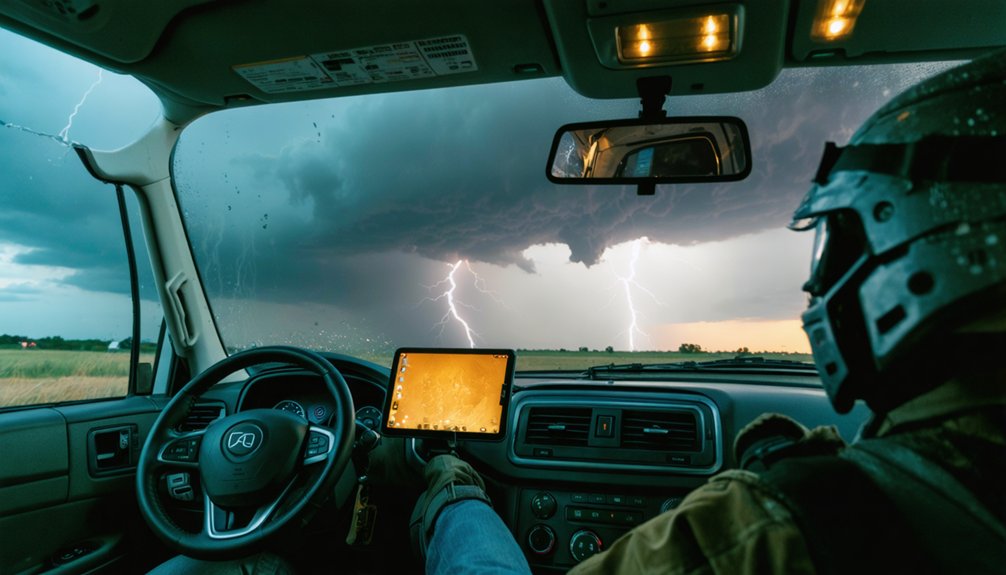
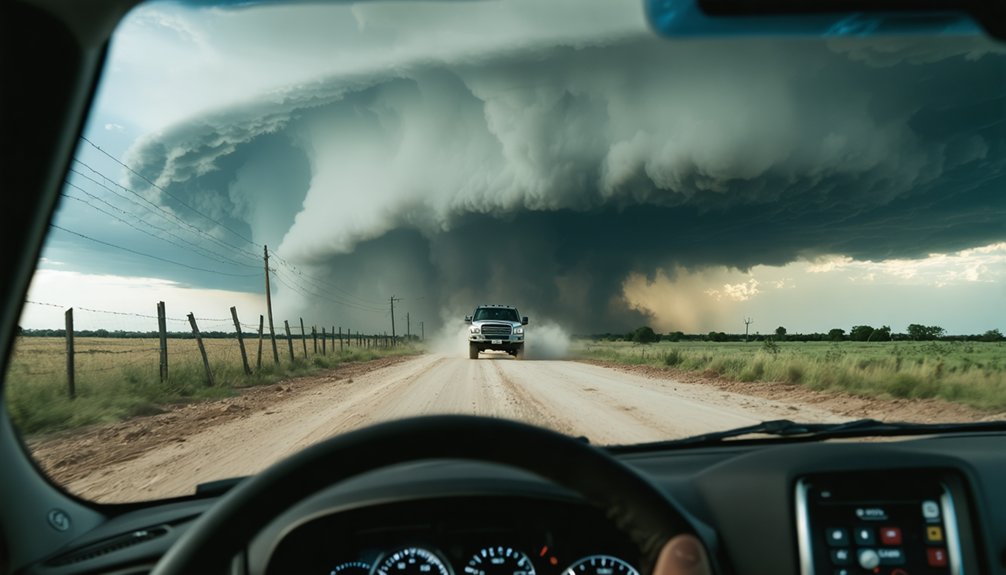
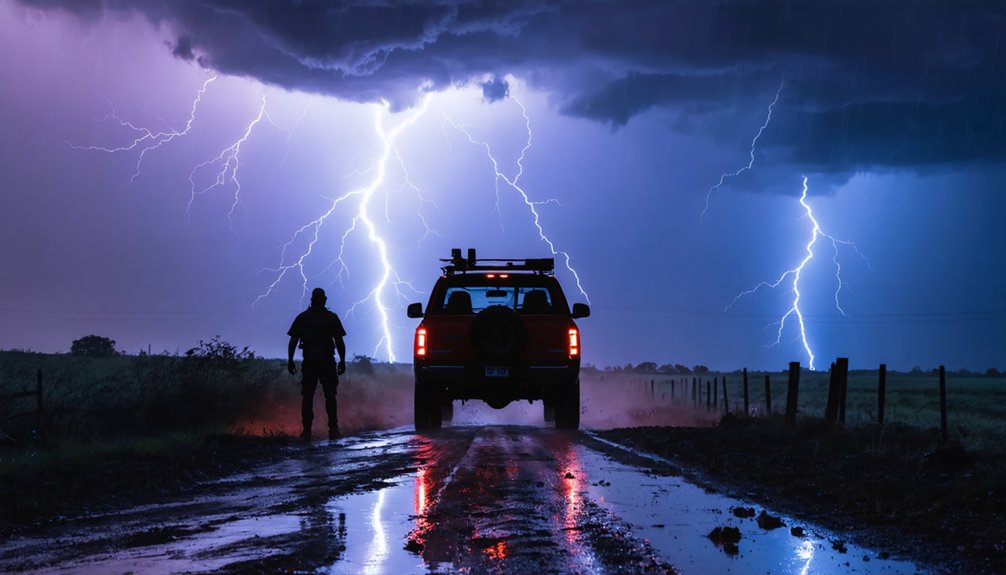
Storm chasing at night removes every visual advantage you depend on during daylight. Your high beams cover only 350–500 feet, lightning gives you fragmented snapshots lasting under one second, and wall clouds disappear against dark skies. Hydroplaning risk spikes above 35 mph on wet roads you can’t fully see. Fatigue degrades your decision-making by nearly 30% within 90 minutes. Every system protecting you fails simultaneously, and what follows explains exactly how fast it compounds.
Key Takeaways
- Darkness eliminates clear sight lines, limiting high beam visibility to 350–500 feet and making road edges nearly indistinguishable.
- Wet roads increase hydroplaning risk, with traction loss occurring rapidly at speeds exceeding 35 mph.
- Wall clouds and tornadoes become nearly impossible to detect visually without continuous radar support at night.
- Fatigue degrades risk assessment accuracy by nearly 30% within 90 minutes, compounding nighttime decision-making challenges.
- Cellular networks and GPS signals fail under severe weather, leaving chasers dangerously reliant on compromised navigation systems.
The Visibility Gaps That Make Night Storm Chasing Uniquely Dangerous
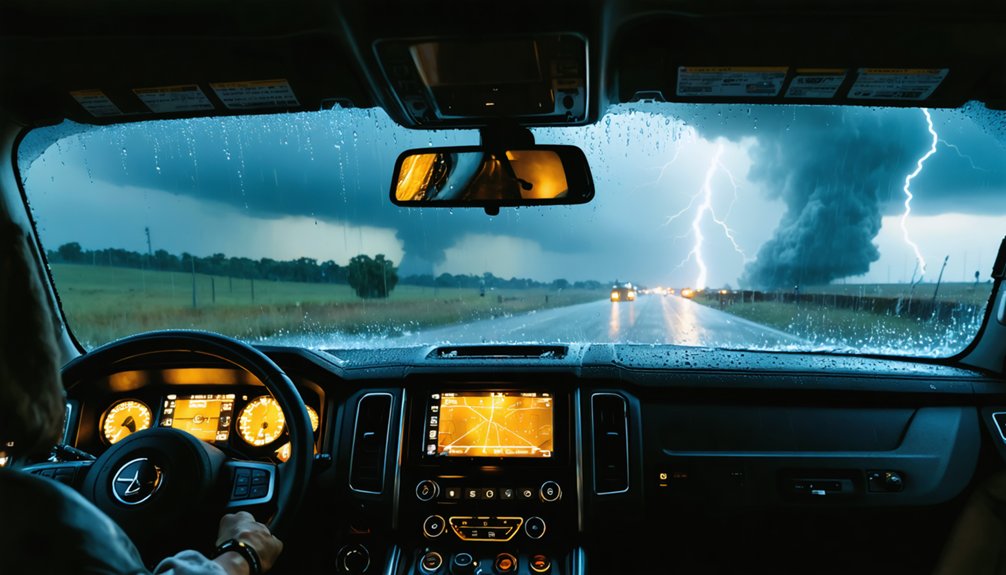
When you’re chasing storms at night, darkness strips away the primary safety tool every chaser relies on: unobstructed sight lines. Visibility challenges multiply instantly once the sun drops below the horizon. Your high beams illuminate only a narrow road corridor, leaving terrain features, road edges, and critical storm structure completely obscured.
Lightning flashes offer milliseconds of illumination — barely enough to register wall clouds or rotating formations before darkness reclaims the landscape.
Lightning gives you a heartbeat of clarity — then swallows the sky whole.
Night navigation across open plains becomes genuinely hazardous when you can’t distinguish a road’s edge from a ditch drop-off.
Unlike daytime chasing, where visual confirmation supplements radar data, nighttime operations force near-total reliance on instruments. That single-source dependency narrows your decision window and eliminates the redundancy that keeps experienced chasers alive.
How Darkness Kills Your Visibility on the Plains
When you drive across the plains at night, your high beams illuminate only a narrow strip of road surface for roughly 400 feet, leaving surrounding terrain completely dark.
Lightning flashes last mere milliseconds, giving you only fragmented snapshots of the environment before darkness reclaims it.
Road edges and curbs vanish entirely without consistent lighting, forcing you to navigate by guesswork rather than confirmed visual data.
High Beams Fall Short
Darkness on the open plains strips away nearly every visual reference point you’d otherwise rely on. Your high beams project roughly 350–500 feet ahead, but that range shrinks fast when rain, hail, or fog cuts through the beam. High beam effectiveness drops dramatically under precipitation, reducing usable illumination to under 200 feet. At highway speeds, that’s barely two seconds of reaction time.
Night vision challenges compound the problem further. Your eyes need 20–30 minutes to fully dark-adapt, and every lightning flash resets that process instantly.
Road edges disappear. Terrain contours flatten. What looked like open road could be a flooded dip or a debris field. You’re fundamentally traversing a dynamic, high-threat environment with severely degraded sensory input and minimal margin for error.
Lightning Reveals Little
Lightning flashes last between 0.2 and 1 second—long enough to create a strobe-like illusion of visibility, but far too brief for your eyes to process meaningful spatial data. Your pupils can’t adapt fast enough between flashes, leaving you functionally blind in the intervals.
Storm awareness demands you recognize what lightning actually reveals versus what it doesn’t:
- Wall clouds blend completely into black sky backgrounds
- Rotating debris fields remain invisible between strike intervals
- Terrain elevation changes appear distorted under strobe conditions
- Road edges vanish immediately after each flash fades
Lightning safety protocols exist precisely because these millisecond reveals create dangerous overconfidence. You think you’ve seen the storm’s structure, but you’ve captured only fragmented snapshots.
That false confidence pushes chasers deeper into positions they can’t safely escape when conditions deteriorate rapidly.
Road Edges Disappear
Beyond what lightning fails to show you, the plains themselves actively erase your road boundaries the moment darkness falls. Your high beams illuminate roughly 160 feet ahead, but they’re projecting light onto a flat, featureless surface where road edges blend seamlessly into gravel shoulders and open terrain.
Nighttime navigation across storm corridors means you’re operating without the visual anchors that define safe driving zones. Road safety depends on contrast — white lines against asphalt, curbs against soil — and darkness eliminates that contrast entirely.
Studies show drivers misjudge lane positioning by 18 inches or more without visible edge markers. You’re not just driving blind to the storm. You’re driving blind to the road itself, which means one steering miscalculation sends you off the pavement before you’ve registered the error.
The Hydroplaning Threat on Rain-Soaked Night Roads
When you drive through rain-soaked plains at night, water accumulates in tire paths and reduces friction between rubber and asphalt almost instantly.
You lose steering control the moment hydroplaning begins, leaving you unable to correct your trajectory or respond to sudden road hazards.
At speeds exceeding 35 mph on wet surfaces, your tires can’t channel water fast enough to maintain contact with the road, making traction loss a near-certain outcome in heavy rainfall.
Traction Loss Risks
Rain-soaked roads at night greatly amplify your risk of hydroplaning, stripping tires of traction in milliseconds.
Poor road conditions combined with reduced visibility aids make traction assessment nearly impossible. Rainfall impact compounds vehicle performance issues, demanding strict safety precautions.
Apply these driving strategies immediately:
- Reduce speed by 30% — tire maintenance becomes irrelevant once water film separates rubber from asphalt.
- Avoid sudden steering corrections — hydroplaning triggers instant directional loss, compounding danger exponentially.
- Monitor tire tread depth — worn tires can’t channel water efficiently, accelerating traction failure.
- Increase following distance — rain-soaked surfaces extend braking distances considerably beyond normal parameters.
Your freedom depends on disciplined decision-making. Ignoring these protocols transforms manageable rainfall impact into life-threatening loss of vehicle control.
Steering Control Dangers
Hydroplaning strips your steering input from the road surface the instant a water film of just 1/10 inch forms beneath your tires at speeds exceeding 35 mph.
At night, you won’t see standing water until you’re already gliding across it. Your steering techniques become useless when rubber loses contact with pavement — turning the wheel changes nothing.
Driver awareness is your first defense. Reduce speed below 35 mph on rain-soaked roads.
If hydroplaning begins, don’t brake hard or jerk the wheel. Release the accelerator gradually and steer straight.
Traction maintenance depends on properly inflated tires with adequate tread depth of at least 4/32 inches.
Safety measures also include avoiding lane edges where water accumulates deepest.
At night, those pooling zones are completely invisible. You’re driving blind into them.
Why Tornadoes Are Nearly Invisible After Dark
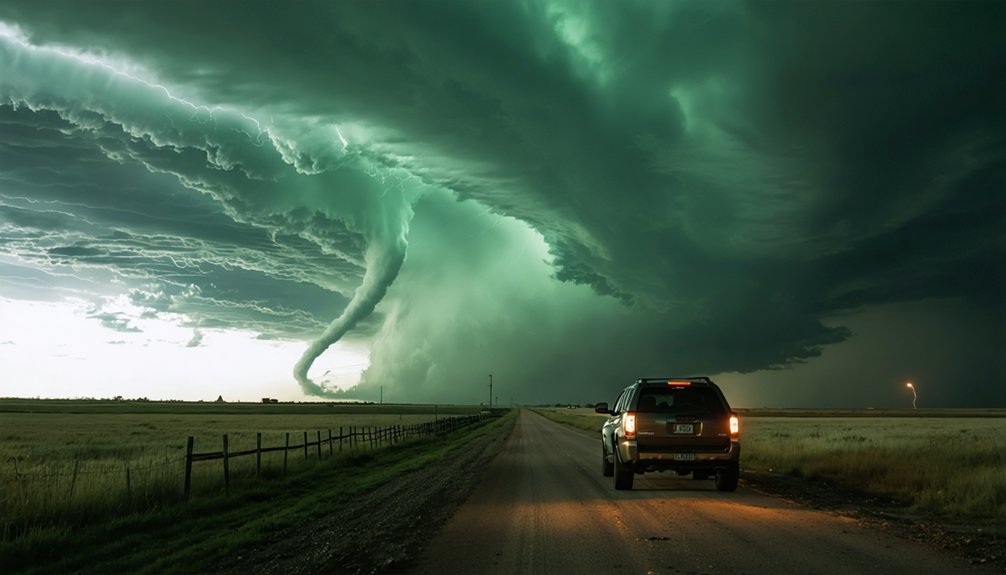
Tornadoes rely on visual contrast to be detectable, and after dark, that contrast nearly disappears. Wall clouds merge seamlessly into the dark sky, stripping away your primary tornado detection capability. Night visibility drops your identification window from minutes to seconds.
Four critical factors make nighttime tornadoes uniquely dangerous:
- Wall clouds become indistinguishable against dark backgrounds.
- Rotating precipitation remains invisible without active radar support.
- Lightning flashes reveal terrain for milliseconds, providing no sustained visual confirmation.
- Sudden tornado drops occur without the visual warning signs daylight provides.
You’re fundamentally moving blind. Radar becomes your only reliable detection tool, yet mobile apps struggle updating real-time data fast enough.
Without continuous radar monitoring and a spotter network, you’re operating with dangerously incomplete information during the most critical decision-making moments.
When Your Tech Fails You Mid-Chase at Night
Cellular networks collapse under severe weather loads precisely when you need them most. Tech reliability degrades fast when precipitation-dense storms overwhelm local towers. Your GPS loses signal in heavy rain bands, stripping away your primary navigation tools mid-pursuit.
Cellular networks fail when storms peak. Precipitation kills your signal, your GPS, and your confidence simultaneously.
Weather apps can’t update real-time radar quickly enough, leaving you operating on stale data. These device limitations aren’t hypothetical—they’re documented failure points that compromise your storm strategies directly.
You can’t afford to depend solely on cellular infrastructure during night chases. Signal challenges demand redundant systems: dedicated radar units, ham radio networks, and offline maps.
Mental readiness means accepting that your tech will fail and preparing accordingly. Night preparation requires building analog backups before you leave, not after your screen goes dark.
How Fatigue and Stress Cloud Your Judgment Faster at Night
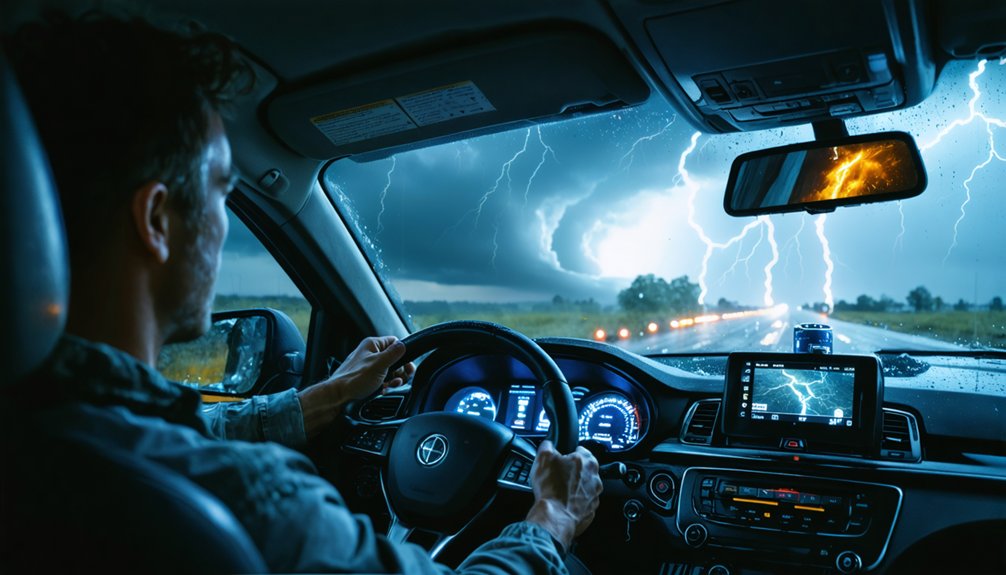
Tech failures don’t just strip your tools—they accelerate cognitive load at night, compounding the fatigue and stress already working against you.
Darkness forces hypervigilance, draining your mental reserves faster than daytime chasing ever would. Without proper nighttime strategies, judgment decline happens rapidly.
Watch for these cognitive overload triggers:
- Fatigue effects accumulate within 90 minutes of sustained nighttime vigilance, impairing risk assessment accuracy by nearly 30%.
- Mental exhaustion degrades decision making precision, causing you to misread radar or misjudge escape routes.
- Stress management failures spike cortisol levels, narrowing your focus dangerously.
- Emotional resilience drops sharply after consecutive high-alert intervals, compounding poor judgment.
You can’t chase effectively if your brain’s already compromised. Recognize these thresholds before they control you.
Why Emergency Response Breaks Down During Night Storms
Cognitive overload doesn’t end with your own judgment failures—it intersects directly with a broken emergency response chain.
During night operations, emergency planning collapses under compounding failures. Communication systems lose cellular integrity in heavy precipitation zones, cutting response coordination entirely. GPS units drop signal accuracy, leaving dispatchers without reliable situational awareness of your exact position.
Resource allocation breaks down when emergency vehicles can’t locate accident sites in low-visibility terrain. Safety protocols designed for daylight conditions don’t translate effectively after dark. Risk assessment becomes reactive rather than proactive when flash floods appear without visual warning.
Downed power lines blend into darkness, creating invisible hazards responders can’t identify quickly. You’re operating in an environment where every system designed to protect you is simultaneously degraded.
Frequently Asked Questions
What Gear Should Night Storm Chasers Carry for Personal Safety?
You’ll need night vision optics, emergency kits, and navigation tools. Follow safety protocols, monitor weather alerts constantly, and maintain strong team dynamics. These essentials keep you operational and free during high-risk nocturnal storm chasing missions.
Are There Legal Restrictions on Storm Chasing During Nighttime Hours?
No blanket laws restrict you, but you’ll face legal liabilities if your actions obstruct emergency responders. Nighttime visibility limitations don’t exempt you from reckless endangerment statutes—local jurisdictions actively enforce traffic and trespassing codes during severe weather events.
How Does Night Storm Chasing Differ From Daytime Chasing Professionally?
At night, you’ll face severe visibility challenges that daylight eliminates—tornado wall clouds vanish into darkness, hydroplaning risks spike on wet roads, wildlife encounters increase, and your communication systems degrade, demanding heightened technical precision and faster independent decision-making.
What Insurance Considerations Apply Specifically to Night Storm Chasers?
Imagine you’ve totaled your chase vehicle at 2 AM—your standard policy won’t cover it. You’ll need specialized liability coverage, thorough risk assessment protocols, documented emergency plans, and extensive vehicle protection to chase freely and legally at night.
How Do Storm Chasing Teams Coordinate Communication During Nighttime Operations?
You’ll rely on encrypted radio channels, GPS technology, and mobile apps for real-time updates. Assign dedicated communication roles, maintain redundant backup systems, and cross-reference radar data continuously to counteract cellular network failures during nighttime storm chasing operations.
References
- https://www.reddit.com/r/stormchasing/comments/ba07iq/chasing_at_night_any_pointers/
- https://www.flame.org/~cdoswell/chasesums/Chase_safety.html
- https://en.wikipedia.org/wiki/Storm_chasing
- https://www.youtube.com/watch?v=uCLaE6ELFik
- https://stormhighway.com/chasingfaq.php
- https://stormtrack.org/threads/night-time-chasing-strategies.23714/
- https://journals.ametsoc.org/view/journals/bams/75/12/1520-0477-75_12_2348.pdf
- https://will.illinois.edu/weatherrealness/episode/storm-chasing-can-be-deadly-heres-how-to-stay-safe
- https://www.nature.com/articles/523135a
- https://cardinalwxservice.com/2022/03/29/the-dangers-of-storm-chasing/