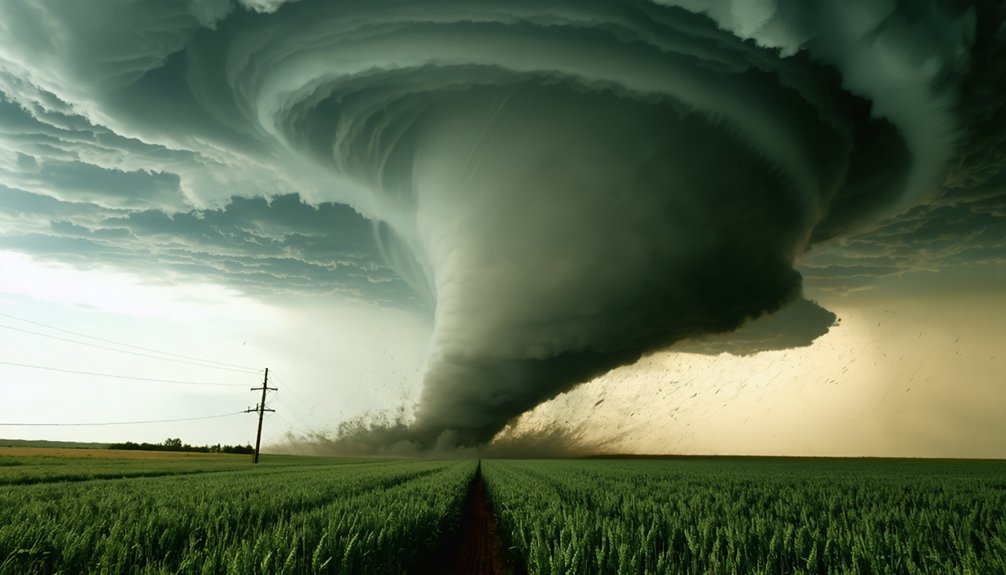
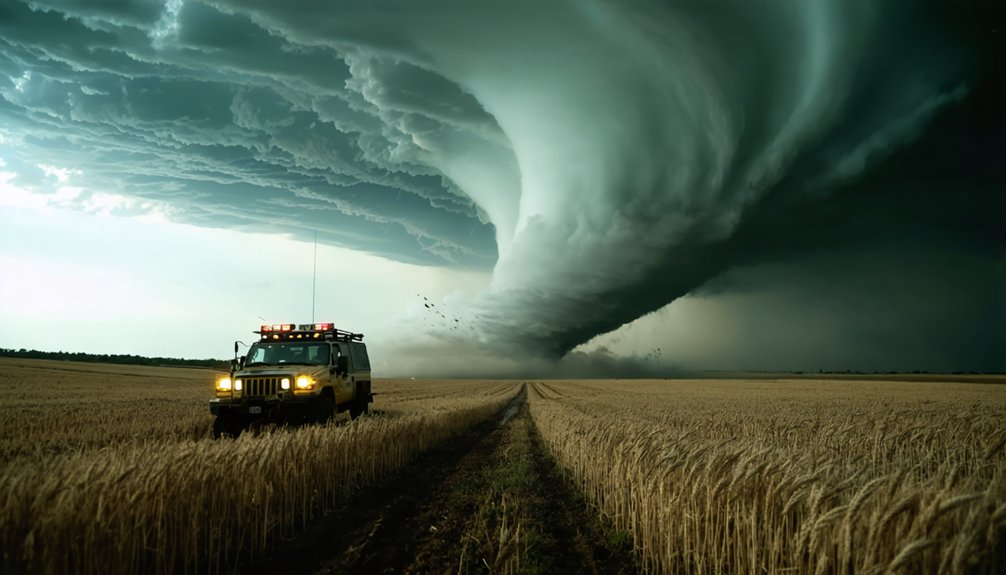
You’ll discover that educational storm chasing has evolved from exclusive pursuit to accessible discipline through programs like Girls Who Chase’s Spring Training, which reached 320 participants—triple initial projections. Modern chasers combine meteorological fundamentals with advanced radar interpretation, analyzing Doppler velocity data and dual-polarization systems to distinguish precipitation types. Veterans with 20-30+ years of experience now teach stratified curricula covering mesoscale analysis, SPC operations, and storm classification. The following sections reveal how systematic knowledge, strategic partnerships, and technological integration transform passionate observers into autonomous forecasters.
Key Takeaways
- Comprehensive training programs now cover meteorology fundamentals, radar interpretation, and mesoscale analysis, reaching 320 participants through structured curricula.
- Advanced technology including dual-polarization radar, AI tornado classification, and GPS-integrated NEXRAD enables precise storm tracking and safety.
- Girls Who Chase addresses gender imbalance through visibility campaigns, helping participants transition from commercial tours to autonomous forecasting operations.
- Storm chasers combine scientific observation with calculated risk assessment, driven by intellectual curiosity rather than reckless thrill-seeking behavior.
- Climate change impacts create new educational opportunities as rapid intensification events and extreme weather patterns increase documentation needs.
Breaking Down Barriers: How Educational Platforms Are Democratizing Storm Chasing
While storm chasing once existed as an insular domain accessible primarily through academic meteorology programs or informal mentorship networks, the COMET-GWC partnership has catalyzed a fundamental shift in educational accessibility. You’ll now find structured training reaching 320 participants—triple initial projections—addressing critical gaps in severe weather meteorology.
These inclusive learning opportunities extend beyond traditional gatekeepers through platforms like Spring Training: Inclusive Storm Chasing 101, which prioritizes operational barriers identification over exclusivity. Despite digital media challenges where algorithms often obscure authentic scientific content, educational storm documentation persists on platforms like YouTube, transforming communication intermediaries into daily educators for millions.
This democratization breaks the historical taboo surrounding storm chasing within established meteorological societies, evidenced by AMS’s inaugural 2025 training session—a watershed moment granting you autonomous access to once-restricted knowledge domains.
The Rise of Girls Who Chase and Community-Building Initiatives
Within a meteorological field where male participants outnumber female counterparts by margins exceeding 4:1, storm photographers Jennifer Walton and Melanie Metz established Girls Who Chase as a strategic intervention addressing systemic barriers in severe weather sciences.
Girls Who Chase dismantles gender barriers in storm chasing through strategic community intervention within a male-dominated meteorological field.
Their community empowerment initiatives dismantle self-limiting beliefs through visibility campaigns and partnership networks that amplify women’s contributions across meteorological platforms. You’ll find participants shifting from commercial tour dependency to autonomous forecasting operations, with several pursuing STEM certifications and degree programs through integrated storm chasing career pathways.
The decentralized model proves organizational effectiveness doesn’t require institutional scale—grassroots collaboration generates measurable outcomes. Female chasers historically required triple the effort for equivalent recognition, yet actual participation rates exceed public perception.
The initiative expands access for LGBTQIA+ members while addressing underrepresentation of Latina and women-of-color meteorologists throughout severe weather communities.
From Novice to Veteran: What Spring Training Workshops Offer
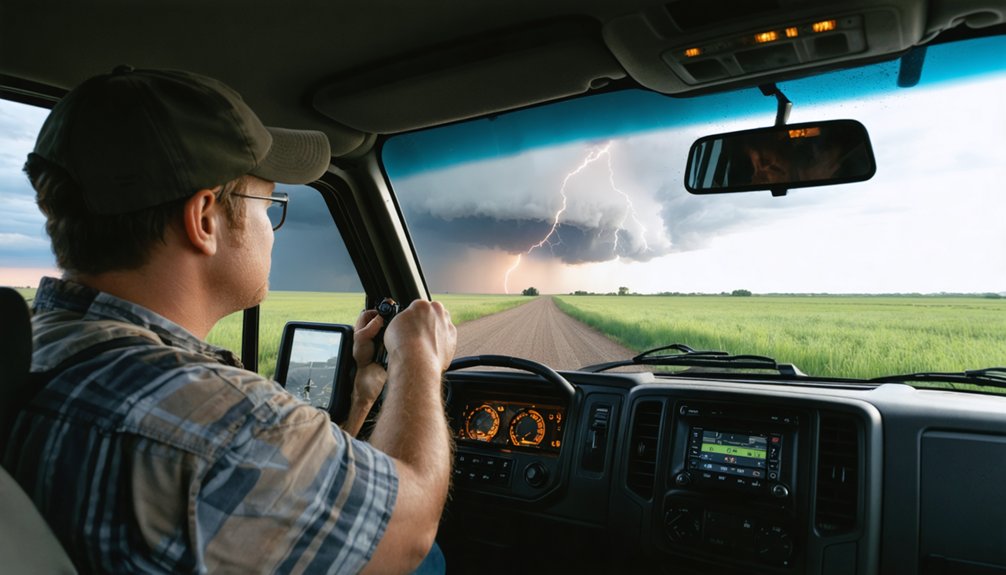
Storm chasing education transforms enthusiasm into operational competency through structured spring training programs that stratify content from foundational meteorology to specialized mesoscale analysis. You’ll encounter thorough curriculums beginning with beginner fundamentals—storm structure, SPC/NWS operations, thunderstorm classification—before advancing to specialized modules like Dr. Robin Tanamachi’s advanced radar interpretation workshops.
Veterans Skip Talbot, Raychel Sanner, and John Sirlin deliver progressive instruction spanning 20-30+ years of field experience, including TIV deployments and Emmy-recognized documentation. The curriculum evolves annually, building a technical library from basic spotter positioning through complex hodograph analysis and nowcasting methodologies.
You’ll access COMET/MetEd partnerships, eight full chase days maximizing field application, and case study integration synthesizing forecasting, radar, and tactical positioning. College of DuPage field trips and free public spotter classes guarantee accessibility while maintaining operational rigor.
Inside “Storm of Passion”: A Family’s Journey Through Tornado Alley
Through the armored chassis of TIV-2, “Storm of Passion” documents how severe convective pursuit reunited father James with sons Evan and Angelo, transforming their fragmented chase efforts into coordinated intercept operations. You’ll observe nine volunteers executing chase coordination considerations across Tornado Alley, simultaneously analyzing Doppler velocity data, monitoring mesocyclone development, and traversing the terrain while capturing family narratives through observational filmmaking.
The documentary’s turning point arrived June 1, 2011, when Connecticut supercells shifted their philosophy from theoretical pursuit to personal accountability. You’ll witness how Memorial Day weekend congestion created dangerous “conga lines” where student-filled vans had thirty-second evacuation windows—a sobering reminder that freedom in storm chasing demands disciplined spacing protocols, not reckless proximity. Their TIV-2 survived EF4 impacts, proving engineered protection enables autonomous severe weather documentation.
The Psychology Behind the Chase: Understanding What Drives Storm Chasers
What compels individuals to deliberately position themselves in the path of rotating supercells capable of generating 300 mph wind speeds? Research reveals storm chasers aren’t reckless thrill-seekers but individuals driven by sensory stimulation factors—the raw aesthetic power of atmospheric phenomena delivers unmatched visual drama.
You’ll find their motivations center on challenging experiences rather than risk itself, combining intellectual curiosity about meteorological patterns with profound emotional engagement dynamics. Studies show chasers score high on sensation-seeking scales, pursuing intense encounters that satisfy survival instincts through carefully calculated positioning.
The activity merges scientific observation with aesthetic appreciation, where motion, intensity, and nature’s force create exhilarating responses. This isn’t about conquering danger—it’s about experiencing atmospheric events that trigger euphoria, awe, and deep spiritual connection to Earth’s most powerful weather systems.
Documentary Lens: How Films Capture America’s Tornado Culture
Documentary filmmakers have transformed America’s tornado culture from sensationalized disaster footage into nuanced examinations of atmospheric violence, community resilience, and the specialized pursuit of severe weather documentation. Martin Lisius’s “Chasers of Tornado Alley” prioritizes storm formation mechanics over destruction imagery, dedicating segments to volunteer spotters who relay real-time data to National Weather Service stations.
You’ll observe how films navigate ethical considerations—respecting the three TWISTEX researchers killed during the May 31, 2013 multiple-vortex event while analyzing meteorological conditions. Netflix’s “The Twister: Caught in the Storm” integrates survivor stories from Joplin’s EF-5 tornado with Jeff and Cathy’s 200-mph wind documentation. These productions emphasize preparedness protocols rather than catastrophe spectacle, shifting public perception from passive fear toward active understanding of supercell dynamics and warning systems.
Operational Skills Every Aspiring Storm Chaser Needs to Master
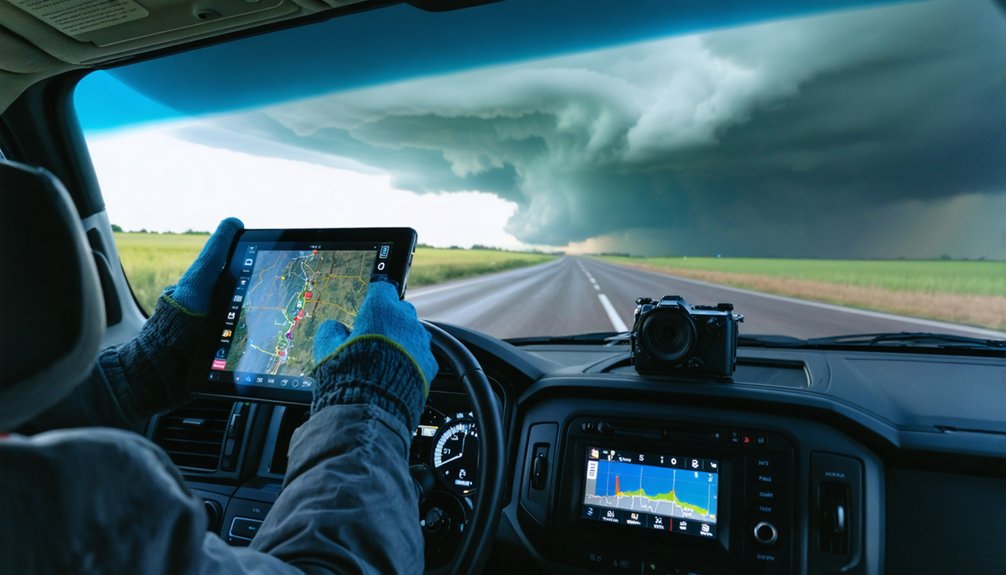
Before you position yourself beneath a developing wall cloud, you must master radar interpretation skills that transform pixelated velocity data into actionable intelligence about mesocyclone rotation and tornado genesis potential. NEXRAD and Dual-Pol systems reveal storm structure that determines your intercept strategy.
Hands on training programs teach mobile mesonet deployment and atmospheric probe operation essential for data collection. You’ll need advanced off-road driving capabilities to traverse compromised terrain while maintaining situational awareness under pressure.
Navigation best practices demand GPS proficiency with ArcGIS integration, pre-planned escape routes accounting for flash flooding, and current road network knowledge. Amateur radio operation guarantees reliable communication when cellular networks fail. CPR certification addresses lightning strike emergencies.
Mental flexibility separates successful chasers from those who chase blindly into danger.
The TIV-2 and Technology’s Role in Modern Storm Interception
The TIV-2 represents a breakthrough in armored storm interception, combining a 14,000-pound reinforced chassis with deployable hydraulic anchoring systems rated for 250 mph winds.
You’ll observe that its 625-horsepower Cummins turbodiesel enables rapid deployment speeds up to 100 mph while maintaining stability through six hydraulic ground skirts and 3-foot penetrating spikes.
This mobile platform integrates Doppler radar, multi-axis anemometry, and barometric sensors with a rotating observation turret, delivering quantifiable atmospheric data from previously inaccessible vortex cores.
TIV-2 Tornado Intercept Vehicle
When confronting a tornado’s 200+ mph winds demands engineering beyond conventional vehicle design, the TIV-2 represents storm chasing’s technological apex. You’re looking at a 14,300-pound fortress built on a 2008 Dodge Ram 3500 chassis, featuring 1/8-inch steel skin welded over a 2-inch square tubing frame.
The armor system layers steel, aluminum, Kevlar, polycarbonate, and rubber—protection that enables unprecedented access to extreme weather patterns.
You’ll find six hydraulic skirts deflecting wind and four ground-anchoring spikes preventing vehicle flipping. The modified 6.7-liter Cummins turbodiesel produces 625 horsepower, pushing you beyond 100 mph when positioning matters most.
The rotating IMAX turret, surrounded by bullet-resistant polycarbonate, captures footage while data analytics advancements transform intercepted measurements into actionable meteorological intelligence. You’re operating where conventional vehicles fail.
Technology Enhances Chase Safety
Advanced dual-polarization radar systems now scan both horizontal and vertical precipitation particles, enabling you to distinguish rain from hail, snow, and tornado debris signatures before intercept. These remote sensing innovations process atmospheric data in real-time, revealing storm structures that traditional methods miss.
You’ll track supercells with NOAA’s rapid-scan satellites updating every 30 seconds, while AI models classify 85% of EF-2+ tornadoes faster than conventional algorithms.
Enhanced safety protocols now include:
- FT752 ultrasonic sensors withstanding 90m/s winds, recording 51.5m/s surface velocities during Texas intercepts
- Mobile mesonets delivering real-time wind data from hail cores and turbulent flows
- Starlink connectivity supporting live streaming from remote locations
- GPS-integrated NEXRAD Level 3 radar providing precise navigation through severe weather corridors
You’re equipped to intercept storms with unprecedented situational awareness.
Climate Change Awareness Through the Eyes of Storm Chasers
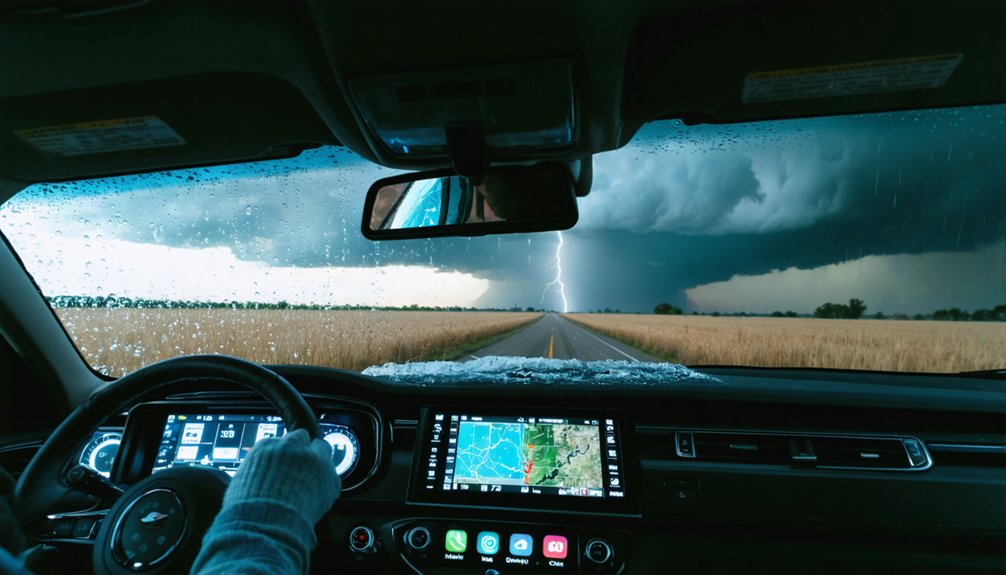
Storm chasers witness climate change’s fingerprints on extreme weather systems firsthand, documenting intensification patterns that scientists confirm through data analysis.
Storm chasers serve as frontline climate observers, gathering critical evidence of how warming temperatures reshape severe weather behavior in real time.
You’ll observe hurricanes like Beryl achieving Category 5 status earlier than ever recorded, powered by Gulf waters exceeding historical temperature thresholds. Each 1°C warming amplifies extreme daily rainfall by 7%, transforming ordinary thunderstorms into flooding catastrophes.
Through real time data sharing, you’re contributing atmospheric observations that enhance forecast models and emergency response protocols. Your citizen science initiatives capture rapid intensification events—storms strengthening dangerously fast as sea surface temperatures climb.
Heat waves now exceed 40°C with unprecedented frequency, while Arctic warming disrupts jet stream stability, triggering polar vortex excursions. You’re tracking measurable shifts in storm tracks, precipitation patterns, and billion-dollar disaster frequencies that validate climate projections.
Building Expertise: Partnerships Between Chasers and Scientific Organizations
Key collaborative developments include:
- AMS-Tornado Titans partnership sponsoring communications internships for tornado safety materials development
- TORUS project deployment of 90-mph RAAVEN drones with three-hour battery life for autonomous storm sampling
- COMET-GWC training programs shifting institutional perspectives from prohibition to education-focused storm chasing methodology
- OTUS Project integration with NIST for custom vertical wind speed sensors capturing thermodynamic tornado data
These frameworks democratize atmospheric research while maintaining FAA-authorized operational standards across regulated airspace.
Frequently Asked Questions
What Insurance Coverage Do Storm Chasers Need for Vehicles and Equipment?
You’ll need extensive coverage for vehicle storm damage, liability insurance coverage for third-party incidents, equipment breakdown coverage for cameras and weather instruments, plus hazardous sports travel insurance. Standard policies won’t protect your chase gear during high-risk meteorological pursuits.
How Do Storm Chasers Generate Income to Fund Their Chasing Activities?
You’ll generate income through media sales to networks, streaming revenue from live coverage, sponsorship opportunities with weather brands, crowdfunding campaigns for expeditions, and guided tours—while tracking mesoscale convective systems transforms your passion into quantifiable revenue streams.
What Are the Legal Restrictions for Storm Chasing on Private Property?
You’re subject to standard trespassing laws when chasing storms—you’ll need explicit property owner permission before entering private land. Without authorization, you’ll face criminal charges and fines, regardless of meteorological conditions or documentation of atmospheric phenomena.
How Has Social Media Changed the Storm Chasing Community Dynamics?
Social media’s transformed your chasing experience through increased collaboration via real-time platforms, yet simultaneously introduced risks of livestreaming—distracted driving during pursuits and algorithm-driven proximity pressure. You’re witnessing fragmented communication patterns replacing centralized forecasting hubs, fundamentally altering community dynamics.
What Physical Fitness Level Is Required for Extended Storm Chasing Trips?
You’ll need moderate cardiovascular conditioning and core strength for extended operations. Physical endurance training comparable to recreational athletics meets weather preparedness requirements—managing multi-day pursuits, equipment handling, rapid repositioning, and sustained alertness during dynamic meteorological events.