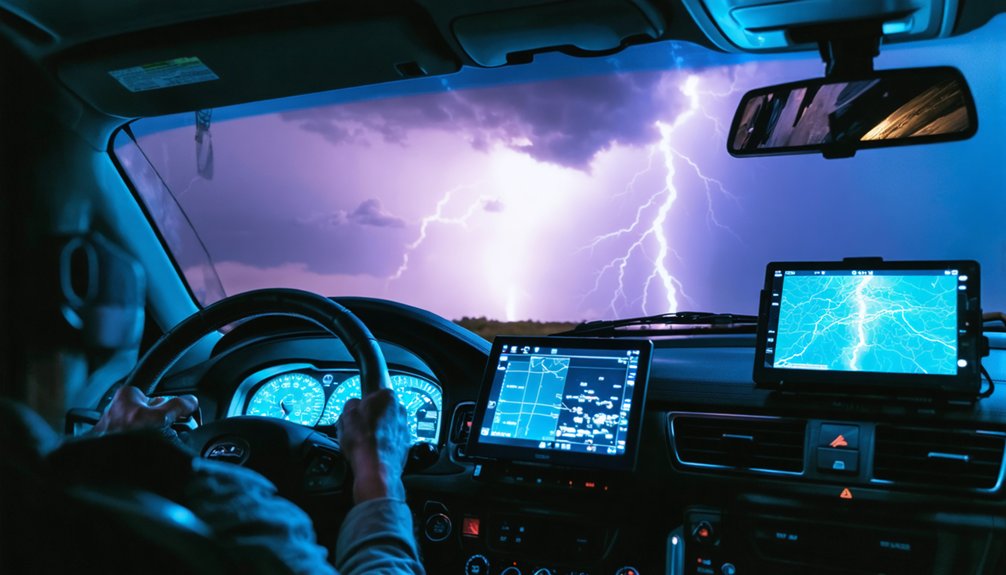
You’ll find 2026’s storm chasing fleet headlined by Reed Timmer’s Dominator 5, featuring disk-like aerodynamics engineered for 240+ mph EF4 intercepts with composite hull protection and hydraulic spike anchoring systems. Complementing armored platforms, you’ll encounter Vortex Vision’s FAA-approved drone deployment technology that launches sensors directly into supercell inflow zones, while Storm Ranger integrates 360° camera systems with 75-mile mobile radar for autonomous navigation. New tactical broadcast trucks and connectivity upgrades expand real-time data transmission capabilities across the intercept spectrum, with detailed specifications awaiting your exploration.
Key Takeaways
- 2026 builds will advance EF-rated protection systems on Dominator vehicles for unrestricted tornado penetration capabilities.
- Dominator 5 features revolutionary disk-like “flying saucer” design providing stability in winds exceeding 240 mph during EF4 encounters.
- Enhanced hydraulic spike anchoring systems proven effective during EF4 intercepts will be integrated into new builds.
- Vortex Vision platform enables FAA-approved drone deployment of miniaturized sensors directly into supercells for unprecedented data collection.
- Storm Ranger incorporates 360° cameras with terrain-adaptive positioning and 75-mile detection range mobile radar for autonomous navigation.
Dominator Fleet Engineering and EF-Rated Protection Systems
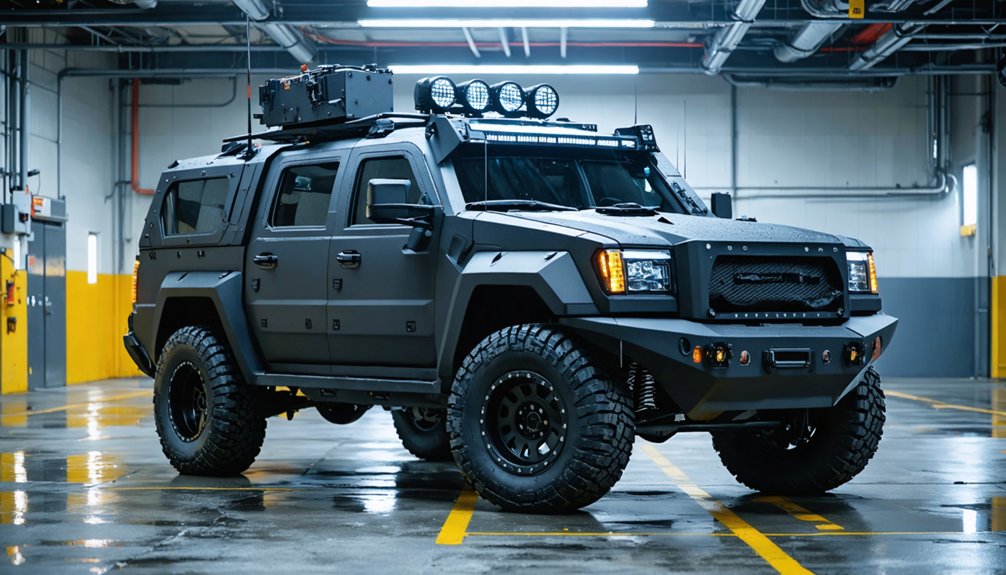
Three armored vehicles comprise Reed Timmer’s Dominator fleet, each engineered as a mobile meteorological platform capable of withstanding direct tornado intercepts.
You’ll find Dominator 3’s 6.7-liter turbodiesel delivering 400 horsepower, paired with specialized suspension components including hydraulic lowering systems and outriggers that anchor the vehicle against EF4/EF5 winds exceeding 200 mph.
The protection architecture layers bulletproof Lexan windows, LINE-X-coated reinforced steel, and deployable wind skirts that seal the undercarriage during high profile tornado intercepts. Roll cages and racing harnesses protect occupants while gull-wing doors provide emergency egress.
This engineering proved critical during May 2013’s Shawnee EF4 intercepts, where Dominator 3 survived three direct passes. The fleet’s 2026 builds will advance these EF-rated protection systems for unrestricted tornado penetration and meteorological data collection.
Spike Anchoring Technology for Extreme Tornado Encounters
Hydraulic spike systems represent the critical difference between surviving and being swept away during direct tornado intercepts. Dominator 3 deploys two massive spikes through its sides, punching 8 inches into ground via custom hydraulic pumps. You’ll activate this anchoring system with a single switch, achieving full deployment in seconds. The spike insertion force penetrates pavement when necessary, creating angled contact points that complement the vehicle’s 15,000-pound mass.
Hydraulic pump efficacy proved itself during the May 2013 EF4 near Shawnee, Oklahoma, holding firm against 200-mph winds. The 2023 Spalding, Nebraska EF1 intercept further validated this technology. Combined with deployable skirts that seal the undercarriage, you’re protected from lift-off while maintaining real-time monitoring capability. This anchoring independence lets you position exactly where you need without relying on external shelters or escape routes.
Dominator 5: The Flying Saucer Concept and Summit-Inspired Design
While traditional storm chase vehicles maintain rectangular profiles optimized for standard driving, Dominator 5’s flying saucer concept fundamentally reimagines vehicular aerodynamics for direct tornado intercepts. The disk-like structural design delivers unmatched stability in winds exceeding 240 mph, drawing directly from 2026 National Storm Chaser Summit Vortex Awards discussions. You’ll benefit from saucer-inspired aerodynamics that minimize wind resistance during EF4 encounters, where previous Dominator models recorded 312 mph radar winds.
The seamless composite hull deflects debris at velocities that destroyed earlier rectangular designs—addressing critical vulnerabilities like Dominator 3’s June 2025 deer strike. Lewis Fabrications completed the conceptual framework following their February 13, 2026 Dominator 3.2 rebuild, integrating bulletproof Lexan windows and LINE-X reinforcements. Your pursuit of extreme intercepts demands this revolutionary low-profile architecture.
Vortex Vision: Drone-Based Sensor Deployment Platform
Reed Timmer’s Vortex Vision platform revolutionizes storm data collection through coordinated drone-based sensor deployment, building on his pioneering work since 2009 with original Dominator vehicles. You’ll access FAA-approved drone operations starting 2026, enabling direct launches into supercells with sensor payload integration that wasn’t possible before.
The system deploys multiple miniaturized sensors simultaneously through inflow zones, dramatically increasing your data acquisition success rate beyond single-probe methods. Multi storm coordination strategies let you track sensors recording 10 Hz resolution data while traveling 30+ miles at 190 mph winds.
Your vehicle integration provides real-time simulated interior storm views, processing data from sensors that’ve reached 39,000 feet in EF4 tornadoes. This autonomous capability gives you unprecedented freedom to collect granular meteorological data without regulatory constraints.
Storm Ranger’s 360° Camera and Multi-Environment Capabilities
Building on advanced sensor deployment capabilities, Storm Ranger’s 360° camera system delivers exhaustive environmental awareness through integrated front, side, and rear components that enable obstacle detection and precise positioning during critical deployment phases.
You’ll leverage terrain mapping algorithms that process real-time visual data from multiple angles, ensuring safe navigation across diverse geographic conditions where fixed installations can’t operate. The system’s obstacle avoidance technologies work alongside your 75-mile detection range mobile radar, creating extensive situational awareness during severe weather operations.
Lane keeping functions at 65-110 km/h, while blind spot monitoring and autonomous emergency braking enhance safety during dynamic storm positioning. You’ll operate with complete autonomy—terrain-adaptive positioning lets you navigate independently, filling coverage gaps and collecting ground-truth data that stationary systems miss.
StormTours Van Configuration and Passenger Experience Features
The StormTours chase van prioritizes passenger capacity optimization through full-size platform selection, accommodating six passengers with two tour guides for eight total occupants—a configuration that enables single reclining captain-styled seats rather than space-compromising bench arrangements. You’ll access guaranteed window seats with unshared armrests and open center aisle design facilitating rapid passenger evacuation protocols during severe weather encounters.
The vehicle undergoes rigorous 96-point pre-season inspections supporting operational reliability standards. Enhanced cooling systems, power distribution infrastructure, and dual 17-inch LCD displays integrate with specialized radar integration through custom fiberglass console housing.
Real-time Doppler visualization employs three-level redundancy backup capability, while onboard WiFi, satellite radio, and climate management systems optimize extended pursuit operations across Texas Panhandle terrain. Backup vehicles maintain stock configurations ensuring continuous tour deployment capacity throughout storm season.
Tactical News Truck Platforms for Broadcast Operations
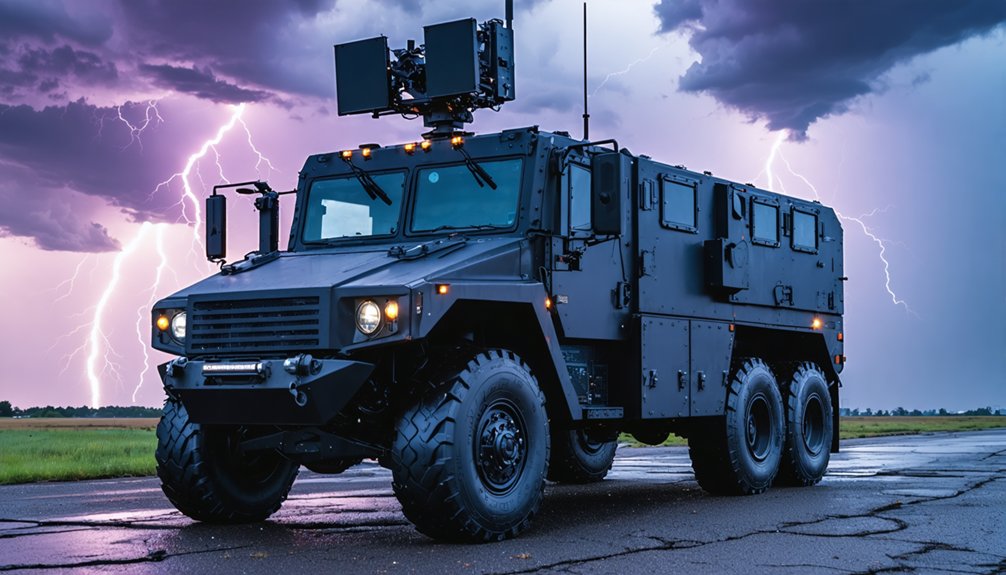
You’ll find tactical news truck platforms built on pickup-based 4WD chassis systems that integrate 60-inch water fording capability and all-wheel drive transfer cases for reliable broadcast operations in severe weather zones.
Custom storage configurations accommodate satellite uplink equipment, camera systems, and transmission gear while maintaining the 70% off-road mobility profile required for remote deployment.
Graphics packages and transmission options now include hybrid-electric powertrains delivering 10-30 kW exportable power for sustained broadcast operations without generator reliance.
Pickup-Based 4WD Chassis Design
Modern storm chasing operations demand pickup-based 4WD chassis platforms that deliver broadcast-grade reliability under severe weather conditions. You’ll find cornerstone chassis options featuring 300 mm constant frame rail height constructed from high-strength steel alloy, providing rugged underbody protection essential for extreme terrain navigation.
The rock-solid frame incorporates full-length channel liners with eight crossmembers delivering superior strength and stiffness during pursuit operations.
Your 4WD traction system enables autonomous deployment across compromised road surfaces, while increased wheel cuts enhance all-wheel drive maneuverability through debris fields. Modern platforms offer wide make and model selections post-chassis choice, with transmission mode options tailored to mission requirements.
New engine mounts and cab isolators reduce noise and vibration, maintaining equipment stability during high-speed intercepts. This engineering foundation supports news gathering, traffic reporting, and storm documentation missions.
Custom Storage and Equipment
Beyond chassis durability, broadcast-grade storm chase vehicles require integrated storage and equipment systems that maintain operational capacity during multi-day severe weather deployments. Your platform needs modular equipment stowage that adapts to changing mission requirements while keeping critical gear accessible.
Essential storage configurations include:
- Multi purpose shelving systems with custom power panels supporting 8kW VIP generator integration and equipment rack mounting
- Rear storage capacity accommodating camera equipment, extra batteries, memory cards, and weather-resistant mounts like roof-mounted Insta360 X4
- Emergency supply compartments storing fuel, water, battery chargers, and essential communications gear for extended remote operations
These systems enable you to deploy custom communications consoles, iPad navigation setups, and deployable displays without compromising vehicle mobility or crew safety during severe weather intercepts.
Graphics and Transmission Options
Tactical news truck platforms integrate two critical operational systems—visual branding that establishes broadcast authority and transmission architecture that guarantees signal reliability during severe weather events. Your Ford F-250’s V8 powertrain delivers 4×4 capability with selectable transmission modes, switching from fuel-efficient 2WD to full traction for slick terrain. Manual hub lockers engage when you’re extracting vehicles from clay-like conditions during storm intercepts.
Rugged graphics wrap 360 degrees around your chassis, complementing steel bumpers, winch systems, and 35-inch all-terrain tires on two-inch lifts. Deployable exterior displays present live meteorological data while roof-mounted FLIR cameras feed multi-platform broadcasts.
Peplink bonds cellular networks with Starlink for uninterrupted streaming, backed by 8-kilowatt inverters providing 12+ hours of engine-independent power. Your waterproof 4K pullout monitor functions in direct sunlight for immediate field reporting.
Individual Chase Vehicle Connectivity and Streaming Upgrades
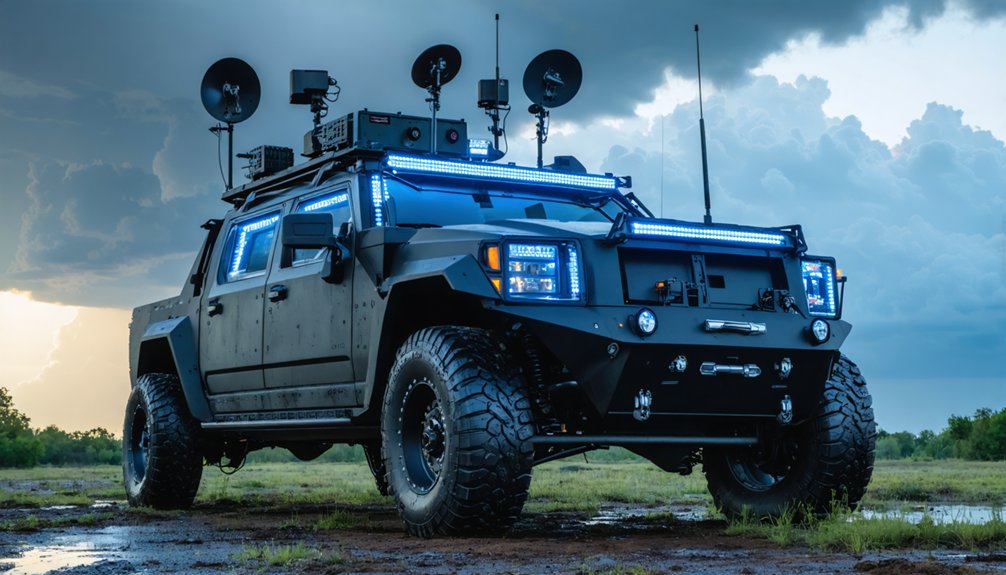
Individual storm chasers now deploy sophisticated connectivity architectures that rival broadcast news operations.
You’ll need multi-network aggregation systems like Dejero’s EnGo 265 or Peplink configurations that blend six cellular connections with Starlink satellite uplinks to maintain 99.9% uptime during severe weather intercepts.
These platforms support simultaneous multi-camera encoding, real-time meteorological data access, and high-bandwidth streaming to audiences exceeding 20 million viewers during peak tornado season.
Multi-Network Connectivity Solutions
While storm chasers once relied on single-carrier cellular plans and hope, today’s connectivity demands have driven the adoption of sophisticated multi-network bonding systems that aggregate multiple data sources into unified, resilient connections.
Modern bonding solutions you’ll encounter include:
- Dejero EnGo 265: Blends six cellular connections from AT&T, T-Mobile, and Verizon through Smart Blending Technology across 3G/4G/5G, Wi-Fi, and satellite—enabling uninterrupted streaming to 20 million viewers during peak tornado season via SRT/WebRTC/RTMP protocols.
- Peplink systems: Integrate Starlink satellite with cellular networks, supporting remote iPad-controlled streaming from compact under-seat installations planned for 2026 deployments.
- Multi-SIM devices: Provider signal aggregation automatically executes network switching algorithms, selecting the fastest tower while distributing connectivity via WiFi throughout chase vehicles—replacing discontinued XM weather data systems since 2013.
Camera System Installations
Increasingly, storm chasers mount multiple camera systems across their vehicles to capture simultaneous perspectives during severe weather events. You’ll find magnet-mount cameras offering 1080p to 2K high resolution stabilization through IBIS technology, secured with IP65 weather resistant enclosure ratings that withstand extreme conditions.
The Storm Ranger’s 2026 upgrade features a 360-degree PTZ system with protective dome shielding, delivering 59.9 fps broadcast-quality footage from rooftop positions. Your multi-camera configurations integrate USB-wired connections alongside Bluetooth and WiFi transfers, managed through stream deck controllers for real-time switching.
Hardwired Blackvue DR750X-2CH dash cameras provide continuous onboard recording, while Manfrotto quick-release systems enable rapid repositioning. Compact remotes capture over nine hours of stabilized 4K documentation, ensuring you won’t miss critical tornado development sequences during extended chase operations.
Multi-Platform Streaming Setup
Capturing high-quality footage means nothing if you can’t broadcast it reliably from remote locations. Your mobile broadcasting operations depend on redundant connectivity and efficient configuration. The Highways & Hailstones app generates unique RTMP URLs and Stream Keys through Record > Live Storm Chase > Setup Streaming, which you’ll paste into your broadcast software.
Core streaming components include:
- Peplink bonded router combining Verizon Jetpack, AT&T hotspot, and Starlink for uninterrupted connectivity
- Stream Deck integration enabling multi-camera control with 360° roof and dash cams
- iPad-based remote desktop managing stream start/stop commands from your navigation position
You’ll configure restreaming destinations for simultaneous broadcasts across Twitch, YouTube, and social platforms. Your Weboost Drive Reach stabilizes cellular signals while maintaining autonomous control over your entire streaming workflow from anywhere in Tornado Alley.
FAA Clearances and 2026 Operational Readiness
As storm chasing operations expand into aerial platforms for 2026, operators must navigate a complex certification landscape shaped by recent regulatory changes and heightened safety protocols. You’ll need Air Carrier Certificates and Operations Specifications under 14 CFR Parts 121 and 135, requiring five-stage certification: pre-application, formal application, document compliance, demonstration and inspection, and final certification.
FAA approval processes now incorporate stricter rotorcraft safety regulations following the American Airlines 5342 crash, including permanent airspace restrictions near DCA and modified helicopter routes at major airports. The bipartisan bill introduced February 21, 2026, accelerates certification for electric air taxis and next-gen aircraft, potentially streamlining your path to operational readiness. You’ll maintain compliance with 49 USC § 41110(e) fitness requirements while leveraging exemptions for earlier deployment.
Frequently Asked Questions
What Is the Typical Cost to Build a Custom Storm Chasing Vehicle?
You’ll face vehicle customization costs ranging from $35,000 to $750,000 depending on your build’s complexity. Storm chaser safety precautions like armored plating, bulletproof windows, and hydraulic anchoring systems substantially impact your final investment, ensuring you’re protected while pursuing storms freely.
How Do Storm Chasers Obtain Insurance for Modified Tornado Research Vehicles?
Traversing insurance’s murky waters, you’ll secure standard all-encompassing coverage without mentioning modifications during application. Insurance requirements rarely flag research equipment, while the vehicle registration process treats chase vehicles as standard automobiles, preserving your independence.
What Training Is Required Before Operating Drones Near Active Tornadoes?
You’ll need Part 107 certification covering drone licensing requirements, plus specialized Part 108 BVLOS training for storm operations. Master weather monitoring protocols, TFR checks, and emergency yield procedures—then maintain VLOS unless you’re certified for beyond-visual-line-of-sight flight.
Can Civilians Purchase Decommissioned Dominator Vehicles for Personal Use?
No decommissioned Dominators exist for civilian purchase; Reed Timmer privately owns and operates them. If you built a similar vehicle, you’d need standard legal ownership requirements like registration and insurance, plus understanding personal safety features for extreme conditions.
What Fuel Efficiency Do Armored Storm Chasing Vehicles Typically Achieve?
You’ll typically see armored storm chasers achieve 13-14 mpg despite specialized engine configurations with turbocharging and fuel injection. Fuel efficiency improvements remain limited since heavy armor plating and reinforced systems prioritize crew safety over consumption optimization.