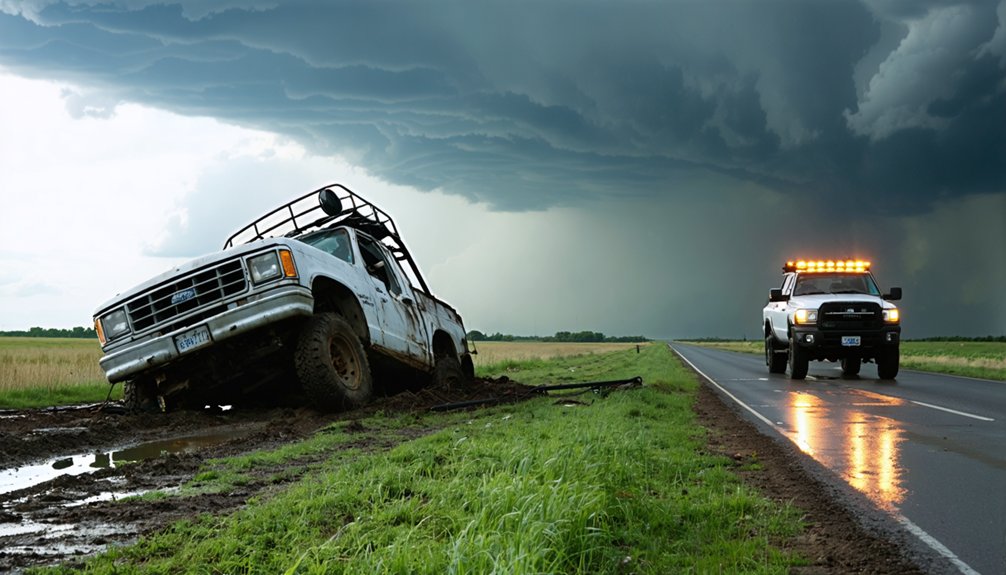
On May 31, 2013, you’re looking at the moment tornado research lost its most disciplined close-range investigator. Tim Samaras, founder of TWISTEX, died when the El Reno tornado — over 2.6 miles wide — expanded erratically and sent a subvortex directly into his team’s Chevrolet Cobalt. The impact ejected crew members Paul Samaras and Carl Young while Tim remained buckled in the wreckage. All three died at the scene. What unfolded before that moment reveals how even the most methodical science couldn’t outpace this storm.
Key Takeaways
- Tim Samaras was a storm researcher who deployed pressure-sensing probes near tornadoes through his organization, TWISTEX.
- The El Reno tornado exceeded 2.6 miles wide and expanded erratically, overwhelming standard intercept safety models.
- A subvortex struck the TWISTEX vehicle directly, causing structural failure and ejecting crew members Paul Samaras and Carl Young.
- Tim Samaras was recovered buckled in the passenger seat; all three team members died at the scene.
- His death removed a key researcher, exposing gaps in tornado data collection and reshaping storm proximity safety protocols.
Who Was Tim Samaras Before El Reno?
Before the El Reno tornado took his life on May 31, 2013, Tim Samaras had built a career grounded in instrumented field research rather than spectacle.
Born on November 12, 1957, he founded TWISTEX, a project designed to deploy pressure-sensing probes near active tornadoes and capture high-resolution structural data.
His work directly advanced storm safety protocols by quantifying extreme pressure drops inside tornado cores.
You’d recognize him from the Discovery Channel’s *Storm Chasers*, but his public presence reflected a disciplined scientific methodology, not recklessness.
Samaras treated every intercept as a structured risk management exercise, calculating positioning, escape routes, and instrument deployment windows.
His data-driven approach earned respect among researchers who understood that meaningful tornado science required controlled proximity, not blind pursuit.
Why the El Reno Tornado Was Uniquely Deadly to Chasers
The El Reno tornado defied standard intercept models in ways that made experience a liability rather than an asset. Its 2.6-mile width exceeded forecasting norms, and its erratic path rendered positional calculations unreliable. You couldn’t trust standard escape geometry because the funnel’s rapid expansion outpaced vehicle repositioning on restricted gravel road networks.
The storm’s subvortices compounded risk unpredictably, striking zones chasers assumed were buffer corridors. This shattered conventional storm safety frameworks built around narrower, more linear tornadoes. Even seasoned researchers operating within established research ethics protocols couldn’t compensate for data that simply didn’t exist yet.
El Reno exposed a systemic gap: intercept strategies had been optimized for tornadoes the field had already documented, not for outlier events rewriting the measurement scale in real time.
How Tim Samaras and the TWISTEX Team Were Overtaken
Positioned near U.S. 81 in Canadian County, the TWISTEX Chevrolet Cobalt had limited exit options when the tornado’s lateral expansion accelerated beyond intercept parameters. The funnel’s 2.6-mile width blocked available gravel road escape routes faster than the crew could reposition.
A subvortex then struck the vehicle directly, destroying it and ejecting Paul Samaras and Carl Young. Tim Samaras was recovered still buckled in the passenger seat. All three died at the scene.
The research implications here are significant. Even experienced field operators with disciplined storm safety protocols couldn’t compensate for an erratically expanding, multi-vortex system. The TWISTEX team wasn’t reckless—they were overtaken by an event that exceeded historical behavioral models.
Their deaths exposed critical gaps in intercept geometry planning for anomalous tornado formations.
What the Subvortex Did to the TWISTEX Vehicle and Its Crew
When a subvortex made direct contact with the Chevrolet Cobalt, it didn’t simply push the vehicle—it applied differential wind loading across the car’s structure at a scale the frame couldn’t absorb.
The subvortex impact produced four documented outcomes:
- Structural failure of the Cobalt’s chassis under asymmetric wind pressure
- Ejection of Paul Samaras and Carl Young from the vehicle
- Displacement of the wreckage into a nearby farmer’s field
- Containment of Tim Samaras, still buckled in the passenger seat post-vehicle destruction
You’re looking at physics operating beyond any safety margin engineers design for.
The subvortex didn’t behave like standard tornado winds—it rotated independently, concentrating force in a localized column that overwhelmed the vehicle completely within seconds.
What Tim Samaras’s Death Cost Tornado Research
Losing Tim Samaras didn’t just remove one researcher from the field—it collapsed a uniquely integrated system of expertise, instrumentation design, and operational execution that TWISTEX had built over years. Samaras engineered his own probes, interpreted the data they captured, and executed deployments with precision few teams could replicate. That combination produced meteorological insights into interior tornado pressure gradients that remain difficult to reproduce today.
No institutional framework fully absorbed TWISTEX’s methodology after May 31, 2013. You’re looking at a direct gap in close-range thermodynamic data collection that still affects modeling accuracy.
Beyond data loss, his death reshaped storm safety protocols across the chasing community, forcing researchers to reassess proximity thresholds during rapid tornado expansion events. The cost wasn’t symbolic—it was structural and measurable.
Frequently Asked Questions
Where Exactly Was Tim Samaras’s Body Found After the Tornado?
You’ll find that search efforts recovered Tim Samaras buckled in the passenger seat of the destroyed Chevrolet Cobalt, located in a farmer’s field amid tornado debris near U.S. 81 in Canadian County, Oklahoma.
How Old Was Paul Samaras When He Died at El Reno?
⚗ Paul Samaras was 24 when he died. Your meteorological analysis of El Reno’s data reveals tornado safety failures claimed him as the subvortex overtook the TWISTEX team on May 31, 2013.
How Many Total Fatalities Did the El Reno Tornado Cause Overall?
The El Reno tornado caused 8 total fatalities and 151 injuries. You’ll find that despite advances in weather prediction, tornado safety remains critical, as even data-driven researchers couldn’t escape this storm’s unpredictable, record-breaking behavior.
What Type of Vehicle Was the TWISTEX Team Driving That Day?
Like a chariot riding into battle, you’d find the TWISTEX team driving a white Chevrolet Cobalt — a standard sedan offering minimal vehicle safety for tornado research operations against El Reno’s unprecedented 2.6-mile-wide rotating monster.
Where Was the Memorial for the TWISTEX Team Later Established?
You’ll find the TWISTEX tribute memorial location established near Reuter Road and Radio Road in Canadian County, Oklahoma — precisely where crews recovered the destroyed Chevrolet Cobalt from a farmer’s field after the storm.
References
- https://en.wikipedia.org/wiki/Tim_Samaras
- https://www.reddit.com/r/tornado/comments/1au5emt/can_someone_eli5_what_happened_to_tim_samaras/
- https://en.wikipedia.org/wiki/2013_El_Reno_tornado
- https://www.youtube.com/watch?v=oPrc8z4VW4w
- https://extras.denverpost.com/stormchaser/chapter6.html
- https://en.wikipedia.org/wiki/TWISTEX
- https://www.youtube.com/watch?v=Tiq2QvWYMqM
- https://awards.journalists.org/entries/last-days-storm-chaser/
- https://www.facebook.com/groups/severewxupdates/posts/26845572795134350/
- https://www.cnn.com/2013/06/03/us/storm-chasers-killed