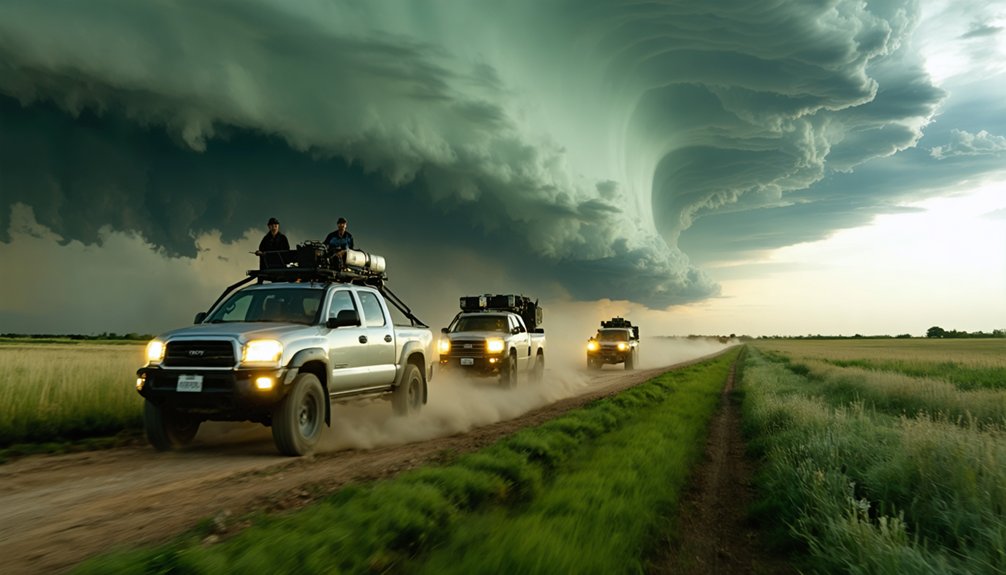
When you study the best storm chaser photographers, you’ll find they share a precise blend of meteorological skill, artistic vision, and field discipline. Photographers like Jason Weingart, Mike Hollingshead, and Aaron Jayjack don’t rely on luck—they analyze forecast data, master split-second positioning, and craft images that carry real emotional weight. Their work also drives public awareness, turning complex storm data into powerful visuals. Each photographer’s perspective reveals a deeper layer of this demanding craft.
Key Takeaways
- Jason Weingart integrates real-time meteorological education with visual storytelling, teaching storm structure, timing, and angle during guided chase tours.
- Mike Hollingshead’s 30-year career reveals how pattern recognition and adaptation to technological advances define dedicated storm photography professionals.
- Aaron Jayjack combines lightning analytics and meteorological awareness, emphasizing split-second positioning decisions over luck when capturing tornadoes.
- Charles Edwards prioritizes emotional storytelling through light, contrast, and composition, balancing artistic interpretation with scientific accuracy in storm imagery.
- Justin Snead demonstrates how consistent branding, rapid social posting, and personal storytelling build engaged audiences around storm photography content.
Jason Weingart on Teaching Storm Photography From the Field
Jason Weingart doesn’t just chase storms—he brings others into the field with him. Based in Texas, he runs dedicated storm-chasing tours that put you directly inside severe-weather environments, where meteorological education happens in real time. You’re not watching a lecture—you’re reading the sky, tracking rotation, and making positioning calls alongside an experienced chaser.
Weingart’s approach ties visual storytelling to field logistics. He’ll show you how timing, angle, and storm structure combine to produce images that carry both scientific weight and emotional impact.
You learn to see a storm the way a forecaster thinks about it and capture it the way a photographer feels it. For anyone serious about storm photography, his model proves that the best classroom has no walls.
Mike Hollingshead’s Thirty Years Behind the Storm Camera
Thirty years behind a storm camera builds a kind of knowledge no classroom replicates. Mike Hollingshead’s 1993–2023 field span puts him at the center of two massive shifts you can’t ignore:
- Meteorological innovations transformed forecasting accuracy, letting chasers position earlier and safer before tornadoes developed.
- Equipment innovations moved storm photography from film limitations to digital precision, reshaping what’s capturable in low-light, high-chaos conditions.
- Long-duration commitment revealed patterns in storm behavior that short-term chasers simply don’t accumulate.
You’re looking at a photographer who didn’t just witness change — he adapted through it, continuously. Hollingshead’s body of work stands as a living record of how storm photography matured alongside the science driving it.
That consistency separates career chasers from seasonal ones.
Aaron Jayjack on Timing and Placement in Storm Chaser Photography
Where Hollingshead’s edge came from decades of accumulated pattern recognition, Aaron Jayjack’s work zeroes in on something more immediate: the split-second decisions that determine whether you’re in position or watching a tornado from the wrong angle.
Jayjack treats storm visualization as a core skill, reading a storm’s structure in real time to anticipate its next move before it happens. You can’t afford to react late when a tornado shifts direction.
His approach to lightning analytics helps him understand discharge patterns, giving him a calculated advantage when framing dramatic electrical activity.
Jayjack’s images reflect a discipline where meteorological awareness and precise field positioning intersect. For any photographer serious about severe-weather work, his methodology demonstrates that timing isn’t luck — it’s preparation executed under pressure.
Justin Snead on Building a Storm Photography Brand Through Social Media
Few storm chasers have built a public identity as deliberately as Justin Snead, known online as @thedreadlocktraveler. He treats storm symbolism as visual currency, turning raw severe-weather moments into a recognizable personal brand.
His approach shows you that social media isn’t secondary to field work — it’s the platform where storm symbolism and weather symbolism reach audiences who’ll never stand near a tornado.
His brand strategy breaks down into three core practices:
- Rapid posting of field imagery to sustain real-time audience engagement
- Personal storytelling that connects weather symbolism to movement and freedom
- Consistent visual identity across platforms that reinforces storm symbolism
You can learn from Snead that branding and chasing aren’t separate pursuits — each one amplifies the other.
Charles Edwards on Making Severe Weather Look as Dramatic as It Feels
Charles Edwards has built a reputation on closing the gap between what severe weather looks like and what it actually feels like. His approach leans heavily on emotional storytelling, treating each storm not as a data point but as an experience worth translating into a frame.
You’ll notice his images carry weight beyond documentation—light, contrast, and composition work together to mirror the raw tension of standing near a violent storm system.
Edwards applies artistic interpretation without sacrificing accuracy. He doesn’t manufacture drama; he positions himself to capture it honestly.
For you as a viewer, that means his photographs don’t just inform—they pull you into the moment. That balance between scientific observation and visual impact defines what separates his work from standard weather documentation.
Shane Adams on Risk, Discipline, and the Chase-to-Image Workflow
Shane Adams treats risk as a variable you manage, not a barrier you ignore—every decision in the field reflects a calculated read of storm behavior, escape routes, and positioning windows. His discipline shows in how consistently he places himself inside productive storm structure without overcommitting to a dangerous intercept.
When you study his workflow, you see a tight sequence from forecast analysis to field execution to image capture that wastes little time and misses fewer shots.
Calculated Risk Management
Storm chasing demands a calculated balance between proximity and survival, and Shane Adams has built his entire workflow around that tension. His risk assessment process begins before he ever leaves the vehicle, reading storm structure, escape routes, and terrain in real time.
You’ll notice his safety protocols aren’t reactive—they’re built into every decision point:
- Position selection: He chooses intercept angles that maximize image capture while preserving multiple exit options.
- Storm mode recognition: He identifies when a storm shifts from photogenic to dangerous, triggering an immediate repositioning response.
- Time discipline: He sets hard limits on how long he stays inside a high-risk zone, regardless of the shot.
That disciplined framework is what separates calculated field access from reckless exposure—and it’s what keeps him returning to chase another day.
Field Discipline Drives Results
Every decision Shane Adams makes in the field—from intercept angle to exit timing—feeds directly into the final image. You’re watching a photographer who treats storm ethics not as a constraint but as a competitive advantage.
When you respect the storm’s motion and follow established safety protocols, you stay in position longer, which means more opportunities to capture defining moments.
Adams doesn’t chase recklessly—he reads the structure, commits to a route, and executes deliberately. That discipline separates productive intercepts from wasted drives.
You won’t find him gambling on position when conditions shift dangerously.
The chase-to-image workflow demands both scientific awareness and visual instinct. Adams demonstrates that field discipline isn’t limiting—it’s what keeps you alive, mobile, and ready when the storm delivers its best moment.
Chase-to-Image Workflow Breakdown
From the moment Adams spots a developing supercell, a disciplined sequence of decisions locks into place—one that moves seamlessly from meteorological read to final image. You’re watching a process built on preparation, not chance.
- Pre-chase: Equipment maintenance is non-negotiable—sensors, lenses, and power systems get checked before wheels roll.
- Field positioning: Adams reads storm motion and structure to place himself where light, contrast, and rotation converge.
- Post-chase: Color grading refines raw captures, pulling out the atmospheric tension already present in the frame.
Each phase depends on the one before it. Skip equipment maintenance, and you miss the shot. Rush color grading, and you lose the story the storm already told. Adams treats every link in that chain with equal precision.
How Professional Storm Chasers Read Weather Before the Chase Begins
Before a single image gets captured, professional storm chasers spend hours analyzing atmospheric data to determine whether conditions will support severe weather. You’re looking at model runs, skew-T charts, and surface analysis maps long before you load the vehicle.
Wind shear and cloud cover are two of the first indicators you assess—wind shear tells you whether a storm can organize and rotate, while cloud cover signals moisture boundaries and potential cap strength.
Photographers like Mike Hollingshead and Shane Adams have refined this pre-chase process over decades, treating forecast work as seriously as fieldwork. You identify a target area, plot intercept routes, and monitor convective outlooks in real time.
The image begins not at the camera, but at the forecast desk.
Cameras, Vehicles, and Field Gear Storm Chasers Use on Every Chase
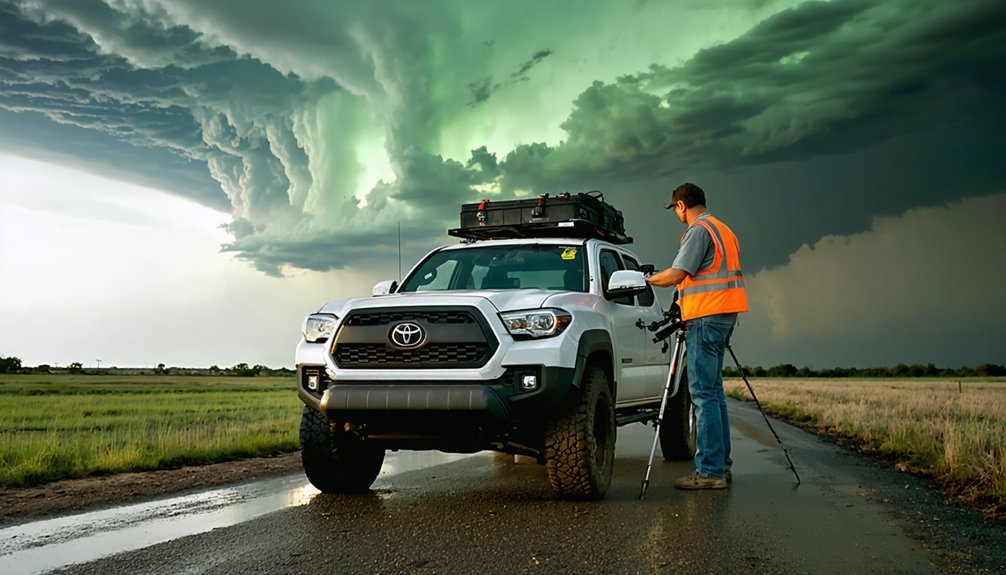
When you’re chasing severe weather, your gear list isn’t optional—it’s operational. Every item earns its place based on function, durability, and rapid deployment.
Storm chasers like Jason Weingart and Mike Hollingshead have refined setups built around field reality, not convenience. Camera stabilization keeps footage usable when wind and vehicle vibration threaten every frame. Vehicle modifications—reinforced frames, external mounts, and directional antennas—turn a truck into a mobile command post.
Your core chase kit typically includes:
- Weather-hardened camera bodies paired with wide-angle and telephoto lenses for structure and proximity shots
- Stabilized mounting systems that absorb road and wind interference during active pursuit
- Vehicle modifications including external power, roof platforms, and storm-rated communication arrays
Every piece of gear reflects a decision made before the storm ever forms.
The Forecasting and Timing Skills That Define Elite Storm Chasers
Before you reach a storm, you’ve already made dozens of decisions based on atmospheric data—surface analysis, upper-level winds, instability indices, and moisture profiles all shape where you position yourself.
Elite chasers like Mike Hollingshead and Shane Adams don’t guess at storm timing; they read model output and mesoscale discussions with the same precision a surgeon applies to a procedure.
You’re not just chasing weather—you’re intercepting a moving, evolving system, and even a 20-minute miscalculation can mean the difference between a career-defining image and an empty sky.
Reading Atmospheric Data Precisely
Though storm chasing looks visceral and spontaneous on camera, it’s grounded in disciplined atmospheric analysis long before a single frame gets captured. You’re studying atmospheric oscillations, tracking wind shear, and running data interpolation across multiple model runs before you ever leave home base.
Elite chasers like Mike Hollingshead and Shane Adams know that precise reads on raw data separate productive days from wasted ones. You’re not guessing — you’re synthesizing:
- Skew-T diagrams to assess instability and convective potential
- Surface boundary positioning to identify ideal storm initiation zones
- Mesoscale model divergence to anticipate timing windows accurately
Every variable you misread costs you the shot. The photographers who consistently capture iconic imagery aren’t lucky — they’ve simply done the analytical work most people skip entirely.
Timing Storm Intercepts Strategically
Reading the data correctly is only half the equation — acting on it at the right moment is where intercepts are won or lost. You’ve got to commit to a position before the storm forces your hand.
Elite chasers like Shane Adams and Aaron Jayjack don’t wait for certainty; they move on probability, cutting off angles that give them clean sight lines to storm formations without sacrificing an escape route.
Timing a lightning strikes sequence or a tornado touchdown means anticipating the storm’s next move, not reacting to its last one. You’re constantly recalculating — road networks, storm motion, light direction.
Every minute of hesitation costs you position. The photographers who consistently capture defining images aren’t lucky; they’ve disciplined themselves to decide fast and move faster.
Why Storm Chaser Photos Are Now Central to Public Weather Communication
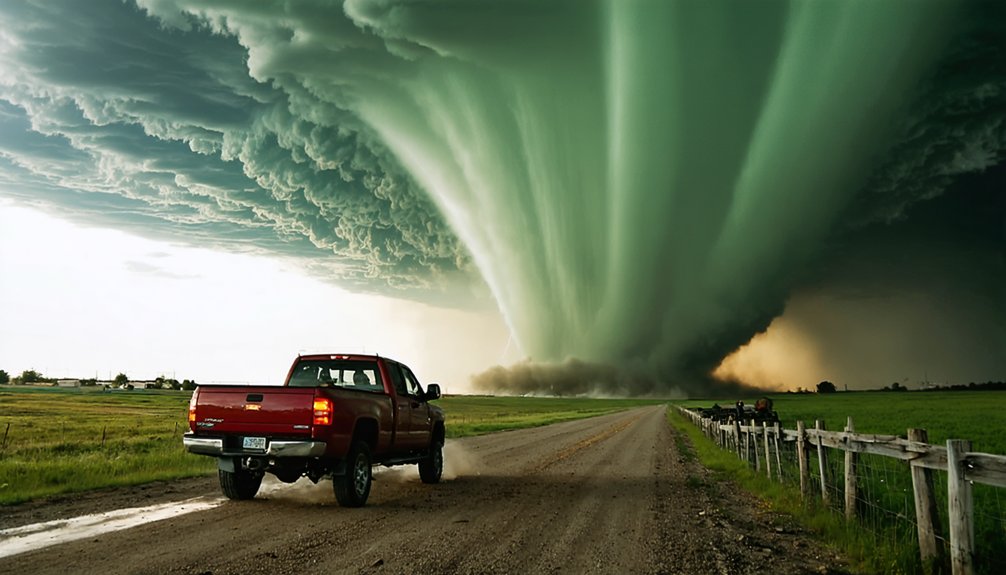
Storm chaser photos have become one of the most effective tools in public weather communication, cutting through abstract forecasts with immediate, visceral imagery. Meteorological communication once relied heavily on radar maps and technical briefings. Visual storytelling changed that by putting raw, field-captured images directly in front of the public.
Photographers like Aaron Jayjack and Charles Edwards produce imagery that does more than document — it informs and alerts. Their work now serves three critical functions:
- Translating complex storm data into images anyone can understand
- Driving real-time awareness during active severe-weather events
- Building public respect for the destructive power of extreme weather
You’re living in an era where a single storm photograph can reach millions before official warnings fully circulate — that’s real communicative power.
Frequently Asked Questions
How Do Storm Chasers Handle Mental Health After Traumatic Field Experiences?
You’d typically lean on peer support groups and post-trauma counseling after intense field experiences. Talking with fellow chasers who’ve witnessed the same destruction helps normalize reactions, while professional counseling equips you with practical coping tools for long-term resilience.
What Insurance Coverage Do Professional Storm Chasers Typically Carry?
You might think standard auto covers it—it doesn’t. You’ll need specialized insurance policies combining Liability coverage, vehicle protection for off-road conditions, and equipment riders to safeguard your gear when you’re chasing severe weather professionally.
How Do Storm Photographers Manage Income During Slow Weather Seasons?
You diversify your revenue through workshops, print sales, and licensing archives. You’ll use weather prediction tools to plan shoots and refine storm photography techniques, keeping skills sharp and income steady when active chase seasons slow down.
Do Storm Chasers Collaborate With Emergency Management Agencies Directly?
By Jove, you’ll find storm chasers actively collaborate with emergency management agencies, sharing real-time data from your storm chasing gear and weather prediction tools to aid response efforts, warnings, and community safety decisions.
What Legal Permits Are Required for Storm Chasing Across State Lines?
You don’t need specific permits for storm chasing across state lines. However, you must respect storm chase regulations, local traffic laws, and storm chasing ethics. Permits and legalities vary if you’re filming commercially.
References
- https://www.jasonrweingart.com/go-storm-chasing
- https://nomadict.org/justin-snead-thedreadlocktraveler-photographer-based-in-the-us/
- https://stormhighway.com/30-years-of-storm-photography.php
- https://digital-photography-school.com/5-incredible-storm-photographers-best-images/
- https://www.reddit.com/r/tornado/comments/1mfcj4e/i_made_a_storm_chaser_tier_list_any_constructive/
- https://www.shutterstock.com/blog/storm-chasers-weather-photography
- https://www.snowaddiction.org/2014/06/the-worlds-best-storm-chaser-photography.html
- http://www.skip.cc/chase/links/