Climate change is measurably intensifying the storms you face. Warmer oceans supply more evaporative energy, fueling stronger hurricanes, while atmospheric moisture increases roughly 7% per degree of warming, producing heavier rainfall. NOAA projects tropical cyclone intensity will rise 1%–10% under a 2°C scenario, with rainfall near storm centers increasing up to 22%. Rapid intensification events are becoming more frequent, compressing your preparation window. The full scope of what’s driving these trends goes much deeper.
Key Takeaways
- Rising global temperatures increase atmospheric energy, fueling faster storm formation, stronger winds, and greater destructive potential overall.
- Warmer oceans supply more evaporative energy, intensifying hurricanes and preventing storms from weakening before landfall.
- Climate change causes hurricanes to produce approximately 14% more rainfall, significantly increasing flood risks near storm centers.
- Rapid intensification events are becoming more frequent, dangerously reducing preparation and evacuation time for coastal communities.
- Rising sea levels raise baseline water levels, allowing storm surge to penetrate deeper inland and cause greater damage.
The Atmospheric Conditions Driving Stronger Storms
As global temperatures rise, the atmosphere gains energy that fundamentally alters how storms form and intensify. Warmer surface air accelerates convection, disrupting atmospheric stability and creating conditions where storms develop faster and hit harder. You’re looking at a system where every degree of warming adds measurable fuel to storm mechanics.
Warmer oceans drive increased evaporation, injecting heat and moisture directly into cloud dynamics, which amplifies storm growth and sustains higher wind speeds.
Warmer air also holds more water vapor before condensation triggers, meaning storms carry heavier precipitation loads.
These aren’t speculative projections — they’re measurable shifts in atmospheric physics. Understanding these conditions matters because stronger background energy means stronger storms, greater unpredictability, and ultimately, less time for you to respond before damage becomes catastrophic.
How Warmer Oceans Fuel More Powerful Storms
When you examine the mechanics of hurricane formation, you’ll find that rising sea surface temperatures serve as the engine driving storm intensification.
Warmer oceans accelerate evaporation, injecting additional heat and moisture into the atmosphere that storms convert directly into destructive energy.
You can trace this feedback loop clearly: higher ocean temperatures mean more fuel, and more fuel means stronger, more dangerous storms.
Rising Sea Surface Temperatures
Oceans absorbing excess heat from climate change are directly intensifying tropical storms and hurricanes. Warmer sea surface temperatures supply more evaporative energy, increasing moisture transfer into storm systems and driving stronger convection. This mechanism elevates wind speeds and amplifies destructive potential per storm event.
You’re already witnessing cascading consequences beyond storm intensity — coral bleaching and ocean acidification signal that ocean chemistry and biology are fundamentally destabilizing under thermal stress. Warmer oceans accelerate evaporation rates, injecting additional heat and water vapor into developing cyclones.
NOAA data confirms that higher sea surface temperatures correlate directly with rapid intensification events. Even modest temperature increases generate measurable upticks in storm energy, meaning your coastal infrastructure faces compounding risks as ocean warming continues accelerating throughout this century.
Increased Evaporation Fuels Storms
Warmer sea surfaces don’t just intensify storms through heat alone — they drive a mechanical process rooted in evaporation that directly amplifies storm energy.
As ocean temperatures rise, evaporation accelerates, loading the atmosphere with water vapor that releases latent heat during condensation. That released energy powers stronger updrafts, reshapes cloud patterns, and intensifies precipitation dynamics across the storm system.
Warmer oceans fundamentally transfer stored thermal energy directly into storm circulation. NOAA data confirms this feedback loop contributes to higher wind speeds and increased rainfall intensity.
You’re looking at a self-reinforcing cycle: warmer water evaporates faster, storms access more energy, and destructive potential scales upward.
Understanding evaporation’s role clarifies why ocean temperature isn’t just background data — it’s the engine driving storm amplification.
How Climate Change Is Making Hurricanes More Intense
As ocean temperatures climb, you’re seeing hurricanes draw more energy from the sea surface, driving up peak wind speeds and pushing more storms into Category 4 and 5 territory.
Rapid intensification—where a storm’s winds jump dramatically in a short window—is becoming more common, making it harder for you to prepare before a storm reaches its most dangerous state.
On top of stronger winds, you’re also facing heavier rainfall and amplified storm surge, as warmer air holds more moisture and rising sea levels push floodwaters farther inland.
Warmer Oceans Fuel Intensity
Why are hurricanes getting stronger? Warmer oceans are the primary driver, and you can’t ignore the data. Rising sea surface temperatures directly fuel hurricane intensity by increasing evaporation, heat transfer, and atmospheric moisture. Meanwhile, ocean acidity and marine biodiversity shifts signal deeper systemic changes affecting storm-breeding environments.
Here’s what the science shows:
- Warmer oceans increase evaporation, injecting more heat and moisture into storm systems.
- Stronger convection near warm surfaces accelerates storm formation and growth.
- NOAA GFDL projects tropical cyclone intensity could rise 1% to 10% under a 2°C warming scenario.
- The proportion of Category 4 and 5 storms is projected to increase considerably.
You’re facing a future where each storm carries greater destructive potential than the last.
Rapid Intensification On The Rise
Favorable storm track conditions and reduced wind shear over warming ocean corridors are allowing hurricanes to maintain and rapidly build intensity closer to coastlines.
Some storms are also decelerating, prolonging destructive wind and rainfall exposure.
Even without an increase in total storm frequency, this behavioral shift means each event carries notably greater destructive potential — compressing evacuation timelines and overwhelming emergency response capacity.
Heavier Rainfall And Surge
Beyond wind and rapid intensification, climate change is reshaping two other destructive forces: rainfall and storm surge. Warmer air holds more moisture, accelerating storm formation and increasing precipitation loads. Rising seas then amplify every surge event, pushing floodwaters farther inland.
Here’s what the data shows:
- Rainfall rates could rise ~14% globally under a 2°C warming scenario.
- Projected range spans +6% to +22% within 100 km of storm centers.
- Storm surge damage intensifies because higher baseline sea levels extend inland reach.
- Climate adaptation becomes critical as hurricanes deliver more water, faster, into coastal communities.
You’re not just facing stronger winds—you’re facing storms engineered by warming to flood deeper and linger longer.
How Much More Rain Are Hurricanes Producing?
As global temperatures rise, hurricanes are producing markedly more rainfall—and the data backs this up. NOAA’s Geophysical Fluid Dynamics Laboratory projects average tropical cyclone rainfall rates will increase roughly 14% under a 2°C warming scenario, with a range spanning +6% to +22% within 100 km of storm centers.
Warmer air holds more water vapor before condensation, directly amplifying precipitation intensity.
NASA’s climate models reinforce this trajectory, projecting even heavier hurricane rainfall by 2100.
NASA’s climate models confirm the trend: expect significantly heavier hurricane rainfall as we approach 2100.
You’re not just facing stronger winds—you’re facing flood conditions that accelerate coastal erosion and amplify storm surge impacts far inland.
These compounding effects mean infrastructure, property, and personal freedom to live without government-mandated evacuation zones are increasingly at risk as wetter storms redefine what “normal” hurricane damage looks like.
Why Category 4 and 5 Hurricanes Are Becoming More Common
The data is unambiguous: the proportion of tropical cyclones reaching Category 4 or 5 intensity is climbing, and climate change is the primary driver. Warmer oceans transfer more energy directly into storm systems, pushing wind speeds into catastrophic ranges.
Four mechanisms explain this shift:
- Sea surface temperatures provide 10% greater intensity potential under a 2°C warming scenario
- Rapid intensification events are increasing, compressing your storm preparedness window dramatically
- Warmer air sustains stronger convection, maintaining peak winds longer
- Higher baseline ocean heat content prevents storms from weakening before landfall
This directly threatens coastal infrastructure designed for historical storm benchmarks, not future realities. You’re facing structures, evacuation routes, and flood barriers built for a climate that no longer exists. Upgrading those systems isn’t optional—it’s urgent.
What Is Rapid Intensification and Why Is It Increasing?

Rapid intensification sits at the center of why Category 4 and 5 storms are catching coastal communities off guard. It’s defined as a wind speed increase of at least 35 mph within 24 hours — a threshold storms are crossing more frequently.
Historical patterns show warmer ocean temperatures are the primary driver, supplying sustained energy that accelerates storm development faster than forecast models can track. Climate change has made upper-ocean heat deeper and more persistent, removing a natural brake on intensification.
You’re then left with storms that jump categories overnight, compressing your preparation window dramatically. Effective mitigation strategies require updated early-warning infrastructure, stronger building codes in coastal zones, and policy frameworks that account for accelerating intensification trends rather than relying on historical storm behavior as a reliable baseline.
How Sea Level Rise Makes Storm Surge More Destructive
When sea levels rise, they lift the baseline from which storm surge builds, so even a moderate hurricane can push water farther inland than a stronger storm would have decades ago.
NOAA confirms that rising seas directly amplify the destructive reach of individual tropical cyclones, turning what were once manageable surge events into catastrophic floods.
If you live in a coastal community, you’re now facing a compounding risk: the same storm that your infrastructure was designed to withstand can now overwhelm it because the ocean’s starting point is simply higher.
Rising Seas Amplify Surges
As sea levels rise, storm surge doesn’t just get higher—it reaches farther inland, threatening communities that were once considered safe. Accurate storm prediction now demands accounting for this compounding risk. Climate adaptation isn’t optional; it’s a survival strategy.
Here’s what rising seas mean for surge damage:
- Higher baseline water levels let surges penetrate deeper into coastal zones.
- NOAA confirms that sea level rise directly amplifies the destructive power of individual tropical cyclones.
- Flood risk increases even if storm intensity stays unchanged.
- Communities once buffered by elevation now sit within surge reach.
You can’t separate storm surge modeling from sea level trends anymore. Every centimeter of rise expands the damage footprint, reshaping risk maps and demanding smarter, faster infrastructure decisions.
Higher Baselines Flood Farther
The math is straightforward: a higher baseline water level means storm surge travels farther inland before it loses momentum. Every inch of sea level rise directly extends a surge’s destructive reach, threatening properties that historically sat beyond flood zones.
NOAA confirms that rising seas amplify individual storm impacts even when storm frequency stays flat. That reality carries serious insurance implications — premiums are climbing, and coverage in coastal markets is shrinking as actuarial models reassess risk.
Your storm preparedness plan can’t rely on outdated flood maps that predate accelerating sea level rise. The same Category 3 hurricane hitting your coastline today produces measurably worse flooding than it would have two decades ago.
Higher baselines don’t wait for stronger storms — they make ordinary ones devastating.
Coastal Communities Face Greater Risk
Nowhere is climate change’s compounding risk more visible than in how sea level rise reshapes storm surge damage for coastal communities. Higher baselines mean surge penetrates farther inland, threatening your property, infrastructure, and autonomy over your land.
Four critical realities define this risk:
- Storm surge reaches farther inland as higher sea levels amplify every hurricane’s destructive footprint.
- Beach erosion accelerates, stripping away natural buffers that once absorbed surge energy before it reached communities.
- Coral bleaching weakens reef systems, eliminating natural wave barriers that historically reduced surge impact.
- Flood frequency increases even without stronger storms, because baseline water levels are already elevated.
You’re facing greater damage per storm event — not because storms are always stronger, but because the ocean starts higher.
Why Coastal Populations Face Compounding Storm Risks
Coastal populations don’t face just one climate-driven threat — they face several converging hazards that compound each other’s destructive potential. Rising seas elevate baseline water levels, so storm surge penetrates farther inland and strikes coastal infrastructure harder.
Rising seas don’t just threaten coastlines — they amplify every storm, pushing surge farther inland with compounding force.
Simultaneously, warmer oceans intensify hurricane wind speeds and rainfall rates, multiplying structural damage and flooding. You’re not just contending with a stronger storm — you’re contending with a stronger storm on top of higher seas.
Degraded marine ecosystems, including eroded wetlands and coral reefs, historically absorbed wave energy and buffered shorelines. As those natural barriers weaken, coastal infrastructure loses critical protection.
Each compounding factor amplifies the others, creating a feedback loop of escalating risk. Understanding these interactions isn’t academic — it’s essential for making informed decisions about where and how you live.
How Climate Change Is Fueling Severe Thunderstorms Over Land
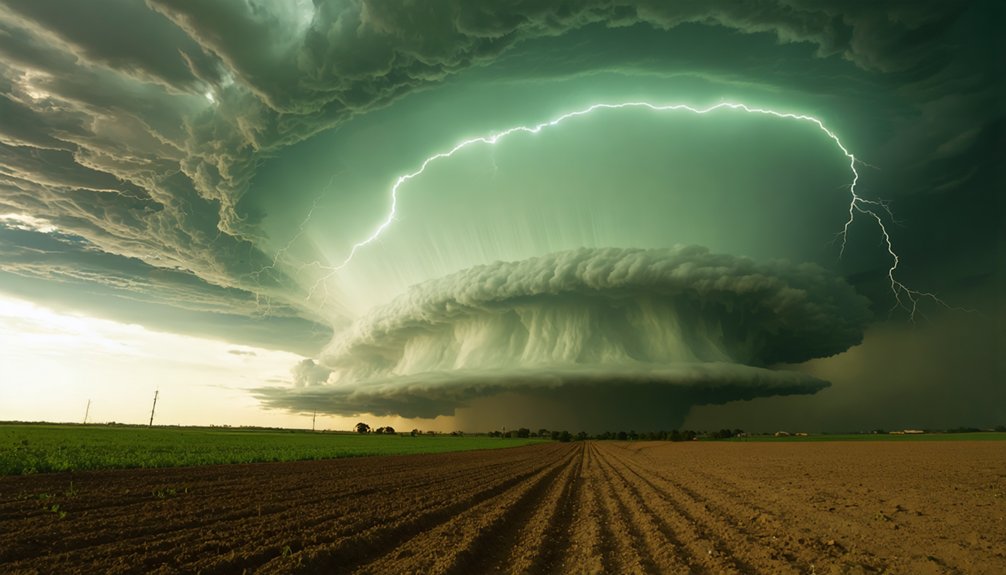
While coastal storms dominate climate headlines, warming is also intensifying severe thunderstorms across continental interiors. Urban heat and air pollution accelerate surface warming, driving stronger convective updrafts that fuel dangerous storm cells. You’re facing measurably higher risks as atmospheric conditions shift.
Research projects favorable severe convective storm conditions will increase by 5% to 20% per 1°C of global warming. Here’s what that means practically:
- Larger hailstones become more likely as warmer air supports stronger updrafts
- Flash flooding intensifies as warming air holds more moisture before releasing it
- Damaging wind events increase as stronger convection generates more powerful downdrafts
- Storm frequency rises, particularly across regions warmed by Gulf of Mexico temperature increases
Stronger storms mean greater destruction per event, regardless of total storm counts.
How Worsening Storm Trends Will Reshape Coastal Risk by 2100
By 2100, converging storm trends will fundamentally alter coastal risk profiles in ways that compound rather than simply add together. Rising seas elevate baseline water levels, letting storm surge penetrate farther inland and overwhelm urban infrastructure not engineered for those loads.
By 2100, rising seas won’t just creep inland—they’ll let storm surge rewrite the rules of coastal survival.
Simultaneously, tropical cyclones are projected to intensify 1%–10% under a 2°C warming scenario, while rainfall rates near storm centers could rise roughly 14%. You’re looking at stronger winds, heavier flooding, and higher surge arriving together.
Ecosystem resilience—functioning wetlands, reefs, barrier systems—can buffer some surge energy, but degraded ecosystems offer diminishing protection.
Rapid intensification events leave coastal communities less time to respond. These compounding dynamics mean risk isn’t linear; it accelerates, demanding infrastructure and governance strategies built for a fundamentally different threat environment.
Frequently Asked Questions
Which Regions Are Most Vulnerable to Increased Storm Severity From Climate Change?
Regional vulnerabilities hit coastal impacts hardest — you’ll find tropical coastlines, low-lying deltas, and hurricane-prone zones like the Gulf Coast face amplified storm surge, intensified winds, and heavier rainfall as climate change accelerates.
How Does Climate Change Affect the Frequency of Storms Overall?
Climate change doesn’t clearly increase storm frequency, but it’s making each storm far more dangerous. You’ll face stronger intensities and heavier rainfall, complicating storm prediction and demanding smarter climate adaptation strategies to protect your freedom and safety.
Can Building Codes Be Updated to Better Withstand Climate-Driven Storm Intensity?
Yes, you can advocate for updated building codes that prioritize structural resilience against intensifying storms. With wind speeds rising ~6% per decade and rainfall up 14%, stronger standards protect your property and preserve your autonomy.
How Do Governments Currently Prepare Communities for Worsening Storm Conditions?
Even if you think government’s slow, it’s actively boosting community resilience through data-driven emergency planning—updating evacuation routes, enforcing stricter flood zone policies, and using storm surge projections to protect your freedom to rebuild safely.
What Economic Costs Are Associated With Increasingly Severe Climate-Driven Storms?
You’re facing surging insurance costs and strained emergency response budgets as climate-driven storms intensify. With hurricane intensity rising ~6% per decade and rainfall projected up 14%, you’ll bear escalating infrastructure, property, and disaster recovery expenses.
References
- https://scied.ucar.edu/learning-zone/climate-change-impacts/climate-severe-storms
- https://www.c2es.org/content/hurricanes-and-climate-change/
- https://www.gfdl.noaa.gov/global-warming-and-hurricanes/
- https://climateinstitute.ca/news/fact-sheet-climate-change-and-storms/
- https://www.climatesignals.org/climate-signals/storm-intensity-increase
- https://www.climatecentral.org/climate-matters/hurricane-strength-attribution
- https://www.americanprogress.org/article/climate-change-fueled-hurricanes-are-increasingly-destructive-and-costly-for-u-s-communities/
- https://science.nasa.gov/earth/climate-change/a-force-of-nature-hurricanes-in-a-changing-climate/
- https://www.bbc.com/future/article/20240712-modern-hurricanes-are-rewriting-the-rules-of-extreme-storms
- https://www.climate.gov/news-features/understanding-climate/climate-change-probably-increasing-intensity-tropical-cyclones