When you trace a tornado’s destructive power to its origin, you’ll find horizontal wind shear converting into concentrated vertical rotation through tilting, stretching, and angular momentum conservation. Supercell updrafts tilt shear-generated vorticity upward, while converging air amplifies it dramatically. The swirl ratio then determines whether you get one stable vortex or multiple suction vortices. Each mechanism builds on the last, and the full picture reveals just how precisely these forces must align.
Key Takeaways
- Wind shear creates horizontal vorticity, which supercell updrafts tilt vertically, initiating the rotating column that defines a tornado’s core structure.
- Vortex stretching amplifies weak ground-level rotation through angular momentum conservation, intensifying wind speeds as converging air accelerates toward the vortex axis.
- The swirl ratio determines vortex complexity, with higher values producing multiple suction vortices orbiting the parent tornado at devastating speeds.
- Low pressure within the tornado core sustains intensity by drawing air inward and creating upward pressure-gradient forces that vertically stretch vorticity.
- The Rear Flank Downdraft shapes tornadogenesis by pulling the mesocyclone groundward, forming tornadoes within the shear zone between updraft and downdraft.
How Supercell Thunderstorms Spawn Tornadoes
Supercell thunderstorms produce the vast majority of significant tornadoes (EF2+) and virtually all violent tornadoes (EF4–EF5), making them the dominant tornadogenic mechanism in the atmosphere.
Supercell thunderstorms reign supreme in tornado production, generating nearly every violent, landscape-altering EF4–EF5 twister on record.
You’ll find that tornado formation begins when horizontal wind shear generates horizontally oriented rotation within the storm’s environment. Warm, moist air parcels carry streamwise vorticity, spinning like spiraling footballs as the updraft ingests them.
The updraft then tilts this horizontal vorticity into the vertical, initiating rotation about a vertical axis. Vortex stretching amplifies this rotation dramatically—vertical vorticity near the ground starts at roughly one-hundredth that of a mature tornado.
Despite this process occurring in nearly all supercells, only 30% produce tornadoes, indicating that additional dynamic factors govern whether rotation ultimately reaches tornado strength.
How Horizontal Wind Shear Becomes Vertical Rotation
When you examine the atmospheric conditions preceding tornadogenesis, you’ll find that horizontal wind shear establishes a tube of horizontally oriented rotation parallel to the ground.
As warm, moist air parcels carrying streamwise vorticity get ingested into a supercell’s powerful updraft, the updraft tilts that horizontal rotation into the vertical plane.
You can think of this tilting mechanism as the critical conversion process that transforms layer-by-layer wind speed differentials into the vertical vorticity that ultimately drives mesocyclone development.
Wind Shear Creates Rotation
Most violent tornadoes trace their origins to a deceptively simple atmospheric process: horizontal wind shear converting into vertical rotation. When wind speed or direction changes with altitude, it generates a horizontally spinning tube of air.
The supercell’s powerful updraft then tilts this horizontal rotation into the vertical plane, establishing the foundational spin necessary for tornado development.
Once vertical vorticity exists, vortex stretching amplifies it dramatically. As converging air narrows toward the rotation axis, angular momentum conservation forces rotational speed to increase — identical to a skater pulling their arms inward.
What begins as barely measurable vertical rotation intensifies by orders of magnitude through this mechanism. You’re fundamentally witnessing atmospheric physics enforcing basic conservation laws, transforming diffuse environmental shear into the concentrated, violent rotation defining a mature tornado vortex.
Tilting Vorticity Vertically
Horizontal wind shear produces a tube of spinning air oriented parallel to the ground — but a tornado requires vertical rotation, so the supercell’s updraft must physically reorient that vorticity.
Vorticity tilting converts horizontal spin into vertical spin through four sequential steps:
- Wind shear generates horizontally rotating air tubes near the surface.
- The supercell’s powerful updraft ingests those tubes from below.
- Rising air bends the horizontal vorticity upward, reorienting it toward the vertical axis.
- Rotation initiation begins as streamwise vorticity aligns with the updraft’s vertical motion.
You’re fundamentally watching angular momentum get redirected 90 degrees. Once vertical vorticity exists within the updraft column, vorticity stretching amplifies it dramatically — transforming that modest spin into the concentrated rotational force driving a tornado’s destructive core.
How Converging Air Spins a Tornado to Full Strength
Once nascent rotation establishes itself beneath a supercell’s mesocyclone, converging air parcels drawn inward toward the vortex axis undergo a dramatic acceleration governed by the conservation of angular momentum—the same physical principle that spins a figure skater faster as she pulls her arms inward. As radial distance decreases, tangential velocity increases proportionally, concentrating tornado energy into an increasingly compact core.
You can think of vorticity stretching as the mechanical amplifier here. Vertical vorticity near the ground begins at roughly one-hundredth of mature tornado values, yet strong upward pressure-gradient forces associated with overlying updraft rotation drive rapid intensification.
Vortex stability depends critically on this stretching process—without sustained convergence and vertical acceleration, nascent rotation simply dissipates rather than tightening into a destructive, fully realized tornado vortex.
What Determines Whether a Tornado Has One Vortex or Many?
When you examine what separates a single-vortex tornado from a multiple-vortex tornado, you’ll find that the swirl ratio—a non-dimensional parameter relating tangential to radial flow—is the primary governing factor.
Once the swirl ratio reaches approximately S ≥ 0.8, the parent vortex becomes unstable and spawns 2 to 6 suction vortices rotating around its perimeter near the ground.
These suction vortices aren’t merely structural curiosities; each carries intense tangential winds and extremely low core pressure, making them capable of producing localized damage far exceeding what the parent vortex alone would generate.
Swirl Ratio Governs Structure
Whether a tornado develops a single coherent vortex or fractures into multiple swirling sub-vortices hinges on a non-dimensional parameter called the swirl ratio. During tornado genesis, vortex stretching amplifies rotation, but the swirl ratio ultimately dictates the tornado’s final morphology. Here’s how it breaks down:
- S < 0.8 – A single, stable vortex dominates.
- S ≈ 0.8 – The parent vortex begins spawning daughter vortices near the ground.
- S approaching 3 – Multiple vortices increase from 2 up to 6 suction vortices.
- S ≥ 3 – Maximum vortex complexity develops around the parent perimeter.
You can think of the swirl ratio as the governing dial controlling whether you’re witnessing one disciplined funnel or a chaotic cluster of independent, destructive sub-vortices.
Single Versus Multiple Vortices
The swirl ratio doesn’t just shape tornado morphology—it governs the fundamental decision between a single coherent vortex and a cluster of suction vortices. Below S ≈ 0.8, vortex stability holds, and you’re observing a single, organized structure with predictable rotation.
Once the swirl ratio crosses that threshold, the parent vortex breaks down, spawning two to six suction vortices orbiting its perimeter. This shift dramatically changes damage potential. Each daughter vortex carries intense tangential winds and extreme low-core pressure, redistributing tornado debris in chaotic, cycloid patterns across the ground.
You can recognize multiple-vortex signatures in post-storm damage surveys precisely because of these irregular debris fields. As the swirl ratio climbs toward three and beyond, vortex stability further deteriorates, increasing daughter vortex count and amplifying localized destruction within the broader circulation.
Suction Vortex Formation Dynamics
Understanding what tips a tornado from single to multiple vortices requires looking past the swirl ratio threshold and into the mechanics that actually generate suction vortices. When vortex stability breaks down, the parent circulation reorganizes into rotating daughter vortices.
You can trace this breakdown through four key dynamics:
- Swirl ratio exceeds S ≥ 0.8, destabilizing the core
- Frictional vorticity near the surface amplifies asymmetric instabilities
- Low core pressure intensifies within each daughter vortex independently
- Tornado debris lofted asymmetrically accelerates localized pressure differentials
Each suction vortex orbits the parent perimeter, concentrating wind speeds beyond what the single-vortex structure produces alone. Vortex stability determines whether these sub-vortices persist or collapse back into a unified core.
The occlusion downdraft mirrors this same process at the mesocyclone scale, confirming the mechanism operates across atmospheric hierarchies.
What the Swirl Ratio Tells Us About Tornado Structure
Among the key parameters governing tornado morphology, the swirl ratio stands out as the primary non-dimensional quantity that determines whether a tornado organizes as a single vortex or fractures into multiple sub-tornadic vortices.
When the swirl ratio reaches approximately S ≥ 0.8, the parent vortex spawns daughter vortices around its perimeter. As it climbs toward 3 and beyond, you’ll see the count increase from 2 up to 6 suction vortices.
Understanding this parameter lets you predict structural evolutions before they occur. Vortex stretching amplifies angular momentum as converging air tightens around the rotational axis, intensifying each daughter vortex independently.
Each suction vortex carries dangerously low core pressure and strong tangential winds, making multiple-vortex tornadoes particularly destructive across wider damage corridors than their single-vortex counterparts suggest.
How the Pressure Drop Inside a Tornado Drives Its Behavior
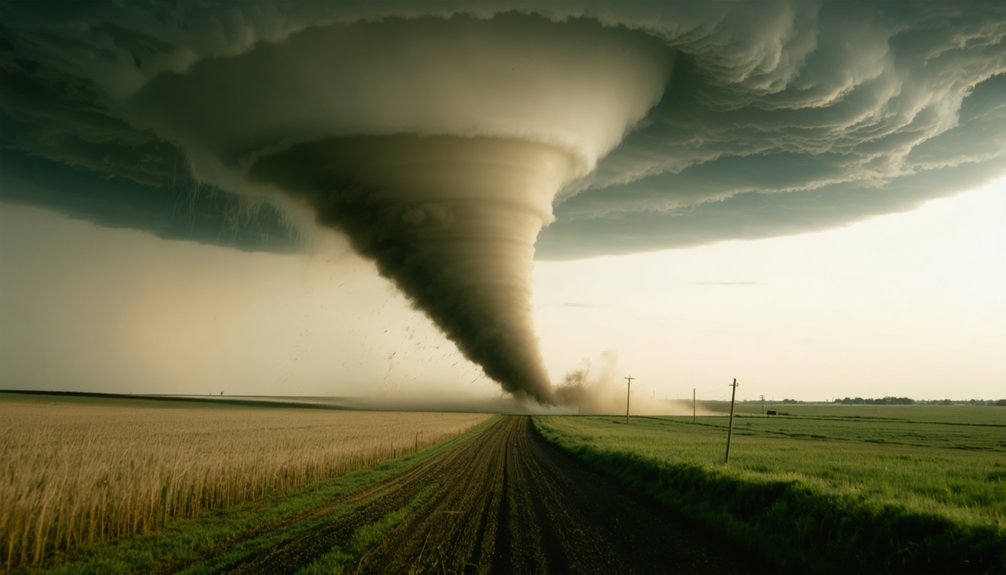
Swirl ratio governs how a tornado’s vortex splits and multiplies, but pressure dynamics drive why those vortices behave so destructively once they form. The tornado core maintains critically low pressure, generating the suction that sustains vortex alignment and concentrates tornado energy. Here’s what that pressure drop actually does:
Pressure dynamics don’t just follow tornado formation—they fuel it, sustaining every destructive vortex that swirl ratio creates.
- It pulls converging air inward, accelerating rotation through angular momentum conservation.
- It creates a powerful upward-directed pressure-gradient force that stretches vertical vorticity rapidly.
- It sustains each daughter vortex’s own low-pressure core, compounding destructive potential across multiple vortices.
- It maintains the two-celled vortex structure observed during peak intensity phases.
You can’t separate pressure behavior from structural behavior—they’re mechanically inseparable. The drop isn’t just a symptom of the tornado; it’s the engine sustaining it.
How Rear Flank Downdrafts Pull the Mesocyclone to the Ground
Pressure dynamics sustain the vortex once it forms, but the rear flank downdraft (RFD) is what forces the rotating mesocyclone down to the surface in the first place. The RFD drags rapidly descending air groundward, pulling the mesocyclone’s rotation with it.
When the RFD gust front overtakes the forward flank downdraft gust front, mesocyclone occlusion occurs. The updraft weakens at lower levels while remaining strong aloft, creating vertical stretching that dramatically intensifies rotation.
An occlusion downdraft can then develop within the mesocyclone updraft, and tornadoes form in the shear zone between these two competing airflows. Vortex stability depends critically on this balance.
As the tornado matures, lofted tornado debris marks the convergence boundary where RFD-driven inflow meets the ascending vortex core.
Why Most Supercells Never Produce a Tornado
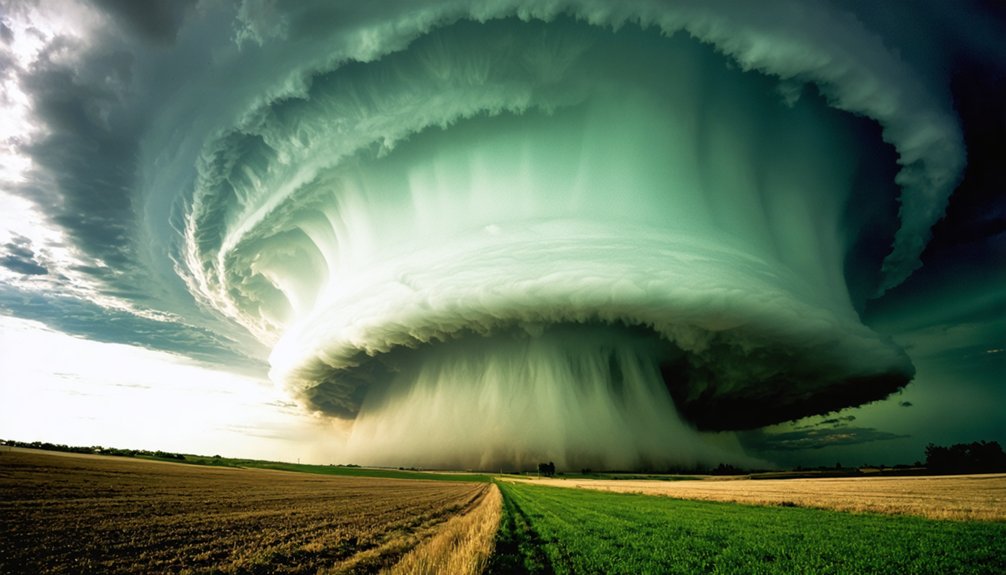
Despite supercells possessing all the large-scale ingredients for tornadogenesis, only 30% actually produce tornadoes—a statistic that exposes a critical gap in current understanding. Mesocyclone evolution doesn’t guarantee surface vortex development.
Four factors likely determine whether the tornado lifecycle initiates:
- RFD thermodynamics — Cold, stable downdraft air can suppress near-surface rotation before stretching intensifies it.
- Vorticity magnitude — Near-surface vertical vorticity starts at roughly one-hundredth of a mature tornado’s value, requiring precise amplification conditions.
- Pressure-gradient alignment — The updraft’s upward suction must precisely overlap developing low-level rotation.
- Boundary layer moisture — Insufficient warm, moist inflow weakens streamwise vorticity entering the updraft.
You’re essentially watching a system where vortex stretching occurs broadly, yet only specific configurations unlock full tornadogenesis.
Frequently Asked Questions
Can a Tornado Contain More Than Six Suction Vortices Simultaneously?
Based on current knowledge, you won’t typically observe more than six suction vortices simultaneously. Tornado formation and vortex dynamics research confirms swirl ratios beyond 3 produce a maximum of six daughter vortices around the parent perimeter.
How Does Friction Near the Ground Contribute to Tornado Rotation?
Friction effects near the surface generate horizontal vorticity that’s tilted vertically into the updraft, amplifying your tornado’s spin. Ground turbulence intensifies this process, making frictionally-generated horizontal vorticity the dominant rotational contributor among all three possible sources.
What Does Two-Celled Vortex Structure Mean for Tornado Intensity?
When you observe a two-celled vortex structure, you’re witnessing peak tornado formation intensity—vortex dynamics drive a central downdraft surrounded by fierce rotating updrafts, maximizing angular momentum and confirming the tornado’s most destructive, powerful state.
How Does the Occlusion Downdraft Differ From the Rear Flank Downdraft?
Cut to the chase: the RFD wraps around the mesocyclone’s exterior, dragging rotation downward, while the occlusion downdraft forms centrally within the mesocyclone updraft itself, directly influencing downdraft dynamics and vortex stability near tornado formation zones.
Why Does Solid-Body Rotation Occur Inside the Tornado Core?
Inside the core, viscous forces dominate, locking air parcels into uniform angular velocity—that’s solid-body rotation. You’ll find vortex dynamics enforce rotational stability here, preventing differential motion that’d otherwise fragment the tornado’s coherent structure.
References
- https://brian-f-farrell.fas.harvard.edu/publications/structure-and-dynamics-tornado-vortices
- https://sites.psu.edu/pmarkowski/how-tornadoes-form/
- https://ams.confex.com/ams/pdfpapers/21580.pdf
- https://en.wikipedia.org/wiki/Tornadogenesis
- https://geo.libretexts.org/Bookshelves/Meteorology_and_Climate_Science/Practical_Meteorology_(Stull)/15:_Thunderstorm_Hazards/15.03:_Section_4-
- https://atoc.colorado.edu/~saraht/atoc1050/Class_News/Chapter19ppt.pdf
- https://journals.ametsoc.org/view/journals/mwre/131/12/1520-0493_2003_131_2968_mdrooa_2.0.co_2.pdf
- https://www.aappsdpp.org/DPP2018Program/pdf/CD-I3.pdf
- https://academic.oup.com/book/56078/chapter/442161731