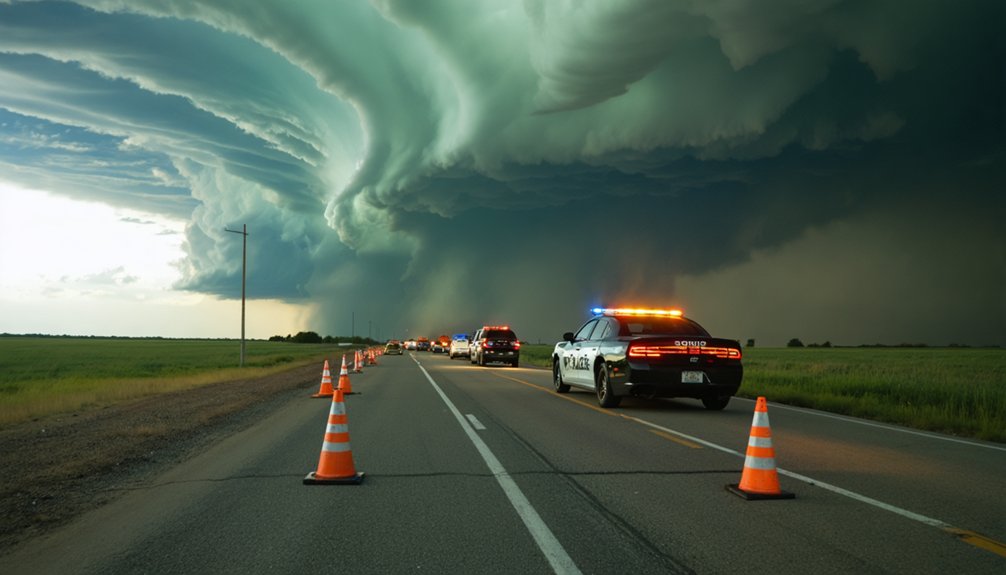
You don’t need a license to chase storms in most of the U.S. Storm chasing is largely governed by personal responsibility, not federal or state law. However, Oklahoma changed the game with House Bill 2426, creating an optional “severe weather tracker license” for professionals. Without one, you can’t bypass roadblocks, access closed roads, or enter exclusion zones during tornado warnings — violations carry fines up to $500. There’s considerably more to understand about how this framework affects you.
Key Takeaways
- No federal or state law requires a license to chase storms; it remains largely a matter of personal responsibility.
- Oklahoma’s optional “severe weather tracker license,” established via House Bill 2426, targets media and university professionals, not hobbyists.
- Licensed chasers gain privileges like bypassing roadblocks and traveling closed roads; unlicensed chasers cannot legally access these.
- SKYWARN™ spotter training is free and voluntary but does not qualify anyone for Oklahoma’s professional storm chaser license.
- Entering restricted zones during tornado warnings without a license risks fines up to $500 and potential criminal charges.
Do You Need a License To Chase Storms?
Whether you’re a hobbyist or a professional meteorologist, no federal or state law requires a license to chase storms. You can pursue severe weather independently without certification, formal training, or government approval. Storm safety remains your personal responsibility, and no regulatory body mandates compliance before you head into the field.
The legal implications are straightforward: you retain full freedom to chase without credentials. However, certain privileges—like bypassing roadblocks or activating emergency lights—are restricted to licensed professionals in Oklahoma under House Bill 2426. Amateur chasers operate outside that framework entirely.
Optional SKYWARN™ spotter training, offered through local National Weather Service offices, provides structured safety knowledge without imposing legal requirements. It’s voluntary, accessible, and recommended for anyone serious about operating effectively in severe weather environments.
What Can Amateur Storm Chasers Do Without a License?
If you’re an amateur storm chaser, you don’t need any federal or state license to pursue storms independently.
You can optionally enhance your skills through SKYWARN™ spotter training, offered by local National Weather Service offices, though certification isn’t required.
However, without a professional license, you’re restricted from accessing closed roads, bypassing roadblocks, or entering exclusion zones during active tornado warnings.
No License Needed
Although no federal or state law requires a license to chase storms, you’ll want to understand exactly what that means in practice. You’re free to pursue storms independently, document severe weather, and operate without certification. No governing body mandates credentials for amateur chasers.
However, the legal implications shift depending on your location and behavior. Entering designated exclusion zones during tornado warnings without a license carries criminal penalties and fines up to $500. You’re also responsible for your own insurance coverage, as no institutional backing protects independent chasers from liability.
Optional SKYWARN™ spotter training through local National Weather Service offices strengthens your situational awareness without restricting your freedom. You retain full operational independence while gaining credibility and technical competence through voluntary certification.
Optional Spotter Training
Operating without a license doesn’t mean operating without resources. You can access structured training that sharpens your storm safety awareness and weather preparedness without surrendering your independence.
Local National Weather Service offices offer free SKYWARN™ spotter training—no certification mandate attached. You complete it on your terms.
Three core benefits of voluntary SKYWARN™ training:
- Situational awareness – You learn to identify rotation, wall clouds, and funnel development with precision.
- Communication protocols – You understand how to relay accurate field reports to NWS meteorologists.
- Risk mitigation – You develop decision-making frameworks that reduce exposure during rapidly evolving events.
Certification remains optional. No federal or state statute requires it for independent chasers. Training simply converts raw enthusiasm into disciplined, data-informed field behavior—a measurable upgrade to your operational effectiveness.
Amateur Chasing Restrictions
While no federal or state law restricts general storm chasing, amateur chasers operate within a defined legal boundary—one that excludes specific privileges reserved for licensed professionals. You can pursue storms freely, but Oklahoma’s HB 2426 draws a hard line: entering exclusion zones during active tornado warnings without a license is a criminal offense, exposing you to legal penalties up to $500 in fines.
You also won’t access closed roads, bypass roadblocks, or run red lights—privileges strictly reserved for licensed trackers. Insurance requirements remain your personal responsibility, as no institutional coverage applies to independent chasers.
You’re operating as a private citizen, not an emergency responder. Understanding these boundaries isn’t restrictive—it’s strategic. Knowing exactly where your legal freedom ends lets you chase smarter and stay protected.
Oklahoma’s New Storm Chaser License Explained
Oklahoma’s storm chaser licensing framework stands out as the most structured regulatory approach in the U.S., and it’s worth breaking down exactly what it entails. Oklahoma House Bill 2426 creates an optional “severe weather tracker license,” targeting professionals in media or university research — not hobbyists. It won’t restrict your freedom to chase independently.
Licensed trackers gain measurable advantages that directly support storm safety and weather forecasting missions:
- Emergency vehicle status — proceed through red lights during active severe weather events
- Road access — travel closed highways when tornado warnings are issued
- Roadblock bypass authority — navigate law enforcement exclusion zones legally
Costs include a $500 initial fee and $250 renewal. The law was scheduled to take effect July 1, 2025.
Does SKYWARN Certification Help You Qualify for Oklahoma’s License?
If you’ve completed SKYWARN™ spotter training, you hold a federally recognized certification that qualifies you as a trained storm spotter—but Oklahoma’s licensing system operates on an entirely separate track.
The state’s professional license requires employment by an FCC-licensed TV station or affiliation with an accredited meteorology program, criteria that SKYWARN certification doesn’t satisfy on its own.
You can be a certified SKYWARN spotter and still fail to meet Oklahoma’s eligibility requirements, because the two systems serve distinct purposes and carry different legal weight.
SKYWARN’s Role Explained
SKYWARN™ certification, while widely recognized as the gold standard for storm spotter training, doesn’t directly qualify you for Oklahoma’s professional severe weather tracker license. The two systems serve different functions within storm safety and weather awareness frameworks.
Oklahoma’s license requires:
- Employment or contracting with an FCC-licensed TV station or accredited university meteorology program
- A recommendation letter from a chief meteorologist or authorized university official
- A background check plus valid vehicle insurance documentation
SKYWARN™ trains you to observe and report accurately — it doesn’t establish the professional employment ties Oklahoma’s bill demands.
Think of SKYWARN™ as foundational knowledge, not a credential that unlocks emergency responder privileges.
If you’re chasing independently, SKYWARN™ remains valuable, but it won’t grant you access to closed roads or bypass authority during tornado warnings.
Certification Versus Licensure
Understanding the distinction between certification and licensure clarifies why SKYWARN™ training alone won’t qualify you for Oklahoma’s severe weather tracker license.
SKYWARN™ certifies your spotter knowledge voluntarily — it carries no legal implications regarding emergency vehicle privileges or roadblock access.
Oklahoma’s HB 2426 establishes a formal licensure framework requiring FCC-licensed TV station employment or accredited university affiliation, a background check, a chief meteorologist’s recommendation letter, and valid vehicle insurance.
SKYWARN™ operates outside this statutory structure entirely. You can hold SKYWARN™ certification while remaining ineligible for Oklahoma’s license.
Ethical considerations matter here — pursuing licensed status without meeting eligibility requirements exposes you to fines up to $500 and potential revocation.
Both systems serve distinct purposes, and confusing them creates legal vulnerabilities you’ll want to avoid.
Who Qualifies for a Professional Storm Tracking License?
Not everyone qualifies for Oklahoma’s professional storm tracking license — eligibility is tightly scoped to two categories of applicants. If you’re pursuing this credential, you’ll need to meet specific employment and institutional requirements before gaining emergency responder status during severe weather events.
Oklahoma’s professional storm tracking license isn’t for everyone — only two categories of applicants even qualify.
You must satisfy all three core criteria:
- Employment verification — You must work for or contract with an FCC-licensed TV station or an accredited university offering meteorology programs.
- Recommendation letter — A chief meteorologist or university official must formally vouch for your weather analysis qualifications.
- Background check and insurance — Valid vehicle insurance and a clean background check are non-negotiable submission requirements.
This structure keeps storm safety standards high while protecting your freedom to operate professionally in the field.
What Special Privileges Do Licensed Storm Chasers Get?
Once licensed, you gain a set of operational privileges that functionally classify you as an emergency responder during severe weather events. These license benefits directly expand your operational range when conditions escalate.
You can legally proceed through red traffic lights, travel on weather-closed roads, and bypass law enforcement roadblocks during active tornado warnings. Your vehicle can display flashing emergency lights, signaling your authorized status to other drivers and officers on scene.
These privileges activate specifically during significant weather events, giving you access to critical vantage points that unlicensed chasers legally can’t reach.
From a storm safety standpoint, this authorization lets you operate closer to dangerous systems while maintaining legal protection.
Law enforcement can request your license for verification, so carry it during every deployment.
What Happens If You Storm Chase Without a License in Restricted Zones?
Chasing storms in restricted zones without a license carries direct legal consequences under Oklahoma’s framework. Entering exclusion zones during active tornado warnings without credentials exposes you to enforcement measures that directly limit your operational freedom.
Specifically, violations trigger:
- Fines up to $500 per documented infraction
- Criminal charges for unauthorized entry into designated exclusion zones
- License revocation if you hold credentials and breach established protocols
Law enforcement can request license verification on-site, and non-compliance compounds your legal exposure. The bill doesn’t ban amateur chasing outright, but it draws a hard boundary around restricted zones.
If you’re operating without a license in those areas during tornado warnings, you’re not *steering* a gray area — you’re breaking the law.
Is Oklahoma’s Storm Chaser License a National Model?
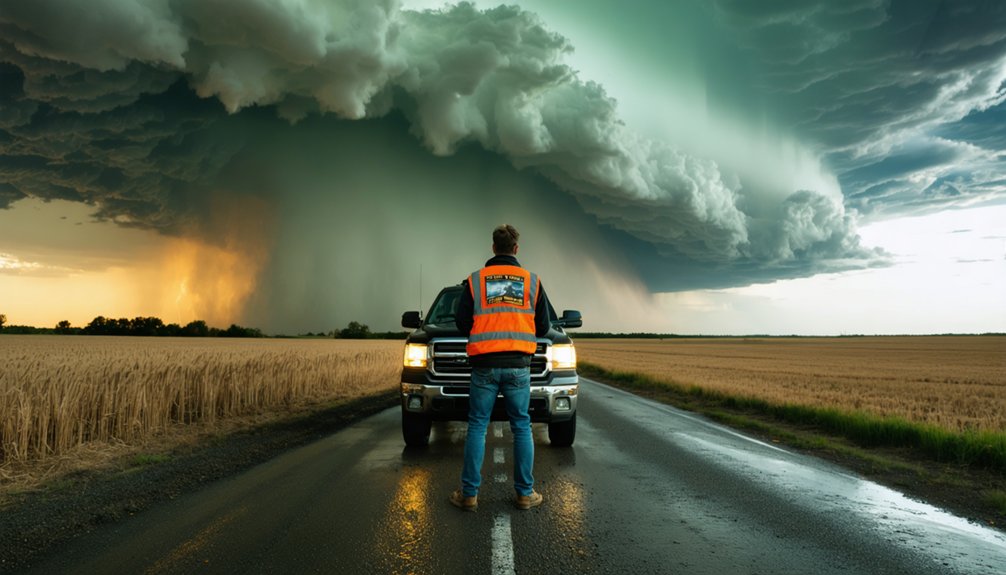
Whether Oklahoma’s licensing framework will influence other states depends on how effectively it performs under real-world conditions. Oklahoma’s Senate Bill 158 establishes a structured, voluntary system with defined eligibility criteria, background checks, and tiered fees—$500 initial, $250 renewal. These licensing procedures create a replicable template other states could adapt.
The legal implications extend beyond Oklahoma’s borders. If licensed chasers demonstrate measurable improvements in data collection and public safety outcomes, legislators elsewhere may introduce comparable bills. However, the framework restricts emergency privileges to FCC-licensed media and accredited university affiliates, which limits its scope.
You should monitor how enforcement data shapes future legislative decisions. A voluntary model that respects amateur freedom while granting professionals operational advantages could become the standard other tornado-prone states reference.
Frequently Asked Questions
How Much Does Oklahoma’s Storm Chaser License Cost to Obtain?
You’ll pay $500 to obtain Oklahoma’s severe weather tracker license initially, with $250 for renewals. The storm chase regulations and license application process target professionals only, keeping your freedom intact as an independent chaser.
Can University Researchers Apply for the Professional Storm Tracking License?
You’ve got an absolutely massive opportunity! University researchers can apply for the professional storm tracking license if you’re affiliated with an accredited meteorology program. The license application process prioritizes storm chasing safety for qualified academic professionals.
What Recommendation Letters Are Required for the License Application Process?
You’ll need a recommendation letter from a chief meteorologist or university official to meet licensing requirements. This guarantees storm chasing safety standards are upheld while preserving your freedom to pursue professional severe weather tracking credentials.
Can Licensed Storm Chasers Run Red Lights During Severe Weather Events?
Yes, you can run red lights during severe weather events if you’re licensed. Storm chase safety and legal considerations grant you emergency vehicle status, letting you navigate traffic signals and closed roads during tornado warnings.
When Did Oklahoma’s Professional Storm Chaser Licensing Law Take Effect?
This law’s impact is monumental—Oklahoma’s professional storm chaser licensing law took effect July 1, 2025. You’ll find it revolutionizes storm safety by establishing clear license requirements for professionals pursuing severe weather tracking credentials.
References
- https://www.reddit.com/r/stormchasing/comments/1l83otq/inevitable_license_much/
- https://www.okhouse.gov/posts/news-20250206_2
- https://www.weather.gov/btv/skywarn_join
- https://en.wikipedia.org/wiki/Storm_chasing
- https://weather.com/news/weather/news/2025-02-05-oklahoma-storm-chasers-license-bill
- https://www.reddit.com/r/stormchasing/comments/1if5q3h/a_bill_is_being_proposed_to_require_licensing_to/
- https://www.clearhq.org/news/oklahoma-considers-severe-weather-tracker-licensure-2-6-25
- https://www.youtube.com/watch?v=nkaoU6hrGFs