You’ll discover that Tim Samaras revolutionized tornado science through TWISTEX’s groundbreaking deployment of Hardened In-Situ Tornado Pressure Recorders—engineering marvels that captured an unprecedented 100-millibar pressure deficit inside Manchester’s F4 tornado on June 24, 2003. His interdisciplinary team combined ballistics expertise with atmospheric instrumentation, recording temperature, humidity, and wind data at ten samples per second. The May 31, 2013 El Reno tragedy claimed Samaras, his son Paul, and colleague Carl Young when 295-mph winds and rapid expansion patterns created impossible escape conditions that fundamentally transformed storm-chasing protocols.
Key Takeaways
- Tim Samaras founded TWISTEX, combining his Pentagon weapons-testing expertise with multidisciplinary teams for coordinated tornado research and data collection.
- His turtle probes captured unprecedented tornado measurements, including a historic 100-millibar pressure drop during the 2003 Manchester F4 tornado.
- TWISTEX revolutionized atmospheric science by proving direct measurement surpasses theoretical models in understanding tornadogenesis and extreme weather phenomena.
- The 2013 El Reno tragedy claimed Samaras, his son Paul, and Carl Young when a tornado unexpectedly expanded and accelerated.
- TWISTEX’s three-decade contributions reshaped tornado safety protocols and established new standards for in-situ atmospheric data collection.
From Engineer to Storm Chaser: The Early Years of Timothy Samaras
Born on November 12, 1957, in Lakewood, Colorado, Timothy Samaras exhibited an early aptitude for understanding mechanical and electronic systems, particularly atmospheric phenomena. His early storm fascination drove him to investigate meteorological processes independently, while his amateur radio expertise emerged at age 12, enabling him to build transmitters from salvaged television components.
By 17, you’d find him managing a service shop, then immediately moving on to the University of Denver Research Institute post-graduation. At 20, he’d secured Pentagon clearance, testing weapons systems.
This autodidact engineer—lacking formal meteorological credentials—eventually channeled his ballistics and blast testing experience at Applied Research Associates into tornado research. In 1999, he established TWISTEX, designing deployable “turtle probes” to capture in-situ measurements within tornado vortices.
Building TWISTEX: Assembling a Team of Tornado Researchers
As Samaras moved from Applied Research Associates‘ blast testing facilities to active tornado fieldwork in the late 1990s, he recognized that capturing in-situ vortex measurements demanded more than engineering expertise—it required coordinated meteorological analysis, rapid deployment logistics, and real-time atmospheric data collection.
TWISTEX’s rigorous personnel selection process recruited specialists across multiple disciplines: atmospheric scientists Dr. Bruce Lee and Dr. Cathy Finley co-directed mobile mesonet operations, while meteorologists Tony Laubach and Carl Young handled positioning and probe deployment. Matt Grzych’s data analysis innovations enabled real-time software integration, and Chris Karstens developed mesonet algorithms as an ISU Ph.D. candidate.
The team deployed hardened instruments recording pressure, temperature, humidity, and wind at ten samples per second—methodical fieldwork distinct from conventional storm chasing’s reactive approaches.
Revolutionary Technology: The Turtle Probes and Breakthrough Measurements
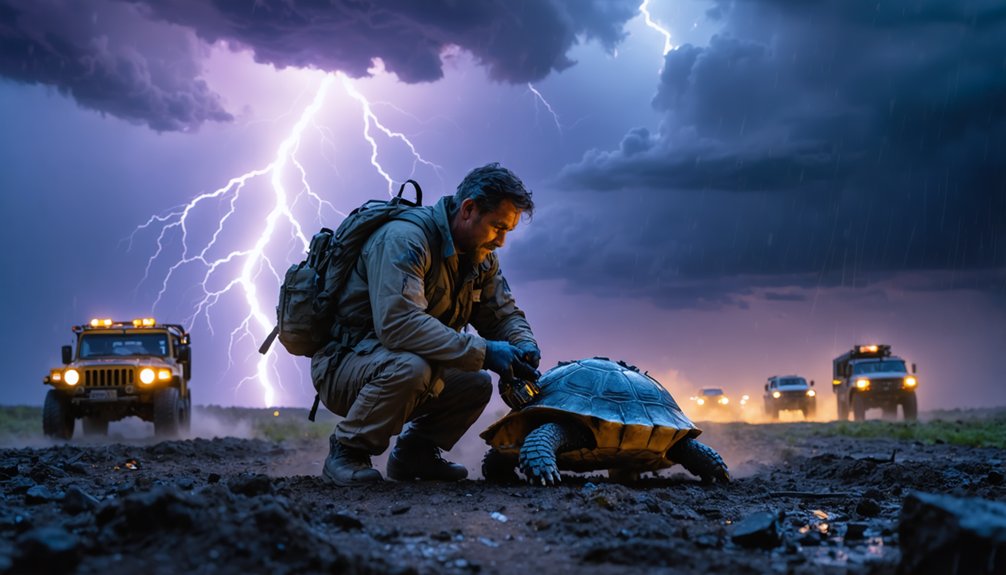
Samaras rolled out his first Hardened In Situ Tornado Pressure Recorder (HITPR) in 1999, engineering a squat, 50-pound device that resembled a traffic cone melted onto hot asphalt—deliberate form following function. You’d recognize the genius in its sensor durability: metal construction housing temperature, pressure, and humidity instruments alongside multiple cameras capturing photogrammetric evidence from tornado interiors.
The breakthrough came June 24, 2003, when Probe 3 intercepted Manchester’s F4 tornado, recording an unprecedented 100-millibar pressure drop—the largest decrease ever documented. Your understanding of tornadogenesis transformed as these instruments delivered thermodynamic data previously confined to computer models.
The turtles measured real-time GPS coordinates, captured 360-degree footage, and later incorporated ultrasonic anemometers for direct windspeed readings, filling critical voids in atmospheric science’s knowledge base.
Manchester, South Dakota: Recording History Inside an F4 Tornado
When Probe 3’s sensors locked onto the Manchester F4’s core on June 24, 2003, they captured a 100-millibar pressure deficit in under sixty seconds—the steepest barometric gradient ever documented within a tornadic vortex.
You’re witnessing unprecedented atmospheric data from Kingsbury County, where Samaras deployed turtle probes along 425th Avenue, GPS-marking each position. The mile-wide funnel, refracting sunlight through suspended debris—drywall, shingles, tree branches—scoured foundations across 3.75 miles.
Despite F4-intensity winds reaching 260 mph, the National Weather Service rated it EF-3 due to limited structural targets in farm country. RaXpol’s high-resolution Doppler complemented in-situ measurements, advancing storm zone safety precautions.
This deployment revolutionized tornado science while informing post disaster community rebuilding protocols, proving direct measurement beats theoretical models when understanding nature’s most violent atmospheric phenomena.
The El Reno Tragedy: A Final Mission in the Most Dangerous Storm
On May 31, 2013, at 6:23 p.m., a rapidly evolving tornadic system near El Reno, Oklahoma claimed the lives of Tim Samaras, his son Paul Samaras, and colleague Carl Young—marking the first documented fatalities of professional meteorologists during active field research.
The wedge tornado generated catastrophic 295 mph winds while expanding from one mile to 2.6 miles width in thirty seconds. Forward velocity accelerated from 20 mph to 60 mph as the system executed an unexpected directional shift.
Heavy precipitation obscured visual tracking, preventing the harrowing escape attempts by multiple chase teams. Tim’s final transmission acknowledged their compromised position moments before a sub-vortex struck their vehicle.
This tragedy reshaped safety protocols across the research community while cementing the enduring legacy of TWISTEX’s three-decade contribution to atmospheric science.
Frequently Asked Questions
How Many National Geographic Grants Did Tim Samaras Receive Throughout His Career?
Throughout his career, you’ll find Tim Samaras received 18 National Geographic grants from 2003 to 2013. As a dedicated weather observer, he conducted extensive field research, deploying tornado probes and logging over 35,000 miles annually studying atmospheric phenomena.
What Happened to TWISTEX After the El Reno Tornado in 2013?
TWISTEX effectively ended after the El Reno tornado killed its three core researchers. You’ll find the project’s future faced insurmountable challenges—losing director Tim Samaras, meteorologist Carl Young, and videographer Paul Samaras eliminated operational capacity despite 2015 continuation plans.
Did Tim Samaras Have Formal Education in Meteorology or Atmospheric Science?
Breaking the academic mold, you’ll find Samaras lacked formal meteorology degrees. His educational background stemmed from self-teaching and hands-on engineering work. Career progression through radio technology and weapons testing built his atmospheric expertise without traditional credentials.
What Other Storm Chasers or Researchers Were Influenced by Samaras’s Work?
You’ll find Samaras’s innovative storm chasing techniques influenced hundreds of researchers worldwide who attended his National Storm Chasers Convention. His impact on storm research community inspired scientists to develop tornado-withstanding instruments, advancing direct measurement capabilities and expanding atmospheric data collection methods.
How Did Tim Samaras Balance Family Life With Dangerous Storm Chasing?
You’ll find Tim prioritized family above all—establishing home workshops on 35 acres, involving children in chasing operations, and maintaining engineering work alongside research. His work-life balance philosophy emphasized pursuing passions while keeping family priorities central to career decisions.