You’ll find the safest child-friendly storm shelter options in interior basement rooms with reinforced walls, padded under-stairwell spaces, and above-ground safe rooms near living areas. Consider underground steel shelters with non-slip floors, garage storm shelters featuring easy-access latches, or designated apartment shelter zones away from windows. Community safe rooms and neighboring homes with certified protection also provide reliable alternatives. Each location requires proper reinforcement, quick accessibility, and comfort items to keep your family secure during tornado warnings, and understanding the specific requirements for each option will help you make the best choice.
Key Takeaways
- Above-ground safe rooms near living spaces provide quick access for children and eliminate dangerous stairs during tornado warnings.
- Under-stairwell shelters offer proximity to common areas while including comfort items like padding, blankets, and emergency supplies for families.
- Interior basement rooms with reinforced walls combine safety with familiar spaces that reduce children’s anxiety during storms.
- Underground steel shelters feature non-slip floors, padded seating, and child-safe hydraulic doors that resist debris impact.
- Garage-integrated safe rooms allow easy entry for all family members including pets while maintaining FEMA P-320 compliance standards.
Interior Basement Rooms With Reinforced Walls
When severe weather threatens, an interior basement room with reinforced walls offers your family the highest level of protection available in residential construction. You’ll need 12-inch fully-grouted CMU walls with two #5 reinforcing bars spaced at 8-inch centers to withstand wind pressure and flying debris. Below-ground placement provides maximum protection while maintaining easy access without stairs, ensuring ADA compliance for all family members.
Your shelter requires proper anchoring to the foundation at each corner and doorway opening to resist uplift forces. Install a 14-gauge steel door with three-point locks for entry security. Consider storage requirements for emergency supplies and water.
Maintenance considerations include ventilation systems for fresh air supply and drainage solutions to keep the space dry during storm events.
Under-Stairwell Shelters With Padding and Comfort Items
You’ll need to reinforce the under-stairwell space with 12-inch fully-grouted CMU walls containing two #5 bars on 8-inch centers to meet ICC 500 structural requirements.
Install 0.45-inch closed-cell blue polyolefin padding on interior walls and 1/2-inch anti-fatigue matting on floors to protect children from impact injuries during severe weather events.
Stock the shelter with emergency supplies including water, first aid kits, flashlights, and comfort items like blankets to sustain your family during extended stays.
Structural Safety and Reinforcement
Before installing an under-stairwell storm shelter, you’ll need to ensure the structure meets FEMA P-320 and ICC-500 compliance standards for engineering design and debris impact resistance. Structural integrity assessments confirm your home’s foundation can support reinforced concrete or steel walls capable of withstanding 250 mph winds and EF-5 tornado forces.
Professional installation guidance verifies proper anchoring, ventilation systems, and secure locking mechanisms that won’t fail during pressure changes.
Your shelter requires impact-tested doors with multiple locking points and reinforced hinges. Protected air vents maintain circulation while blocking debris penetration. Install impact-resistant padding over concrete or steel surfaces to reduce injury risks from flying objects.
Drainage systems prevent water accumulation, and ADA-compliant designs accommodate family members with mobility limitations, giving everyone quick access to life-saving protection.
Essential Comfort Supplies Inside
Since under-stairwell storm shelters typically measure 4-6 feet in height and width, you’ll spend critical minutes or hours in cramped quarters where strategic padding transforms concrete surfaces into protected refuge zones. Layer closed-cell foam insulation sheets beneath foam-backed rugs to create moisture-resistant flooring.
Install wall-mounted fold-down seats with functional storage options underneath for emergency supplies. Pack Mylar emergency blankets and fleece throws rated for temperature drops during power outages.
Establish supplementary lighting sources through rechargeable LED lanterns with 20+ hour runtime, backed by glow sticks requiring no batteries. Position clip-on reading lights on structural supports for hands-free illumination. Stock entertainment supplies—card decks, puzzle books, and stuffed animals—to occupy children during extended waits. Battery-powered fans guarantee air circulation in enclosed spaces. These preparations maintain both safety and autonomy.
Above-Ground Safe Rooms Near Common Living Spaces
When seconds count during a tornado warning, an above-ground safe room positioned near your home’s main living areas provides life-saving accessibility that underground shelters can’t match. You’ll appreciate the quick entry for elderly family members, small children, and pets without traversing stairs or hatches.
Above-ground safe rooms deliver critical seconds of accessibility when tornado warnings strike, eliminating dangerous stairs and hatches that slow emergency shelter access.
These adaptable safe room layouts integrate seamlessly into garages or workshops, sacrificing just 2.5″ per wall while offering weather protected storage spaces for valuables.
Key advantages for your family:
- Instant accessibility – No climbing down ladders or wrestling with heavy doors when storms approach
- Zero flooding risk – Unlike underground shelters that trap water and create dangerous conditions
- Portable protection – Take your investment with you when relocating to new properties
Installation requires minimal structural modifications, and you’ll benefit from available tax incentives and insurance deductions.
Underground Steel Shelters With Child-Safe Features
While above-ground shelters offer convenience, underground steel shelters deliver superior protection through reinforced construction that withstands EF5 tornado forces exceeding 250 mph. You’ll access these underground bunkers with amenities through flush-mount entrances in your garage’s concrete slab or via trapdoors in your yard. Hydraulic lift cylinders open doors against 12,000 pounds of debris, ensuring you won’t get trapped.
Install in ground shelters beneath gardens with child-safe features like non-slip floors, padded seating, and storage for comfort items. You’ll need waterproof sealants and drainage systems to prevent flooding.
Stock shelves at child-accessible heights with snacks and toys to reduce anxiety during storms. Annual inspections verify door mechanisms, structural integrity, and ventilation systems function properly, maintaining your family’s independence through severe weather events.
Garage Storm Shelters With Easy-Access Latches
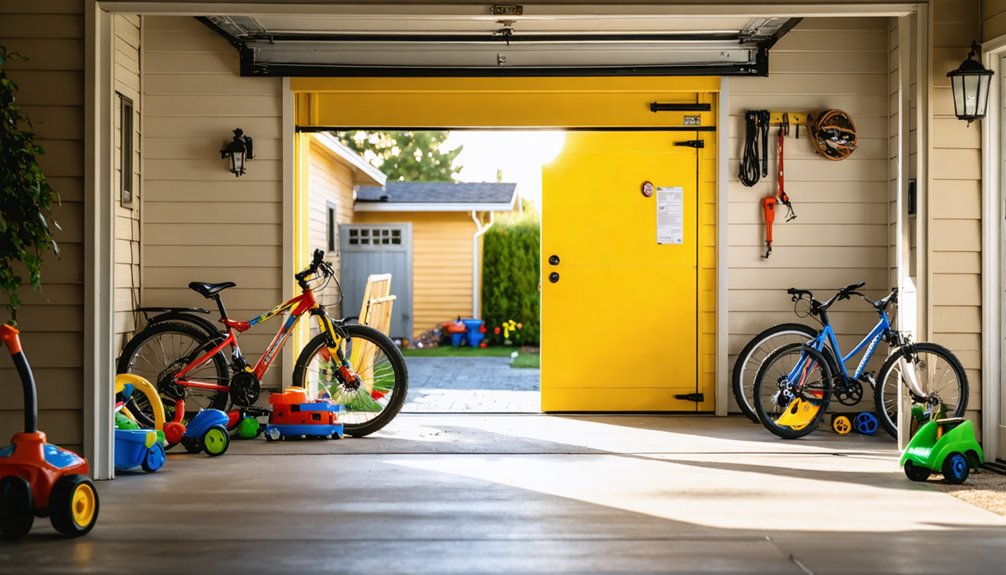
Garage storm shelters eliminate outdoor exposure during severe weather by integrating FEMA-compliant protection directly into your home’s existing structure. You’ll find above ground accessibility features like walk-in access that removes dangerous ladder climbs, while ground-level entry keeps your family safely indoors.
Underground garage installation requirements include 9 feet width and 13.5 feet height clearance, with modular designs completing setup in 4-5 hours without heavy anchoring.
Child-safe access mechanisms include:
- Spring-loaded vault-style handles with 3-bolt reinforced locking that children can operate during emergencies
- Easy-slide lids requiring simple mechanical engagement without complex operations
- Handheld remote controls for emergency exit activation, lifting 12,000 pounds with single-button access
These shelters withstand 250+ mph winds while maintaining user-friendly entry systems that don’t compromise your family’s independence.
Prebuilt Storage Closet Conversions With Emergency Supplies
Converting your existing storage closet into a FEMA-compliant safe room protects your family without the expense of new construction. You’ll find lightweight modular kits from companies like Ironclad and SafeCave that install in 3-4 hours without professional help. These systems bolt directly into your reinforced wooden structures, transforming ordinary closets into EF5-rated shelters.
Select a ground-floor, windowless closet measuring at least 3×5 feet. Install steel-reinforced panels over existing walls using construction screws anchored to studs. Replace hollow doors with solid-core alternatives featuring heavy-duty hinges and slide bolt locks. Add weather stripping around the perimeter to guarantee wind resistance.
Stock your shelter with plastic bins containing emergency supplies, battery-operated LED lights, and certify proper ventilation through door grills. This dual-purpose space serves storm protection while maintaining everyday storage functionality.
Community Safe Rooms and Public Storm Shelters
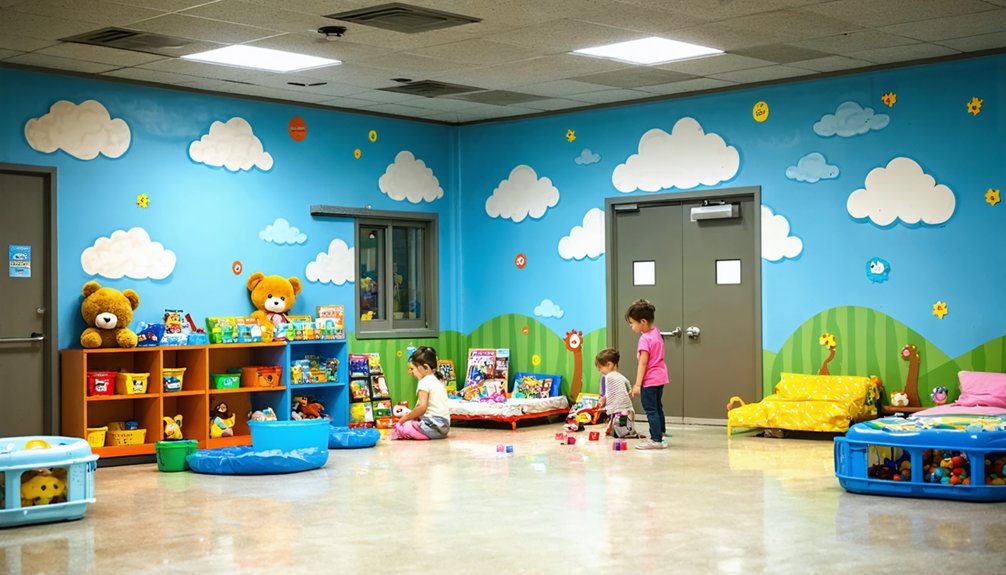
You’ll need to locate your nearest public storm shelter before tornado season arrives by contacting the South Carolina Emergency Management Division at 1-866-246-0133 or checking with your county’s emergency management agency. If you live in a mobile home, identify these community safe rooms immediately, as mobile homes offer no tornado protection and require evacuation to a sturdy shelter.
Confirm operational hours and activation procedures with your local emergency management office, since some public shelters only open when authorities issue evacuation orders or activate emergency protocols.
Locating Nearby Public Shelters
When your home lacks adequate shelter space or you live in a mobile home or apartment, locating nearby public storm shelters becomes essential for your family’s safety. Contact your local emergency manager or fire department to identify designated shelters in your area, as most communities don’t maintain public facilities.
Verify shelter locations through municipal preparedness plans and tornado monitoring apps like WeatherCall NexGen, which sends real-time alerts to your devices.
Key steps for finding child-friendly public shelters:
- Use interactive mapping tools like Survive-A-Storm Shelter Finder to identify nearby facilities with distances and capacities
- Check with apartment managers, mobile home park offices, and coworkers about accessible shelter options
- Plan your route in advance and leave before warnings issue, as tornado alerts may not provide sufficient travel time
Red Cross shelters welcome families without ID requirements or fees.
Mobile Home Resident Options
Mobile home residents face heightened tornado risks due to their structures’ vulnerability to high winds, making community safe rooms and dedicated storm shelters an essential alternative to remaining inside during severe weather. Many mobile home parks now feature designated BoxSAFE TX community shelters certified to FEMA 320, 361, and ICC-500 standards, rated for 250 mph EF-5 winds. You’ll find these premium steel units accommodate 8-10 people with bench seating, lighting, and climate control.
If your park lacks communal protection, consider above-ground or underground options. However, rental property restrictions often limit personal installations without landlord approval. Underground shelters require land ownership for permanent placement. Above-ground units anchored to concrete slabs offer portability when you relocate. All FEMA-compliant shelters require minimal shelter maintenance requirements—primarily checking locks, ventilation, and emergency supplies annually.
Verifying Shelter Availability Hours
How do you confirm a public shelter’s operating hours before disaster strikes? You’ll find verified occupancy hours by clicking red icons on interactive maps that display real-time services at open shelters. Bay Area warming centers typically operate Monday, Wednesday, and Friday evenings from 5 p.m. to 7 a.m., with expanded hours during severe weather events.
Essential verification steps:
- Sign up for AC Alert, Nixle, and AlertSF.org to receive immediate shelter activation notifications
- Monitor Berkeley Emergency Map for live shelter status and public transportation access routes
- Tune to KCBS 740 AM or KQED 88.5 FM for evacuation locations and operating schedules
For San Francisco shelters, apply for one-night beds after 4:30 p.m. daily at designated access points. No identification required—just your name and previous address.
Designated Shelter Areas in Apartments and Multi-Family Buildings
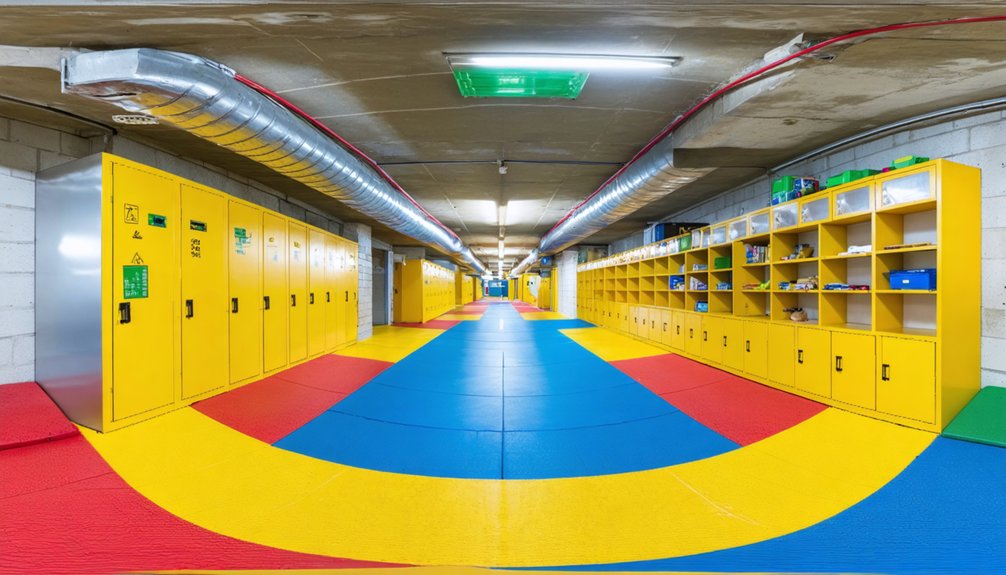
Multi-family residential buildings present unique challenges for storm shelter implementation, as they must protect dozens or hundreds of residents within structural and spatial constraints. You’ll find ICC 500-compliant shelters typically located in ground-floor interior corridors, reinforced concrete shelters beneath stairwells, or converted crawlspace nooks meeting 250 mph wind load requirements.
Building codes mandate architect-stamped drawings showing exact shelter locations, capacity calculations, and accessibility routes. Your apartment complex must provide clear signage directing you to designated areas during emergencies. Verify these spaces include proper ventilation systems, emergency lighting, and multiple egress points.
Request documentation proving third-party testing certification and annual maintenance records. Don’t assume common areas qualify—only spaces meeting debris impact protection and anchoring standards provide genuine protection for your family.
Interior Corner Spaces Away From Windows and Exterior Walls
When exterior walls and windows pose the greatest threat during tornadoes, interior corner spaces provide your most accessible alternative to dedicated storm shelters. You’ll maximize protection by positioning your family in corners away from wind-driven debris and flying glass. These locations naturally fit into existing garage or room corners without requiring basement construction, giving you independence from costly modifications.
Key advantages for your family:
- Structural resilience: Corner positioning reduces external impact risks during winds exceeding 200 mph
- Built-in supply storage: Store emergency provisions discreetly within corner spaces
- Internal stairwell access: Utilize protected stairwells as secondary shelter routes in multi-level homes
You’re creating defensible space that doubles as secure storage while maintaining rapid access during emergencies—essential freedom when seconds matter.
Neighboring Homes With Certified Storm Protection
If your property lacks space for a dedicated shelter, establishing agreements with neighbors who maintain FEMA P-320 or ICC 500 certified storm protection creates a viable emergency alternative. You’ll need to verify their shelter meets the 150-foot maximum distance requirement from your residence. Request documentation showing NSSA seal numbers and third-party engineering verification.
Confirm the shelter accommodates your family within its 16-person capacity rating and provides adequate egress points. Establish clear protocols for access during warnings, ensuring children can reach it quickly from nearby playground structures or accessible storage spaces. Document written permission and exchange contact information.
Test the evacuation route with your kids during calm weather, making them familiar with the path and entry procedures.
Frequently Asked Questions
How Do I Help My Child Overcome Fear of Entering Dark Shelters?
Make shelter seem welcoming by decorating it together and storing favorite items inside. Introduce shelter through play during calm weather—have picnics, read stories, or play games there. Practice regular visits so it’ll feel familiar and safe during storms.
What Age Can Children Carry Their Own Emergency Supply Backpack?
Children as young as 2 can carry their own emergency backpacks with proper design. You’ll want backpacks with waist clips for weight distribution. Pack age-appropriate supplies: lightweight items like clothes and snacks for younger kids, heavier essentials for older children.
Should I Practice Shelter Drills During Actual Severe Weather Warnings?
No, don’t practice shelter drill preparation during actual severe weather alerts. You’ll need that timing for real protection. Instead, conduct drills before peak severe weather season when you’re free to focus on perfecting your family’s response without genuine danger.
How Often Should I Replace Food and Water in Shelter Supplies?
Though it seems tedious, you’ll maintain your family’s safety by rotating water every six months and replenish supplies annually. Maintain proper rotation by placing new items behind older ones, ensuring your shelter stays ready without government dependency.
Can Pets Stay With Children in Community Storm Shelters?
Most community storm shelters don’t allow pets with children due to strict shelter animal policies. You’ll need to check your specific shelter’s pet accommodation requirements beforehand, as only certified service animals are typically permitted during tornado emergencies.