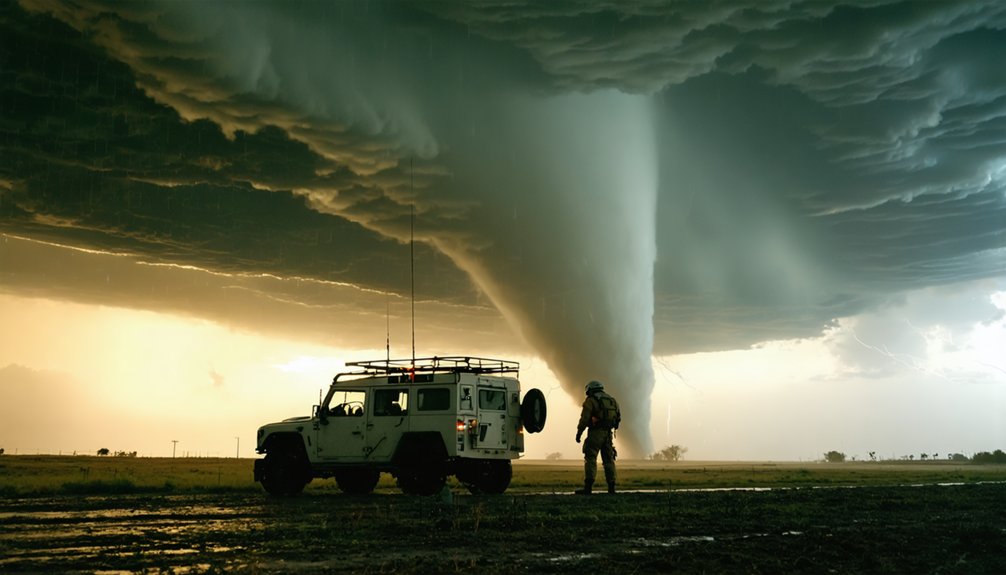
For Tornado Alley storm chasing, you’ll find the TIV-2 leading with its 14,300-lb mass and 250-mph wind resistance across six driven wheels, while the SRV Dominator 3‘s Ford F-350 chassis delivers 200-mph protection with 400 hp turbodiesel power. The Titus offers 24 external cameras and hydraulic stabilizers at 12,000 lbs, and Toyota’s Stormtrooper 4Runner provides practical off-road capability with reinforced protection. Each vehicle’s armored construction, hydraulic deployment systems, and specialized equipment directly impact your survival margins during close-range intercepts.
Key Takeaways
- SRV Dominator 3 features a Ford F-350 chassis with 400 hp turbodiesel, offering 200-mph wind resistance in a 10,000-lb armored fortress.
- TIV-2 provides six-wheel all-wheel drive with 14,300-lb mass, hydraulic spikes, and skirts for anchoring in 250-mph winds.
- The Stormtrooper Toyota 4Runner offers excellent off-road capability with Bilstein shocks, mud-terrain tires, and snorkel for water fording.
- The Titus features 24 external cameras, hydraulic stabilizers, and onboard weather center in a 12,000-lb Dodge-based platform.
- The Flash Ford F-150 combines fuel-efficient 3.5L EcoBoost engine with 360-degree camera turret and protective roll cage.
SRV Dominator 3: The Ultimate Tornado Intercept Machine
When Reed Timmer’s team engineered the SRV Dominator 3, they built it on a Ford F-350 chassis and transformed it into a 10,000-pound fortress capable of withstanding 200-mph winds. You’ll find thick steel armor plating and bulletproof Kevlar protecting the ruggedized construction design, while gullwing doors enable rapid emergency evacuation. The 6.7-liter turbodiesel generates 400 horsepower through a six-speed automatic, delivering enough power to escape dangerous vortices while maintaining 16-17 mpg highway efficiency.
The deployable wind skirt system seals the undercarriage when stationary, working with air suspension that lowers the vehicle’s profile against wind forces. Specialized monitoring equipment includes IMU acceleration tracking, atmospheric pressure sensors, humidity monitors, and GPS positioning—all transmitting real-time storm data. The deployable sensor nose cone captures high-resolution measurements before parachute recovery.
TIV-2: Six-Wheel Powerhouse for Extreme Storm Encounters
The TIV-2’s six-wheel all-wheel drive configuration distributes its 14,300-pound mass across three driven axles, delivering superior traction through differential lockers when positioning for tornado intercepts.
You’ll find this system engineered to withstand sustained 250 mph winds through deployable hydraulic spikes that penetrate 3 feet into soil, while hydraulic skirts seal ground gaps against violent updrafts.
Sean Casey’s design has proven its capability through multiple successful tornado core penetrations across Oklahoma and Kansas, collecting NOAA research data that civilian vehicles can’t access.
Reinforced Six-Wheel Drive System
Built on a turbocharged Dodge 3500 chassis, TIV-2’s conversion to a 6×6 configuration delivers unmatched traction across Tornado Alley’s unpredictable terrain. You’ll command three driven axles with dual rear tires, distributing 14,000 pounds across ten contact points for superior ground pressure management. The reinforced chassis design integrates multiple differential lock systems on each axle, ensuring power reaches every wheel when conditions deteriorate.
Beadlocks prevent tire separation during aggressive off-road maneuvers, while upgraded ground clearance lets you navigate obstacles that stop conventional vehicles. Though operators reverted to four-wheel drive after season 2, the six-wheel capability remains available when maximum traction becomes non-negotiable. This configuration transforms challenging terrain into accessible intercept zones, giving you positioning freedom other chase vehicles can’t match.
Maximum Wind Resistance Capabilities
Engineering excellence defines TIV-2’s ability to survive direct tornado encounters through a multi-layered defense system rated for 250 mph winds. You’ll find customized aerodynamic systems including six hydraulic skirts that deploy to ground level, deflecting wind and eliminating dangerous undercarriage airflow. The consolidated front skirt design minimizes air gaps that could compromise stability during EF5 conditions.
Advanced anchoring mechanisms provide critical security through four hydraulic spikes that penetrate up to 3 feet into soil with harpoon-style tips. Combined with the 14-ton steel frame and deployable skirts, you’re protected against uplift forces that flip conventional vehicles. The system delivers 200+ mph resistance when fully deployed, with non-anchored capability reaching 130 mph. This engineering approach has proven successful through documented direct intercepts at maximum-rated wind speeds.
Proven Tornado Intercept History
Since its 2008 deployment across Oklahoma and Kansas tornado corridors, TIV-2 has compiled an operational record that validates its extreme-weather engineering through documented direct intercepts. You’re looking at a vehicle that’s driven directly into tornado paths across multiple Storm Chaser seasons, with each encounter informing data collection improvements through its Doppler radar, anemometers, and barometric sensors.
The platform’s meteorological research impact extends beyond entertainment—it’s contributed actionable intelligence to NOAA’s tornado research programs. Field-tested hydraulic spikes and skirt systems proved their design under real-world conditions, while the reinforced steel construction withstood forces that would destroy conventional vehicles. This operational history demonstrates that proper engineering eliminates the barrier between you and the extreme weather phenomena you’re determined to study firsthand.
TIV-1: The Original Ford-Based Intercept Pioneer
You’ll find the TIV-1’s foundation in a modified 1997 Ford F-350 Super Duty chassis, featuring double-walled 1/8-inch steel armor and 1¼-inch Lexan windshields rated to withstand 200 mph winds from EF0 to EF3 tornadoes. This 14,000-pound intercept vehicle achieved early storm chasing success from 2003 through its Storm Chasers television appearances, capturing IMAX footage of tornado interiors while maintaining an 80-90 mph top speed and 500-mile range from its 7.3L Powerstroke turbodiesel.
The TIV-1 now serves as a backup platform to the six-wheeled TIV-2, preserving its legacy as the original tornado intercept pioneer with hydraulic ground claws and extensive meteorological instrumentation.
Modified Ford F-Series Foundation
The 1997 Ford F-450 chassis served as the foundation for TIV-1, transforming a heavy-duty truck platform into a 14,000-pound armored intercept vehicle capable of withstanding 200 mph winds. You’ll find the 10-wheel configuration delivers heightened ground clearance advantages essential for traversing debris-strewn terrain during active intercepts.
The modified 7.3-liter Power Stroke turbodiesel generates up to 400 horsepower, pushing speeds to 90 mph while maintaining a 500-mile operational range from its 60-gallon fuel system.
The airbag suspension capabilities provide critical stability when deploying in volatile conditions, while the rebuilt ATS transmission handles the demanding torque requirements. After season 2, engineers reinstalled four-wheel drive, recognizing that unrestricted mobility across unpredictable landscapes outweighs any weight savings from the original two-wheel-drive setup.
Early Storm Chaser Success
Emerging from Sean Casey’s IMAX filmmaking vision in 2002, TIV-1 established the benchmark for purpose-built tornado intercept vehicles through systematic engineering that prioritized crew protection and scientific documentation.
You’ll find its exceptional intercept maneuvers stemmed from a rebuilt ATS transmission and Five Star torque converter, delivering 400 horsepower while maintaining 90 mph capability despite 14,000 pounds of armor plating. The 1997 Ford F-Series platform provided terrain navigation capabilities essential for positioning in ideal filming zones.
Triple-layered polycarbonate windows and double-walled steel construction withstood 200 mph winds, protecting 75 percent of documented U.S. tornado encounters. Integrated meteorological instruments—sonic anemometers, GPS tracking, pressure sensors—transformed each intercept into quantifiable scientific data.
Hydraulic stabilization claws added in 2007 further enhanced your operational freedom during direct tornado penetration missions.
Backup Vehicle Legacy Role
Building upon Casey’s pioneering work, TIV-1’s development in 2002 revolutionized storm intercept methodology through its Ford F-450 two-wheel-drive chassis foundation—a platform specifically chosen for its 14,000-pound weight capacity and structural durability under extreme modification.
You’ll find its backup vehicle capabilities centered on critical weather data collection through sonic anemometers measuring three-dimensional wind forces, blade-style anemometers tracking one-dimensional speeds, and integrated pressure sensors.
The 7.3L diesel powerplant, modified to 400 horsepower with rebuilt ATS transmission, enabled 90-mph pursuit speeds through rain-soaked Midwest terrain. Double-walled steel reinforcement and 1¼-inch Lexan windshields provided 200-mph wind resistance, protecting approximately 75 percent of U.S. tornado encounters.
Despite its Discovery Channel prominence, TIV-1 now sits neglected in Hays, Kansas—its legacy preserved through successor designs.
The Stormtrooper: Toyota 4Runner Built for Tornado Alley
When severe weather conditions demand reliable transportation across unpaved rural roads and flooded access routes, storm chasers require vehicles that balance capability with practical modifications. The 2005 Toyota 4Runner “Stormtrooper” exemplifies this approach through budget-conscious engineering.
Its foundation includes Bilstein 5100 shocks paired with Toytec and Eibach springs, delivering enhanced off-road performance across Tornado Alley‘s varied terrain. The modular modifications strategy allows incremental upgrades—255/85/16 BFG Mud-Terrain KM2 tires on 16″ steel wheels provide clearance while maintaining replacement affordability.
Protection systems include rock sliders, skid plates, and a high-clearance exhaust. The snorkel enables water fording through flooded intersections. Interior sleeping platform and deep cycle battery support extended deployments. Communication requirements are met through CB radio integration, while the custom roof rack accommodates camp lighting for remote operations.
Titus: Custom-Modified Storm Chasing Champion
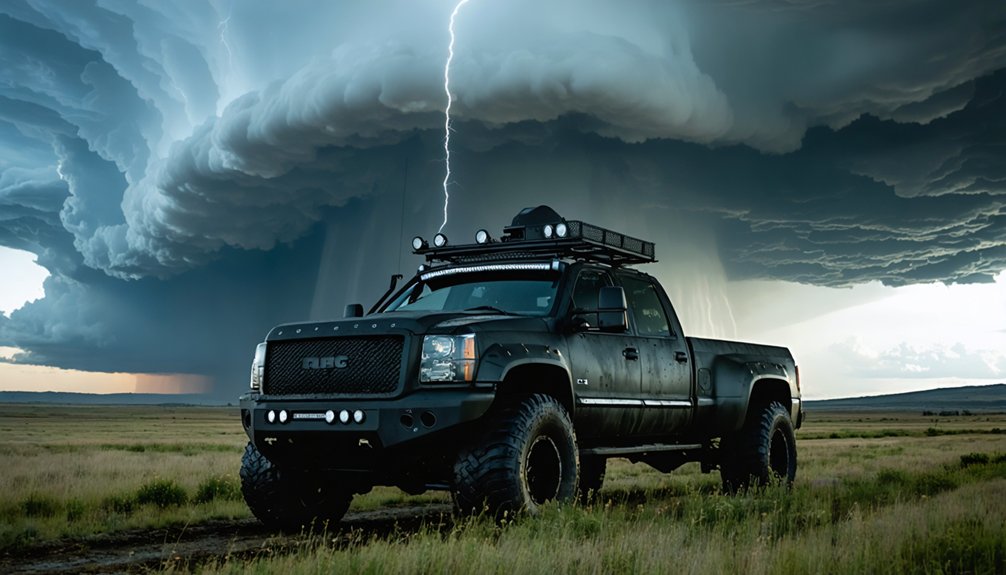
Where conventional storm-chasing vehicles fail at 140 MPH, the Titus armored interceptor maintains structural integrity through winds reaching 170 MPH—an EF4 tornado threshold that separates hobbyist equipment from professional-grade platforms.
This 12,000-pound Dodge-based fortress integrates special surveillance features through 24 external cameras, eliminating blind spots during intercepts. You’ll command steering performance enhancements via hydraulic stabilizers that anchor the vehicle during deployment, while a mobile GPS system and onboard weather center maintain navigation capabilities if your team disperses.
The three-person crew configuration prioritizes operational efficiency over passenger capacity. Inspired by TIV 2’s engineering principles but optimized for mid-range intercepts, Titus delivers 100 MPH road speeds while maintaining the structural rigidity required for close-range tornado documentation. It’s purpose-built equipment for operators who refuse equipment limitations.
Flash: High-Mileage Ford F-150 From Tornado Hunters
Unlike armored interceptors that sacrifice mobility for protection, Flash demonstrates how strategic engineering transforms a production truck into a high-endurance chase platform. This 2015 Ford F-150’s 3.5-liter EcoBoost V6 delivers turbo acceleration when you’re racing toward rapidly developing supercells. The aluminum construction enhances fuel efficiency, providing mileage capacity that supports 80,000-100,000 kilometers annually—spanning half a day’s drive from Saskatchewan to the Texas-Mexico border without refueling.
The external roll cage and bulletproof-grade spray-on bedliner protect against debris impacts while maintaining quick gas pedal response. High-resolution anemometers capture real-time wind data as camera array capabilities include a 360-degree turret housing IMAX equipment. BF Goodrich KO2 tires on 20-inch wheels deliver off-road traction through debris fields without compromising highway performance—essential freedom for unpredictable pursuit routes.
Essential Features for Storm Chasing Vehicles
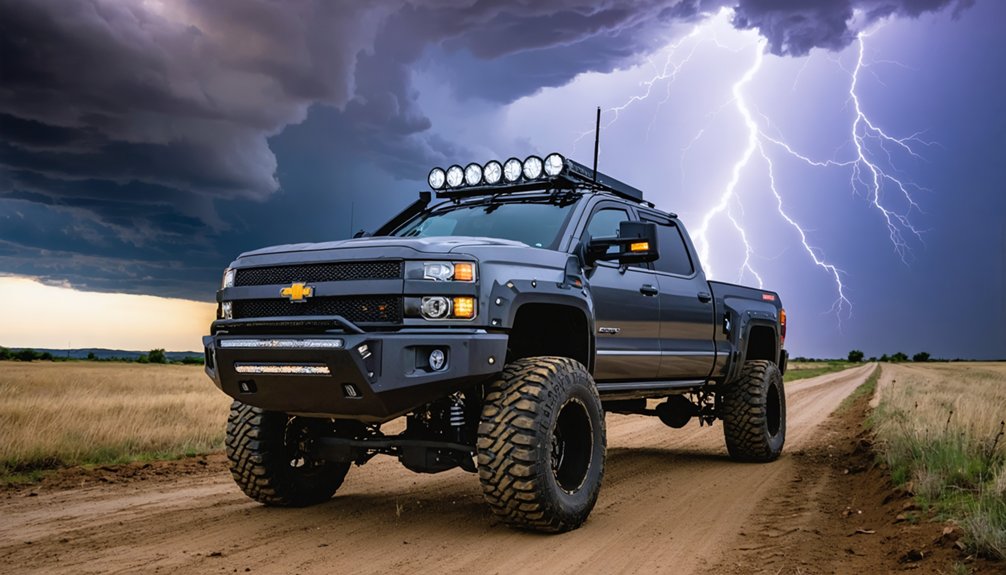
While interceptor vehicles like Flash prioritize endurance and mobility, purpose-built chase platforms require specific engineering features that separate survivable storm penetration from reckless exposure. You’ll need armored construction—1/8-inch steel plate with Kevlar composite over reinforced tubing, paired with 1.63-inch bulletproof polycarbonate windows.
Survivable storm penetration demands armored steel construction, Kevlar composites, and bulletproof polycarbonate—separating engineered protection from reckless exposure.
Hydraulic stabilizing spikes penetrate pavement, anchoring your 15,000-pound platform against violent winds while body skirts seal the underside. Ground radar system capabilities demand custom power panels supporting dual equipment racks and an 8kW generator.
Aerial sensor integration requires cellular data boosters and sturdy mounting systems for swiveling displays. Six-wheel drive with front hub lockers provides escape capability when roads deteriorate. Suspension airbags with redundant air systems maintain stability during rapid repositioning.
Extended fuel capacity—up to 92 gallons—ensures 750-mile autonomous range without dependency on compromised infrastructure.
Wind Resistance and Deployment Systems Explained
When you’re intercepting tornadoes, your vehicle’s wind resistance capacity determines survival margins in extreme conditions. Deployable hydraulic skirts and anchoring spikes transform a 130 mph wind tolerance into 250+ mph EF5-rated protection by eliminating undercarriage airflow and securing the chassis directly to the ground.
Understanding these deployment systems’ specifications—from spike penetration depth to hydraulic redundancy—enables you to select equipment that maintains structural integrity when wind speeds exceed 200 mph.
Deployable Wind Skirt Technology
How do storm chasers prevent their vehicles from becoming airborne projectiles when intercepting tornadoes at close range? The Dominator 3‘s hydraulic suspension design drops body skirts on three sides within seconds, sealing gaps that would otherwise channel wind underneath the chassis. This automated deployment strategy eliminates lift forces by denying turbulent airflow purchase points beneath the 15,000-pound vehicle.
Hydraulic anchoring spikes simultaneously punch through pavement into ground substrates, creating mechanical resistance against lateral wind forces. The system’s redundant air suspension works in concert with the lowering mechanism, enabling rapid activation when entering high-wind environments. By blocking airflow access to the underside while maintaining one strategically open side for operational flexibility, these deployable skirts transform a vulnerable mobile platform into a ground-anchored observation post capable of withstanding extreme tornado-force winds.
Wind Speed Tolerance Ratings
Mechanical anchoring systems alone can’t guarantee vehicle survival without understanding the precise wind thresholds at which failure occurs. Standard sedans overturn at 52-67 m/s, while travel trailers fail at just 24 m/s with perpendicular winds.
You’ll need specialized equipment: TIV 2’s deployed configuration withstands 250 mph headwinds through improved wind resistance design, while its non-deployed state handles 130 mph. Dominator 3 survives 200 mph conditions using thick steel armor and dual-glass systems. Real-world testing at 160 mph—exceeding Wyoming’s recorded 155.2 mph tornado winds—confirmed structural integrity.
Vehicle stability enhancement comes from hydraulic spikes, wind skirts sealing undercarriages, and reinforced frameworks. TIV 2’s 14,000-pound mass and Dominator’s turbodiesel power provide the freedom to intercept EF5 tornadoes safely.
Anchoring Systems in Action
Before tornado-force winds strike your intercept vehicle, a multi-stage deployment sequence must execute flawlessly to prevent catastrophic rollover. Your airbag suspension lowers the chassis to ground level while hydraulic skirts deploy on three or four sides, blocking underside wind penetration.
The hydraulic spike design then activates—TIV 2’s two massive side spikes, TIV 1’s four-point configuration, or Dominator 3’s eight-inch pavement-penetrating anchors punch several feet into earth. This anchoring stability combines with 14,000-15,000 pounds of vehicle mass to resist EF3-level forces. TIV 2’s proven performance includes surviving direct tornado strikes without movement, demonstrating how properly deployed spikes and ground-contact skirts eliminate the lifting forces that flip conventional vehicles.
You’re engineering survival through methodical mechanical advantage.
Real-World Tornado Intercept Success Stories
The most significant breakthroughs in tornado science have come from successful close-range intercepts that captured unprecedented atmospheric data under extreme conditions. Union City 1973 marked the turning point—mobile radar combined with ground observations revolutionized our understanding of supercell morphology.
The TIV1’s 2006 dual-tornado intercept delivered integrated radar, instrument, and video data from 50 feet above the vortex, recording 139 mph winds. Dominator 3’s legendary intercept captured a 55 millibar pressure drop in under one second with winds exceeding 160 mph. These missions contributed to vortex ii cooperation efforts, validating wind tunnel testing models.
The TIV’s 2007 season yielded three successful intercepts with Discovery funding, while 2009 brought full VORTEX II participation. You’re witnessing science that demands both courage and precision.
Choosing the Right Storm Chasing Vehicle for Your Needs
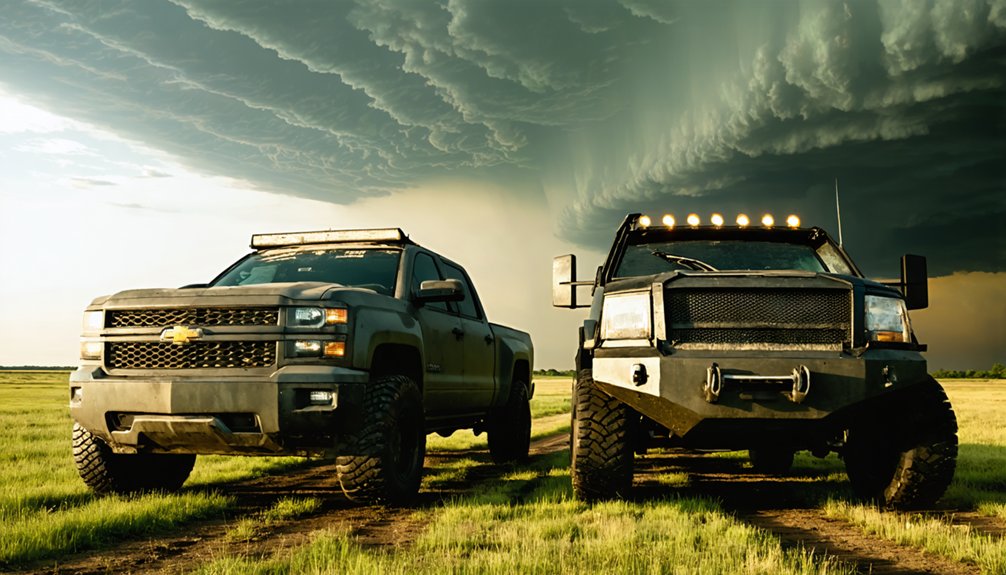
While armored intercept vehicles like TIV2 capture headlines with their extreme-engineering specifications, most chasers need practical platforms that balance reliability, capability, and cost for consistent deployment across Tornado Alley‘s 3,500-mile weekly coverage areas.
Vehicle reliability factors dictate your selection. Fleet vehicles like 2002 Chevrolet Malibus or 2006 Ford Crown Victoria Police Interceptors guarantee parts availability in small towns where you’ll inevitably need repairs. Hail damage tolerance matters—expect dings.
For terrain, AWD or 4WD handles muddy county roads where thin mud layers create treacherous conditions. Adequate ground clearance prevents high-centering on dirt roads.
Electronics and power support requirements are critical. Install heavy-gauge wiring for fused 12V outlets and true sine wave inverters—never square wave—to protect sensitive equipment. Ram mounts secure your scanner and communication devices while avoiding airbag zones.
Frequently Asked Questions
What Insurance Coverage Is Required for Storm Chasing Vehicles?
You’ll absolutely need extensive insurance covering hail and wind damage, plus minimum $1 million liability coverage if operating commercially. Personal policies won’t cut it—storm chasing demands commercial-grade protection to maintain your freedom on the road.
Do Storm Chasers Need Special Licenses to Operate These Vehicles?
You don’t need special licenses for most chase vehicles under 26,001 lbs—standard driver’s license requirements apply. However, armored rigs exceeding weight thresholds require CDL Class B certification, though specialized training programs aren’t mandated federally.
How Much Does Annual Maintenance Cost for Tornado Intercept Vehicles?
You’ll spend $2,000-$5,000 annually on tornado intercept vehicle maintenance, covering fuel efficiency losses from heavy modifications, accelerated tire wear considerations from dirt roads, windshield replacements, and cumulative six-figure costs over extended chasing careers requiring strategic financial planning.
Can Civilians Legally Purchase and Operate Retired Storm Chasing Vehicles?
Yes, you can legally purchase retired storm chasing vehicles. You’ll need to meet standard vehicle registration requirements for your state. Weather radar integration systems remain functional, though you’re responsible for ensuring all equipment complies with FCC regulations.
What Communication Equipment Is Essential for Coordinating Storm Chasing Teams?
Your team’s survival depends on mobile radio systems for instant coordination and satellite communication devices as backup when cellular networks fail. You’ll need HAM radios, cellular phones across multiple carriers, and GPS-enabled satellite messengers for reliable emergency contact.