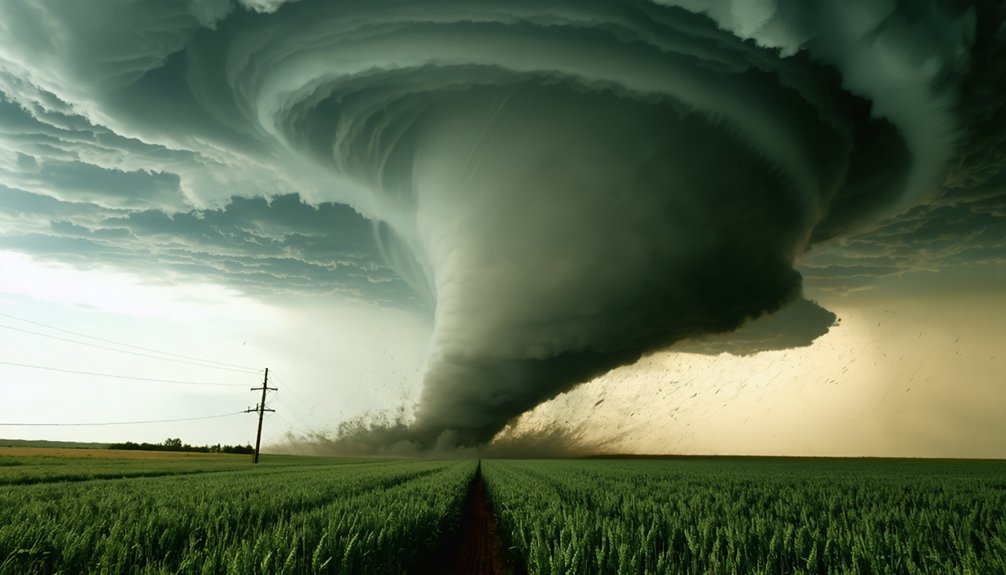
*Twisters* (2024) follows Kate Carter‘s trauma-driven return to storm chasing after a five-year absence caused by witnessing colleague deaths. You’ll encounter two competing methodologies: Tyler Owens’ intuitive Tornado Wranglers providing direct community aid versus Storm Par’s profit-driven data exploitation. The climactic EF5 tornado forces Kate to deploy experimental sodium polyacrylate technology—a scientifically controversial intervention that meteorologists dismiss as unfeasible yet raises critical questions about humanity’s impulse to control atmospheric systems we barely comprehend. The narrative explores whether technological intervention justifies potentially catastrophic environmental consequences.
Key Takeaways
- Kate Carter returns to storm chasing after five years of trauma-induced absence to deploy experimental tornado suppression technology.
- The Tornado Wranglers operate independently through YouTube funding, providing direct community aid and democratizing storm data through transparent documentation.
- The climactic EF5 tornado draws inspiration from the 2013 El Reno tornado, featuring a record 2.6-mile width and catastrophic destruction.
- Kate’s sodium polyacrylate intervention proposes moisture extraction to disrupt tornadoes, though meteorologists dismiss the concept as scientifically unsupported.
- Tyler’s intuitive storm chasing and Kate’s trauma-informed methodology converge during crisis, demonstrating complementary rather than competing approaches.
The Story Behind Kate Carter’s Return to Storm Chasing
Although Kate Carter’s retreat from storm chasing appears straightforward on the surface, the narrative architecture of *Twisters* (2024) reveals a more complex psychological framework driving her five-year absence. You’ll discover her trauma stems from witnessing colleagues Praveen, Addy, and Jeb perish during catastrophic storm operations—an event that triggered debilitating panic attacks and profound survivor guilt.
Her emotional recovery trajectory shifts when she recognizes Tyler’s team isn’t pursuing glory but channeling profits toward displaced victims, contrasting sharply with Storm Par’s exploitative methodology. The collaborative teamwork during El Reno rescue operations becomes her catalyst for reengagement.
Kate’s ultimate redemption—driving into a tornado’s core to deploy experimental suppression technology—demonstrates how scientific purpose and humanitarian objectives supersede personal fear, transforming paralysis into purposeful action.
Meet the Tornado Wranglers and Storm Par Teams
Conversely, Tyler Owens’s Tornado Wranglers reject institutional constraints entirely:
- YouTube-funded independence eliminates investor accountability, preserving operational autonomy
- Direct community aid through merchandise profits bypasses bureaucratic interference
- Transparent documentation democratizes storm data without proprietary restrictions
Kate initially dismisses the Wranglers as sensationalists until witnessing their Crystal Springs recovery efforts—revealing that authentic scientific contribution doesn’t require corporate validation. Javi and Kate ultimately abandon Storm Par after uncovering profit-driven exploitation masquerading as research advancement.
The Tragic EF5 Tornado That Changed Everything
The film’s climactic EF5 tornado sequence synthesizes meteorological complexity with narrative stakes, departing markedly from procedural storm-tracking into catastrophic urban impact. You’ll recognize the real life inspiration: 2013’s El Reno tornado, which killed TWISTEX researchers Tim Samaras, Paul Samaras, and Carl Young. The filmmakers amplify drama—upgrading the actual EF3 rating to EF5 while maintaining the record 2.6-mile width that made the original event uniquely lethal.
The human impact manifests through cascading infrastructure failures: oil refinery ignition, shelter overflow, and the theater’s structural vulnerability. Kate’s polyacrylate intervention against established safety protocols reflects the franchise’s persistent tension between scientific method and desperate action. When the vortex tears the building open, nearly claiming Lily and Tyler, you’re witnessing Hollywood’s translation of meteorological unpredictability into immediate bodily threat.
How Sodium Polyacrylate Beads Work to Disrupt Tornadoes
Beyond the visceral destruction of the climactic tornado sequence lies the film’s central scientific premise: sodium polyacrylate beads can weaken or dissipate a tornado by absorbing its moisture. You’re presented with a deployment mechanism where barrels launch these super-absorbent polymers alongside silver iodide into the storm’s core, theoretically disrupting rotation through storm absorption dynamics.
The film imagines sodium polyacrylate beads disrupting tornado rotation by extracting moisture—a scientifically unsupported premise that meteorologists categorically reject.
The proposed mechanism involves:
- Moisture extraction – Seven grams absorbs significant water volume, scaled to 28.8 cubic meters across multiple barrels
- Chemical density implications – Calculated density of 5.7 × 10^5 determines volumetric distribution patterns
- Rapid deployment – One-minute formation window demands immediate dispersal into tornadoes extending two kilometers high
Yet meteorologists dismiss this concept entirely. No scientific groundwork supports stopping tornadoes through chemical intervention, while environmental consequences could exceed the original storm’s devastation—raising questions about whether control justifies catastrophic side effects.
Tyler Owens vs. Kate Carter: Two Approaches to Storm Chasing
While Tyler Owens rockets fireworks into tornadoes for his million YouTube subscribers, Kate Carter scrutinizes storm data from the safety of a New York City office—two methodologies that embody storm chasing’s fundamental tension between spectacle and science.
Tyler’s intuitive approach treats storms as “unexplainable phenomena” you must experience firsthand, funding operations through ad revenue while providing post-disaster aid. Kate’s trauma-informed methodology prioritizes controlled experimentation with groundbreaking tracking systems, contrasting scientific and intuitive approaches fundamentally.
Their philosophies converge during the El Reno crisis, where Tyler’s field instincts enable rapid evacuations while Kate’s analytical precision guides life-saving deployments. The importance of balancing risk and caution emerges through mutual rescues—Tyler extracting Kate from debris, Kate stabilizing overturned vehicles.
Neither approach proves superior; survival demands integrating both perspectives, transforming reckless spectacle and cautious research into coordinated storm intervention.
The Corporate Corruption Threatening Scientific Research
Corporate malfeasance now permeates scientific publishing at unprecedented scales, with fraudulent papers proliferating ten times faster than legitimate research growth. You’re witnessing peer review corruption orchestrated through networks where editors, authors, and brokers collude to bypass quality controls.
Paper mills exploit journals systematically, doubling their output every eighteen months while retractions lag hopelessly behind.
Data integrity challenges mirror broader economic crime patterns:
- Third-party intermediaries facilitate fraud in both procurement ($3.1 billion documented losses) and academic publishing
- Detection mechanisms fail consistently—148 of 180 countries show stagnant or worsening corruption metrics
- Enforcement gaps persist despite 81% of executives acknowledging robust anti-corruption frameworks
Organizations lose 5% of revenue to fraud annually. Scientific institutions face identical vulnerabilities, yet lack comparable compliance infrastructure. Your access to reliable research depends on dismantling these entrenched networks.
From Oklahoma to El Reno: Key Filming Locations
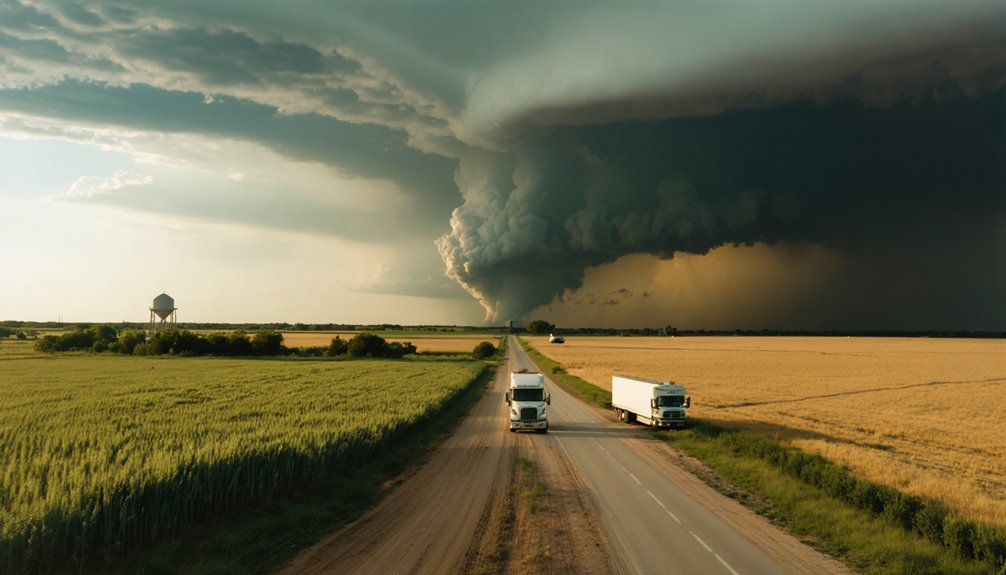
Production geography tells a different story than institutional failures in research—one where Oklahoma’s landscape became the canvas for manufactured disaster. *Twisters* deployed Prairie Surf Studios in downtown Oklahoma City as its operational hub, constructing interior sets and soundstages that would anchor 60 days of principal photography beginning May 8, 2023.
You’ll find El Reno locals’ experiences centered on the Historic Centre Theatre, where tornado shelter scenes referenced the town’s devastating 2013 event—exploitation masquerading as homage. Chickasha’s 16,000 residents watched three blocks transformed into fictional Crystal Springs, then cinematically obliterated. Small town economic impacts materialized through 597 crew positions and 1,000 extras, temporary employment that vanishes when production wraps.
Park Avenue became New York. Midwest City’s Brewer Field hosted a scripted rodeo. Rural communities from Howe to Burbank provided authentic backdrops for Hollywood’s commodified catastrophe.
The Climactic Mile-Wide EF5 Tornado Sequence
When Kate and the storm-chasing teams converge on El Reno, the film manufactures its catastrophic centerpiece—a mile-wide EF5 tornado exceeding 200 mph that exploits real tragedy for blockbuster spectacle.
The film transforms the real 2013 El Reno disaster into manufactured spectacle, appropriating genuine tragedy for blockbuster entertainment value.
The sequence escalates through rapid fuel ignition when the vortex strikes petroleum infrastructure, creating an unprecedented fire-tornado hybrid. This extreme structural damage overwhelms municipal shelters, forcing townspeople into a vulnerable movie theater where Tyler becomes trapped by debris during evacuation.
The climax demonstrates how Hollywood appropriates disaster:
- Real 2013 El Reno tornado killed renowned storm chaser Tim Samaras, yet the film transforms this tragedy into entertainment fodder
- Scientifically dubious silver iodide intervention validates dangerous hero-complex mythology around tornado manipulation
- Kate’s reckless vehicle deployment into tornado’s center glorifies risk-taking over established safety protocols
Revolutionary Technology That Could Change Tornado Science
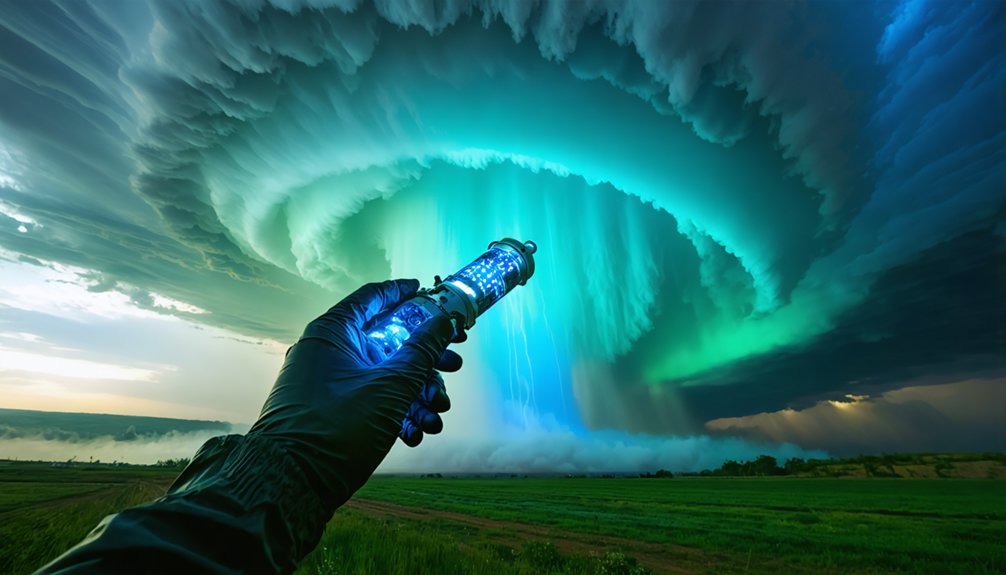
While *Twisters* showcases cutting-edge meteorological equipment to lend scientific credibility to its narrative, the film consistently distorts operational realities to manufacture dramatic proximity between researchers and violent atmospheric phenomena. You’ll recognize portable phased array radars and balloon-borne sensor arrays—real technologies deployed at considerably safer distances than depicted.
These novel data collection methods genuinely enhance 3D wind mapping capabilities, providing researchers fuller atmospheric pictures through multiple observation points. However, the film’s centerpiece—Kate’s super absorbent chemical deployment targeting storm disruption capabilities—remains pure fiction. No scientific studies back this approach’s efficacy; tornado-scale energy demands impossible material quantities, and unknown consequences plague theoretical energy disruption.
While NOAA consultants guaranteed prop accuracy, actual meteorologists pursue understanding, not modification. The technology exists; Hollywood’s application doesn’t.
What Happens After Kate’s Successful Tornado Intervention
You’ll notice Kate’s tornado intervention succeeds not just scientifically but personally—she abandons her New York departure to remain in Oklahoma’s storm belt.
The film establishes a commercial venture merging Storm Par’s radar technology with Tyler’s operational resources, positioning the three leads as business partners rather than competitors.
This resolution transforms Kate from a trauma-paralyzed researcher into an active field scientist who reconciles her emotional connection to storm chasing with her technical expertise.
Kate Chooses Oklahoma Over New York
Kate’s transformation from trauma-induced isolation to renewed purpose crystallizes in the film’s airport sequence, where her decision to abandon New York represents more than geographical preference—it signals a fundamental recalibration of her professional identity and emotional landscape.
Her emotional journey from Jeb’s death through successful intervention demonstrates that confronting professional challenges in tornado research requires geographic proximity to the storm systems themselves. The Will Rogers World Airport scene captures this pivotal redirection, where she rejects the safety of NOAA’s bureaucratic distance.
Key dimensions of Kate’s choice:
- Scientific autonomy: Oklahoma provides direct access to experimental validation rather than New York’s administrative constraints
- Trauma reconciliation: Remaining honors Praveen, Addy, and Jeb’s contributions to atmospheric research
- Collaborative potential: Tyler and Javi’s support network enables continued innovation beyond institutional limitations
New Research Partnership Forms
The airport decision immediately transforms into operational reality as Kate and Tyler forge an unprecedented research partnership that merges Storm PAR’s sophisticated sensor technology with Kate’s predictive meteorological instincts.
You’ll witness interdisciplinary knowledge sharing as Javi’s data-driven approach complements Kate’s field expertise, creating a hybrid methodology that transcends traditional academic boundaries. Their collaboration deploys sensor arrays inspired by the original TOTO project, capturing three-dimensional wind scans that previous generations couldn’t access.
What’s remarkable isn’t the technology—it’s the mutual trust development between former rivals who recognize storm chasing’s evolution demands cooperation over competition. This alliance represents freedom from outdated research hierarchies, where crowdfunded tech teams and university-trained meteorologists combine forces.
The partnership prioritizes actionable atmospheric data over social media spectacle, advancing tornado science beyond Hollywood’s dramatic intervention fantasies.
Frequently Asked Questions
Is Twisters 2024 a Sequel or Reboot of the Original Twister?
You’ll find it’s officially a standalone sequel—it references the original’s tornado prediction methods and weather data collection technology like Dorothy, but introduces entirely new characters and stories without direct plot continuation from 1996.
Who Are the Main Actors Playing Kate Carter and Tyler Owens?
Hollywood’s genius move: casting Daisy Edgar-Jones and Glen Powell as Kate Carter and Tyler Owens. You’ll recognize Powell’s lead actor background from *Top Gun: Maverick*, while supporting cast details reveal Edgar-Jones starred in *Normal People*.
Did the Filmmakers Use Real Tornadoes or CGI Special Effects?
The filmmakers combined both approaches for visual realism—you’ll see practical effects like jet engines and pneumatic rigs creating on-set wind and debris, while CGI generated the actual tornadoes through ILM’s sophisticated simulation engines and particle systems.
Is the Sodium Polyacrylate Tornado Disruption Technology Based on Real Science?
No, you won’t find legitimate weather modification techniques supporting this concept. Real tornado disruption technologies don’t exist—scientists confirm the polymer scheme lacks scientific foundation, with deployment logistics, environmental damage, and impossibly short warning times making it pure fiction.
Will There Be a Twisters Sequel After the 2024 Movie?
The sequel’s practically guaranteed given blockbuster returns. You’ll see potential spin-off possibilities expand the franchise, while merchandising opportunities drive studio decisions. Universal and Warner Bros. haven’t officially confirmed, but development’s reportedly underway—financial success demands continuation.