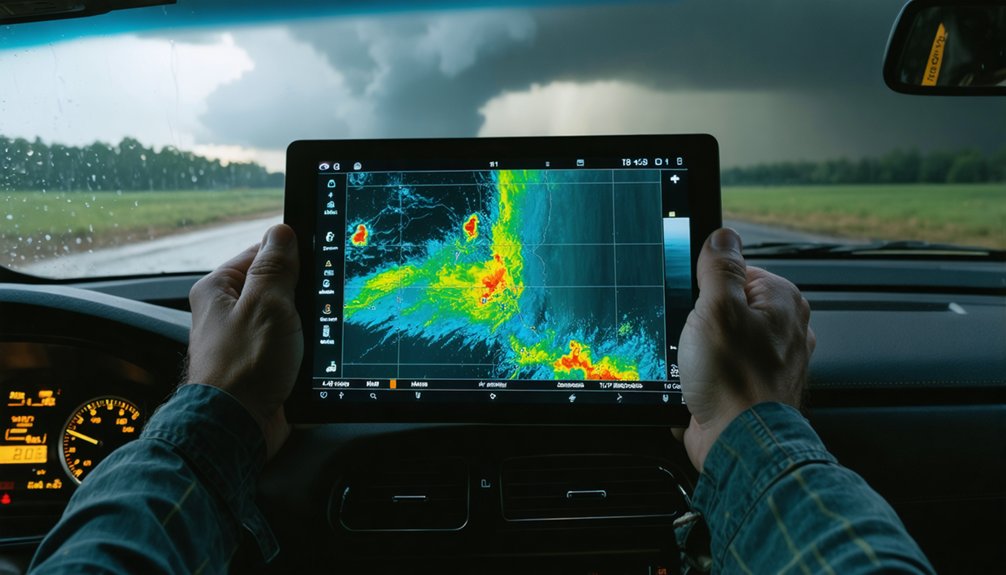
Convective initiation (CI) is the moment the atmosphere shifts from suppressed to explosive convection. You need sufficient CAPE—ideally above 1,000 J/kg—combined with manageable CIN to identify viable chase targets. Lifting mechanisms like frontal systems, drylines, and outflow boundaries force surface air past the level of free convection. On radar, fine-line signatures and rapidly intensifying cores confirm active CI. Master these signals and you’ll consistently position yourself ahead of developing supercells.
Key Takeaways
- Convective initiation occurs when lifting mechanisms overcome the capping layer, forcing surface air to rise past the level of free convection.
- CAPE values above 2,500 J/kg signal explosive severe weather potential, while readings above 1,000 J/kg indicate meaningful storm development conditions.
- Moderate CIN between 50–150 J/kg prevents premature convection, allowing surface heating to build instability before storms fire.
- Fine line radar signatures reveal boundary positions where convergence zones concentrate lift, indicating the most likely initiation points.
- Chasers must continuously monitor radar and reassess targets when boundaries shift or multiple failed initiation attempts signal marginal instability.
What Triggers Convective Initiation?
Convective initiation occurs when atmospheric lifting mechanisms overcome the cap—that layer of warm air aloft suppressing surface-based convection. Multiple triggering mechanisms drive this process: frontal systems, drylines, outflow boundaries, sea-breeze fronts, and terrain-induced orographic lift all generate the upward forcing necessary for storm development.
You’ll also need sufficient CAPE paired with low CIN to support explosive convection once lifting begins. Atmospheric conditions must favor buoyancy—meaning surface air must warm enough to rise freely beyond the level of free convection.
Boundary-layer convergence zones concentrate moisture and enhance lift simultaneously. Radar fine lines identify these boundaries before storms fire, giving you critical lead time.
Understanding which triggering mechanisms dominate your target area directly sharpens your initiation timing and positioning decisions on chase day.
How Do CAPE and CIN Tell You Whether to Chase?
CAPE and CIN work together as a go/no-go decision framework before you commit to a chase day. CAPE thresholds indicate available energy for storm development — values above 1,000 J/kg suggest meaningful convective potential, while readings above 2,500 J/kg signal explosive severe weather conditions.
CIN effects, however, determine whether that energy ever releases. Moderate CIN between 50–150 J/kg actually benefits chase days by preventing premature convection, allowing surface heating to build unstable air until a forcing mechanism breaks the cap cleanly.
Moderate CIN doesn’t kill your chase day — it builds it, holding energy in reserve until conditions break decisively.
Excessive CIN above 200 J/kg typically suppresses initiation entirely. When you identify high CAPE paired with manageable CIN and a defined forcing boundary, you’ve got actionable chase conditions.
Low CAPE with minimal CIN produces weak, disorganized storms not worth pursuing.
How Boundaries Drive Convective Initiation
While high CAPE and manageable CIN set the stage, boundaries are what actually trigger convective initiation. Boundary dynamics force air upward through convergence zones, focusing storm development into specific, targetable locations.
Without a boundary, even unstable environments often remain dormant.
Key boundary types you’ll encounter include:
- Cold fronts and drylines — create sharp convergence zones that concentrate lift across defined corridors
- Outflow boundaries — act as small-scale cold fronts, recycling storm energy and spawning new convection
- Sea-breeze and gust fronts — generate localized convergence that pinpoints initiation with surprising precision
Radar fine-line signatures help you identify boundary positions in real time.
Supercells tracking along boundaries dramatically increase tornado potential, making boundary identification one of your most critical pre-chase priorities.
How to Spot Convective Initiation on Radar
Spotting convective initiation on radar requires knowing exactly what to look for before storms fully develop. Watch for fine line signatures, which appear as thin, elongated reflectivity features marking boundary positions. These radar signatures reveal where convergence zones concentrate particles and insects, pinpointing likely initiation areas before cells become visible.
As convection begins, you’ll notice small, weak reflectivity echoes emerging along these fine lines. Monitor their intensity trends closely. Rapidly intensifying cores signal robust updraft development and potential supercell formation.
Effective storm tracking means reviewing radar from the previous evening, identifying boundary-producing convective complexes and historical storm tracks through your target area.
Multiple failed initiation attempts appearing on radar indicate marginal atmospheric conditions, helping you reassess your target before committing valuable chase time to an underperforming setup.
How to Adjust Your Chase Target When CI Signals Shift
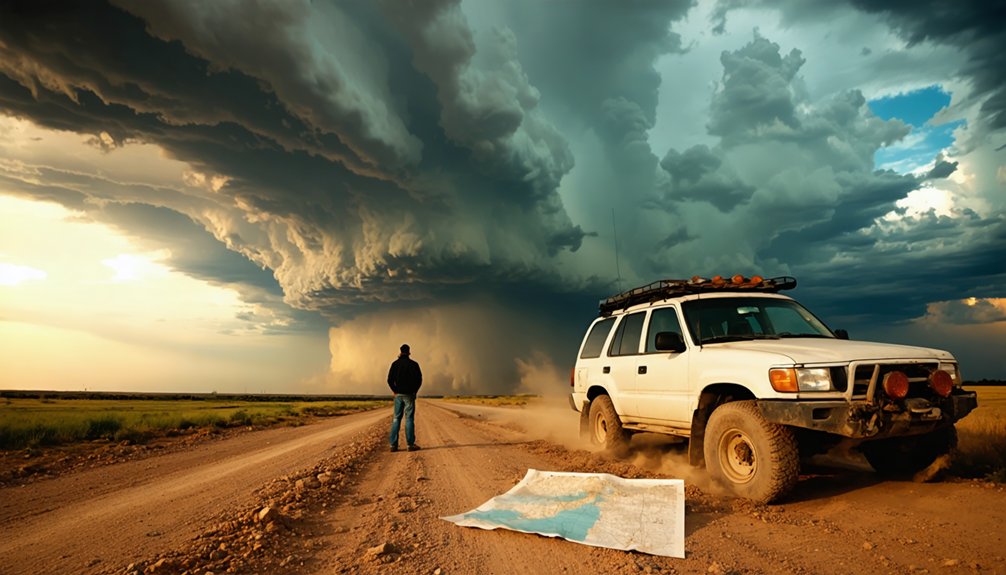
Once you’ve identified CI signals on radar, shifting conditions may force you to reassess your chase target quickly. Boundary movements, failed initiation attempts, or unexpected cap strengthening all demand immediate target reassessment and chase flexibility.
Watch for these key indicators that signal a target shift:
- Boundary displacement: If a dryline or outflow boundary accelerates east or west, reposition your intercept point accordingly.
- Multiple failed CI attempts: Repeated initiation failures along a boundary suggest marginal instability; abandon that corridor and identify stronger forcing elsewhere.
- New fine-line signatures: Fresh convergence boundaries appearing on radar may indicate superior initiation zones requiring a complete target pivot.
Reacting decisively to shifting CI signals separates productive chases from wasted positioning. Stay mobile, monitor radar continuously, and never anchor yourself to a deteriorating target.
Frequently Asked Questions
What Role Does Orographic Lift Play in Convective Initiation Timing?
Terrain influence accelerates your convective initiation timing as orographic effects force air masses upward mechanically. You’ll notice lift mechanisms triggering storm development earlier over elevated terrain than flat surfaces, independent of surface heating cycles.
How Does Downslope Warming Specifically Strengthen Atmospheric Caps Before Storms?
When air descends terrain, it compresses and warms adiabatically — that’s downslope dynamics directly boosting cap strength. You’ll notice this warmer air aloft creates stronger inhibition, suppressing convection until surface heating finally overcomes that reinforced barrier.
Can Convective Temperature Thresholds Be Met Without Thunderstorms Actually Developing?
Yes — like a key that fits but won’t turn, convective temperature thresholds can be met yet storm development still fails. You’ll find insufficient moisture, weak forcing, or strong CIN can each independently suppress convection despite surface heating.
How Far in Advance Should Radar Monitoring Begin Before a Chase Day?
Begin your radar strategies the evening before your chase day. You’ll want to apply monitoring techniques that identify boundary-producing convective complexes, revealing historical storm tracks and initiation zones across your target area early.
How Do Seasonal Patterns Affect Boundary Positioning and Convective Initiation Forecasting?
Over 70% of U.S. tornadoes occur March–June. Seasonal changes shift boundary dynamics dramatically—you’ll track drylines pushing eastward in spring while sea-breeze fronts dominate summer coastal convective initiation, letting you anticipate prime targeting zones freely.
References
- https://www.youtube.com/watch?v=R193S2lw8n0
- https://www.severe-weather.eu/learnweather/severe-weather-theory/convective-initiation-mk/
- http://www.ndtornado.com/primary/terms.htm
- https://www.stormgroupchasers.com/storage/uploads/4c9b4987-7a95-4630-9ece-d7cbf7f4ca90/Storm-Structure-Briefing-Nov-2025.pdf
- https://www.facebook.com/KevinSmithWx/photos/here-we-go-watching-multiple-attempts-at-convective-initiation-on-radar-its-tryi/1375978263446086/
- https://www.frontiersin.org/journals/earth-science/articles/10.3389/feart.2025.1555755/full
- https://www.reddit.com/r/IAmA/comments/1eiewgz/were_three_meteorology_researchers_with/
- https://www.weather.gov/oun/spotterglossary
- https://www.instagram.com/p/DV1vbnnkbQV/
- https://stormtrack.org/threads/downslope-warming-and-convective-initiation.19237/