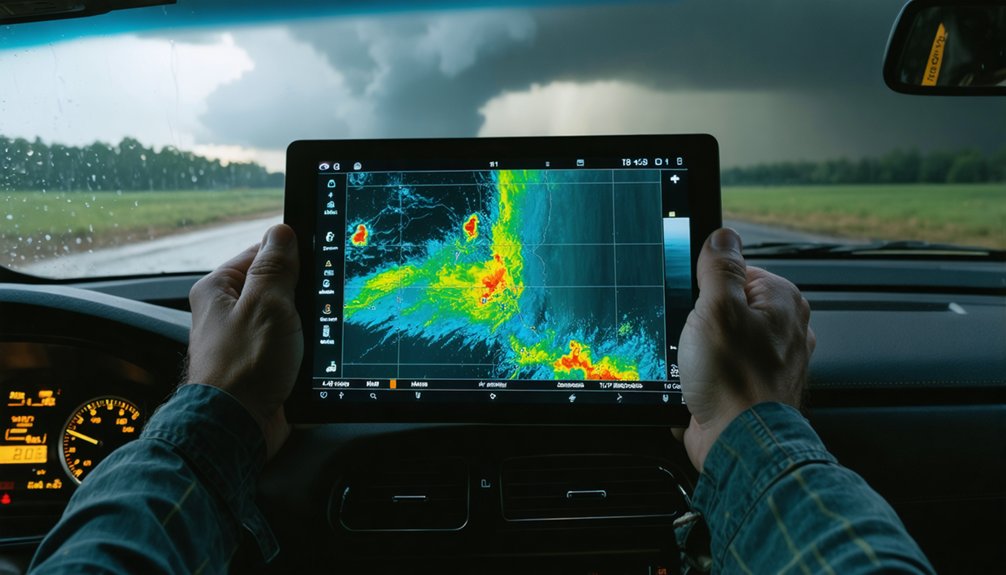
The Storm Prediction Center‘s convective outlooks are your most reliable tool for anticipating severe weather threats across the contiguous United States. They use a six-tier risk scale—from Thunderstorm through High—to communicate tornado, wind, and hail dangers up to eight days out. Each tier demands a progressively stronger response from you. Day 1 and Day 2 outlooks break down specific hazard probabilities, while Days 4–8 shift to broader guidance. There’s much more to unpack about how these forecasts work and how to act on them.
Key Takeaways
- The SPC issues convective outlooks forecasting severe weather threats, including tornadoes, large hail, and damaging winds, up to eight days in advance.
- A six-tier risk scale ranging from Marginal to High communicates the severity, coverage, and organization of expected severe thunderstorms.
- Day 1 and Day 2 outlooks provide separate tornado, wind, and hail probability percentages representing likelihood within 25 miles of a point.
- Hatched overlays highlight especially dangerous hazards, such as strong tornadoes (EF2+), hurricane-force winds (74+ mph), and very large hail (2″+).
- Early preparation is encouraged, as risk categories serve as progressive action windows before life-threatening severe weather events develop.
What Is a Storm Prediction Center Convective Outlook?
The Storm Prediction Center (SPC), based in Norman, Oklahoma, issues convective outlooks to communicate expected severe weather threats across the contiguous United States up to eight days in advance.
These outlooks are central to modern weather forecasting, giving you critical information about the potential for tornadoes, large hail, and damaging winds before storms develop.
Storm prediction at this level relies on identifying atmospheric conditions conducive to intense, rapidly developing thunderstorms. The SPC then forecasts the types and magnitudes of threats those conditions make possible.
Outlooks use a six-tier risk scale, ranging from no severe weather to high risk, helping you quickly assess the danger level in your area. Each category reflects expected storm organization, coverage, intensity, and hazard probability.
What Do the Six Convective Outlook Risk Categories Actually Mean?
Each of the six risk categories on the SPC’s convective outlook scale carries a specific meaning tied to storm organization, coverage, intensity, and hazard probability.
Understanding these risk implications keeps you ahead of dangerous weather.
1. Marginal & Slight (1-2): Expect limited or low-coverage severe storms.
Storm preparedness here means monitoring conditions, not necessarily acting immediately.
2. Enhanced (3): Greater concentration of organized severe thunderstorms.
You should actively review your safety plans and stay weather-aware.
3. Moderate & High (4-5): Widespread severe weather becomes likely, potentially including multiple tornadoes and numerous severe thunderstorms.
Immediate preparedness action is warranted.
The baseline Thunderstorm category simply signals a 10%+ thunderstorm probability—no severe criteria met.
Each step upward demands progressively stronger personal response.
What Do the Tornado, Wind, and Hail Percentage Numbers Mean?
Beyond the categorical risk labels, Day 1 and Day 2 outlooks break severe weather probability down into three separate percentage values—one each for tornadoes, damaging winds, and large hail. Each percentage represents the chance of that specific hazard occurring within 25 miles of any given point—roughly the size of a major metropolitan area.
Tornado probabilities, wind gust likelihoods, and hailstone size thresholds each carry their own risk communication value for precise impact assessments. When forecasters expect strong tornadoes (EF2+), hurricane-force wind gusts (74+ mph), or very large hail (2.00″+), they add a hatched overlay to that probability area.
Day 3 outlooks consolidate these into a single combined percentage, reflecting greater forecast uncertainty. Days 4–8 drop categorical designations entirely, offering only broader probability guidance.
What the Convective Outlook’s 25-Mile Radius Rule Means for You
Every percentage value you see on a convective outlook represents the probability of a severe weather event occurring within 25 miles of a specific point—an area roughly equivalent to a major metropolitan area.
Understanding this 25 mile impact helps you make smarter local response decisions.
Consider what this means practically:
- A 10% tornado probability means a 1-in-10 chance a tornado strikes within 25 miles of your location—not negligible.
- Your suburb and city center share the same risk if they fall within that radius together.
- Rural and urban areas receive equal weighting, so isolation doesn’t reduce your assessed probability.
You’re not just a passive recipient of these numbers—you’re equipped to act on them with precision before conditions deteriorate.
How Day 1, Day 2, and Day 3 Convective Outlooks Differ
As you examine Day 1, Day 2, and Day 3 outlooks, you’ll notice each provides distinct levels of hazard detail, with Days 1 and 2 breaking out separate probability values for tornadoes, wind, and hail, while Day 3 collapses all three into a single combined severe weather probability.
The SPC issues Day 1 outlooks five times daily—at 0600Z, 1300Z, 1630Z, 2000Z, and 0100Z—while Day 2 receives two issuances and Day 3 follows its own reduced schedule, reflecting the diminishing forecast confidence at greater lead times.
Each outlook’s validity period shifts accordingly, with Day 1 running through 1200Z the following day, Day 2 covering the 24-hour window from 1200Z one day out to 1200Z two days ahead, and Day 3 extending the forecast horizon further while sacrificing the granular hazard breakdowns you’d find in the nearer-term products.
Hazard Probability Breakdown Differences
While Day 1 and Day 2 outlooks break down severe weather probabilities into three separate categories — tornadoes, wind, and hail — Day 3 outlooks combine all three into a single probability value.
These hazard communication strategies reflect increasing forecast uncertainty as lead time grows. Understanding these probability interpretation techniques helps you extract maximum value from each outlook type.
Here’s how the breakdown differs across days:
- Day 1: Separate tornado, wind, and hail probabilities, each assessed within 25 miles of any point.
- Day 2: Same three-category structure as Day 1, though with slightly greater uncertainty baked in.
- Day 3: A single combined severe weather probability replaces individual hazard values, limiting your ability to distinguish dominant threat types.
Forecast Specificity By Day
Beyond how probabilities are structured, the three outlook days also differ meaningfully in their categorical specificity, issuance frequency, and how much detail forecasters can reliably communicate.
Day 1 outlooks are issued five times daily, giving you the most current picture of risk evolution as conditions sharpen.
Day 2 receives two issuances, offering solid categorical detail while acknowledging slightly reduced forecast accuracy.
Day 3 narrows further—forecasters issue a single combined severe probability rather than separate tornado, wind, and hail values, reflecting growing atmospheric uncertainty.
All three days retain the full categorical risk scale, from Marginal through High, but the confidence behind each designation decreases with time.
Understanding these distinctions helps you interpret not just what a risk category says, but how much weight the underlying forecast can reasonably carry.
Issuance Schedules And Validity
Each outlook day follows a distinct issuance schedule tied directly to how far ahead forecasters are looking. Issuance timing and validity duration tighten as the threat window approaches.
Day 1 updates five times daily:
- 0600Z — initial issuance, valid through 1200Z the following day
- 1300Z, 1630Z, 2000Z — midday refinements as conditions evolve
- 0100Z — final overnight update, still valid through 1200Z
Day 2 issues twice — at 0730Z or 0830Z depending on daylight saving time, then again at 1730Z — covering 1200Z the next day through 1200Z two days out.
Day 3 follows a reduced schedule, reflecting greater uncertainty.
You’ll notice fewer updates and combined probabilities rather than individual hazard breakdowns, giving you a broader but less refined picture of potential threats.
Why the Convective Outlook Gets Vaguer Beyond Day 3

As forecast lead time extends beyond Day 3, atmospheric predictability drops sharply, making categorical risk designations impractical.
You’ll notice that Days 4 through 8 outlooks abandon the familiar six-tier risk scale entirely, replacing it with simple probability values indicating the likelihood of severe weather within 25 miles of any point.
This shift from categories to raw probabilities reflects the SPC’s acknowledgment that greater temporal distance introduces too much uncertainty to reliably distinguish between, say, a Slight and an Enhanced risk.
Increasing Forecast Uncertainty
The SPC’s convective outlooks grow progressively vaguer the further out you look, and that shift is by design.
Forecast limitations compound daily as atmospheric uncertainty factors multiply beyond Day 3. Here’s how the SPC adapts:
- Day 3 drops individual tornado, wind, and hail probabilities, replacing them with a single combined severe weather probability.
- Days 4–5 eliminate categorical risk designations entirely, displaying only broad percentage-based severe weather probabilities.
- Days 6–8 maintain probability-only formatting, reflecting the lowest confidence thresholds in the outlook cycle.
These aren’t arbitrary restrictions—they reflect genuine atmospheric predictability limits.
You’re getting the most accurate representation of what forecasters actually know. Presenting false precision beyond Day 3 would mislead you, so the SPC deliberately scales back specificity as confidence drops.
Probability Over Categories
Beyond Day 3, categorical risk labels disappear entirely from SPC outlooks—and that’s intentional. As forecast lead time extends, atmospheric uncertainty grows too large to justify structured risk tiers.
Instead, you’re working solely with probability values indicating the chance of severe weather within 25 miles of any point.
This shift carries real probability significance: a 15% probability on Day 6 doesn’t equate to a Slight Risk designation—it simply means conditions *may* become favorable. Your risk interpretation must adjust accordingly.
You’re no longer reading a confident categorical assessment; you’re evaluating raw likelihood against substantial atmospheric uncertainty.
Days 4 through 8 demand that you treat probabilities as possibility flags, not certainties. The absence of categories isn’t a limitation—it’s an honest reflection of what the science can reliably deliver.
What the Colors and Numbers on a Convective Outlook Map Mean
When you look at a convective outlook map, six color-coded risk categories communicate the expected severity of storm threats across the contiguous United States.
Understanding color significance and risk interpretation lets you quickly assess your exposure:
- Light green (Thunderstorms) – 10%+ probability of general thunderstorm activity, not necessarily severe.
- Dark green through orange (Marginal, Slight, Enhanced) – progressively organized, more intense severe weather, numbered 1 through 3.
- Red and magenta (Moderate, High) – widespread severe weather potential, numbered 4 and 5, indicating multiple tornadoes and numerous severe thunderstorms.
The numbers embedded within each category aren’t decorative — they’re ranked severity indicators.
Hatched overlays appearing within any category signal elevated threats: strong tornadoes (EF2+), hurricane-force winds (74+ mph), or hail exceeding 2.00 inches.
When Does the SPC Issue a Special Hazard Highlight?

When you see a special hazard highlight on an SPC outlook, it signals that forecasters expect conditions to exceed standard severe weather thresholds.
Specifically, the SPC issues these highlights when it anticipates strong tornadoes rated EF2 or higher, hurricane-force wind gusts of 74 mph or greater, or very large hail measuring at least 2.00 inches in diameter.
You’ll find these highlights nested within the broader categorical outlook, providing an additional layer of precision beyond what the standard risk categories communicate.
Strong Tornado Expectations
The SPC issues special hazard highlights to flag elevated threats that exceed standard severe weather thresholds. For tornadoes, that threshold is EF2 or higher—storms capable of catastrophic destruction.
Understanding strong tornado characteristics helps you act decisively when these highlights appear.
When the SPC flags a strong tornado threat, here’s what you need to know:
- EF2+ winds exceed 111 mph, destroying well-constructed homes and creating dangerous projectiles.
- Highlighted areas demand immediate action—standard marginal or slight risk responses aren’t sufficient.
- Tornado safety measures must be pre-planned, including identifying reinforced shelter locations before storms arrive.
You shouldn’t wait for a warning to prepare. A special highlight signals that conditions favor violent, long-track tornadoes—giving you critical lead time to protect yourself and your family.
Hurricane-Force Wind Gusts
Strong tornadoes aren’t the only hazard the SPC flags with special highlights—hurricane-force wind gusts trigger them too. When forecasters expect wind gusts reaching 74 mph or higher, they issue a special highlight to alert you to the elevated danger.
That threshold matters because gusts at that intensity produce hurricane impacts typically associated with coastal storms, yet these events strike inland areas with little warning.
Understanding this distinction gives you a critical wind safety advantage. A standard severe thunderstorm warning covers winds at 58 mph or greater, but a special highlight signals something considerably more destructive.
At 74+ mph, you’re looking at structural damage, downed trees, and dangerous projectiles. Recognizing when the SPC elevates its messaging helps you make smarter, faster decisions about protecting yourself and your property.
Very Large Hail Criteria
Hail reaches a threshold where standard severe criteria no longer captures the full danger—and that’s exactly when the SPC steps in with a special highlight.
When forecasters expect very large hail measuring 2.00 inches or greater, they’ll issue a special hazard highlight to warn you of escalating hail impacts beyond the standard 1.00-inch severe threshold.
Here’s what triggers that elevated designation:
- Size threshold — Hailstones must meet or exceed 2.00 inches in diameter
- Documented hail impacts — Structural damage, vehicle destruction, and injury risk increase sharply at this size
- Atmospheric conditions — Forecasters must identify environments specifically capable of producing and sustaining very large hail through intense updrafts
This highlight operates independently from categorical risk levels, giving you precise, actionable hazard information.
How Often Does the SPC Actually Upgrade a Convective Outlook?
When the SPC upgrades a convective outlook, it almost always does so by just one risk level.
Outlook upgrades spanning two or more categories are rare because they signal sudden, unexpected shifts in atmospheric conditions — something forecasters work hard to avoid telegraphing late in the process. The further out you look, the harder forecasting challenges become, which is precisely why Days 4–8 abandon categorical risk designations entirely.
Multi-category upgrades are rare — they signal the kind of sudden atmospheric shifts forecasters work hard to anticipate in advance.
If you’re tracking a potential severe weather event, expect incremental changes as confidence builds. A Marginal risk might become Slight, then Enhanced as the event approaches.
Jumping straight from Marginal to Moderate would be unusual. Understanding this upgrade pattern helps you interpret SPC products accurately and gauge how rapidly a situation is or isn’t deteriorating.
How to Read a Convective Outlook and Know When to Act
Reading a convective outlook correctly means knowing what each risk tier actually signals — not just that severe weather is possible, but how organized, intense, and widespread it’s likely to be.
Your severe weather preparedness depends on interpreting these tiers accurately, not reactively.
Use these risk communication strategies when reviewing any outlook:
- Marginal or Slight — Monitor weather monitoring apps and local alert systems; no immediate action required, but stay informed.
- Enhanced — Activate your emergency response plans, review storm safety tips, and confirm shelter locations.
- Moderate or High — Execute plans immediately; public awareness campaigns and community education programs exist precisely for these rare, life-threatening events.
Don’t wait for the highest category to act. Earlier tiers are your preparation window — use them.
Frequently Asked Questions
How Accurate Are SPC Convective Outlooks Compared to Actual Severe Weather Outcomes?
You’d think predicting storms miles ahead is impossible, but SPC’s model performance delivers remarkable forecast accuracy—you’ll find their outlooks reliably identify severe weather threats, though uncertainty grows exponentially as lead times extend beyond Day 3.
Can Convective Outlooks Be Issued for United States Territories Outside the Contiguous States?
No, you can’t receive SPC convective outlooks beyond CONUS. Territorial coverage excludes Hawaii, Alaska, and U.S. territories entirely. Despite satellite observations monitoring these regions, the SPC’s forecast authority strictly limits outlooks to contiguous states only.
Are Convective Outlooks Available as Mobile Alerts or Only Online?
The knowledge base doesn’t specify mobile alerts availability. You can access convective outlooks through online accessibility via SPC’s website, but for mobile alerts, you’d need to verify delivery options through third-party weather applications or emergency notification systems.
How Does the SPC Coordinate With Local National Weather Service Offices on Outlooks?
The SPC coordination process doesn’t operate in isolation—local forecasting offices actively use SPC outlooks as a foundation, then you’ll see them refine warnings and watches based on their regional expertise and real-time observations.
Has the Convective Outlook Risk Scale Ever Changed Since Its Original Introduction?
Yes, the risk scale’s evolved historically. You’d find the six-tier system wasn’t always standard — historical changes added “Enhanced” around 2014, refining risk scale evolution from a simpler four-category framework, giving you more precise severe weather decision-making freedom.
References
- http://davidstang.org/research/SPCOutlooks.pdf
- https://hodo.graphics/blog/post/2025-01-20-spc-outlooks.html
- https://origin-west-www-spc.woc.noaa.gov/about/outlooks/
- https://www.cfinotebook.net/notebook/weather-and-atmosphere/convective-outlook
- https://www.weather.gov/media/ewx/iwt/SPC_WPC_Differences.pdf