Storm tracking devices give you simultaneous measurements of up to eight atmospheric variables—including barometric pressure, dew point, and crosswind data—with sensor uptime exceeding 99.99%. You’re getting verified, time-stamped intelligence instead of delayed forecasts or error-prone manual observations. Advanced sensors detect subtle atmospheric shifts during wind-driven rain and intense snowstorms without signal degradation. That continuous data stream supports everything from evacuation coordination to hurricane prediction modeling, and there’s considerably more to uncover about what these devices make possible.
Key Takeaways
- Storm tracking devices measure temperature, humidity, wind speed, barometric pressure, and more, providing comprehensive simultaneous environmental data for informed decision-making.
- High-precision sensors maintain accurate readings during adverse weather, with uptime exceeding 99.99% for uninterrupted, reliable data collection year-round.
- Real-time data transmission reduces response lag, enabling emergency personnel to make quick, informed decisions during critical weather events.
- Durable, weatherproof construction with IP-65 water resistance ensures long-lasting performance across extreme conditions without frequent maintenance requirements.
- Historical data logging identifies recurring storm patterns, strengthens hurricane prediction models, and supports smarter infrastructure planning and emergency preparedness.
What Can Storm Tracking Devices Actually Measure?
Modern storm tracking devices measure an extensive suite of atmospheric variables simultaneously, giving you a complete picture of weather conditions in real time. Their measurement capabilities span temperature, humidity, wind speed, wind direction, barometric pressure, dew point, wind chill, and crosswind data.
You’re not limited to surface-level readings either — advanced sensor technologies capture subtle atmospheric shifts that traditional instruments routinely miss.
These devices deliver high-precision readings even during wind-driven rain and intense snowstorms, ensuring your data remains reliable when conditions deteriorate most.
Precision holds steady when storms peak — your readings stay accurate through rain, wind, and heavy snow.
Customizable dashboards let you configure exactly which parameters you monitor, putting control directly in your hands.
Whether you’re chasing hurricanes or managing agricultural operations, you’ll access thorough, simultaneous environmental measurements that empower faster, more informed decisions without depending on delayed or secondhand weather reports.
How Accurate Are Modern Storm Tracking Devices?
Knowing what storm tracking devices measure matters little if their readings can’t be trusted. Modern units deliver precision you can rely on through:
- High-precision sensors that detect subtle shifts in temperature, humidity, and wind speed with greater reliability than traditional instruments.
- Advanced sensor technology that maintains accuracy verification even during wind-driven rain and intense snowstorms without signal degradation.
- Consistent device calibration standards that minimize mechanical failures and human error, ensuring readings stay dependable across variable conditions.
Storm chasers worldwide trust these devices because professional networks achieve uptime exceeding 99.99%, giving you uninterrupted data flow year-round.
You’re not guessing anymore—you’re working with verified atmospheric measurements. Whether you’re tracking a local storm or a hurricane, accurate data puts real decision-making power in your hands.
Why Real-Time Data Matters When Every Second Counts
When you’re tracking a storm, real-time data gives you instant access to weather conditions from any field location, enabling split-second decisions as atmospheric variables shift.
You’ll benefit from continuous data recording that captures temperature, humidity, and wind speed fluctuations across extended periods, building a reliable foundation for trend analysis.
Instant Weather Condition Access
Real-time weather data isn’t just a convenience—it’s a critical operational advantage when severe conditions develop faster than traditional forecasting methods can track.
Instant access to field-level atmospheric readings lets you respond before conditions become unmanageable.
Key operational benefits include:
- Remote field positioning — You can pull accurate readings from any location, eliminating dependency on centralized stations that miss localized storm behavior.
- Weather adaptability — Continuous data streams let you adjust decisions dynamically as temperature, wind speed, and humidity shift in real time.
- Reduced response lag — Immediate data transmission cuts the delay between condition changes and your operational response.
When seconds determine outcomes, waiting on delayed reports isn’t acceptable.
Direct, instant access gives you the situational control needed to act decisively and independently.
Continuous Data Recording Benefits
Continuous data recording transforms raw atmospheric readings into actionable intelligence by preserving every measurement shift across extended timeframes. You’re not just capturing isolated snapshots—you’re building a thorough atmospheric record that powers accurate data analysis and trend forecasting.
When storm systems evolve unpredictably, having access to continuous historical datasets lets you identify behavioral patterns that single-point measurements simply can’t reveal. You can cross-reference pressure drops, temperature fluctuations, and wind acceleration sequences to anticipate developing threats before they escalate.
This capability frees you from dependence on incomplete information, giving you verified, time-stamped data whenever critical decisions demand it.
Researchers and field professionals alike rely on these uninterrupted records to refine hurricane prediction models, improve emergency response timelines, and maintain authoritative situational awareness throughout any severe weather event.
Reducing Human Error Risks
Human judgment under pressure degrades fast, and that’s exactly where real-time data monitoring steps in to close the gap.
Automated monitoring eliminates the inconsistencies that come with manual readings, fatigue-driven oversights, and mechanical instrument failures.
Here’s what human error reduction delivers for you:
- Elimination of misread data — Sensors capture precise atmospheric changes without interpretation bias, giving you reliable numbers instantly.
- Consistent measurement intervals — Automated systems record continuously, removing gaps caused by human scheduling errors or missed observation windows.
- Immediate anomaly detection — Threshold-based alerts flag critical shifts the moment conditions change, bypassing delayed human recognition.
You’re not operating blind when automated monitoring handles the data pipeline.
You’re making decisions backed by verified, uninterrupted information — exactly the advantage severe weather demands.
How Storm Tracking Devices Are Built to Last
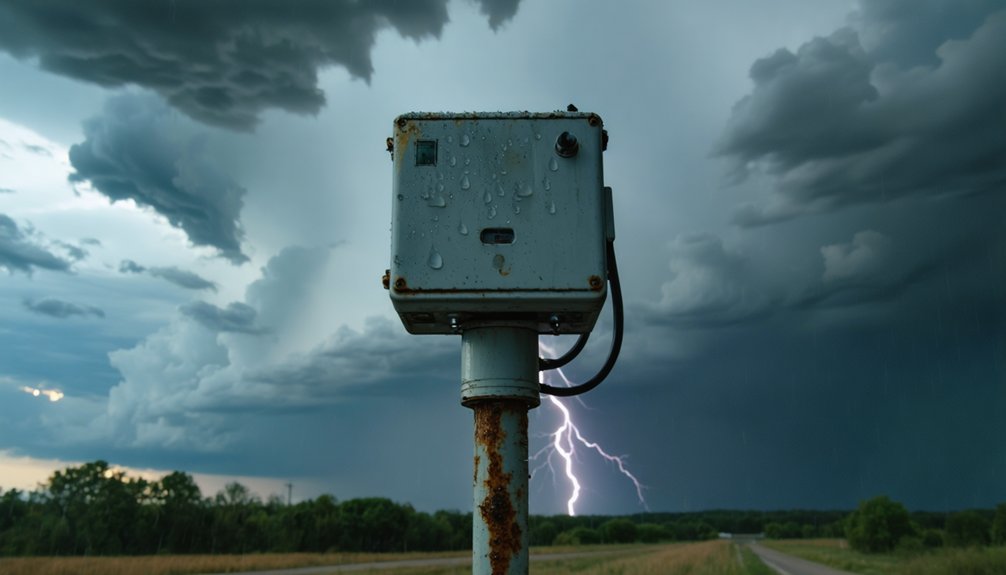
Storm tracking devices endure some of the harshest conditions on Earth, so their construction prioritizes robustness without sacrificing portability. You’ll find that durable materials form the foundation of every professional-grade unit, enabling reliable operation through rain, snow, extreme heat, and freezing temperatures.
Manufacturers engineer robust design standards directly into each component, ensuring long lasting performance across wide temperature ranges without frequent maintenance or recharging. Ratings like IP-65 water resistance protect internal sensors from wind-driven rain and heavy precipitation exposure.
You’re not just getting equipment that survives extreme conditions — you’re investing in instrumentation that maintains measurement accuracy throughout those events.
Lightweight construction keeps your kit portable, while weatherproof housing guarantees consistent uptime exceeding 99.99%, giving you uninterrupted data collection precisely when you need it most.
Custom Alerts That Keep People Out of Danger
Three critical advantages these systems deliver:
- Threshold precision — You set parameters based on specific field conditions, eliminating irrelevant alerts that create noise and delay response.
- Multi-parameter monitoring — Simultaneous tracking of crosswind, dew point, wind chill, and station temperature gives you complete situational awareness instantly.
- Rapid protocol activation — Once thresholds trigger, you implement safety measures immediately, protecting staff and minimizing exposure to escalating hazards.
You’re not reacting to danger — you’re anticipating it. That distinction saves lives.
How Storm Tracking Devices Improve Emergency Response
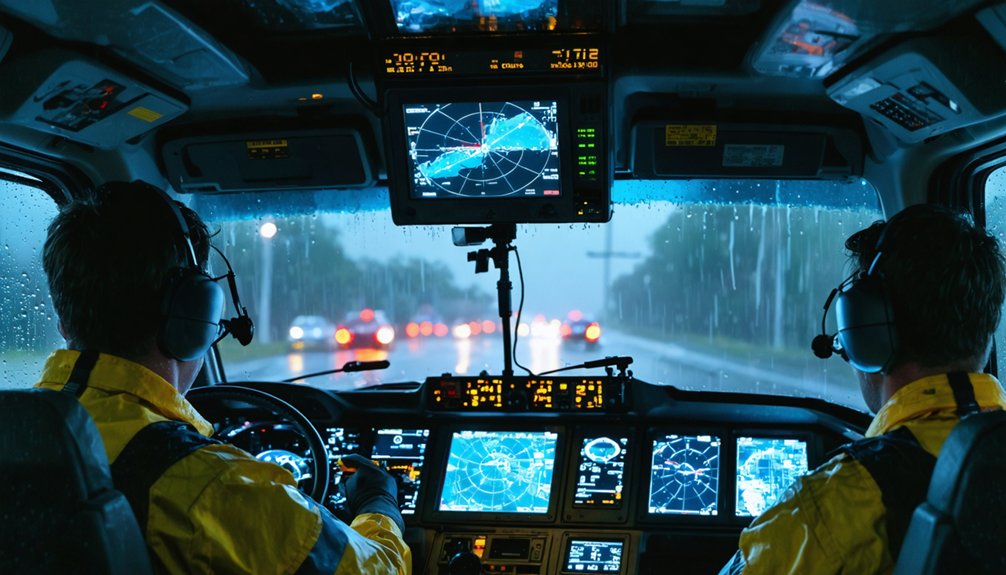
When severe weather strikes, the difference between effective emergency response and catastrophic failure often comes down to data speed and accuracy. Storm tracking devices give meteorologists and first responders real-time atmospheric data, enabling rapid coordination of evacuation strategies before conditions become life-threatening.
You can identify localized storm phenomena—from neighborhood-level microbursts to Category 5 hurricanes—and immediately share verified data with emergency personnel. IoT sensors and drone technology assess ground-level damage without risking additional lives, strengthening your emergency preparedness infrastructure considerably.
These devices maintain 99.99% uptime throughout severe weather events, ensuring continuous data flow when communication failures are least acceptable. You’re not relying on delayed reports or manual observations—you’re acting on precise, real-time intelligence that protects communities and maximizes your team’s operational effectiveness during critical response windows.
What Storm Trackers Reveal Over Time
Beyond real-time emergency response, storm tracking devices build an invaluable historical record that reshapes how you understand atmospheric behavior.
Continuous data logging lets you retrieve, compare, and act on verified storm patterns without depending on incomplete information.
Here’s what long-term storm tracker data reveals:
- Recurring storm patterns — Identify seasonal cycles and geographic vulnerabilities that inform smarter infrastructure and evacuation planning.
- Evolving data trends — Track gradual atmospheric shifts over months or years, strengthening hurricane prediction models with precise historical inputs.
- Anomaly detection — Spot deviations from established baselines quickly, giving you the freedom to respond proactively rather than reactively.
You’re not just monitoring weather — you’re building independent, verifiable knowledge that keeps decision-making power in your hands.
Why Professionals Rely on Storm Tracking Devices

From National Geographic field teams to storm chasers operating in the most volatile atmospheric conditions on Earth, professionals don’t just prefer these devices — they depend on them.
You’re working with instruments that maintain uptime exceeding 99.99%, delivering uninterrupted tracking capability around the clock. Sensor calibration guarantees readings stay precise even during wind-driven rain or intense snowstorms, eliminating the mechanical failures tied to older methods.
Data integration connects ground-level IoT sensors with drone technology, letting you assess damage without risking personnel. High-resolution screens stay readable through heavy precipitation, and lightweight designs don’t slow you down in the field.
When your decisions directly impact evacuations and public safety, you can’t afford unreliable equipment — and these devices don’t give you a reason to settle for less.
Frequently Asked Questions
How Much Do Professional Storm Tracking Devices Typically Cost to Purchase?
Pricing details aren’t in my available data. For a thorough buying guide and cost comparison, you’d want to research current market options independently to find the storm tracking device that fits your budget and freedom-driven fieldwork needs.
Can Storm Tracking Devices Integrate With Existing Weather Station Networks?
Yes, you can integrate storm tracking devices with existing weather station networks. They’re built for network compatibility, enabling seamless data sharing with meteorologists, emergency responders, and research institutions, expanding your monitoring capabilities considerably.
How Long Do Storm Tracking Device Batteries Last During Continuous Operation?
The knowledge base doesn’t specify battery lifespan details, but storm tracking devices support continuous operation through infrastructure maintaining consistent data collection without frequent recharging, so you’ll experience reliable, uninterrupted monitoring even during extended severe weather tracking deployments.
Are Storm Tracking Devices Suitable for Personal Home Weather Monitoring Use?
Like a personal meteorologist in your pocket, storm tracking devices are perfect for home use. They’ll sharpen your local forecasts, boost personal safety, and let you monitor real-time temperature, humidity, and wind data independently.
What Certifications or Standards Must Storm Tracking Devices Meet Professionally?
You’ll want devices meeting IP-65 waterproof certification requirements and industry standards ensuring 99.99% uptime reliability. They must withstand extreme temperatures, wind-driven rain, and intense storms while delivering high-precision, uninterrupted atmospheric measurements you can professionally trust.
References
- https://kestrelinstruments.com/blog/kestrel-meters-storm-chasing-reliable-tracking-for-severe-weather-conditions
- https://www.rikasensor.com/a-what-are-the-advantages-of-using-digital-weather-instruments.html
- https://www.global-view.net/post/why-weather-resistant-trackers-are-essential-for-reliable-tracking
- https://publicsafety.ieee.org/topics/hurricane-tracking-technology-advancements-and-opportunities/
- https://www.youtube.com/watch?v=a96yBjgY6Is
- https://perryweather.com/resources/best-lightning-detection-networks-ranked/
- https://ayokasystems.com/news/harnessing-tech-to-predict-and-prepare-for-hurricanes-like-never-before/
- https://weatherscientific.com/blogs/weather-scientific-blogs/how-to-track-thunderstorms-at-home-using-radar-pressure-and-wind-signals
- https://www.weather.gov/bmx/radar_aboutnwsradar_howdoesitwork