When you examine the data, the link between climate change and hurricanes becomes undeniable. Warmer oceans fuel stronger winds, while a 2°C warmer atmosphere holds 10–15% more moisture, supercharging rainfall and flooding. Major hurricanes have already increased from 1979 to 2017, with Category 4–5 storms projected to rise 50%+ per 1°C of warming. Storm surge, rapid intensification, and slower storm movement compound these threats. The full picture of what’s driving these changes—and what’s coming—runs deeper than you might expect.
Key Takeaways
- Warmer oceans fueled by climate change intensify hurricanes, increasing wind speeds and rainfall while making storms more destructive overall.
- A 2°C warmer world produces 10–15% more precipitation per storm, significantly raising flood risks in coastal and inland regions.
- Major hurricanes reaching Category 4–5 intensity have increased from 1979 to 2017, with a projected 50%+ rise per 1°C warming.
- Climate change may not increase total hurricane frequency but drives fewer, more powerful storms with catastrophic damage potential.
- Slower-moving storms, rising sea levels, and aging coastal infrastructure amplify hurricane impacts, demanding stronger preparedness and resilience planning.
How Climate Change Is Making Hurricanes More Dangerous
Climate change is reshaping hurricanes in measurable, compounding ways — making them wetter, more powerful, and increasingly destructive. Warmer oceans intensify wind speeds, while warming air holds 7% more moisture per degree Celsius, driving heavier rainfall and catastrophic flooding.
Warmer oceans, wetter storms — climate change isn’t coming for hurricanes. It’s already here, rewriting the rules.
You’re looking at 10–15% more precipitation in a 2°C warmer world — a reality demanding serious hurricane preparedness, adaptive infrastructure, and stronger disaster response frameworks.
These shifts carry significant policy implications and insurance challenges, as recovery strategies grow costlier and ecosystem impacts expand. Rapid intensification trends, slower storm movement over land, and rising storm surge collectively stress community resilience.
Closing knowledge gaps through climate education and public awareness isn’t optional — it’s foundational to protecting individual freedom from increasingly unavoidable climate-driven destruction.
Why Warmer Oceans Are the Engine Behind Stronger Storms
When you examine what powers a hurricane, you’ll find that ocean heat is the primary fuel driving storm intensity.
Warmer waters transfer energy into the atmosphere, directly boosting wind speeds and overall storm strength.
Human-caused climate change has raised ocean temperatures considerably, as the ocean absorbs roughly 90% of the excess heat generated by rising greenhouse gas emissions.
This makes today’s Atlantic hurricanes measurably more powerful than those of previous decades.
Ocean Heat Drives Intensity
Oceans are the primary energy source that drives hurricane intensity, and as they warm due to human-caused climate change, they’re feeding storms with unprecedented fuel.
Understanding ocean temperatures and hurricane dynamics reveals a direct mechanical relationship: warmer surface waters accelerate evaporation, transferring thermal energy directly into storm systems.
The Atlantic Multi-decadal Oscillation contributes to storm patterns, but broader global ocean warming ties unmistakably to greenhouse gas emissions.
Oceans absorb roughly 90% of heat generated by rising emissions, creating persistent climate feedbacks that strengthen storm intensity over time.
Historical trends confirm this trajectory — major hurricane numbers increased between 1979 and 2017.
You’re witnessing a compounding cycle where each degree of warming directly amplifies hurricane wind speeds and destructive power, systematically threatening coastal communities.
Warming Waters Boost Winds
Warmer ocean surfaces directly power hurricane wind intensification through a thermodynamic process you can trace step by step.
When ocean currents carry heat toward storm tracks, they amplify energy transfer between sea and atmosphere, dropping atmospheric pressure and accelerating wind speeds.
Temperature variability across basins shapes hurricane patterns—warmer water means more evaporation, more fuel.
You can measure climate impact precisely: each degree Celsius of ocean warming increases wind intensity meaningfully, while reducing wind shear allows storms to organize vertically without disruption.
NOAA projects Category 4-5 hurricane frequency increasing over 50% per degree of warming.
What you’re witnessing isn’t randomness—it’s physics.
Rising greenhouse gas emissions drive ocean heat absorption, fundamentally rewiring the thermodynamic engine that determines how powerful these storms become.
How Rising Temperatures Are Turbocharging Hurricane Rainfall
When you consider that warmer air holds approximately 7% more moisture per degree Celsius of warming, the implications for hurricane rainfall become stark.
In a 2°C warmer world, you’re looking at 10-15% more precipitation from these systems, translating directly into catastrophic inland flooding.
Climate data confirms that tropical cyclone rainfall rates have already increased across the Atlantic, and models project this trend will accelerate sharply through 2100.
Warmer Air, More Moisture
As the atmosphere heats up, it holds more water vapor — and that has direct consequences for hurricane rainfall. You’re looking at a system where moisture dynamics amplify storm output with measurable precision.
The atmospheric impact is straightforward: warmer air increases water vapor capacity by 7% per degree Celsius.
Here’s what that means in real terms:
- A 2°C warmer world produces 10–15% more rainfall per storm
- Tropical cyclone rainfall rates have already increased globally
- Models project considerably higher rainfall rates by 2100
- Heavy precipitation events tied to hurricanes will intensify flood risk considerably
You can’t separate these outcomes from rising temperatures. The data confirms that warmer air isn’t just a background condition — it’s an active driver reshaping hurricane rainfall intensity.
Flooding Risks Ahead
More moisture in the atmosphere doesn’t just mean heavier rain — it means flood risk on a scale that’s fundamentally different from what coastal and inland communities have historically planned for.
You’re looking at 10–15% more rainfall in a 2°C warmer world, compounding storm surge, threatening coastal ecosystems, and exposing critical gaps in infrastructure resilience.
Slower-moving storms over land amplify precipitation totals, overwhelming flood mitigation systems designed for yesterday’s climate.
Urban planning, emergency response frameworks, and insurance challenges haven’t kept pace.
Environmental justice concerns intensify as vulnerable communities bear disproportionate storm recovery burdens.
Community preparedness and public awareness aren’t optional — they’re survival tools.
Without recalibrating every layer of your risk architecture, you’re not managing future hurricanes; you’re inheriting them unprepared.
How Climate Change Is Worsening Storm Surge and Coastal Flooding
Climate change is compounding storm surge and coastal flooding risks through two reinforcing mechanisms: intensifying storms and rising sea levels.
You’re facing a fundamentally altered threat landscape where these forces multiply each other’s damage potential.
The threat landscape has fundamentally shifted — compounding forces now multiply damage potential in ways once considered extreme outliers.
Key drivers undermining coastal resilience:
- Stronger storms generate higher storm surge, pushing more water inland with greater destructive force.
- Sea level rise raises the baseline, meaning surge travels farther and floods deeper.
- Slower storm movement over land increases precipitation totals, amplifying inland flooding.
- North Atlantic storms slowed 16% between 1949-2016, extending flood duration considerably.
Hurricane Helene’s record rainfall demonstrated human-caused climate change‘s direct fingerprint on catastrophic flooding.
Without aggressive emissions reductions, intensifying storms combined with rising seas will systematically erode your coastlines’ ability to withstand future hurricane impacts.
Are Climate Change Hurricanes Becoming More Frequent?
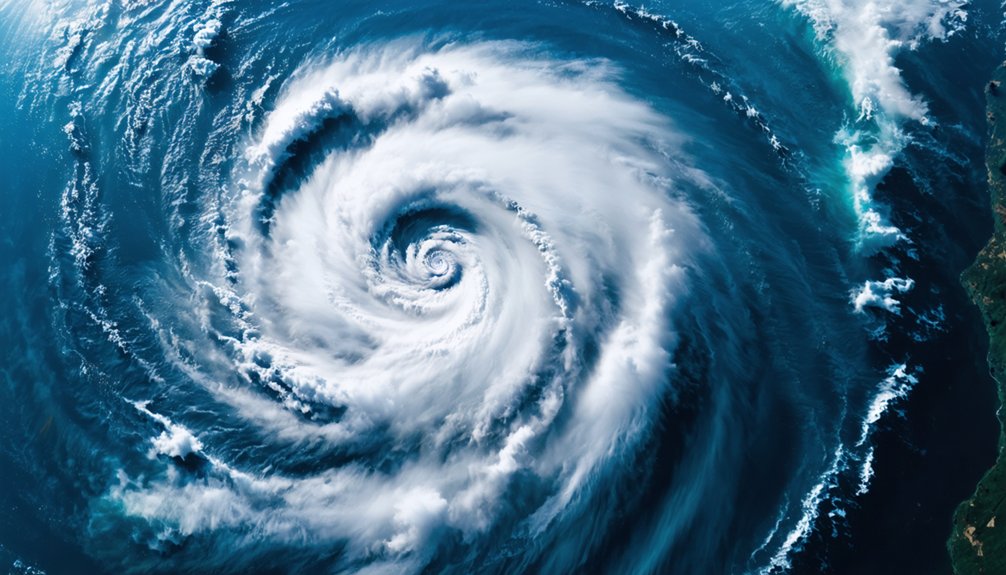
When it comes to hurricane frequency, the science delivers a counterintuitive finding: climate change isn’t necessarily producing more storms—it’s producing worse ones.
Global storm variability data suggests total hurricane patterns may actually decrease or hold steady by the 21st century. Atlantic tropical storms are projected to decline in raw numbers.
However, don’t mistake fewer storms for safer conditions. The critical shift is compositional: major hurricanes increased between 1979 and 2017, while weaker storms diminished.
You’re seeing a greater proportion reaching Category 4-5 intensity. Scientists haven’t established high-confidence links between greenhouse gases and past Atlantic frequency changes, but the intensity trend is unambiguous.
Fewer storms hitting harder represents a fundamentally different risk calculus than simply counting storm frequency.
How Climate Change Is Accelerating Rapid Intensification
Beyond raw frequency, the mechanism that’s reshaping hurricane risk most dramatically is rapid intensification—a phenomenon climate change is making both more probable and more dangerous.
Climate feedbacks are accelerating storm behavior at measurable rates. Here’s what the data shows:
- Wind escalation: Annual intense hurricanes increase over 50% per 1°C of ocean warming, fundamentally altering hurricane patterns.
- Ocean currents: Warmer subsurface waters sustain intensification longer, giving storms sustained energy sources.
- Precipitation surge: Rainfall rates near storm centers climb sharply as atmospheric moisture increases 7% per degree Celsius.
- Category jumps: NOAA projects more Category 4-5 storms with higher sustained wind speeds by 2100.
You’re not watching gradual change—you’re watching compounding climate feedbacks systematically weaponize storm behavior against coastal communities.
Which Coastal Regions Face the Greatest Hurricane Risk?
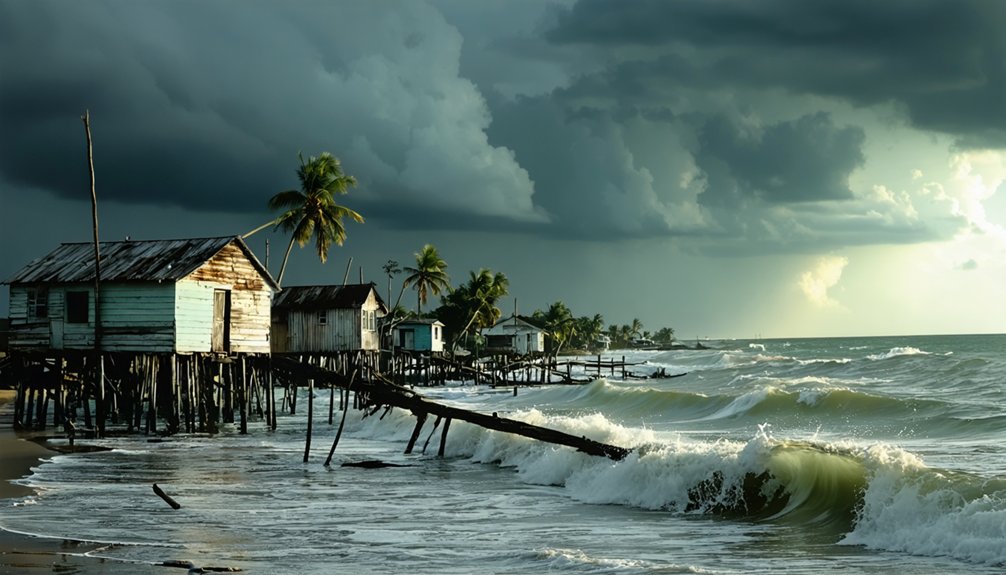
Where you live determines how much these intensifying storms threaten your safety, property, and infrastructure. The Gulf Coast, East Coast, Caribbean Islands, and Southeast States face disproportionate exposure to Category 4-5 hurricanes, storm surge, and catastrophic flooding.
Your risk assessment should account for coastal infrastructure vulnerabilities, including aging seawalls, low-elevation zones, and high-density population corridors.
Coastal infrastructure vulnerabilities — aging seawalls, low-elevation zones, and overcrowded corridors — amplify your community’s storm risk exponentially.
Caribbean Islands face compounded threats from limited evacuation plans and constrained emergency response resources.
Gulf Coast communities confront accelerating storm intensification over warm shallow waters, while East Coast cities face increasing flood mitigation demands from rising seas.
You can’t afford passive preparation — proactive storm preparedness, including reinforced infrastructure investment and clearly defined evacuation plans, directly determines how well your community survives increasingly powerful storms.
What Scientists Predict for Climate Change Hurricanes Through 2100
Understanding which regions face the greatest risk today only tells part of the story — scientists project that hurricane behavior will shift dramatically before 2100, reshaping threat profiles across every vulnerable coastline.
You’ll need to update your hurricane preparedness strategies as models confirm these four shifts:
- Intensity surge — Category 4-5 storms increase 50%+ per 1°C warming, straining coastal infrastructure and insurance implications.
- Rainfall amplification — Expect 10-15% more precipitation in a 2°C warmer world, demanding stronger disaster response frameworks.
- Rapid intensification — Storm tracking becomes harder as intensification windows shorten dramatically.
- Northward migration — Shifting storm patterns threaten previously lower-risk zones, requiring expanded environmental policies and climate resilience planning.
Public awareness of these projections isn’t optional — it’s foundational to survival.
Frequently Asked Questions
Can Individuals Reduce Hurricane Risk Through Personal Carbon Footprint Changes?
Yes, you can reduce hurricane risk by shrinking your carbon footprint through lifestyle changes like consuming less energy. Collectively, these actions slow ocean warming, which directly drives hurricane intensification, rainfall increases, and coastal flooding risks.
How Do Hurricanes Affect Mental Health in Impacted Communities?
Hurricanes devastate your mental health through PTSD, anxiety, and depression. You’ll face prolonged trauma recovery as climate-intensified storms grow more destructive. However, you can build community resilience by fostering social networks, accessing mental health resources, and collectively advocating for climate action.
What Role Do Mangroves Play in Protecting Coastlines From Hurricanes?
Just as rising seas threaten coastlines, mangrove ecosystems coincidentally offer your best natural defense. They absorb wave energy, reduce storm surge, and strengthen coastal resilience, cutting hurricane flood damage considerably — you’d lose irreplaceable protection without them.
How Do Hurricane Evacuation Plans Account for Climate Change Projections?
You’ll find that evacuation strategies now integrate climate modeling to account for intensified storms, higher storm surges, and increased rainfall projections, helping you anticipate broader flood zones, faster intensification timelines, and shifting hurricane tracks driven by warming oceans.
Are Hurricane-Resistant Building Materials Becoming More Widely Used Today?
Yes, you’re seeing wider adoption of hurricane-resistant sustainable materials and innovative designs. Updated building codes and urban planning now integrate climate data, driving technically sound, freedom-preserving construction choices that protect communities from intensifying storm risks.
References
- https://www.climatecentral.org/climate-matters/hurricanes-and-climate-change-2025
- https://earth.org/data_visualization/how-hurricanes-activity-links-to-climate-change/
- https://science.nasa.gov/earth/climate-change/a-force-of-nature-hurricanes-in-a-changing-climate/
- https://www.gfdl.noaa.gov/global-warming-and-hurricanes/
- https://pmc.ncbi.nlm.nih.gov/articles/PMC3511756/
- https://www.c2es.org/content/hurricanes-and-climate-change/
- https://products.climate.ncsu.edu/weather/hurricanes/climate-change/
- https://www.ucs.org/resources/hurricanes-and-climate-change