Climate change is making storm chasing more dangerous and unpredictable than ever. Since 1980, the proportion of major hurricanes has doubled, and storm seasons now extend year-round, straining your resources and preparation. Tornado Alley is shifting eastward into areas with weaker infrastructure, while rapid intensification compresses your decision-making windows. Traditional forecasting models can’t keep pace with these erratic patterns, forcing you to adapt constantly. The deeper you look into these changes, the more critical your survival strategies become.
Key Takeaways
- Storm intensity has doubled since 1980, compressing decision windows and demanding faster responses from storm chasers.
- Shifting storm paths and unpredictable trajectories make traditional escape routes and forecasting models increasingly unreliable.
- Tornado Alley’s eastward migration exposes new regions with inadequate infrastructure, creating unfamiliar risks for chasers.
- Extended storm seasons now demand year-round operational readiness, straining equipment, resources, and maintenance cycles.
- Redundant communication systems and pre-planned emergency protocols are essential as infrastructure failures become more common during extreme weather.
How Is Climate Change Making Storms Harder to Chase?
As climate change intensifies atmospheric temperatures, storms are becoming more powerful, more frequent, and harder to predict—creating a compounding challenge for storm chasers.
Since 1980, the proportion of major hurricanes has doubled, signaling a dangerous shift in storm intensity. You’re now operating in an environment where weather unpredictability has become the norm, not the exception.
Traditional forecasting models can’t keep pace with rapidly shifting storm trajectories.
Tornado Alley is physically migrating eastward, forcing you into unfamiliar terrain with different risk profiles.
Storm seasons now extend beyond historical warm months, demanding year-round climate resilience from both your equipment and decision-making frameworks.
Rapid intensification means you have less preparation time, compressing your safety margins considerably.
Adapting isn’t optional—it’s essential for survival in this evolving operational landscape.
Shifting Storm Patterns and the New Tornado Alley
If you’ve been chasing storms in the central plains for years, you’ll need to rethink your geographic strategy—Tornado Alley is shifting eastward toward the densely populated Southeast and Gulf Coast states.
Where infrastructure and storm shelters aren’t built to handle the escalating threat. You’re now operating in regions where building codes lag behind the new reality, putting both you and local residents at greater risk.
Compounding this challenge, storm seasons are stretching beyond their historical boundaries, forcing you to extend your operational calendar and adapt to unfamiliar terrain and weather patterns year-round.
Tornado Alley Moving East
Where storms once reliably churned across Kansas and Oklahoma, they’re now carving new paths eastward toward the Southeast and Gulf Coast states. This shift isn’t random—rising atmospheric temperatures are fundamentally redrawing severe weather geography.
You’re now contending with a landscape where urban expansion has placed millions more people directly in harm’s way. Densely populated cities that never prioritized storm preparedness now face tornado threats their infrastructure resilience wasn’t designed to handle.
Traditional forecasting models you’ve relied on are struggling to keep pace. Tornadoes are striking beyond historical boundaries, demanding that you rapidly expand your operational range and knowledge base.
Building codes, shelter systems, and emergency networks in these newly affected regions remain dangerously underprepared for the intensifying threat now headed their way.
New Geographic Risk Zones
How dramatically has the risk landscape shifted? Tornadoes are increasingly targeting the Southeast and Gulf Coast states, regions with dense populations and infrastructure resilience gaps that Tornado Alley never stress-tested. You’re now operating in territories where urban expansion has created sprawling metropolitan areas directly in harm’s way.
The data confirms this isn’t temporary. Storm frequency beyond the central plains has measurably increased, forcing you to reconsider traditional deployment strategies. Building codes in these newly affected regions weren’t designed for this threat level, meaning civilian vulnerability runs high.
As a chaser, you’re steering through unfamiliar terrain with fewer established safety corridors. These new geographic risk zones demand updated operational frameworks, precise local knowledge, and rapid adaptability—because the storms don’t care about historical boundaries anymore.
Extended Storm Season Challenges
The storm season you once planned around is dissolving. Severe weather events now extend well beyond traditional warm months, forcing you to maintain operational readiness year-round. Storm data confirms tornadoes and hurricanes are emerging in previously low-risk periods, dismantling historical scheduling assumptions.
Your weather models aren’t keeping pace. Traditional forecasting frameworks were built on stable seasonal patterns that climate change has fundamentally disrupted. You’re now operating with greater uncertainty across longer timeframes, demanding constant model recalibration.
This extended season stretches your resources thin. Equipment maintenance cycles compress, fatigue accumulates, and financial planning becomes more complex. You can’t rely on predictable off-seasons for recovery and preparation.
Adapting means building flexible operational frameworks that treat storm season as a continuous, year-round reality rather than a defined window.
How Erratic Storm Paths Are Getting Storm Chasers Killed
As storm paths grow increasingly erratic due to climate change, the margin for error in storm chasing has narrowed to near-zero. Unpredictable wind shifts and sudden lightning strikes are catching even experienced chasers off guard, with fatal consequences.
Key dangers you’re now facing include:
- Tornadoes deviating sharply from predicted trajectories, eliminating safe exit routes
- Unpredictable wind surges exceeding equipment and vehicle tolerances
- Sudden lightning strikes during rapid storm intensification phases
- Storms accelerating faster than evacuation windows allow
- Traditional forecasting models failing to capture erratic movement patterns
Tornado Alley’s eastward shift places storms over unfamiliar terrain, compounding navigational risks. You’re operating in regions where road networks weren’t designed for rapid storm chaser repositioning, making erratic storm paths increasingly lethal.
Can Storm Chasing Gear Keep Up With Extreme Conditions?
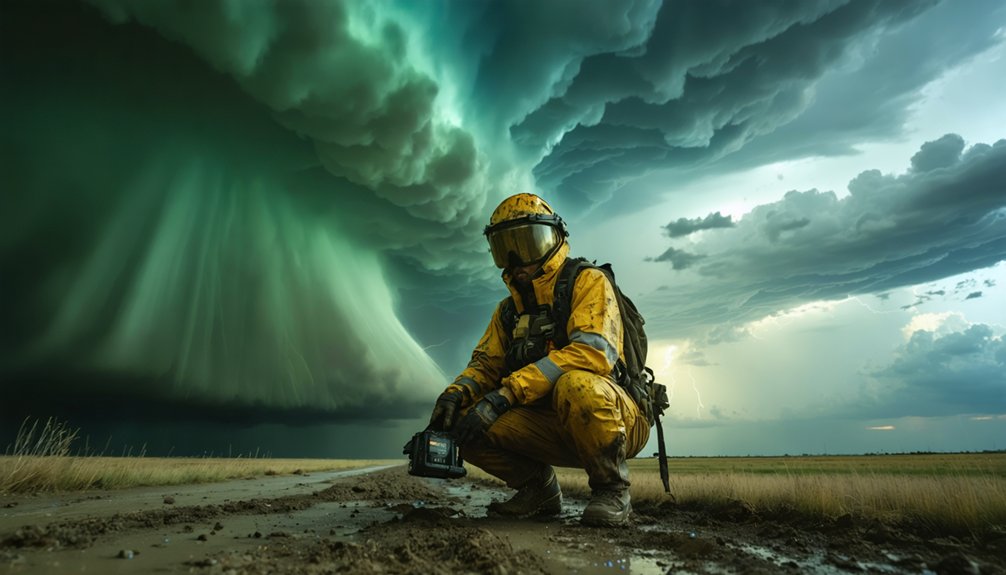
Storm chasing gear wasn’t engineered for the extreme conditions climate change is now producing, and that gap is widening fast. You’re deploying instruments built for historical storm intensities into environments that now exceed those benchmarks regularly.
Storm gear durability is failing under harsher precipitation, stronger winds, and prolonged exposure to extreme temperatures, forcing costly replacement cycles.
Remote sensing accuracy drops precisely when you need it most — inside intensifying storms. Transmission barriers then block real-time data analysis, compounding your operational risks.
Equipment innovation can’t remain reactive; it must anticipate conditions that forecasting models still struggle to predict. High-resolution radar and ruggedized mobile units represent the direction forward, but without accelerated development investment, your gear will consistently lag behind the storms you’re chasing.
How AI and Radar Tech Are Changing Storm Chasing
Gear limitations demand smarter solutions, and that’s exactly where AI and radar technology are stepping in. Predictive analytics and data integration are reshaping how you track, analyze, and respond to storms in real time.
Key advancements driving this shift:
- High-resolution radar systems deliver precise storm path predictions, reducing your margin of error
- AI-powered predictive analytics process shifting trajectories faster than traditional forecasting models
- Satellite imagery integration provides real-time data, sharpening storm path accuracy
- Mobile radar units give you ground-level data that satellites can’t capture alone
- Collaborative data platforms merge multiple data streams, strengthening your decision-making under pressure
These tools don’t just improve accuracy—they expand your operational freedom by giving you faster, cleaner intelligence before conditions turn deadly.
The Safety Rules Storm Chasers Can’t Afford to Ignore
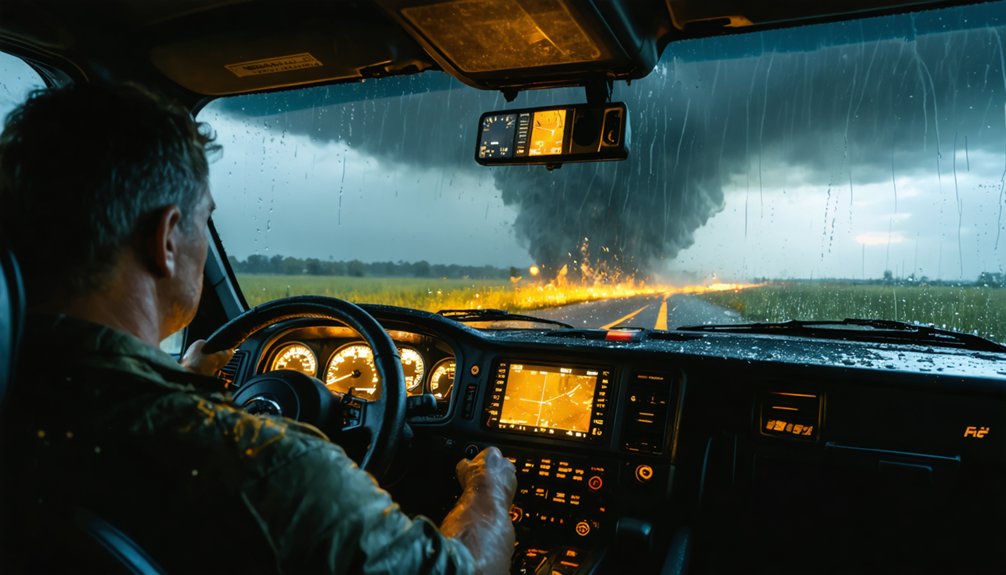
As storm intensity rises and trajectories grow less predictable, you can’t rely on outdated safety habits to keep you alive. You must pre-plan multiple escape routes, monitor real-time weather data continuously, and maintain reliable emergency communication systems before you’re ever within range of a storm.
These protocols aren’t optional—with rapid intensification giving chasers less time to react, a single lapse in preparation can be fatal.
Know Your Escape Routes
When storm intensity escalates without warning, knowing your escape routes isn’t optional—it’s survival arithmetic.
Historical weather patterns once made exit planning predictable, but storm prediction advancements reveal shifting trajectories that invalidate traditional routes fast.
Plan every chase with these non-negotiables:
- Map multiple exits before positioning—never rely on a single corridor
- Monitor perpendicular escape angles relative to storm movement, not parallel paths
- Track real-time radar updates to identify route compromises instantly
- Avoid low-lying roads prone to flash flooding during rapid intensification
- Pre-load offline maps since cellular networks fail in extreme conditions
Storms moving eastward into densely populated regions create unfamiliar terrain for chasers.
Your escape route isn’t a backup plan—it’s your primary strategy before you ever leave the vehicle.
Monitor Weather Constantly
Continuous weather monitoring isn’t a best practice—it’s the operational baseline that keeps you alive. Climate change has fundamentally disrupted traditional weather forecasting models, forcing chasers to adapt in real time.
Storm trajectories shift faster, intensification accelerates unpredictably, and seasonal boundaries no longer apply.
You can’t rely on morning briefings alone. Data accuracy degrades rapidly during active storm events, meaning you must cross-reference multiple sources continuously—mobile radar, satellite feeds, and ground-based sensors simultaneously.
A single data gap can position you directly in a storm’s redirected path.
Build redundant monitoring systems into your setup. Real-time feeds aren’t optional equipment; they’re your decision-making infrastructure.
When atmospheric conditions evolve within minutes, your survival depends entirely on how current your information actually is.
Prioritize Emergency Communication
How you communicate during a storm emergency determines whether your team gets out alive. Rapid storm intensification leaves little margin for communication failures, making emergency preparedness non-negotiable. Establish communication protocols before you’re in the field, not during a crisis.
- Designate a primary and backup communication channel before deployment
- Assign one team member solely to monitor transmissions during active pursuit
- Establish predetermined check-in intervals every 15-30 minutes
- Use satellite communicators where cellular networks fail in remote regions
- Coordinate emergency rally points with local emergency management agencies
Climate-driven storms now intensify faster, compressing your decision window dramatically. Your communication protocols must account for transmission barriers and equipment failures under extreme conditions.
Freedom in the field depends entirely on disciplined, pre-planned communication systems that function when infrastructure collapses around you.
Frequently Asked Questions
How Does Climate Change Affect the Mental Health of Storm Chasers?
Ever feel the weight of the storm before it hits? Climate change intensifies that burden—you’re facing greater mental health impacts, demanding stronger psychological resilience as rapid storm intensification leaves you less time to prepare and adapt.
Are Storm Chasing Tours Becoming More Dangerous for Paying Tourists?
Yes, storm chasing tours are growing more dangerous for you as a tourist. Shifting storm trajectories and rapid intensification strain tour logistics and tourist safety, giving operators less time to prepare effective evacuation responses.
How Are Insurance Costs Changing for Professional Storm Chasers?
Picture your wallet screaming as loudly as the storms you’re chasing! Insurance premiums are skyrocketing because risk assessment models now reflect intensified storms, shifting trajectories, and a 30% surge in chasers, making coverage increasingly costly for you.
What Career Opportunities Exist for Storm Chasers Amid Climate Change?
You’ll find expanding opportunities in storm chasing technology development, climate data analysis, and AI-driven forecasting. As storms intensify and shift geographically, you can leverage specialized skills in emergency protocol design, remote sensing, and collaborative data platform innovation.
How Are Densely Populated Areas Adapting Building Codes for Stronger Storms?
You’re seeing densely populated areas prioritize urban resilience through stricter building codes and infrastructure upgrades, directly responding to stronger storms shifting eastward. These adaptations protect your freedom to live safely in newly storm-vulnerable regions.
References
- https://www.youtube.com/watch?v=uFGdZeKtYnI
- https://environment.leeds.ac.uk/icas-research-impact/doc/storm-chasers-making-life-saving-forecasts
- https://crazystormchasers.com/climate-change-and-the-future-challenges-for-storm-chasers/
- https://www.nationalgeographic.com/travel/article/storm-chasing-is-an-exhilarating-rush-but-is-it-safe
- https://www.edf.org/climate/how-climate-change-makes-hurricanes-more-destructive
- https://atmos.earth/science-and-nature/warming-skies-have-triggered-a-new-era-of-unpredictable-storms/
- https://www.cosmopolitan.com/lifestyle/a39895714/storm-chasers-climate-change/