Today’s storm prediction combines Doppler radar, geostationary satellites, AI-driven models, and ensemble frameworks into a single unified workflow. You’re getting forecasts that extract atmospheric patterns from decades of historical data, merge real-time radar reflectivity with satellite moisture fields, and run multiple simulations to map the full probability space of storm behavior. AI systems like NOAA’s AIGFS cut processing time dramatically. Keep going to see exactly how each layer works together.
Key Takeaways
- AI models like NOAA’s AIGFS and DeepMind’s WeatherNext 2 analyze decades of historical data, delivering faster and more accurate storm forecasts.
- Ensemble models run multiple simulations with varied inputs, revealing the full probability range of storm behavior rather than single deterministic outcomes.
- NOAA’s Hybrid-GEFS system combines AI-driven forecasts with traditional ensemble outputs, improving detection of low-probability, high-impact storm events.
- Dual-polarization Doppler radar distinguishes hail from rain and identifies high-reflectivity cores, enabling earlier detection of potentially intensifying storms.
- Unified forecasting workflows integrate radar, satellite, lightning, and surface data, reducing reliance on individual instruments and improving overall forecast accuracy.
Why Traditional Forecasting Tools Still Drive Storm Prediction
Despite the rapid rise of AI-driven and satellite-based tools, traditional forecasting methods still form the operational backbone of storm prediction. You can’t replace what continues to deliver results.
Surface observations capture real-time temperature, pressure, wind, and humidity, while weather balloons supply critical vertical atmospheric profiles. These inputs feed directly into numerical methods that solve physics-based equations across global and regional grids.
Surface observations and weather balloons feed the physics-based equations that make numerical forecasting possible.
Data assimilation then merges raw observations with model output, sharpening observation accuracy and boosting forecasting confidence when simulations align with current conditions.
Traditional tools maintain their historical relevance because AI systems themselves train on decades of data those same instruments collected. Model integration depends on that foundation.
Without it, probabilistic storm prediction loses its grounding, and your operational reliability drops considerably.
What Radar Reveals About a Storm Before It Turns Severe
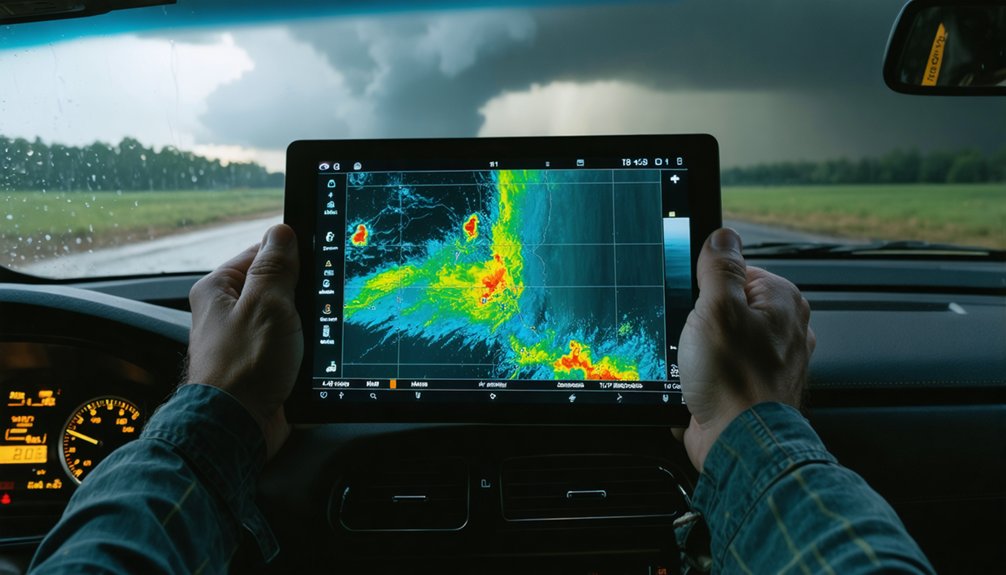
When you examine a storm cell on Doppler radar, you’re reading reflected energy signatures that reveal precipitation density, internal structure, and the presence of rain, hail, or snow before conditions turn severe.
Doppler frequency shifts tell you whether storm components are moving toward or away from the radar source, giving you rotational data that can indicate developing severe circulation.
High-reflectivity cores, rapidly expanding cell tops, and anomalous velocity couplets are measurable warning signs you can track in real time to anticipate intensification.
Reading Storm Cell Structure
A radar screen can tell you far more than where rain is falling — it reveals the internal architecture of a storm long before sirens sound. Reflected energy intensity, measured in dBZ, maps precipitation density and exposes cell morphology — whether a storm is a disorganized multicell cluster or a rotating supercell.
You can identify bounded weak echo regions, vault structures, and hook echoes, each signaling distinct storm dynamics that precede severe weather. Forward-flank and rear-flank downdrafts become readable in velocity data, showing rotational signatures at multiple altitudes.
Dual-polarization radar adds another layer, distinguishing hail from rain based on particle shape and orientation. Reading these structural signatures early gives you the critical decision window that single-layer precipitation maps simply can’t provide.
Doppler Shifts Detect Motion
Before a storm turns severe, Doppler frequency shifts give you a direct window into atmospheric motion that reflectivity data alone can’t provide. When precipitation particles move toward the radar, the returned frequency increases; movement away decreases it. That frequency shift translates directly into velocity measurement, letting you quantify wind speeds inside the storm core.
This radar technology powers real-time motion analysis of rotating updrafts, wind shear gradients, and diverging outflow boundaries. Storm dynamics that suggest rotation or mesocyclone development become visible minutes before visible damage occurs.
Doppler effect principles let forecasters distinguish inflow from outflow, identify tornado-producing circulation signatures, and track storm-relative helicity changes. You’re not guessing at intensity—you’re reading precise velocity data that defines exactly how dangerous a cell is becoming.
Rainfall Density Warning Signs
Reflected radar energy doesn’t just confirm a storm exists—it quantifies how much precipitation is packed into the storm’s core and how rapidly that density is changing.
You’re looking at reflectivity values measured in dBZ, where readings above 40 dBZ indicate heavy rain, above 50 dBZ signal hail potential, and above 60 dBZ demand immediate attention.
Forecasters track these rainfall patterns continuously, watching for sudden reflectivity spikes that indicate explosive intensification. Warning thresholds aren’t arbitrary—they’re calibrated against historical severe-weather datasets, giving you statistically defensible decision points rather than guesswork.
When reflectivity gradients steepen sharply across a small horizontal distance, that tight packing signals a storm organizing into something dangerous. Acting on those density signatures early is what separates informed response from reactive scrambling.
How Satellites Track Storm Development From Space
Orbiting thousands of miles above Earth, geostationary satellites provide continuous, wide-area monitoring of storm systems across the Atlantic and Pacific basins, capturing cloud structure, moisture fields, and convective development in near real time.
Through satellite imagery and remote sensing, you gain precise visibility into storm evolution across regions where ground-based networks fall short. Atmospheric profiles reveal moisture analysis data critical for identifying instability layers before convective systems intensify.
GOES-16 and GOES-17 expanded lightning detection capabilities across the Americas, linking electrical activity directly to storm structure. You can track cloud patterns and storm tracking trajectories simultaneously, integrating these datasets into numerical models at minimal computational cost.
Geostationary monitoring delivers the continuous, high-resolution observational coverage that modern forecasters need to anticipate rapid storm development accurately.
How AI Models Are Changing Storm Prediction Right Now

If you’ve been following storm prediction trends, you’ll notice that AI models are now reshaping forecast timelines in measurable ways.
NOAA’s AIGFS completes a full 16-day global forecast in roughly 40 minutes, consuming just 0.3% of the computing resources required by the operational GFS.
DeepMind’s WeatherNext 2 pushes speed further, running eight times faster than its predecessor and enabling forecasters to test considerably more scenarios within a single forecast cycle.
AI Forecasting Speed Gains
AI models are reshaping storm prediction by slashing the time and computing power needed to generate forecasts. Machine learning systems now extract atmospheric patterns from decades of historical data, bypassing the computational overhead of traditional physics solvers.
NOAA’s AIGFS model delivers a full 16-day forecast in roughly 40 minutes, consuming just 0.3% of the computing resources required by the operational GFS. That’s a dramatic leap in AI efficiency.
DeepMind’s WeatherNext 2 runs eight times faster than its predecessors, letting forecasters test more scenarios within a single operational window. You gain broader forecast coverage without proportional infrastructure costs.
These speed gains don’t sacrifice resolution or accuracy—they expand what’s computationally feasible, giving forecasters and decision-makers faster, richer storm intelligence when it matters most.
Real-World AI Model Examples
Several AI models are already operating in real forecast environments, not just research labs. DeepMind’s WeatherNext 2 handles real time analysis of wind speed, pressure, cyclone path, intensity, and storm structure simultaneously.
NOAA’s AIGFS completes a 16-day forecast in roughly 40 minutes, consuming only 0.3% of the computing power that traditional GFS requires. These AI applications aren’t replacing ensemble systems entirely; instead, NOAA’s AIGEFS integrates machine learning with probabilistic frameworks to address forecasting challenges around uncertainty.
Model comparisons between AI-driven and physics-based systems show competitive predictive accuracy across multiple variables. Data integration remains central, as these models train on decades of atmospheric records to sharpen storm simulations.
You’re now watching a measurable shift in operational forecasting infrastructure, driven by speed, efficiency, and expanding capability.
Why Ensemble Storm Models Catch What a Single Forecast Can’t
When a single deterministic forecast commits to one atmospheric solution, it masks the uncertainty baked into every initial condition measurement.
Ensemble models eliminate that blind spot by running dozens of simultaneous simulations, each initialized with slightly perturbed inputs. That ensemble variability reveals the full probability space of storm evolution, track, and intensity rather than a single, brittle projection.
Ensemble models run dozens of simultaneous simulations, revealing the full probability space instead of one brittle projection.
You gain something a deterministic run can’t deliver: uncertainty quantification expressed as actionable probabilities.
If 30% of ensemble members show tornado-producing supercells while 70% show linear convection, you’re seeing genuine atmospheric ambiguity, not model error.
NOAA’s Hybrid-GEFS compounds this advantage by integrating AI-driven forecasts with traditional ensemble output, capturing low-probability, high-impact events that deterministic models routinely miss.
That’s forecast intelligence you can actually act on.
How Radar, Satellite, and AI Data Combine Into One Forecast

Ensemble models give you the probability space, but that probability space is only as good as the observational data feeding it.
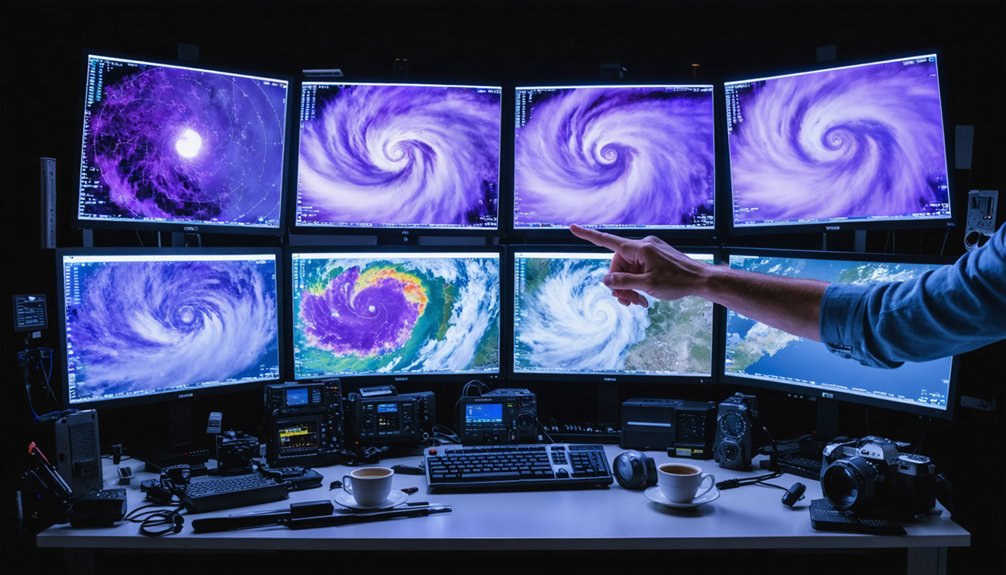
Modern storm analysis depends on radar integration, satellite fusion, and AI collaboration working simultaneously. Doppler radar captures real-time precipitation structure and storm motion. GOES-16 satellite fusion adds continuous large-scale moisture and convective fields.
AI collaboration accelerates data synergy by identifying atmospheric patterns across decades of historical records faster than traditional solvers.
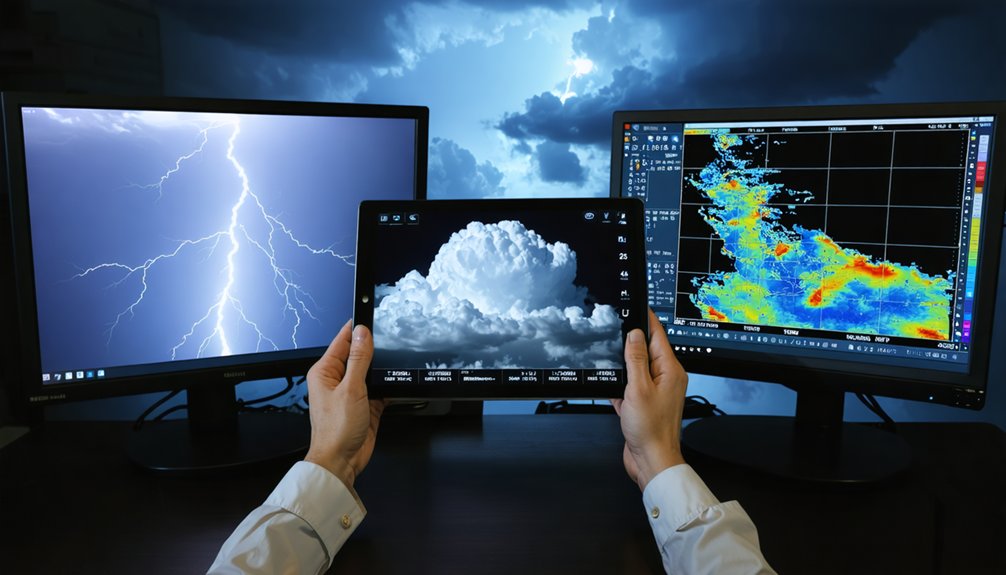
Observation blending merges these streams inside GSI ensemble-variational frameworks, where lightning data assimilation links electrical activity directly to storm microphysics.
Predictive modeling sharpens when radar, satellite, surface, and upper-air inputs converge into one unified workflow.
Forecasting accuracy improves because you’re no longer relying on any single instrument—you’re running a fully integrated, multi-source storm prediction system.
Frequently Asked Questions
How Accurate Are AI Storm Predictions Compared to Traditional Forecasting Methods?
AI algorithms deliver “comparable atmospheric insights” to traditional methods, but you’ll encounter model bias and prediction limits. Data accuracy improves when both systems combine, offering you faster, ensemble-driven storm forecasts without sacrificing precision.
Can Storm Prediction Tools Warn Communities Before a Tornado Actually Forms?
Yes, today’s tornado detection and warning systems can alert you before a tornado touches down. Doppler radar identifies rotation signatures, ensemble models flag instability, and AI tools accelerate threat identification, giving you critical lead time to act.
How Do Forecasters Decide Which Storm Prediction Model to Trust Most?
You’d evaluate model selection by comparing ensemble agreement, historical accuracy, and data assimilation quality. When multiple models converge, prediction reliability rises. You’d also weigh computational efficiency, resolution, and how well each model matches current observational conditions.
What Role Does Lightning Data Play in Improving Thunderstorm Forecasts Today?
When you assimilate lightning detection data into ensemble-variational hybrid frameworks, you’re linking electrical activity to storm microphysics like graupel formation, sharpening storm analysis without significant computational cost, ultimately delivering faster, more precise thunderstorm initialization and forecast accuracy.
How Far in Advance Can Modern Tools Reliably Predict a Hurricane’s Landfall?
You can rely on modern hurricane forecasting tools to predict landfall up to 5–7 days out. Today’s predictive technology, including ensemble models and AI systems like WeatherNext 2, delivers increasingly precise track and intensity guidance within that window.
References
- https://www.livescience.com/39135-incredible-technology-how-to-forecast-severe-storms.html&rut=1a3de720ea7f9e7fa2a0cf65cd92c0e50c3911c6fd47b48ec59748e93e5bf43e
- https://www.reddit.com/r/meteorology/comments/1emasf6/hi_meteorologists_how_do_you_predict_the_path/
- https://deepmind.google/science/weathernext/
- https://spectrum.ieee.org/severe-weather-forecast-lightning
- https://ral.ucar.edu/technologies/forecasting-systems
- https://www.youtube.com/watch?v=0MCOwbFSURk
- https://www.cbsnews.com/news/noaa-ai-driven-weather-models-improve-forecast-speed-accuracy/
- https://www.youtube.com/watch?v=pNRU1bsNvik
- https://climavision.com/resources/the-ultimate-guide-to-weather-forecast-models/
- https://www.noaa.gov/news-release/noaa-deploys-new-generation-of-ai-driven-global-weather-models